PART 2
At seven the next morning, Noah ate cereal at the kitchen table with the red car parked beside his bowl.
He kept glancing at the cabinet where I had hidden the black card in an old cookie tin with our birth certificates, my divorce papers, and the hospital bill from his bronchitis two winters earlier.
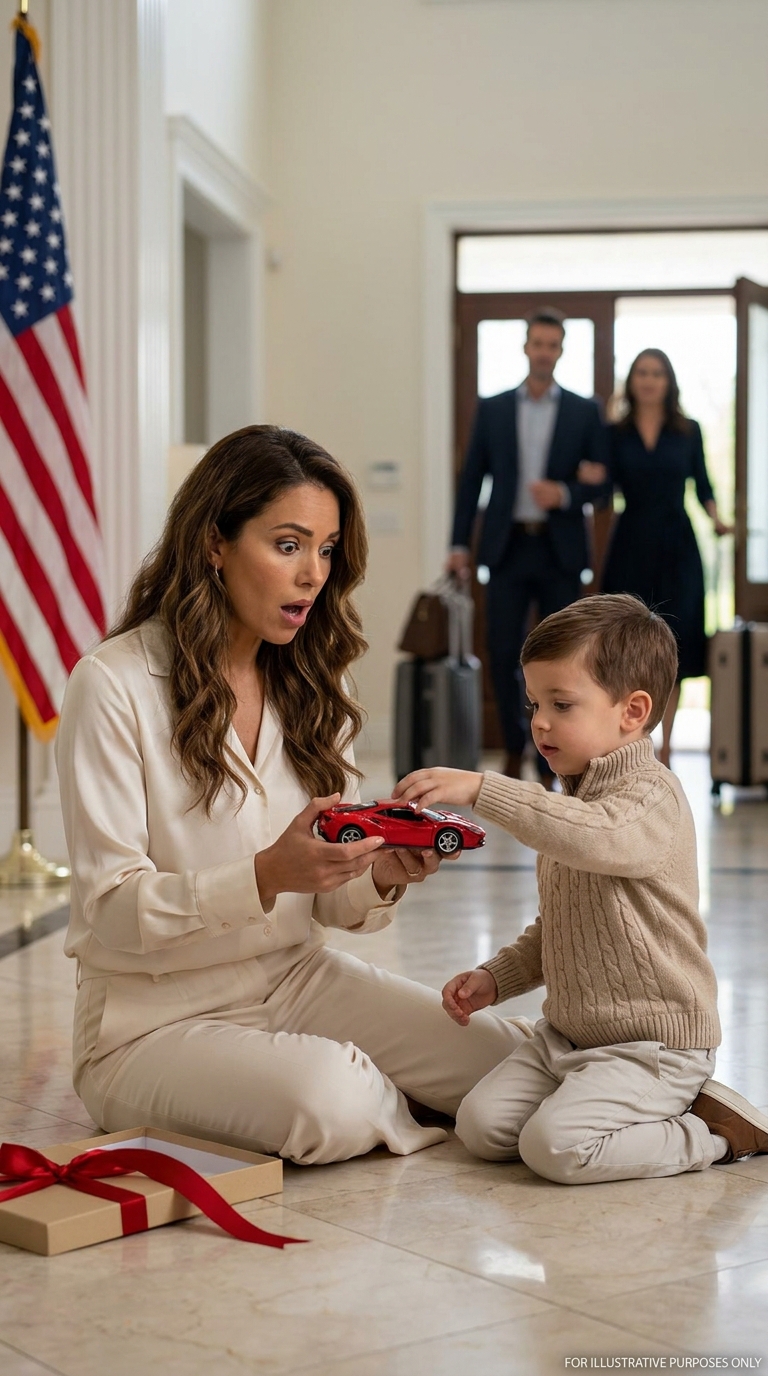
“Mom,” he said, “are you going to check it?”
I stirred my coffee though there was no sugar in it. “Check what?”
He gave me a look too old for his face. “The card.”
I hated that he knew. I hated that Mason had dragged him into something with adult weight and child-size bait.
“Yes,” I said carefully. “After I drop you at school.”
His eyes widened. “What if Dad put a lot of money on it?”
“What matters is where it came from.”
“Money comes from banks.”
“Not always.”
He frowned. “Can money be bad?”
I looked at the ceiling stain, the cheap cereal, his backpack with the zipper I had repaired twice. “Money can be clean or dirty. Clean money comes with truth attached. Dirty money comes with secrets.”
Noah touched the little red car. “Dad said don’t tell anyone.”
“I’m your mother,” I said, softer. “There is no secret about you that someone gets to keep from me.”
He nodded, but disappointment clouded his face. “If there’s money, can you buy yourself a new winter coat?”
I nearly cried into my coffee.
Most kids would ask for sneakers or a PlayStation. My son wanted his mother to stop shivering at the bus stop.
After I walked him to school, I took the train downtown to a bank branch near LaSalle Street. The black card looked wrong in my hand. Too heavy. Too sleek. Like it belonged to someone who never checked prices at the grocery store.
Inside the bank, everything was glass, marble, and quiet judgment.
A woman in a navy blazer approached. “How may I help you?”
“I need to check the balance on this card.”
She looked at my thrift-store coat, then at the card. Her professional smile flickered.
“Of course.”
At the ATM alcove, I entered Noah’s birthday.
The screen accepted it.
My pulse hammered in my ears.
I pressed “balance inquiry.”
For three seconds, the machine hummed.
Then the number appeared.
$1,200,000.00
I stared until the digits blurred.
One million two hundred thousand dollars.
Not twelve hundred. Not twelve thousand. One point two million.
My knees weakened.
With that money, I could fix the roof. Pay the medical debt. Move Noah out of a neighborhood where sirens sang him to sleep. Put him in tutoring. Buy him books, braces, a bed that didn’t sag in the middle.
I could breathe.
That was what scared me.
Because relief is how traps become beautiful.
I backed away from the machine without withdrawing a cent. I did not print a receipt. I did not touch anything except the card.
On the sidewalk, Chicago wind slapped my face awake.
Mason had ignored Noah for three years. He had missed school plays, dentist appointments, fevers, parent-teacher nights. He had not accidentally become generous on his wedding day. A man who wants to provide for his son sends a check, calls a lawyer, sets up a trust.
He does not hide a million dollars inside a toy and write Don’t tell anyone.
By the time I got home, my hands were numb.
I put the card back in the tin, then opened my old bookkeeping notebook and wrote everything down: date of delivery, witnesses, card location, note, balance, no withdrawal.
Numbers had always calmed me. Numbers did not flirt, lie, remarry, or pretend a broken toy was love.
At 8:43 that night, Mason called.
I stared at his name until the screen almost went dark.
Then I answered.
“Emily,” he said, warm as poison. “Did Noah like the car?”
“He recognized it.”
A pause.
“And did you find anything else?”
I walked into the kitchen and closed the door so Noah would not hear. “You mean the bank card?”
Mason exhaled. I could hear music behind him, laughter, glasses clinking. His wedding reception was still going. “Good. I was hoping you would.”
“Why?”
“It’s for my son.”
“Then why hide it?”
He laughed softly. “You always were dramatic.”
I pressed record on my old phone and placed it beside the sink.
“Mason, if you wanted to support Noah, you could have paid child support.”
“I had cash flow issues.”
“You married into the Harrington family in front of half of Chicago.”
His voice hardened. “That money is for Noah’s future. Be grateful.”
“Whose account is it?”
“It doesn’t matter.”
“It matters if our child’s name is attached to it.”
A sharp silence followed.
Then Mason said, “Listen carefully. Use what you need. Fix that dump you live in. Buy the kid clothes. But keep your mouth shut.”
There it was.
Not love.
Instruction.
“Does Camille know?” I asked.
His breathing changed.
“Leave my wife out of this.”
“Does her family know?”
“You always were too curious for your own good.”
I looked at the water bowl under the leak. Plink. Plink. Plink.
“I haven’t touched a dollar,” I said.
He laughed, ugly this time. “Still pretending poverty makes you noble?”
“No. I’m making sure poverty doesn’t make me stupid.”
His voice dropped. “Don’t make trouble, Emily. I can give Noah a life you never could. Private school. Travel. A real home. If you fight me, a judge might wonder why you kept him in a leaking house when his father had resources.”
My fingers tightened around the phone.
There it was again.
The hook under the gift.
“You disappear for three years,” I said, “and now you want to play father because money is involved?”
“I am his father.”
“No,” I said. “You are the man who sent him a broken toy on your wedding day.”
I hung up before my voice could shake.
Then I wrote down every word I could remember.
By midnight, I understood one thing clearly: the black card was not a gift.
It was a loaded gun, and Mason had placed it in my child’s hands.
PART 3
Three days later, the first alert came.
I had gone back to the bank, not to withdraw money, but to activate notifications. The account officer, a cautious woman named Priya Shah, listened while I explained that I was Noah’s legal guardian and needed alerts for any movement connected to the card.
She asked for my custody order, my ID, and Noah’s birth certificate.
I had all three.
Poor women learn to carry proof. Proof that we are mothers. Proof that we are not lying. Proof that we deserve to ask questions in rooms designed for people who already have answers.
Priya could not tell me everything. Bank rules, privacy, account structure. But she helped me set up secondary alerts tied to my phone.
“Ms. Carter,” she said quietly before I left, “if you believe this account was opened improperly using your child’s information, you should speak with an attorney.”
That was the first time someone official said out loud what I had been afraid to name.
Improperly.
Using your child.
I walked out into the cold with the black card burning in my purse.
The alert came while I was balancing invoices for a Polish bakery in Bridgeport.
TRANSFER COMPLETED: $300,000.00
REMAINING BALANCE: $900,000.00
For a moment, the bakery sounds vanished. No oven fans. No register. No woman asking for rye bread.
Just my own heartbeat.
Three hundred thousand dollars had disappeared from Noah’s “future” without the card ever leaving my locked tin.
I called Mason from the alley behind the bakery.
He answered on the fifth ring. “What now?”
“You moved three hundred thousand dollars.”
“I invested it.”
“From our son’s account?”
“My account.”
“You told me it was for Noah.”
“It is. I’m growing it.”
“With whose permission?”
He sighed. “You really don’t understand how money works.”
“I understand enough to know you don’t hide investments in a child’s toy.”
His tone turned bored. “A land deal came up near O’Hare. My cousin Blake has an LLC positioned to buy before zoning changes. We move fast, we triple it.”
Blake.
Mason’s cousin Blake Whitaker, a failed contractor with two bankruptcies, one DUI, and a talent for appearing whenever someone else had money.
“You used Noah as a shield,” I said.
Mason snapped. “Watch your mouth.”
“No. You watch mine. I haven’t touched a cent. If this becomes a legal issue, don’t even think about blaming me.”
He laughed. “Legal issue? You’re a diner waitress with a bookkeeping side hustle.”
“I’m also the custodial parent of the minor whose account you’re draining.”
The line went quiet.
Then he said, “Be careful, Emily. Camille’s family has attorneys in Washington who eat people like you for lunch.”
“Good,” I said. “Then they’ll understand paperwork.”
I hung up shaking.
That afternoon, Noah came home and found me sitting at the table with the red car in front of me.
“Mom?”
I looked at him. His hair was damp from sleet. His cheeks were red. His backpack hung off one shoulder, zipper splitting again.
“Are we in trouble?” he asked.
That was the awful thing about raising a child after betrayal. They develop weather sense. They can feel storms before thunder.
“No,” I lied. “But I need to look at the car again.”
He placed it on the table.
“Did Dad do something bad?” he asked.
I did not answer fast enough.
His face changed.
He climbed onto the chair and turned the car over himself. “The wheel makes noise.”
“What?”
“This one.” He spun the rear wheel. It clicked strangely. “I thought maybe a rock got stuck.”
He pulled.
The wheel came loose.
Something tiny fell onto the table.
A SIM card.
For a second, I could not move.
Noah blinked. “Why would a phone chip be in my car?”
My mouth went dry.
Because your father is not careless, I thought. Because the bank card was theater. Because this little chip might be the real key.
“Go wash your hands,” I said.
“But—”
“Now, Noah.”
He obeyed, frightened by my voice.
I dug through the junk drawer for my old flip phone, the one I kept because it still held charge and because poor people do not throw away things that might one day matter.
I inserted the SIM card.
The phone lit up.
Then messages began pouring in.
Bank verification codes. Transfer confirmations. Real estate appointments. Notary reminders. Password resets. Messages from “Blake LLC.” A two-factor code dated the same minute the $300,000 left the account.
I sat down slowly.
Mason had sent the card to make it look like I controlled the money.
But he had hidden the SIM card that controlled access inside the wheel.
Maybe he meant to retrieve it later. Maybe he forgot. Maybe he never imagined an eight-year-old boy would inspect the only gift his father had sent in three years as if it were treasure.
Noah came back, drying his hands on his shirt.
“Mom,” he whispered, “is Dad going to take me away?”
I stood and pulled him into my arms.
“No.”
“You promise?”
I closed my eyes.
I wanted to promise like mothers promise when the monsters are imaginary.
But this monster wore a tuxedo, had a lawyer, and knew our address.
“I promise,” I said anyway. “But I need help.”
“From who?”
I looked at the SIM card on the table.
“From someone who knows how to fight men who hide behind money.”
PART 4
The attorney’s office was on the twelfth floor of an old building near the Chicago River, the kind with brass elevator doors and hallways that smelled faintly of dust and power.
His name was Daniel Mercer.
Not young. Not flashy. Gray at the temples, sleeves rolled, eyes tired in the way honest people get tired after years of listening to liars.
I placed everything on his desk: the note, the black card, printed screenshots from the flip phone, bank alerts, my custody order, my notebook, proof of unpaid child support, medical bills, school attendance forms, birthday photos where Mason was missing year after year.
Daniel Mercer did not interrupt.
When I finished, he leaned back and looked at the broken red car.
“That,” he said, “is either the ugliest birthday gift I’ve ever seen or the stupidest financial crime container in Illinois.”
I almost laughed.
Almost.
Then I cried.
Not pretty crying. Not movie crying. The kind that comes out of the body like something rotten being forced from a wound.
“I’m scared he’ll take Noah,” I admitted.
Mercer slid a box of tissues toward me. “Men like your ex usually threaten custody when they need leverage, not when they want bedtime duty.”
“He said he can give Noah a better life.”
“A better life is not a better balance sheet. Courts care about stability, history, care, safety, truth. You have three years of evidence that you are the parent. He has a wedding video and a suspicious account.”
“What do we do?”
“First, you do not spend a dollar. Second, we request bank records through proper channels. Third, we notify the court that a minor’s identity may have been used in questionable financial activity. Fourth, if Mr. Whitaker files for custody, we bury him in facts.”
Facts.
The word steadied me.
On my way home, I bought Noah a hot chocolate from a corner café because some days children deserve sweetness even when adults are at war.
When I picked him up from school, a silver Mercedes was parked in the loading zone.
Mason leaned against it with a glossy shopping bag in one hand.
Parents stared.
Of course they did. Mason looked like a visiting celebrity in our neighborhood: wool coat, expensive shoes, watch shining under the gray sky.
“Noah!” he called loudly. “Buddy!”
Noah froze beside me.
Every child in his class turned.
Mason opened his arms. “Come here, son. Dad brought you something.”
Noah’s hand slipped into mine.
Mason’s smile tightened. “Noah.”
My son looked at him, then at the bag, then at me.
He did not move.
Mason took one step closer. “Don’t be shy. It’s a Nintendo Switch. The good one.”
A few kids gasped.
Noah’s eyes filled, but not with joy.
With panic.
Then he said, very quietly, “Sir, I have to go home.”
Sir.
The word hit Mason harder than a slap.
A mother near the fence looked away. Another whispered, “Oh my God.”
Mason’s face flushed. “Sir?”
I stepped between them. “Don’t do this here.”
His jaw flexed. “You poisoned him.”
“You abandoned him.”
“I am trying to fix it.”
“With electronics in front of witnesses?”
His smile vanished. “Get in the car, Noah.”
Noah hid behind my coat.
I looked Mason straight in the eye. “He is not getting into your car.”
“You’ll regret embarrassing me.”
“You embarrassed yourself when your child didn’t know what to call you.”
For one second, I thought he might grab my arm.
But parents were watching. Teachers were watching. Mason Whitaker never lost control in public unless the lighting favored him.
He stepped back, lifted the shopping bag like a prop, and said loudly, “I’ll keep trying, son. No matter what your mother says.”
Noah cried on the bus ride home without making a sound.
That hurt worst of all.
That evening, Camille came to my house.
I recognized her from the wedding photos, though she looked smaller without the white dress and cameras. She wore a cream coat, her blond hair pinned neatly, diamond ring catching the porch light.
Behind her stood Mason’s mother, Evelyn.
I did not invite them inside.
Camille spoke first. “Emily, I’m not here to fight.”
“That’s good,” I said. “Because I am.”
Her mouth tightened. “Mason believes Noah would benefit from living with us part-time. We have space. Excellent schools. Security. Tutors. A stable environment.”
I looked past her at Evelyn, who wore grief like perfume.
“A stable environment?” I repeated. “When Noah had pneumonia, Mason didn’t answer seven calls. When Noah’s school needed emergency contacts, Mason’s number was disconnected. When Noah asked if his father still loved him, I had to lie because the truth was too heavy.”
Camille’s expression shifted.
Just slightly.
Evelyn stepped forward. “Don’t punish the child because you’re jealous.”
I laughed once. “Jealous of what? A man who mails secrets to children?”
Camille’s eyes sharpened. “What does that mean?”
Evelyn touched her arm quickly. Too quickly.
I saw it.
Camille saw it too.
For the first time, Mason’s new wife looked uncertain.
I lowered my voice. “Ask your husband what was hidden in the toy car he sent my son on your wedding day.”
Camille stared at me.
Then she turned without another word and walked back to her car.
Evelyn followed, but not before giving me a look full of fear.
Not anger.
Fear.
That was when I knew Mason had lied to more women than me.
PART 5
Mason filed for joint custody the next week.
His petition was full of polished cruelty.
He claimed I lived in “substandard conditions.” He claimed Noah lacked “educational enrichment.” He claimed he had “recently become aware” that I was limiting father-son contact due to “unresolved resentment.”
He attached photos of our house.
The ceiling stain. The peeling porch. The cracked front steps.
Photos taken from the street.
I stood in Daniel Mercer’s office with the petition in my hands, shaking so hard the pages rattled.
“He photographed my home.”
Mercer took the papers. “Of course he did.”
“He’s making me look unfit.”
“He’s making himself look observant three years too late.”
I wanted to believe him.
But poverty has a way of making you feel guilty even when you have done nothing wrong. Every unpaid bill becomes a character flaw. Every repaired jacket becomes evidence. Every meal stretched too thin becomes shame.
That night, I found Noah sitting on his bed with the red car in his lap.
“Do I have to live with Dad?” he asked.
I sat beside him. “No one is taking you tonight.”
“That’s not what I asked.”
I looked at my eight-year-old son and realized childhood had already asked too much of him.
“Your dad is asking the court for time with you.”
“Because he loves me now?”
My answer stuck.
Noah nodded as if my silence confirmed what he already knew. “It’s because of the car.”
I pulled him close.
He did not cry. That frightened me more than tears.
Two days later, Camille called.
I nearly didn’t answer.
“Emily,” she said, voice low. “I need to meet you.”
“No.”
“Please. Mason doesn’t know I’m calling.”
That made me pause.
We met in a coffee shop near Millennium Park at ten in the morning. Camille arrived with no makeup, sunglasses pushed into her hair, and a folder clutched against her chest.
She looked nothing like the triumphant bride from the hotel steps.
She looked like a woman who had found blood on a white dress after the photographs were done.
“I asked him,” she said.
“About the toy?”
“About everything.”
I waited.
“He told me you were unstable. That you invented stories. That the card was a simple college fund and you were trying to steal it.”
“Of course he did.”
“But then I checked.”
She opened the folder.
Inside were company documents. Wire confirmations. Emails. A contract between Harrington Coastal Development and a consulting company called Great Lakes Horizon LLC.
Blake Whitaker’s company.
“I work in my father’s firm,” Camille said. “Not as decoration, no matter what Mason tells people. I know how our accounts move. Money disappeared from a project fund six months ago. Mason said it was a timing issue. Then yesterday I found a consulting contract backdated two years.”
Her hands trembled.
“Great Lakes Horizon didn’t exist two years ago.”
I stared at the papers.
Camille’s voice cracked. “He used my family money. Then he moved it through accounts connected to your son.”
The coffee shop noise faded.
“How much?”
“At least $1.2 million. Maybe more.”
I closed my eyes.
Mason had not given Noah a future.
He had hidden stolen money under his name.
Camille swallowed. “There’s something else.”
I opened my eyes.
“I found an apartment lease. Mason kept a place in River North for a woman named Paige. His assistant.”
There it was.
The old familiar humiliation, but this time it was not mine to carry.
“I’m sorry,” I said, and meant it.
Camille laughed bitterly. “Don’t be. I married your nightmare in a better dress.”
For a moment, neither of us spoke.
Then she pushed the folder toward me.
“I’ll testify.”
“Why?”
Her eyes filled. “Because he used a child. I can survive being stupid. I can survive being cheated on. But I won’t help him destroy your son to save himself.”
Daniel Mercer filed an emergency motion the next morning.
Bank records followed. Then subpoenas. Then Mason’s polished world began to crack.
He called me seventeen times in one day.
I did not answer.
He texted: You have no idea what you’re doing.
Then: Camille is confused.
Then: Think about Noah.
Then finally: You’ll pay for this.
I printed every message.
At the first custody hearing, Mason arrived with two attorneys, his mother, and a face arranged into wounded fatherhood.
I arrived with Daniel Mercer, Camille Harrington, a folder of proof, and my son’s broken red toy car sealed in an evidence bag.
When Mason saw Camille on our side of the courtroom, the color drained from his face.
That was the first honest thing I had seen him do in years.
PART 6
Courtrooms do not look like justice.
They look like beige walls, tired clerks, old wood, and people pretending their hands are not shaking.
Mason’s attorney spoke first. He painted me as overwhelmed, poor, emotional, and hostile. He called Mason a “reengaged father” who had recently gained the financial stability to provide his son with opportunities.
Reengaged.
As if fatherhood were a gym membership.
Then Daniel Mercer stood.
He did not shout. He did not perform. He simply opened the file.
“Your Honor, Mr. Whitaker’s sudden interest in custody coincides with the discovery of financial instruments hidden inside a toy delivered to the minor child on the day of Mr. Whitaker’s remarriage.”
The judge looked over her glasses. “Hidden inside a toy?”
Mercer placed the evidence bag on the table.
Mason stared at the red car like it had betrayed him.
Piece by piece, Mercer laid it out: the black card, the handwritten note, the SIM card hidden in the wheel, the bank alerts, the $300,000 transfer, Great Lakes Horizon LLC, Blake Whitaker, backdated contracts, Camille’s documents, Mason’s recorded warning to “keep your mouth shut.”
Mason’s attorney objected repeatedly.
The judge overruled most of it.
Camille testified last.
Her voice shook at first, but grew stronger.
“Mason told me the money was being held for his son. Then he told me Emily was trying to steal it. Then I found documents proving the money came from my family’s company and was routed through accounts connected to the child. When I confronted him, he told me if I didn’t cooperate, we could both go to prison.”
Mason whispered, “Camille.”
She did not look at him.
“He also asked me to support his custody petition so he could show the court he had a stable two-parent household.”
The judge’s face hardened.
Evelyn began crying behind him.
For once, nobody comforted her.
When it was my turn, I told the truth.
I told the court about Noah waiting at windows. About the hospital night Mason ignored. About birthdays. About the livestream. About the package. About my son asking whether money meant his father was coming home.
I did not say Mason was a monster.
I did not need to.
Facts did the work.
At the end of the hearing, the judge denied Mason’s request for expanded custody pending investigation. She ordered supervised visitation only, suspended Mason’s access to any account tied to Noah, and referred the financial evidence to the state’s attorney.
The remaining $900,000 was frozen.
Mason stood so fast his chair hit the wall.
“This is insane,” he snapped.
The judge looked at him. “Mr. Whitaker, sit down.”
He did.
Some men only understand authority when it wears a robe.
Outside the courtroom, Mason caught me near the elevators.
His lawyers were behind him. Camille was gone. Evelyn stood by the wall, pale and useless.
“You ruined me,” he hissed.
I held my purse strap with both hands. “No. I opened the toy.”
His eyes flashed. “You think you’re safe now?”
Daniel Mercer stepped beside me. “Careful.”
Mason looked at him, then back at me.
“You always wanted to punish me.”
“No,” I said. “For years, I wanted you to come back. Then I wanted you to apologize. Then I wanted you to love your son enough not to hurt him.”
My voice steadied.
“Now I just want you away from him until you learn the difference.”
He had no answer.
Two months later, Mason was arrested.
The news called it a fraud investigation involving misappropriated development funds, shell companies, and accounts opened using a minor’s identifying information. They did not print Noah’s name, thank God.
Camille’s father’s company sued Mason and Blake. Blake cooperated almost immediately, which did not surprise me. Cowards rarely sink alone if they can pull someone else under them.
Mason’s mother stopped calling.
Brooke deleted every family post that included Camille.
The Harringtons annulled what they could, legally and socially. Camille moved back to San Diego for a while, but before she left, she mailed Noah a book about classic American cars with a handwritten note.
For when cars become fun again.
I kept the note. I never told Noah the whole story, not then. Children deserve truth in pieces they can carry.
One rainy evening, Mason came to our house.
He looked smaller without the Mercedes, the watch, the perfect coat. His hair was wet. His face unshaven.
I opened the door but kept the chain on.
“Emily,” he said. “Please.”
The word sounded strange in his mouth.
“No.”
“I lost everything.”
I looked at him through the gap. “No. You spent everything that mattered.”
His eyes reddened. “I’m still Noah’s father.”
“Then act like one. Stop using him as a hiding place.”
He pressed his hand to the door. “I have nowhere to go.”
I thought about the nights Noah had fever and Mason had somewhere better to be. I thought about the wedding livestream. The broken car. The bank card. The SIM.
“This house,” I said, “is not a shelter for the consequences you earned.”
Then I closed the door.
Noah came from the hallway holding his blanket.
“Was that Dad?”
I knelt in front of him. “Yes.”
“Is he mad?”
“He’s sad.”
“Because of us?”
“No, baby.” I touched his cheek. “Because of himself.”
Noah looked toward the door for a long time.
Then he whispered, “I don’t want the car anymore.”
I nodded.
But I did not throw it away.
Some scars should be kept high on a shelf, not to worship pain, but to remember what we survived.
PART 7
The final order came in spring.
By then, the roof no longer leaked.
Not because of Mason’s money.
Because I took extra bookkeeping work, Daniel Mercer negotiated a payment plan for my legal fees, and the owner of the Polish bakery sent his cousin to patch the worst sections at half price after hearing just enough of the story to say, “No kid should sleep under dripping water.”
That is the kind of rescue rich people rarely notice.
Ordinary people saving one another in pieces.
The judge awarded me sole legal and physical custody. Mason received supervised visitation only after completing court-ordered financial disclosures, parenting classes, and whatever consequences came from the criminal case.
The $900,000 remaining in the account was placed into a court-supervised trust for Noah’s education and medical needs. Neither Mason nor I could touch it for personal use. Every dollar required documentation.
I was relieved.
Not because I did not need money.
I needed it desperately.
But I needed my son to know something more: that his life could not be bought with stolen funds and called love.
The missing $300,000 became part of the fraud case. Mason blamed Blake. Blake blamed Mason. Camille testified. Evelyn cried in the hallway and told reporters her son had “fallen in with the wrong influences,” as if greed were a weather system and not a choice.
Noah asked fewer questions as the months passed.
He saw a therapist at school. He learned words like “confused,” “angry,” “disappointed,” and “safe.” He stopped sleeping with the red car. Then he stopped checking the window when expensive cars drove by.
On his ninth birthday, I bought him a new backpack.
Navy blue. Strong zipper. Wide straps.
Twenty-seven dollars and ninety-nine cents.
I paid with my own debit card.
When he opened it, he hugged it to his chest exactly the way he had hugged the broken car.
“Mom,” he said, “it’s brand new.”
“I know.”
“For me?”
“For you.”
He looked inside every pocket, amazed by simple abundance.
That night, Daniel Mercer came by with papers for me to sign and a small wrapped box for Noah. Inside was a model kit of a red 1967 Mustang.
Noah laughed. “Another car?”
Daniel smiled. “This one has instructions.”
That became our spring project.
Every Sunday afternoon, after laundry and grocery coupons and homework, Noah and I sat at the kitchen table building the model piece by piece. Sometimes Daniel joined us. Sometimes Mrs. Kowalski from next door brought cookies. Sometimes Camille called from California to ask how Noah was doing, never too long, never pretending to be family, just trying in her quiet way to put one honest stitch into a fabric Mason had torn.
By summer, Noah could ride his bike without training wheels.
I stood on the sidewalk in front of our little house, watching him wobble down the block with his helmet crooked and his mouth open in a scream of joy.
“Mom! Look! I’m doing it!”
“I see you!”
He pedaled past a small American flag stuck in Mrs. Kowalski’s flowerpot for Memorial Day. The flag snapped in the warm wind. The street smelled of cut grass, hot pavement, and somebody grilling burgers too early in the afternoon.
For the first time in years, our house did not feel like a place waiting for disaster.
It felt like a home.
Later, I placed the broken red car on the top shelf of the living room bookcase.
Noah saw me.
“Why are you keeping it?” he asked.
I thought for a moment.
“Because one day, when you’re older, I want you to understand something.”
“What?”
“That love doesn’t hide. It doesn’t threaten. It doesn’t arrive with secret cards and instructions to lie. Real love shows up in boring ways. Lunches packed. Bills paid. Calls answered. Roofs fixed. Apologies made. Truth told.”
Noah leaned against me. “Like you?”
I kissed the top of his head.
“Like us,” I said.
Years later, Noah would become the kind of young man who called when he said he would, kept receipts, laughed loudly, and checked the oil in my car every Thanksgiving. He would remember pieces of the scandal, but not all the fear. That was my victory.
Mason served time, then tried once to write Noah a letter full of excuses dressed as wisdom.
Noah read half of it, folded it, and set it down.
“Maybe someday,” he said. “Not today.”
I did not push him.
Forgiveness, like money, becomes dangerous when someone else tries to spend it for you.
On the afternoon Noah left for college, he packed the model Mustang Daniel had helped him build. Not the broken toy. The one he had made with his own hands.
Before he drove away, he hugged me in the driveway.
“You gave me a future, Mom,” he said.
I shook my head.
“No,” I told him. “You had one all along. I just kept people from stealing it.”
He laughed, wiped his eyes, and got into his car.
I watched until the taillights disappeared at the end of the street.
Then I went back inside our quiet house, looked at the broken red car on the shelf, and felt no pain.
Only memory.
Only proof.
A poor mother can be mocked, threatened, photographed, and underestimated. But when she decides her child is not for sale, even a million-dollar lie can break apart in her hands.