PART 2
Three days after Caleb and I came home, Ryan realized we were gone.
The first call came while I was nursing the baby in my old bedroom, sunlight spilling across the quilt my grandmother had sewn. My phone vibrated on the nightstand, Ryan’s name flashing like a warning light.
My father was sitting by the window, repairing a loose drawer handle. He looked up.
“Answer,” he said. “Put it on speaker.”
My fingers shook as I accepted the call.
“Where the hell are you?” Ryan shouted.
Caleb startled against me.
I swallowed. “At my parents’ house.”
“You took my son?”
I looked at my father. His face did not change.
“Your son?” I said softly. “You told me I had him, so I should raise him.”
There was a pause. Then Ryan laughed, sharp and cruel.
“Oh, grow up. I was drunk. You know how men talk when they’re stressed.”
“You meant it.”
“I said come home.”
“No.”
The word surprised me. It came out calm. Small, but solid.
Ryan’s breathing changed.
“You don’t tell me no, Emma.”
“I just did.”
“You think hiding out in some Wisconsin cow town makes you brave? You embarrassed me. My friends are asking where my wife is. My mother wants to see the baby. You are making me look ridiculous.”
There it was.
Not love.
Not fear for Caleb.
Reputation.
“I’m not coming back,” I said.
His voice dropped.
“If you don’t bring my son back, I’ll come get him myself.”
My father leaned forward, his eyes cold.
“Tell him to try,” he said.
Ryan heard.
“Was that your father?” he snapped. “Put him on.”
My father took the phone.
“This is Thomas Mason.”
Ryan started talking fast, throwing around words like custody, kidnapping, legal rights, husband, father.
My father listened.
Then he said, “You had five days in a hospital room to be a father. You used them to ask my daughter for money.”
Ryan hung up.
Two days later, he arrived.
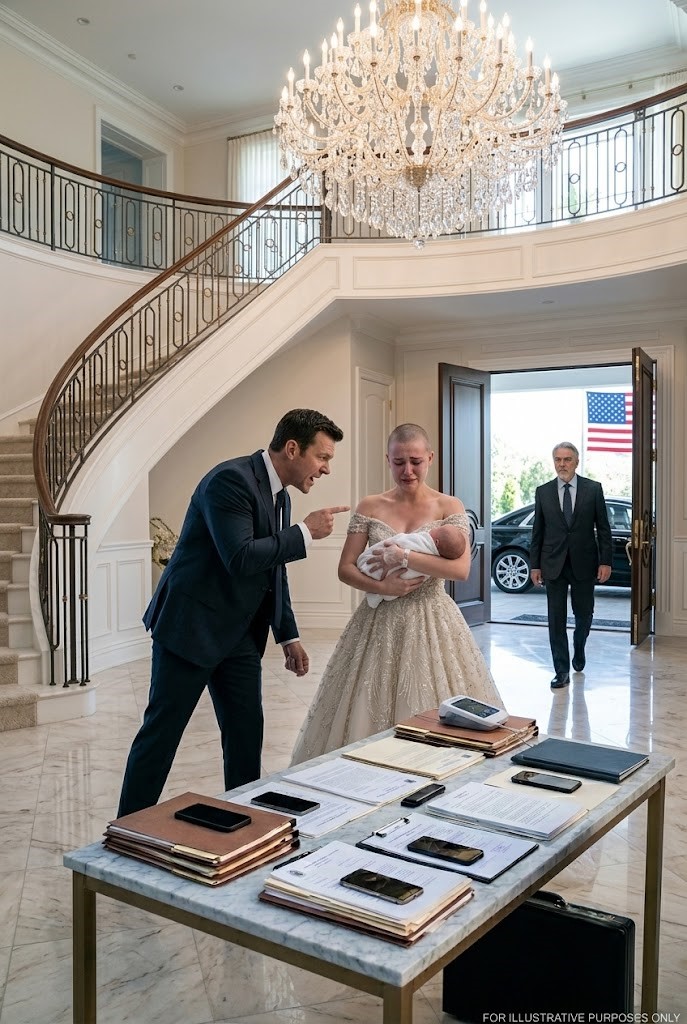
A black Cadillac SUV rolled into our driveway like a funeral car. Ryan stepped out wearing sunglasses and a gray suit. With him came a young attorney carrying a briefcase and a thick-necked man with tattoos down both arms.
Neighbors slowed on the road. Curtains moved in windows.
Ryan stopped at the gate.
“Emma!” he shouted. “Get out here!”
I stood in the bedroom doorway, Caleb in my arms, my incision still aching. My mother put one hand on my shoulder.
“Stay inside,” she said.
My father walked out alone.
“Morning,” he said.
Ryan smirked. “I’m here for my wife and son.”
“My daughter is resting.”
“She’s my wife.”
“She’s recovering from surgery.”
“She left without permission.”
My father opened the gate.
“Come in and sit down,” he said. “If you want to act like civilized men, we’ll talk.”
Ryan looked disappointed. He had wanted a fight in front of the neighbors. Instead, he got my father’s calm.
They sat at the kitchen table.
My mother placed glasses of water in front of them, though nobody touched them. I stood hidden in the hallway, listening.
The attorney cleared his throat.
“Mr. Mason, legally speaking, Mrs. Whitaker had no right to remove the child from the marital home without Mr. Whitaker’s consent.”
My father said, “What marital home?”
The attorney blinked.
“The apartment in Chicago.”
“My daughter paid half the rent until she was too pregnant to work,” my father said. “Her parents paid the hospital bill. Her husband was absent. So I’ll ask again. What home?”
Ryan slapped the table.
“This is nonsense. Emma, get in here.”
Caleb began to cry.
In the kitchen, my father stood.
“You lower your voice in my house.”
Ryan’s tattooed friend pushed back his chair.
“Maybe we should go find her ourselves.”
Before he could take another step, my brother Luke appeared in the doorway, still wearing his work boots and hauling gloves.
Luke was six foot three, built by years of loading freight and splitting wood. He looked at the tattooed man and said, “You touch one door in this house, and you leave without teeth.”
The man stopped.
The young attorney suddenly found his shoes fascinating.
Ryan’s face flushed red.
My father reached into the drawer and pulled out Caleb’s birth certificate.
“His name is Caleb Mason,” he said. “He resides here. If Ryan wants to challenge that, he can file paperwork. Until then, the baby stays where he is safe.”
Ryan stared at the certificate.
“You changed his name?”
“My daughter gave him life,” my father said. “Your son gave her threats.”
Ryan stood so fast his chair fell backward.
“You’ll regret this. All of you.”
My father folded the birth certificate and placed it back in the drawer.
“The road goes both directions,” he said.
Ryan pointed toward the hallway.
“You hear me, Emma? I’ll make sure nobody in this town looks at you the same way again.”
Then he stormed out.
The SUV disappeared in a cloud of dust.
My mother locked the door.
Luke went back outside.
My father sat at the table, suddenly looking older.
I came out with Caleb pressed to my chest.
“Dad,” I whispered, “what if he really does something?”
My father looked at me with the quiet certainty of a man who had survived weather, debt, bad harvests, and grief.
“Then we do what farmers do,” he said. “We prepare before the storm hits.”
That night, after everyone slept, I lay awake listening to Caleb breathe. I knew my parents would protect me, but protection was not enough.
Diapers cost money.
Formula cost money.
Doctor visits cost money.
I had a business degree I had never fully used, an old laptop, and a baby who deserved more than survival.
So I made a promise in the dark.
Ryan could call me abandoned.
He could call me ruined.
He could call me whatever helped him sleep.
But one day, he would look at me and understand the truth:
I had not been thrown away.
I had been set free.
PART 3
I started working before my body was ready.
That is the truth I never admitted to anyone at first.
During the day, I let my mother believe I was resting. I ate the soup she made. I let her tuck blankets around my legs. I smiled when she told me not to lift anything heavier than Caleb.
But at night, when the farmhouse settled into silence and the only sounds were the furnace humming and my son’s tiny breaths, I opened my old laptop and searched for work.
Data entry.
Bookkeeping.
Transcription.
Virtual assistant.
Remote accounting.
Most people ignored me. Some asked for experience I did not have. Others offered scams so obvious they insulted my desperation. But I kept searching because I could not bear the thought of my father buying diapers with money he needed for seed and feed.
My first real job paid thirty dollars.
Thirty dollars to organize a small bakery’s receipts into a spreadsheet.
I worked four nights for it. My scar burned. My eyes throbbed. I typed with one hand while Caleb slept against my chest.
When the payment arrived, I cried harder than I had cried in the hospital.
It was not money.
It was proof.
I was still capable of building something.
My mother found out two weeks later.
She came into my room at midnight carrying warm milk and caught me hunched over the laptop, face pale, hair tied messily, Caleb sleeping in a laundry basket beside the bed because it was the only place I could keep him close while I worked.
“Emma Rose Mason,” she said.
I froze.
“Mom, I can explain.”
She set the mug down.
“You had surgery less than a month ago.”
“I know.”
“You are supposed to be healing.”
“I know.”
Her eyes filled.
“Then why are you doing this to yourself?”
Because I was ashamed.
Because I was grateful.
Because every time my father quietly paid for formula, I felt Ryan laughing somewhere.
I lowered my head.
“I don’t want to be a burden.”
My mother sat beside me. She touched my hair the way she had when I was little.
“You are not a burden,” she whispered. “You are my child.”
“I’m a mother now.”
“You are still my child.”
I cried then. Not loudly. Just enough for her to understand that stopping me would break me in a different way.
After that night, she stopped trying to forbid me. Instead, she made me rest between jobs. She brought me tea. She watched Caleb for an hour in the afternoon so I could finish invoices.
My father pretended not to know, but one morning I found a better desk lamp in my room and a note written in his blocky handwriting.
For your eyes.
No lecture. No speech.
Just love.
By Caleb’s third month, I had steady clients: a bakery in Madison, a mechanic in Green Bay, two Etsy sellers, and a woman who sold organic eggs from a farm thirty miles away. I learned quickly. I was careful. I answered emails on time. Word spread.
One afternoon, I placed two hundred dollars in my mother’s hand.
She tried to give it back.
“No,” I said. “Groceries.”
“Honey—”
“Please.”
She looked at me, then at the bills, then at Caleb kicking happily on the blanket.
“All right,” she said, voice trembling. “But I’m buying you steak.”
I laughed for the first time in months.
That evening, I gave my father a tin of good coffee and Luke a new pair of work gloves. My sister-in-law, Hannah, got soft fabric she had admired at the store but never bought.
My father turned away quickly, but I saw him wipe his eyes.
“You earned this?” he asked.
“I earned it.”
He nodded once.
“That’s my girl.”
For a little while, peace came.
It arrived in small ways.
Caleb’s first smile.
My mother humming in the kitchen.
My father carrying the baby around the porch, explaining corn prices to a three-month-old.
Luke teaching me how to back up files because “city boys may lie, but hard drives fail honestly.”
Then Ryan changed tactics.
He stopped calling.
He stopped showing up.
Instead, rumors arrived.
At first, they came as whispers at church.
Then looks at the grocery store.
Then a neighbor named Patty appeared at our door with a casserole and eyes too bright with curiosity.
“I don’t mean any harm,” she told my mother, which meant harm was exactly what she carried. “But people are saying things.”
My mother stiffened.
“What things?”
Patty lowered her voice, though I was standing right there.
“That Emma ran off because Ryan caught her with another man. That he worked himself sick supporting her while she spent his money. That she took the baby to punish him.”
My mother dropped the dish towel.
The kitchen went still.
I felt heat rise up my throat. Not because it was believable, but because it was clever. Ryan had chosen the oldest weapon against a woman who leaves: call her unfaithful, call her selfish, call her unstable.
My mother’s voice shook with fury.
“You get out.”
Patty blinked. “Linda, I’m just repeating—”
“Then repeat this,” my mother said. “My daughter came home five days after being cut open because her husband told her to raise the baby alone. He visited once. He brought nothing. He asked her for money. Say that at the grocery store.”
Patty left with her casserole.
But rumors do not need permission to grow.
Soon people looked at me like I was a question mark. Some pitied me. Some judged me. Some enjoyed the scandal because misery is entertainment when it belongs to someone else.
Then came the county clinic.
Caleb needed vaccinations. I dressed carefully in clean jeans, a cream sweater, and my only decent coat. My mother offered to go with me, but I refused.
“I have to stop hiding,” I said.
At the clinic, mothers filled the waiting room. Babies cried. Toddlers ran between chairs.
I had just checked in when a sharp voice cut through the noise.
“Well, if it isn’t Emma Whitaker.”
Ryan’s aunt, Marlene, stood near the front desk with a baby on her hip and judgment in her smile.
I said calmly, “It’s Emma Mason.”
Her smile widened.
“Oh, right. You changed names fast, didn’t you?”
Every head turned.
Marlene stepped closer.
“My nephew worked like a dog for you. And you repay him by running off with his child? People say you had someone else waiting.”
Caleb whimpered.
My hands shook, but my voice did not.
“Your nephew told me five days after major surgery, ‘You had him, you raise him.’”
The room went silent.
Marlene’s face tightened.
“He was stressed.”
“He was cruel,” I said. “And if you want to talk about where people were at night, ask Ryan which bars he was in while I went to prenatal appointments alone.”
A woman across the room lowered her magazine.
I stood.
“I will not apologize for taking my son where he is loved. I will not apologize for surviving. And I will not let a man throw me away, then call me trash because I learned how to stand.”
No one moved.
Then the nurse opened the door.
“Caleb Mason?”
I lifted my chin.
“Here.”
As I walked past Marlene, an older woman whispered, “Good for you.”
By sunset, the whole county had heard what happened.
And for the first time, Ryan’s rumor had competition.
PART 4
The woman who changed my life was named Dorothy Hale.
She was president of the county women’s business association, a retired school principal with silver hair, sharp eyes, and the kind of handbag that looked like it contained both peppermints and court documents.
She came to the farmhouse on a Thursday afternoon.
My mother panicked and made coffee. My father wiped his boots twice before coming inside. I sat with Caleb on my lap, wondering whether I was about to be scolded for causing trouble at the clinic.
Dorothy accepted coffee, complimented my mother’s curtains, then turned to me.
“I heard what you said to Marlene Whitaker.”
My stomach dropped.
“Yes, ma’am.”
Dorothy smiled.
“I wish I had said it twenty years ago.”
My mother nearly spilled the coffee.
Dorothy leaned forward.
“Emma, I also heard you do bookkeeping.”
“A little.”
“And computer work?”
“Yes.”
“And you studied business?”
“At the University of Illinois. I didn’t finish my corporate plans exactly.”
“No,” Dorothy said. “You started something better.”
I blinked.
She explained that many women in the county were trying to sell eggs, bread, produce, quilts, soaps, and crafts online. They had skill, discipline, and products people wanted. What they lacked was confidence with computers, spreadsheets, email, invoices, and taxes.
“We need someone who can teach without making them feel stupid,” Dorothy said. “From what I hear, you know what it means to start again.”
The words landed deep.
A week later, I attended my first association meeting at the town hall.
There were twenty-three women in folding chairs. Some held babies. Some wore work boots. Some had tired faces and bright eyes. They were widows, wives, single mothers, grandmothers raising grandchildren, women whose husbands drank too much or earned too little or disappeared when responsibility arrived.
I expected pity.
Instead, they gave me applause.
A woman named Martha, who sold organic eggs, raised her hand.
“I can raise chickens,” she said. “I can’t raise a Facebook page.”
Everyone laughed.
Another woman, Joan, baked bread people drove forty miles to buy, but she kept orders written on napkins and lost half of them.
I went home that night with an idea that would not leave me alone.
I could teach them.
Not fancy business theory. Not corporate nonsense. Real skills. How to make a spreadsheet. How to track orders. How to price products. How to send invoices. How to take clean photos. How to avoid scams.
Dorothy loved it immediately.
“We’ll call it Practical Digital Skills for Working Women.”
I said, “That sounds official.”
She grinned. “Official gets funding.”
The association gave me a five-hundred-dollar equipment loan. I bought a used laptop that did not freeze every ten minutes, a webcam, a small printer, and a cheap whiteboard.
My first online class had twelve students.
Martha joined from her kitchen, chickens clucking in the background. Joan joined from her bakery after midnight. One young mother kept breastfeeding off camera while learning Excel formulas. Another woman accidentally turned herself into a potato with a video filter and could not figure out how to undo it for twenty minutes.
We laughed until we cried.
But we learned.
Within a month, Martha had an order spreadsheet and a waiting list for eggs. Joan stopped losing bread orders. A soap maker named Beth started shipping packages to Milwaukee. A teenager joined to learn invoices for her mother’s jam business.
They started calling me “Teacher Emma.”
At first, I laughed it off.
Then I realized what the name meant.
It meant I was not Ryan’s abandoned wife anymore.
I was useful.
Needed.
Respected.
By Caleb’s sixth month, my classes had expanded to three nights a week. I charged twenty-five dollars for a full course, with free seats for women who could not pay. I kept my bookkeeping clients. I registered a small business under my own name: Emma Mason Consulting.
Dorothy marched me to the county office herself and made sure every form was filed properly.
“Men love to use paperwork as a weapon,” she said. “So we sharpen ours first.”
That sentence saved me.
Because Ryan came back with paperwork.
It was late on a rainy night when headlights swept across the farmhouse windows. My father opened the door before anyone knocked.
Ryan stood outside with two lawyers.
One was the nervous young attorney from before. The other was older, polished, expensive-looking, with silver glasses and a briefcase that probably cost more than my first car.
“Mr. Mason,” he said smoothly, “I’m Attorney Lawrence Bell. We represent Ryan Whitaker.”
My father said, “It’s late.”
“This concerns the child.”
The word child made my blood go cold.
We sat at the kitchen table. Rain tapped against the windows. Caleb slept in my mother’s arms in the living room.
Attorney Bell opened his folder.
“Mrs. Whitaker—”
“Mason,” I said.
He smiled without warmth.
“Legally, not yet.”
Ryan smirked.
Bell continued. Ryan had stable employment in Chicago. A good apartment. Health insurance. A higher income. He intended to seek custody. He would argue that I had removed Caleb without consent, alienated the father, and created instability.
Then he delivered the blow.
“We are also aware that you have been conducting paid classes. If those classes were unregistered, untaxed, or improperly licensed, that would reflect poorly in family court.”
My mother gasped.
Ryan looked victorious.
Bell slid a document across the table.
“A reconciliation agreement. Return to Chicago with the baby. Mr. Whitaker will forgive past misunderstandings, and this matter ends quietly.”
Forgive.
The word nearly made me laugh.
Or scream.
My hands trembled. For one terrible second, fear opened beneath me like a trapdoor. What if they could take Caleb? What if my attempt to survive became evidence against me?
Then my father stood.
He walked to his bedroom and returned with a brown leather notebook.
He placed it on the table beside the lawyer’s agreement.
Attorney Bell frowned. “Sir, what is that?”
My father opened it.
“The truth,” he said.
Page after page, in my father’s careful handwriting, were dates, times, witnesses, phone calls, doctor visits, hospital records, Ryan’s absences, my panic, my pain.
I stared at it, stunned.
My father had been keeping a record for months.
He read aloud.
“March 4. Emma called after appointment. Ryan did not answer. Doctor concerned about blood pressure.”
Ryan’s face changed.
“April 16. Emma fell in parking lot. Ryan at dinner, unreachable.”
Attorney Bell shifted.
“May 9. Delivery complications. Ryan claimed business meeting. Later confirmed at a bar on West Randolph.”
Ryan whispered, “How did you—”
My father turned the page.
“May 14. Hospital. Witnesses Anna Burke and Rachel Cole heard Ryan Whitaker tell Emma: ‘You had him. You raise him.’ Contact numbers listed.”
The kitchen was silent except for the rain.
My father looked at Bell.
“You threaten my daughter with court, we bring this. You threaten her business, we bring tax records, registration, licenses, client testimonials, and the women she helped. You try to shame her, I give this notebook to every newspaper between here and Chicago.”
Attorney Bell closed his folder slowly.
Ryan looked as if someone had pulled the bones from his body.
My father leaned forward.
“You came here thinking farmers don’t keep receipts.”
No one spoke.
Then Bell stood.
“I believe we need to reassess our approach.”
My father pointed to the door.
“Start outside.”
PART 5
After the lawyers left, Ryan disappeared for nearly six months.
No calls.
No threats.
No drunken appearances in the driveway.
Peace returned, but it was no longer fragile. It had roots.
Emma Mason Consulting grew faster than I could handle. I hired two young women from town—Kayla, who had finished community college but couldn’t find work, and Megan, a single mother with a talent for organizing chaos. We turned my old bedroom into an office with two desks, a printer, a coffee maker, and Caleb’s playpen in the corner.
By the time Caleb turned one, I was making more money than Ryan ever gave me. Not millions. Not glamorous money. But honest, steady, life-changing money.
I fixed the roof.
I paid off my parents’ medical bills.
I helped Luke buy a better truck.
I replaced my mother’s ancient stove.
My father pretended the stove was unnecessary, then spent three days telling every neighbor, “My daughter bought that.”
Dorothy nominated me for the county’s Women of Strength award.
I tried to refuse.
She ignored me.
“You’re speaking at the ceremony,” she said.
“I hate stages.”
“You survived Ryan Whitaker. A microphone won’t kill you.”
The ceremony was held at the county auditorium on a bright October afternoon. Banners hung from the walls. Folding chairs filled the room. My students came with flowers. My parents sat in the front row, my father in his best flannel shirt and my mother holding Caleb, who wore tiny suspenders and kept trying to chew the program.
I walked onstage with shaking knees.
Dorothy introduced me as “a woman who turned abandonment into leadership.”
The applause nearly knocked me over.
I spoke about practical skills. About women needing access to tools, not pity. About how financial independence does not make a woman cold—it makes her safe.
I did not mention Ryan by name.
I didn’t need to.
Halfway through my speech, the back doors slammed open.
“Liar!”
The word cracked across the auditorium.
Every head turned.
Ryan stood in the doorway, drunk, red-faced, wearing a suit too wrinkled to save him. Beside him was Aunt Marlene and three men I recognized as the kind of friends who clap when a fool ruins his life.
My stomach turned to ice.
Ryan pointed at me.
“She’s a fraud! That woman abandoned her husband, poisoned my son against me, and built her little business on lies!”
The room erupted.
Dorothy stood. “Remove him.”
Ryan pushed forward.
“No! Let them hear the truth. She cheated. She ran. She stole my child. Now you people clap for her like she’s some saint?”
Caleb began crying in my mother’s arms.
My father started to rise, but I lifted my hand.
Something inside me went quiet.
Not weak quiet.
Dangerous quiet.
I turned to the technician near the stage.
“Please play the second file on my flash drive.”
He looked confused.
“The one labeled TRUTH.”
Dorothy’s eyes widened. She had not known.
I had prepared it months ago—not because I expected this moment, but because some part of me understood Ryan would never stop until the truth stood taller than his lies.
The screen behind me lit up.
The first image appeared: me in the hospital, pale as paper, Caleb newborn beside me, Ryan’s chair empty.
Gasps moved through the audience.
I lifted the microphone.
“This was me five days after surgery.”
The next slide: a screenshot of Ryan’s message.
You had him. You raise him. Don’t drag me into it.
Murmurs turned sharp.
Ryan shouted, “That’s private!”
I looked at him.
“So was my pain. You made it public.”
The next slides appeared one after another.
Hospital discharge papers.
My father’s dated notes.
Messages from clients.
My business registration.
Tax payment confirmations.
Testimonials from women whose businesses had grown because of my classes.
Martha stood from the audience.
“She taught me how to sell my eggs statewide,” she yelled. “You didn’t build her. You tried to bury her.”
Another woman stood.
“Teacher Emma helped me leave debt.”
Then another.
“She helped my daughter get a job.”
The applause started slowly, then grew.
Ryan’s face drained of color.
I turned back to the microphone.
“For months, this man called me unfaithful because I refused to stay abandoned. He called me unstable because I learned to earn. He called me a thief because I protected my baby. So let me say this clearly in front of everyone.”
I looked straight at him.
“I did not steal your son, Ryan. I saved him from becoming another thing you neglected.”
The room exploded.
At that moment, two sheriff’s deputies entered from the side doors. Dorothy had signaled them the second Ryan arrived.
“Ryan Whitaker,” one deputy said, “you need to come with us.”
Ryan stumbled back.
“For what?”
“Public disturbance. Harassment. Possible defamation complaint if Mrs. Mason chooses to file.”
Marlene suddenly became very interested in leaving.
Ryan’s friends backed away from him like cowardice was contagious.
As the deputies took Ryan by the arms, he looked at me. For the first time, I saw not anger, not arrogance, but fear.
“Emma,” he said.
I did not answer.
The doors closed behind him.
The auditorium fell silent.
Then my father stood.
He began to clap.
My mother stood beside him, crying.
Luke stood.
Dorothy stood.
Then the whole room rose, applause thundering against the walls.
I held the microphone with both hands because I was shaking so hard.
But I was not shaking from fear anymore.
I was shaking because the weight of shame had finally fallen off my shoulders, and for the first time in my adult life, I knew exactly who I was.
Not discarded.
Not ruined.
Not Ryan Whitaker’s victim.
Emma Mason.
Mother.
Daughter.
Teacher.
Owner.
Free.
PART 6
A month after the auditorium disaster, a magazine called Working Women Midwest published a feature about me.
The title made me blush: From Abandoned Mother to Rural Business Leader.
I bought one copy.
My father bought twenty-seven.
He mailed them to cousins, neighbors, old friends, and one dentist in Milwaukee he barely knew.
I thought the article would bring a few clients.
Instead, it brought Chicago back.
The call came on a Tuesday morning while I was reviewing invoices.
“Good morning,” a polished male voice said. “Am I speaking with Emma Mason, owner of Emma Mason Consulting?”
“Yes.”
“My name is Daniel Brooks. I’m director of training at Great Lakes Corporate Group in Chicago. We read your profile and reviewed your course model. We’d like to invite you to lead a three-day practical financial systems workshop for our staff and partner companies.”
I nearly dropped the phone.
Great Lakes Corporate Group was massive. Their offices filled half a tower downtown. Companies begged to get vendor contracts with them.
Daniel explained the fee.
I sat down.
It was more than I had made in my first six months of work.
“We’ll cover travel and hotel,” he said. “You may bring your child and a caregiver if needed.”
That night, I told my parents.
My mother looked worried.
“Chicago hurt you.”
My father looked proud.
“Then go back standing.”
So I went.
My mother came with me to help with Caleb. Great Lakes sent a black car to our farmhouse. My father stood in the driveway holding Caleb until the last second.
“Show them,” he told me.
The hotel room overlooked the Chicago River. Caleb pressed his hands against the window, amazed by the lights. My mother wandered from room to room whispering, “Good Lord.”
The next morning, I wore a cream pantsuit I bought with my own money. I pinned my hair back, put on simple pearl earrings, and looked in the mirror.
The woman staring back at me was not the woman from the hospital.
At Great Lakes, Daniel met me in the lobby.
“You’ll have around two hundred attendees,” he said. “Internal managers, administrative staff, and representatives from partner companies.”
Partner companies.
A strange feeling moved through me.
When I entered the auditorium, I understood why.
Ryan was in the fifth row.
He wore a company badge from Whitaker Supply Solutions, one of Great Lakes’ smaller vendors. He was laughing with a colleague when Daniel stepped to the microphone.
“Please welcome our speaker, Emma Mason.”
Ryan’s smile froze.
His face went white.
Our eyes met.
For one second, the whole room disappeared. I saw the hospital. The slammed door. The cold bed. The crying baby.
Then I looked away.
He no longer deserved the center of any room I entered.
I began.
“Good morning. I’m not here to impress you with theory. I’m here to talk about what actually keeps a business alive when the meetings end.”
The first hour covered financial tracking. The second covered process failure. The third covered waste disguised as networking.
I spoke about managers who spent company money on dinners but could not read basic cash flow reports. I spoke about accountability. Documentation. Ethical leadership. The danger of arrogance in business culture.
I never said Ryan’s name.
I did not have to.
By lunch, people were glancing at him.
By the end of the day, he was gone.
He did not return for days two or three.
The workshop was a success. Great Lakes offered me a long-term consulting contract. Daniel shook my hand and said, “Mrs. Mason, you have a rare gift. You make competence feel possible.”
I smiled all the way back to the hotel.
For two days, my mother, Caleb, and I became tourists. We visited the aquarium. We walked along the river. We ate deep-dish pizza that Caleb mostly wore on his shirt. Chicago no longer looked like a place that had swallowed me.
It looked like a place I had outgrown.
On our final evening, we returned to the hotel lobby carrying shopping bags and laughing.
Then I saw him.
Ryan stepped out from behind a marble column.
He looked terrible. Beard untrimmed. Eyes bloodshot. Suit wrinkled. Pride gone.
“Emma,” he said.
My mother pulled Caleb closer.
“No,” she said. “Absolutely not.”
Ryan lifted both hands.
“Please. I just need to talk.”
I wanted to walk past him.
But unfinished things rot if left buried.
“Mom,” I said, “take Caleb upstairs.”
She hesitated.
“Five minutes,” I promised.
When the elevator doors closed behind them, Ryan’s face collapsed.
“I got fired,” he said.
I said nothing.
“After Great Lakes complained about professionalism. My company lost the vendor contract. They blamed me. My boss said my reputation had become a liability.”
“That sounds like a consequence.”
He flinched.
“I know I was awful.”
“You were more than awful.”
“I was scared,” he said. “The baby, the money, everything. I panicked.”
“No,” I said. “You chose yourself.”
Tears filled his eyes.
“I saw you on that stage. I didn’t know you could become this.”
“That is the problem, Ryan. You only respect what impresses you.”
He dropped to his knees in the middle of the hotel lobby.
“Please,” he whispered. “Come back. Let me try again. Let me be a husband.”
I stepped back.
“We will never be married again.”
He covered his face.
“Then let me be a father.”
The answer did not come quickly.
I thought of Caleb. One day he would ask questions. I did not want bitterness to be his inheritance. But I would not hand my son to a man who had treated love like a convenience.
“I will give you rules,” I said.
Ryan looked up, desperate.
“Anything.”
“You will sign divorce papers. I keep full custody. You pay child support into an education account. You see Caleb once a month at my parents’ house, supervised. You come sober, respectful, and alone. No Marlene. No insults. No threats. One mistake, and it ends.”
He nodded through tears.
“Yes.”
“And understand this,” I said. “I am not giving you access because you deserve it. I am giving Caleb the chance to know the truth for himself.”
Ryan bowed his head.
The next morning, in the hotel café, he signed everything.
When I walked away, I did not feel victorious.
I felt finished.
PART 7
The divorce was finalized before Caleb’s second birthday.
On paper, Ryan and I became strangers.
In truth, we had been strangers long before the court stamped it.
With the Great Lakes contract, Emma Mason Consulting moved out of my bedroom and into a small office on Main Street. The sign above the door was navy blue with white lettering. My father stood beneath it for a full ten minutes on opening day, pretending to inspect the screws while wiping his eyes.
Dorothy cut the ribbon.
Martha brought eggs.
Joan brought bread.
My mother brought Caleb, who clapped because everyone else was clapping.
I hired five employees within the first year. We handled bookkeeping for farms, bakeries, repair shops, local nonprofits, and women-owned businesses across the Midwest. We taught digital classes every week. We helped people register businesses properly, pay taxes, price products, and stop apologizing for wanting to earn.
I created the Caleb Mason Scholarship Fund for rural students who needed laptops, books, or certification fees.
My parents’ old farmhouse got a new roof first.
Then new windows.
Then, finally, a second floor.
My mother cried when she saw her new kitchen.
My father walked through the house touching walls like he did not trust them to stay.
“You built this,” he told me.
“No,” I said. “We did.”
He shook his head.
“I planted corn. You planted a future.”
Ryan kept his agreement.
On the last Sunday of every month, he drove up from Illinois in an old sedan. The first visits were awkward. He brought toys too expensive and apologies too late. My father watched him from the porch with the expression of a man supervising a dangerous machine.
Caleb was shy at first.
Then curious.
Then comfortable enough to show Ryan his toy trucks, his drawings, his favorite rocks, his scraped knee, his frog boots, his ability to count to twenty if nobody interrupted him.
Ryan never came inside without permission.
He never raised his voice.
He never mentioned taking Caleb away.
Sometimes I caught him watching my father and Caleb together—Grandpa teaching him how to plant beans, how to hold a fishing pole, how to hammer a nail into scrap wood. Ryan’s face would tighten with something deeper than jealousy.
Loss.
Not the loss of something stolen.
The loss of something he had thrown away.
One autumn evening, after Ryan’s visit, Caleb ran into the kitchen yelling, “Grandpa said I’m strong like Mama!”
My father laughed from the porch.
Ryan stood near his car, hands in his pockets.
“Emma,” he said quietly.
I turned.
“Thank you.”
“For what?”
“For not making him hate me.”
I looked through the window at Caleb dancing with my mother while she tried to set the table.
“I’m not doing it for you,” I said.
“I know.”
He nodded, got in his car, and drove away.
Years passed in steady, golden layers.
Caleb grew into a bright boy with his grandfather’s patience, my stubbornness, and a laugh that could fill every room in the house. My business expanded into three states. Dorothy retired from the association and insisted I take her position. I resisted for one week, which was all she allowed.
Luke’s trucking company grew because our clients needed deliveries. Hannah became my office manager and better at enforcing deadlines than I ever was. My mother started a Sunday dinner tradition that somehow included half the town by accident. My father spent mornings with his coffee, his newspaper, and Caleb beside him, both pretending they were not eating cookies before breakfast.
One spring, Great Lakes invited me back to Chicago to speak at a national conference.
This time, Caleb came too, old enough to sit in the front row beside my mother, wearing a little blazer and waving at me with both hands.
I stood onstage in front of a thousand people and told them the truth.
“Independence is not born from confidence,” I said. “Often, confidence comes later. Independence begins when you are terrified, heartbroken, exhausted, and still decide that your life belongs to you.”
Afterward, people lined up to speak to me. Women cried. Men apologized for things they had done to wives, sisters, daughters. Young mothers asked how to begin.
I told them the same thing every time.
“Begin small. But begin.”
That night, back at the hotel, Caleb asked me about his father.
“Did Dad hurt you?” he asked.
I sat beside him on the bed.
“He hurt me with choices,” I said carefully. “But people can make terrible choices and still try to make better ones later.”
“Do you hate him?”
I thought about the hospital room. The slammed door. The years of rebuilding.
“No,” I said. “Hate is heavy. I had too much to carry already.”
Caleb leaned against me.
“Grandpa says you’re brave.”
I kissed his hair.
“Grandpa says a lot of things.”
“He’s right.”
I smiled into the dark.
When we returned home, my father was waiting on the porch, just like he had the day I came back broken with a newborn in my arms.
Only now, the house behind him was bright. The fields beyond were green. My mother stood in the doorway waving a dish towel. Luke’s truck was parked by the barn. Hannah’s kids were chasing fireflies with Caleb before he had even changed clothes.
My father looked at me and said, “Welcome home.”
Those words had saved me once.
Now they crowned me.
That evening, we ate dinner outside beneath string lights. Ryan had visited earlier that day and left a model airplane for Caleb. My father had pretended not to like it, then spent an hour helping assemble it. My mother served pie. Dorothy called to complain that retirement was boring. The whole table laughed.
I looked around at the people who had stayed.
The people who had lifted me when I could not stand.
The people who never asked me to earn my place in their hearts.
I once believed happiness was a penthouse apartment in Chicago, a husband in a tailored suit, expensive dinners, and the envy of strangers.
I was wrong.
Happiness was my son’s sticky hand in mine.
My mother’s soup.
My father’s notebook.
My brother’s quiet loyalty.
A business built from midnight work and stubborn hope.
A life no one could threaten because I owned it myself.
The storm did not destroy me.
It washed away everything pretending to be shelter.
And what remained was home.