The Daughter They Called a Waste
Part 1
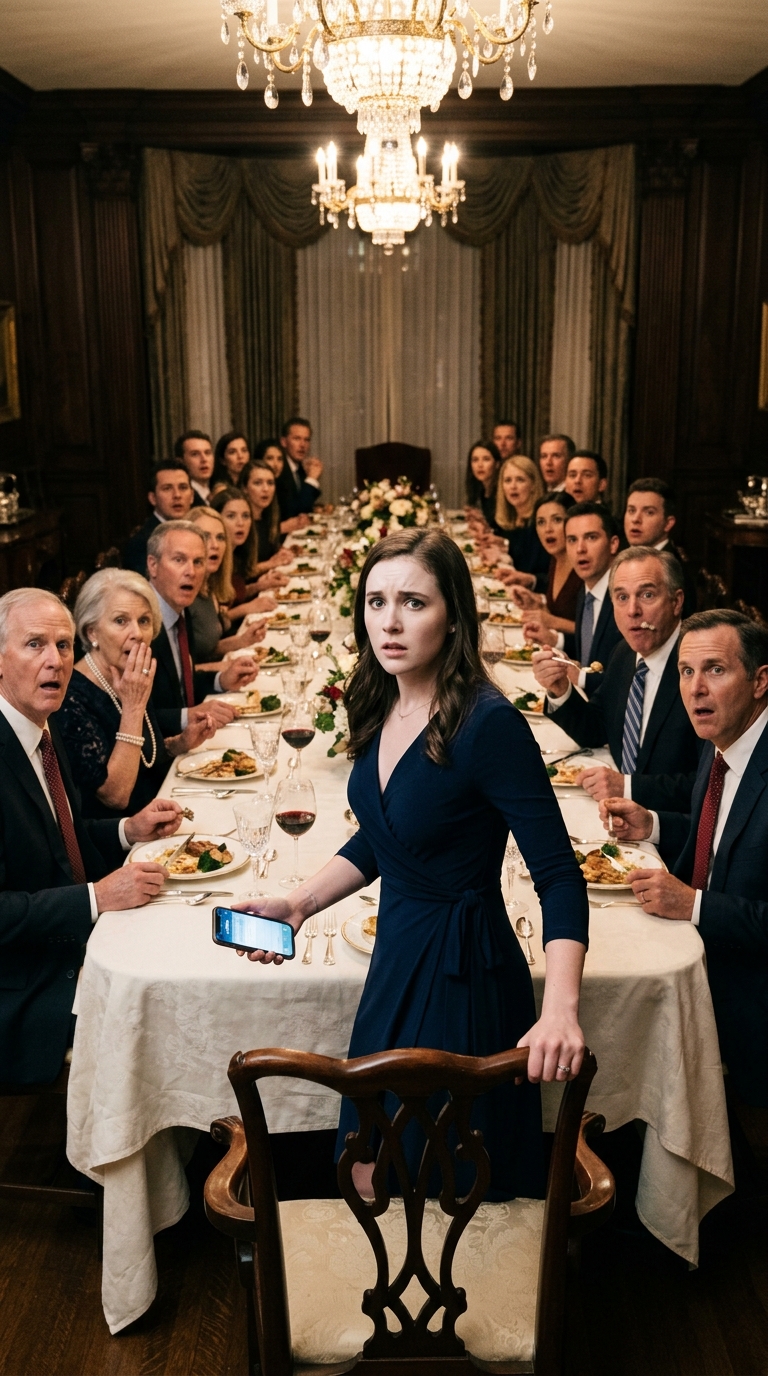
The candlelight flickered across the mahogany table at Chez Laurent while twenty-six family members and close friends celebrated my father’s sixtieth birthday.
The private dining room hummed with polished conversation, expensive perfume, and the gentle clink of crystal glasses. Waiters in black jackets moved silently between chairs, placing French dishes in front of people who believed success had one acceptable shape: prestigious, visible, traditional.
A courtroom.
An operating room.
A corner office.
Not a studio apartment.
Not a twelve-year-old Honda.
And definitely not what my family still called “Chloe’s computer project.”
I sat at the far corner of the long table, quietly cutting my beef bourguignon while my family performed its usual ritual of admiration.
My older sister, Jennifer, commanded the space near Dad’s right side. She was a partner at the city’s most prestigious law firm, dressed in ivory silk, laughing with the easy confidence of someone who had always known her place in the family hierarchy.
My brother David sat across from her, recently promoted to chief of surgery at Metropolitan Hospital. He spoke with his hands, describing cardiac procedures and hospital politics as if the entire table had paid for tickets.
And then there was me.
Chloe Thompson.
Twenty-eight years old.
The youngest.
The quiet one.
The one my parents loved, but never understood. The one relatives introduced with a pause, as if they had to search for a respectable explanation.
“Chloe is still doing her tech thing,” Mom would say.
Still.
That word did a lot of work.
The irony was almost funny.
Two hours earlier, while my family was getting dressed for this dinner, I had been on a video conference with venture capitalists from Silicon Valley finalizing a Series D funding round that valued my company at 1.8 billion dollars.
MedTech Innovations.
The artificial intelligence diagnostic platform I had built from a one-bedroom apartment, six years of isolation, and a refusal to accept that geography should decide whether someone received good medical care.
But none of that mattered in this room.
This room belonged to Robert Thompson.
Distinguished cardiothoracic surgeon.
Forty years saving lives.
A man who believed legacy was built through titles, institutions, and children who followed recognizable paths.
Some of his children, anyway.
“And then I told opposing counsel,” Jennifer said, leaning slightly forward, “that his client’s patent infringement was so obvious even a first-year law student could win the case.”
Laughter rippled around the table.
“The settlement check arrived three days later.”
Dad lifted his wine glass, beaming.
“That’s my girl. Sharp as a scalpel and twice as precise. You’ve got the Thompson instincts, Jennifer. The ability to cut through complexity and go straight for the heart.”
Jennifer smiled like a queen receiving tribute.
Dad turned to David.
“And David, tell everyone about the research publication.”
David practically glowed.
“The New England Journal of Medicine accepted our paper on minimally invasive cardiac procedures. It’ll be the cover story next month. Hospitals worldwide are already asking about implementing our protocols.”
“Outstanding,” Dad said. “Innovation in medicine. Pushing boundaries. That’s what the Thompson name represents. Excellence, leadership, making a real difference.”
I took a sip of water and glanced discreetly at my phone.
A text from Arjun, my chief technology officer, glowed on the screen.
FDA approval just came through. Nationwide deployment approved. This changes everything.
For a moment, the room vanished.
Eighteen months of regulatory review.
Three years of clinical trials.
Twelve countries of pilot testing.
Thousands of patient cases.
The system could now legally support diagnosis for more than two hundred medical conditions with 97.3 percent tested accuracy. Faster than traditional pathways. More consistent than overworked departments. Capable of bringing specialist-level decision support to rural hospitals, emergency rooms, community clinics, refugee camps, and developing regions where access to specialists was not limited.
It was absent.
It would save lives.
I stared at the text until the letters blurred.
Then Aunt Margaret’s voice cut through my thoughts.
“Chloe, dear.”
I looked up.
Dad’s sister smiled at me with the gentle concern people reserve for troubled pets.
“You’ve been so quiet tonight. How are things going with your computer project?”
There it was.
The question landed on the table like a spoon dropped onto marble.
Twenty-six faces turned toward me.
Some curious.
Some amused.
Some already pitying.
“It’s going well,” I said.
The same answer I had given for six years.
Jennifer laughed.
Not loudly.
Worse.
Fondly.
“Going well,” she repeated. “Aunt Margaret, Chloe has been saying that since Stanford. Meanwhile, she still lives in that tiny apartment and drives the same car from college.”
The familiar sting moved through me.
Not sharp anymore.
More like scar tissue being pressed.
Mom gave Jennifer a look, but not the kind that meant stop.
The kind that meant let me say it more gently.
“I’m sure Chloe is doing her best,” Mom said.
My best.
As if I were a child gluing macaroni to paper.
As if I had not just received FDA approval for technology that could change global healthcare.
“The problem,” Mom continued, settling into her favorite lecture, “is that Chloe has never understood practical career choices. Jennifer followed a traditional path, built a solid practice, made partner. David went to medical school, completed residency, became a respected surgeon. That is what success looks like.”
“Exactly,” David added, not cruelly, which somehow made it worse. “I keep telling Chloe she should consider medical school. With her Stanford background, she could probably get into a decent program. Healthcare is stable. Real job security.”
Medical school.
I had an MD in bioengineering from Stanford.
I also had a PhD in computer science.
I had completed both while my family told people I was “still figuring things out.”
Aunt Margaret nodded.
“Medicine is such a noble profession. You could really make a difference.”
Make a difference.
MedTech’s diagnostic AI was already reducing misdiagnosis rates in clinical trials, helping overburdened doctors catch rare conditions faster, and giving hospitals without specialists access to evidence-based diagnostic support.
But at my father’s birthday dinner, I was still the daughter wasting time with computers.
“I appreciate the suggestions,” I said carefully. “But I’m committed to my current work.”
Mom’s patience finally thinned.
“Committed to what, Chloe?”
The table went quiet.
She set down her wine glass.
“What are you actually committed to? Because from where we’re sitting, it looks like you’re committed to avoiding responsibility.”
That landed harder than Jennifer’s laugh.
Around us, people shifted in their chairs.
No one defended me.
“You’re twenty-eight,” Mom continued. “You have a Stanford education, a brilliant mind, and every advantage we could give you. And what have you done with it? Six years of playing with computers while your siblings are out there building real careers, helping real people, making real contributions to society.”
Real contributions.
I looked at my father.
He did not stop her.
That told me more than anything she said.
Part 2
Mom had always been precise when she wanted to hurt me.
She could turn disappointment into arithmetic.
“The truth is,” she said, voice softening in the way that meant the blade was about to go deeper, “we wasted two hundred thousand dollars on your education.”
The words struck the table one by one.
Wasted.
Two hundred thousand.
Your education.
Twenty-six people watched my mother publicly calculate the financial loss of raising me.
“Stanford tuition. Living expenses. Graduate support.” She shook her head. “And look where it got you. A four-hundred-square-foot apartment. A twelve-year-old Honda. Some mysterious project that produces no visible income.”
No visible income.
That part was accurate.
I had hidden everything visible.
I lived modestly because every dollar I could save went back into MedTech during the first years. Research was expensive. Clinical validation was expensive. Regulatory compliance was brutal. Hiring engineers who understood medicine and physicians who respected data required money I refused to waste on status.
My Honda ran.
My apartment was safe.
Target sold perfectly decent shirts.
None of that meant I was failing.
It meant I knew what mattered.
“Jennifer’s law degree cost half as much,” Mom continued. “And look what she achieved. David’s education was expensive, but he saves lives and has the respect of his peers. Your education was the most expensive of all, and you’ve produced absolutely nothing of value.”
Nothing of value.
My phone sat beside my plate with the FDA approval text still glowing in my mind.
Nothing of value.
The AI we built had flagged a rare pulmonary embolism in a rural ER during trials because a tired doctor had missed the pattern.
Nothing of value.
It had identified pediatric sepsis risk six hours earlier than standard escalation in a partner hospital.
Nothing of value.
It had helped clinics in underserved regions triage patients accurately when no specialist was within two hundred miles.
“We could have saved that money,” Mom said. “Invested it. Donated it to charity. Used it for something that actually made a difference.”
Silence followed.
Absolute.
I could hear the air conditioning above us.
The tiny scrape of a waiter stopping near the doorway, sensing he had entered the wrong moment.
Dad finally said, “Emily, that’s enough.”
Emily was my mother.
He said it too late.
He said it softly.
He did not say she was wrong.
That was when my phone rang.
Not the soft vibration of a personal call.
The clear, distinct tone of my business line.
Every head turned.
I glanced at the caller ID.
Katherine Walsh.
Forbes.
My heart stopped.
Katherine Walsh was the senior editor who covered breakthrough technology companies and healthcare innovation. My PR lead had said Forbes might reach out after FDA approval, but not tonight. Not here.
“I should take this,” I said quietly.
Mom’s eyes flashed.
“It’s your father’s birthday dinner. Whatever business call you think you need to take can wait.”
“It’s probably important.”
I answered.
“Hello?”
A woman’s voice came through, polished and authoritative.
“Miss Thompson, this is Katherine Walsh from Forbes magazine. I apologize for calling during evening hours, but we’re working on a time-sensitive story about revolutionary healthcare technology, and I wanted to speak with you personally about your company.”
The table changed.
Subtly at first.
Jennifer stopped moving.
David leaned forward.
Mom’s mouth tightened.
“Of course,” I said. “How can I help?”
“We’d like to interview you about MedTech Innovations for our upcoming issue on companies reshaping American healthcare. Your AI diagnostic platform has caught the attention of our editorial board, and we understand you just received FDA approval for nationwide deployment.”
I could feel the room listening now.
Not politely.
Hungrily.
“That’s correct,” I said.
“Excellent. We’re also told MedTech Innovations has been valued at approximately 1.8 billion dollars following your recent Series D funding round. Is that accurate?”
1.8 billion dollars.
The number seemed to echo off the walls.
Mom’s wine glass froze halfway to her lips.
Jennifer’s mouth parted.
David looked as if someone had changed the language of the room.
“Miss Thompson?” Katherine asked. “Are you there?”
I looked around the table.
At the relatives who had nodded while Mom called my education wasted.
At my father, whose face had gone pale with sudden calculation.
At my siblings, who had never asked what I was actually building.
Then I made a decision.
“Yes,” I said. “I’m here. And yes, the valuation is accurate.”
I tapped the speaker button.
“Actually, could you stay on speaker? I’m with family right now, and I think they would be very interested in this conversation.”
“Of course,” Katherine said.
Her voice filled the private dining room.
“For our readers who may not be familiar with MedTech Innovations, could you explain what your company does?”
I set the phone on the table.
“MedTech Innovations develops artificial intelligence systems for medical diagnosis,” I said. “Our platform analyzes symptoms, patient history, clinical notes, imaging inputs, and basic test results to assist physicians in diagnosing over two hundred medical conditions.”
“And this technology has just received FDA approval?”
“As of this afternoon, yes. We’re approved for nationwide deployment in hospitals, clinics, and healthcare facilities across the United States.”
“That’s remarkable. Can you explain the potential impact?”
I looked directly at my mother.
“Our system provides specialist-level diagnostic support in locations where specialist care isn’t available. Rural hospitals. Emergency departments. Community clinics. Developing countries. Anywhere medical expertise is needed but access is limited.”
“And your accuracy rate?”
“97.3 percent across tested conditions.”
David made a sound.
Small.
Half gasp, half disbelief.
Katherine continued.
“Forbes has tracked MedTech’s growth for two years. You’ve reached unicorn status unusually quickly. What has been the key to that success?”
“Focusing on real problems,” I said. “Not theoretical applications. Too many healthcare AI companies try to replace doctors. We built technology to support them, to help good clinicians make faster and more accurate decisions.”
“And you’ve maintained a relatively low public profile. Most founders at your level actively build personal brands.”
“I was focused on building the technology.”
Aunt Margaret’s hand covered her mouth.
“The goal was never fame,” I continued. “The goal was to help patients.”
Katherine’s voice warmed.
“Well, fame may be harder to avoid now. Forbes is preparing a cover story on MedTech Innovations for our healthcare innovation issue. The working headline is The 28-Year-Old Revolutionizing Medicine.”
Cover story.
I heard someone inhale sharply.
“We’re also including MedTech in our Companies to Watch list and profiling you in our 30 Under 30 healthcare leaders feature.”
Jennifer whispered, “Oh my God.”
Katherine asked one final question.
“What’s next for MedTech Innovations?”
I thought of the deployment timeline waiting on my laptop. The hospital partnerships. The rural pilots. The international expansion. The refugee health initiative we had built quietly because nobody profitable had cared enough to fund it.
“We launch nationwide next month,” I said. “By year’s end, our platform should be available in over two thousand healthcare facilities. Our goal is simple: accurate diagnosis should not depend on where you were born, how much money you have, or whether a specialist happens to be nearby.”
“With your 1.8-billion-dollar valuation, you clearly have resources to pursue that goal.”
“We have resources,” I said. “And responsibility. If you build technology that can save lives, you have an obligation to make it available.”
“Thank you, Miss Thompson. Our photographer will contact your office about the cover shoot.”
“Thank you, Miss Walsh.”
I ended the call.
Then I looked at my family.
For the first time all night, nobody knew what to say.
Part 3
The silence after the call was different from the silence before it.
Before, they had been watching me fail.
Now they were watching themselves become wrong in real time.
Mom lowered her wine glass onto the table. It touched the wood with a tiny clink that sounded impossibly loud.
“Chloe,” she whispered.
I waited.
“That was Forbes.”
“Yes.”
“Calling about your computer project.”
“Calling about MedTech Innovations,” I said. “My artificial intelligence company.”
David spoke first.
His voice was careful, almost clinical, as if he were diagnosing a condition.
“Did she say 1.8 billion?”
“Yes.”
“Billion,” Mom repeated.
“With a B,” Aunt Margaret said faintly.
Dad had not moved.
He sat at the head of the table, hands folded in front of him, his birthday wine untouched.
Finally, he said, “Chloe, are you telling us you built a billion-dollar medical technology company?”
“No,” I said.
His eyebrows drew together.
“I’m telling you I built an AI diagnostic platform that can revolutionize healthcare delivery. Investors valued the company at 1.8 billion dollars. The valuation is not the achievement. The technology is.”
That distinction mattered.
Maybe only to me.
But I needed to say it.
Jennifer stared at me.
“But you live in that apartment.”
“Yes.”
“You drive that old Honda.”
“It runs.”
“You shop at Target.”
“Target sells socks.”
David leaned forward.
“FDA approval,” he said slowly. “You built diagnostic technology that received FDA approval.”
“After three years of clinical trials and eighteen months of regulatory review.”
“But you never went to medical school.”
I looked at him.
“I have an MD in bioengineering from Stanford.”
His face went blank.
“And a PhD in computer science,” I added. “I completed both programs simultaneously.”
Mom’s hand flew to her chest.
“You have a medical degree?”
“I thought you knew about my graduate work.”
Mom looked at Dad.
Dad looked at his plate.
Jennifer whispered, “We thought you were just…”
“Playing with computers?”
No one answered.
“I was developing artificial intelligence systems that could save lives. But yes, technically, computers were involved.”
The irony sat over the table like smoke.
Aunt Margaret spoke softly.
“When you said your work was going well…”
“I meant MedTech was completing clinical trials, raising venture capital, securing hospital partnerships, preparing for FDA approval, and building global deployment infrastructure.”
I lifted my water glass.
“That qualified as going well.”
Dad’s voice was lower now.
“Why didn’t you tell us?”
There it was.
The question I had dreaded and wanted for six years.
“Tell you what?”
“That you were doing something important.”
I almost laughed.
Not because it was funny.
Because it hurt too cleanly.
“Dad, every time I tried to explain my work, someone reduced it to a computer project. Every family gathering became advice about finding a real career. Mom told me I was avoiding responsibility. David told me to consider healthcare. Jennifer laughed about my apartment.”
Jennifer flinched.
I continued.
“For six years, you all assumed I was failing and built every conversation around that assumption.”
Mom’s eyes filled with tears.
“Chloe, we didn’t know.”
“You didn’t ask.”
That sentence landed harder than anything else I could have said.
“You didn’t ask because you thought you already knew. You saw my apartment, my car, my clothes, and decided those things told the whole story.”
Dad looked at me with something like grief.
“I should have asked.”
“Yes,” I said. “You should have.”
Mom reached for a napkin.
“I never would have said those things if I’d known.”
I looked at her.
“That’s not the defense you think it is.”
She froze.
“If you needed a billion-dollar valuation before respecting my work, that says something.”
David nodded slowly.
“She’s right.”
Mom turned toward him, startled.
He looked at me, and for the first time that night, he did not look like my older brother explaining the world to me. He looked like a doctor recognizing another kind of expertise.
“What you built,” he said, “could change emergency medicine. Rural diagnosis. Global health access. I mean, if the accuracy holds at scale—”
“It will,” I said.
He almost smiled.
“Then it’s extraordinary.”
The word hung there.
Extraordinary.
Not cute.
Not mysterious.
Not impractical.
Jennifer set down her fork.
“Chloe, I’m sorry.”
I looked at my sister.
She swallowed.
“I’ve been condescending. I thought because your success didn’t look visible, it wasn’t real.”
“At least that’s honest.”
“I am sorry.”
I nodded once.
Not forgiveness.
Acknowledgment.
Dad finally pushed back his chair and stood.
Everyone straightened instinctively.
He had that effect.
But his voice was not commanding now.
It was uncertain.
“I owe you an apology too.”
The room went still.
“I have spent forty years in medicine,” he said, “and I still failed to recognize medical innovation because it came from the child I had already decided was lost.”
Mom began crying quietly.
Dad looked at me.
“I am proud of Jennifer. I am proud of David. That has always been easy for me because I understood their paths. But you…” He paused. “You were building something beyond my imagination, and instead of being curious, I was disappointed.”
My throat tightened.
That apology mattered.
It did not erase the lecture.
It did not erase years.
But it mattered.
“I appreciate that,” I said.
Mom reached toward me.
“Chloe, please. I’m so sorry. I was cruel.”
“Yes,” I said. “You were.”
Her hand stopped halfway.
“I spent two hundred thousand dollars on your education,” she whispered.
“You invested in me,” I corrected. “Those are different sentences.”
She cried harder.
I stood slowly and placed my napkin beside my barely touched dinner.
“Dad,” I said, walking to his chair.
He looked older than he had at the start of dinner.
“Happy sixtieth birthday.”
I leaned down and kissed his forehead.
“I hope this year teaches you to see all your children clearly.”
Then I looked at Mom.
“The two hundred thousand dollars you said was wasted helped build technology that will provide medical care to people who never had access before. I’d call that money well spent.”
No one spoke.
I picked up my purse.
Jennifer stood.
“Chloe, wait.”
David stood too.
“Can we talk about the platform? I’d really like to understand—”
“Not tonight.”
The answer was quiet, but firm.
I looked around the table at twenty-six people who were seeing me clearly for the first time only because Forbes had said my name loudly enough.
“I’m going home,” I said.
Then I walked out of Chez Laurent past tables of successful people who had no idea they were watching a billionaire leave her father’s birthday dinner in a twelve-year-old Honda.
Part 4
The Forbes cover story published the next morning at 8:00 a.m.
By 8:03, my phone became unusable.
Texts. Calls. Emails. Interview requests. Congratulations from investors. Messages from people I had not spoken to since Stanford who suddenly remembered we were close. Venture funds wanting meetings. Hospital systems requesting pilots. Tech journalists asking for quotes. Medical boards asking for comment.
The headline was worse than Katherine warned.
The 28-Year-Old Founder Bringing AI Diagnosis to Every Hospital in America
There I was on the digital cover, photographed weeks earlier for what my PR team had vaguely called “investor materials.” Black blazer. Simple makeup. Hair pulled back. The kind of photo my mother would have called severe if it had appeared in my apartment instead of Forbes.
By noon, TechCrunch had picked it up.
By two, Wired.
By evening, The Wall Street Journal.
The mysterious founder behind MedTech Innovations had a face.
And that face belonged to the Thompson daughter everyone thought had wasted her education.
Mom called eleven times.
Dad called three.
Jennifer sent a long apology text.
David sent a professional message first, asking if I had published clinical validation data he could review, then a second personal one: I’m sorry I reduced what you were doing because I didn’t understand it.
That one I appreciated more.
It had no performance in it.
I answered none of them that day.
I had deployment meetings.
A company to run.
And, frankly, a nervous system that needed silence.
My apartment was exactly as they had described it.
Four hundred square feet.
Small kitchen.
One window with a stubborn latch.
Desk against the wall, three monitors, one dying plant, stacks of regulatory binders, and a whiteboard covered in deployment timelines.
To them, it had been proof of failure.
To me, it was where the first version of the algorithm worked at 3:17 a.m. after six straight hours of debugging.
It was where I ate instant ramen during our first investor rejection.
It was where I cried after a clinical trial site nearly withdrew.
It was where MedTech Innovations became real.
That night, I sat at my desk, reviewing the rollout plan.
Two thousand healthcare facilities by year’s end.
Rural hospital partnerships first.
Then public health networks.
Then international expansion through our global access initiative.
The world had discovered me.
But the work had not changed.
At 9:42 p.m., Dad left a voicemail.
I listened once.
“Chloe, it’s Dad. I don’t know what to say except that I’m sorry. I watched the interviews today. I read the Forbes piece twice. I keep thinking about all the times I should have asked better questions.”
A pause.
“I would like to see you when you’re ready. Not to explain. To listen.”
That was better.
Not perfect.
Better.
I saved it.
Three days later, David came to my office.
Not my apartment.
My office.
MedTech’s headquarters occupied three floors of a converted warehouse near the university medical district. Open labs. Clinical simulation rooms. Engineering pods. Regulatory offices. A deployment operations center with a wall of screens tracking hospital onboarding timelines.
David arrived in a navy suit, carrying a notebook.
He stopped in the lobby under the MedTech Innovations sign.
For a moment, he looked like a man realizing the building was not a metaphor.
“This is yours,” he said.
“Yes.”
“I mean, I knew after Forbes, but…”
“It’s different standing inside it.”
He nodded.
“I was arrogant.”
“Yes.”
He almost smiled.
“Efficient diagnosis.”
I gave him a visitor badge.
For two hours, I walked him through the system.
The training data safeguards.
The physician override structure.
The bias mitigation work.
The emergency medicine module.
The rare disease detection engine.
The rural deployment interface designed for low-bandwidth clinics.
At first, David asked questions like a skeptical surgeon.
Good.
I preferred skepticism to pity.
Then his questions changed.
They became sharper.
Respectful.
Collaborative.
By the time we entered the clinical simulation room, he was fully engaged.
“This could catch atypical presentations faster than most emergency departments,” he said.
“That’s one of the goals.”
“And reduce specialist bottlenecks.”
“Yes.”
He looked at the diagnostic dashboard.
“Chloe, this is not replacing doctors.”
“No. It’s replacing guesswork under impossible conditions.”
He turned to me.
“I should have understood that.”
“You could have asked.”
“I know.”
The apology came again.
This time simpler.
“I’m sorry.”
I believed him.
Not because he was my brother.
Because he had done the work to understand what he was apologizing for.
A week later, Jennifer visited.
She brought coffee and legal curiosity.
She asked about patents, licensing, regulatory exposure, liability frameworks, and investor rights. Then she admitted, awkwardly, that she had once looked up MedTech’s public filings without realizing I was connected to the company.
“I thought the founder sounded brilliant,” she said.
I raised an eyebrow.
She covered her face.
“I know.”
We laughed.
Not fully repaired.
But real.
Mom was different.
Mom wanted immediate emotional resolution.
She wanted lunch.
Then dinner.
Then a mother-daughter spa weekend, which was so far from what we needed that I wondered whether she knew me at all.
Finally, I agreed to meet her in a quiet café near my office.
She arrived with red eyes and a folder.
“I brought something,” she said.
Inside were old receipts.
Stanford tuition.
Housing.
Books.
Fees.
The accounting of my supposed waste.
My chest tightened.
“I don’t want those.”
“No,” she said quickly. “I don’t mean it like that.”
She took a breath.
“I kept these because I used them to measure disappointment. Every time I worried about you, I looked at the numbers and thought about what we had spent. I thought it gave me the right to judge you.”
She pushed the folder toward me.
“I want you to throw them away.”
I looked at her.
“You can throw them away yourself.”
Her eyes filled.
Then she nodded.
“You’re right.”
She stood, walked to the trash can near the café counter, and dropped the folder inside.
When she returned, she did not sit immediately.
“I’m sorry,” she said. “Not because you became successful. Because I made my love conditional on understanding you.”
That one reached me.
I did not hug her.
But I said, “Thank you.”
Sometimes that is the beginning.
Part 5
Success did not fix my family.
It exposed them.
Some relatives sent congratulations that sounded suspiciously like investment inquiries.
Aunt Margaret asked whether MedTech had “friends and family shares.”
Cousin Brian wanted to pitch a wellness app.
An uncle I had not spoken to in four years sent me an article about tax shelters and wrote: We should talk.
We did not talk.
Money makes distant people remember your number.
But it also clarifies who cares enough to learn the difference between access and relationship.
Dad surprised me most.
He did not ask for anything.
No investment tour.
No public photo.
No attempt to attach the Thompson name to MedTech’s rise.
Instead, he asked if he could come to one of our rural deployment sites.
Not as a consultant.
Not as Robert Thompson, distinguished surgeon.
“As your father,” he said.
I almost said no.
Then I said yes.
We visited a rural hospital three hours from the city. Small emergency department. Aging equipment. Staff who did everything because there was no one else to call.
The MedTech system had gone live there two weeks earlier.
A physician assistant named Carla showed us a case where the AI flagged an unusual presentation of endocarditis that might otherwise have been missed until transfer.
Dad stood very still while she explained.
“This saved time,” Carla said. “Maybe a life.”
Dad looked at the screen.
Then at me.
I saw the moment he understood.
Not the valuation.
Not Forbes.
Not the title.
The work.
On the drive back, he was quiet for nearly an hour.
Then he said, “Your grandfather practiced in a town like that before he moved to the city.”
“I didn’t know that.”
“He hated that people died because expertise was too far away.”
I looked out the window at fields passing by.
“That’s what we’re trying to change.”
“I know that now.”
It was the now that mattered.
At his next birthday dinner, the room was smaller.
Immediate family only.
No private French restaurant.
No twenty-six-person audience.
Dad made a toast before dessert.
“To Jennifer,” he said, “whose work protects ideas.”
Jennifer smiled.
“To David, whose work saves lives in the operating room.”
David lifted his glass.
Then Dad looked at me.
“And to Chloe, whose work reminds me that medicine is bigger than the rooms where I learned it.”
My throat tightened.
Mom reached for my hand under the table.
I let her hold it for a moment.
Then I let go.
That was how our healing worked.
Contact.
Then space.
Both respected.
MedTech’s rollout exceeded projections.
By the end of the year, we were in more than two thousand facilities. The next year, we expanded into global partnerships. We launched a subsidized access program for clinics in underserved regions. We built translation models. We created training modules for non-specialist providers.
Every milestone came with headlines.
But the emails from clinicians mattered more.
Caught a rare disorder.
Avoided delayed transfer.
Helped a clinic without specialists.
Saved a child.
Those were the messages I printed.
Not Forbes.
Not valuations.
Lives.
One evening, I visited my old apartment after moving into a larger place closer to headquarters.
The landlord let me in before the next tenant arrived.
The room was empty.
Smaller than I remembered.
The window latch still stuck.
I stood where my desk had been and thought about the woman who had built the first model here while her family thought she was wasting her life.
She had been lonely.
Stubborn.
Exhausted.
Right.
I wanted to tell her that someday her mother would throw away the receipts.
That her father would stand in a rural hospital and finally understand.
That her brother would ask real questions.
That her sister would apologize without trying to win.
That none of that would matter as much as the fact that she kept building before anyone believed.
But empty rooms do not need speeches.
So I just stood there quietly and said thank you.
Part 6
Three years after the Forbes article, MedTech Innovations went public.
The opening bell ceremony happened in New York.
Our leadership team stood behind me. Engineers. Physicians. Researchers. Regulatory specialists. The people who had built the company, tested it, challenged it, improved it, and carried it into hospitals that needed it.
My family attended.
Jennifer cried before the bell even rang.
David tried to hide his emotion by asking one of our clinical leads a technical question.
Mom held a tissue in one hand and Dad’s arm in the other.
Dad looked at the trading floor, then at me.
“I used to think legacy meant children following the path you understood,” he said.
“And now?”
“Now I think legacy means building something that outgrows you.”
That was the closest my father ever came to poetry.
I smiled.
“Careful. That sounds like growth.”
He laughed.
The bell rang.
People applauded.
Cameras flashed.
MedTech’s valuation moved again, but the number felt less important than it once might have. Not because money did not matter. Money funded deployment, research, access, and independence. Money was power. Money was oxygen for big ideas.
But money was not the proof anymore.
The proof was in the work.
Later, at dinner, Mom raised her glass.
“I want to say something,” she said.
The table quieted.
I braced out of habit.
“I once said Chloe’s education was wasted.”
Her voice trembled, but she continued.
“I said it publicly, cruelly, and ignorantly. I measured her by appearances because I was too impatient to understand her. I was wrong. Completely wrong.”
No one moved.
Mom looked at me.
“I am sorry, Chloe. I am proud of you. Not because the world applauded you, but because you kept going when we didn’t.”
For once, she did not ask me to make her feel better afterward.
That was how I knew the apology was real.
I lifted my glass.
“Thank you.”
Simple.
Enough.
After dinner, I stepped outside alone.
New York moved around me in noise and light. My phone buzzed with messages from investors, reporters, hospital partners, old classmates, and relatives who still thought congratulations might become proximity.
I ignored most of them.
David came outside a few minutes later.
“Too much?” he asked.
“A little.”
He leaned beside me against the railing.
“I use MedTech in my department now.”
“I know.”
“It caught something last month. A case I might have missed until later.”
I looked at him.
“That’s hard to admit.”
“Yes,” he said. “It is.”
We stood in silence.
Then he added, “I’m glad it was there.”
That meant more than any award.
When I finally went back to my hotel room, I took off the formal dress, changed into sweatpants, and opened my laptop.
There were deployment reports waiting.
A rural clinic in Montana.
A mobile health unit in Arizona.
A refugee medical center overseas.
Three new language model validations.
A flagged case requiring review.
The work continued.
It always would.
I thought about that birthday dinner years earlier.
The candlelight.
The mahogany table.
My mother’s voice saying wasted.
The phone call cutting through the silence.
For a while, I thought that moment gave me my dignity back.
Now I know it only revealed what had already been true.
I had dignity when I was ignored.
I had value when no one recognized it.
I was building something important before Forbes called, before my family believed, before the world learned my name.
That is the lesson I keep closest.
Recognition is nice.
Vindication is satisfying.
But neither creates worth.
They only arrive late to what was already there.
The next morning, I called Mom from the hotel before heading to another investor meeting.
She answered on the second ring.
“Chloe?”
“Hi, Mom.”
“Everything okay?”
“Yes,” I said. “Just checking in.”
There was a pause.
A small one.
Then she said, “I’m glad you called.”
No advice.
No judgment.
No performance.
Just that.
After we hung up, I looked out over the city.
I thought about the old Honda, the tiny apartment, the Target socks, the six years of going well.
I thought about the two hundred thousand dollars my mother once called wasted.
Then I smiled.
Some investments take longer to mature.