
PART 2 — THE GIRL WHO PAID FOR EVERYTHING
Before that hospital room, before the panic button, before my mother’s pearls shook while my blood ran down my temple, I used to believe I was loved.
My name is Maya Whitaker. I was thirty-two years old, a senior financial analyst at a private investment firm in Chicago, and the most dependable person in my family.
Dependable.
That was the polite word.
Useful was the honest one.
I grew up in Oak Brook, Illinois, in a brick house with white columns, a manicured lawn, and a mother who cared deeply about appearances. Evelyn Whitaker volunteered at church fundraisers, chaired charity luncheons, and told everyone her family was her greatest blessing. My father, Richard, owned a struggling insurance brokerage that somehow always needed “a little temporary help.” My brother, Connor, was six years younger than me and treated from birth as if he had been delivered with a crown.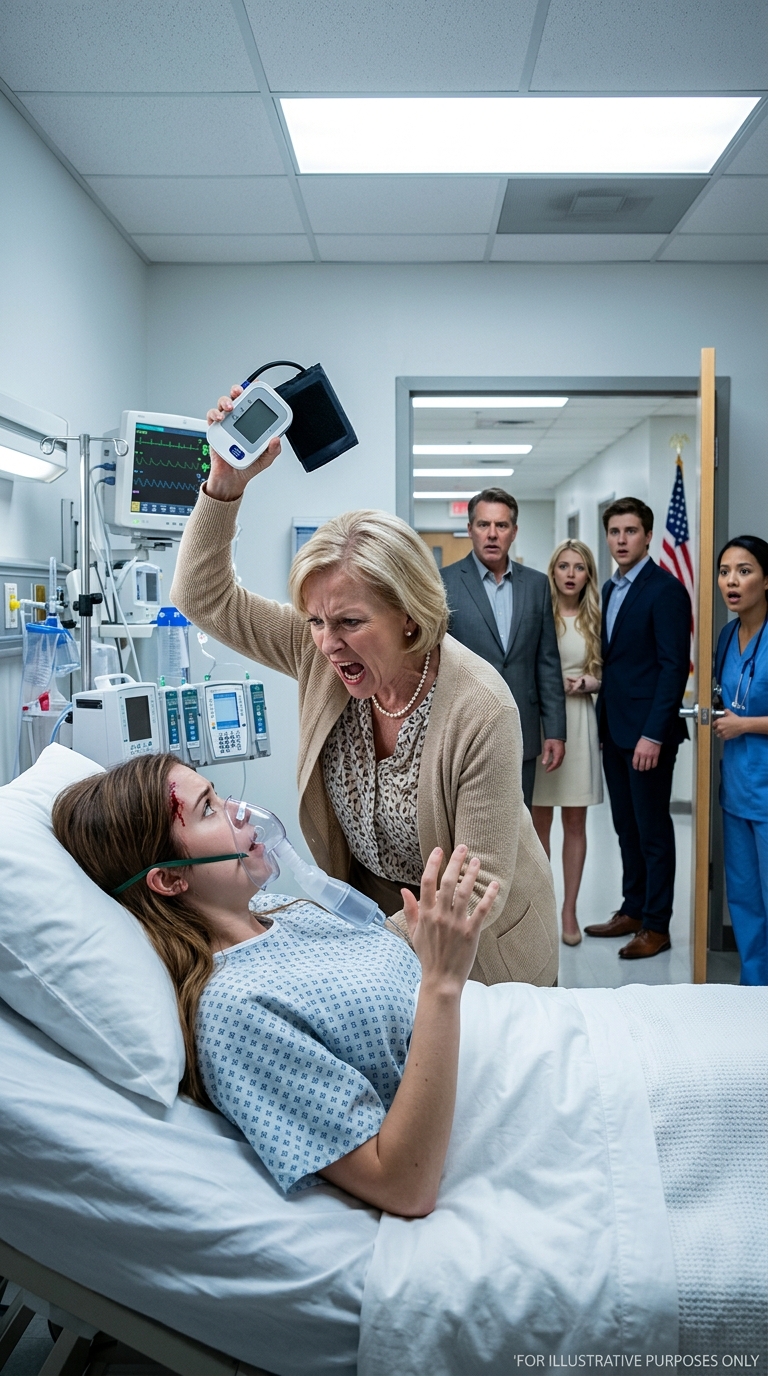
When I brought home straight A’s, my mother said, “Good. Keep it up.”
When Connor brought home a C-minus, she taped it to the refrigerator and said, “At least he’s trying.”
When I got a scholarship to Northwestern, my father said, “That’ll save us money.”
When Connor dropped out of community college after one semester because his professor “didn’t understand his vision,” my parents told him that school was probably too restrictive for creative minds.
That was the pattern of my life.
I achieved.
Connor was celebrated.
I carried.
Connor was excused.
After college, I worked my way into a brutal finance job in downtown Chicago. The kind of job where the windows looked out over the river, the men wore watches worth more than my car, and nobody cared if you had a fever as long as the numbers were correct before the market opened.
My day began at 4:45 in the morning.
Coffee. Train. Emails. Models. Meetings. Reports. More coffee. More reports. Phone calls. Client decks. Market updates. Late nights under fluorescent light while the city glowed cold and blue beneath us.
At first, I told myself the exhaustion was temporary.
Then the family calls started.
The mortgage payment was late.
The electric bill was higher than expected.
Dad needed help with business taxes.
Mom’s prescription wasn’t covered.
Connor needed a new laptop for his brand concept.
Connor needed gas money.
Connor needed rent money after moving into an apartment he could not afford.
Connor needed car insurance.
Connor needed a business coach.
Connor needed a website designer.
Connor needed a second chance.
Connor always needed a second chance.
And somehow, every emergency became my responsibility.
My mother had a gift for making guilt sound like duty.
“Maya, your father is under a lot of stress.”
“Maya, Connor is sensitive. You know pressure shuts him down.”
“Maya, family helps family.”
“Maya, money comes back. Family doesn’t.”
Except money did not come back.
It left my account like blood draining from a wound.
At twenty-seven, I began paying the mortgage on my parents’ house.
At twenty-eight, I took over utilities.
At twenty-nine, I added groceries and medical bills.
At thirty, I was paying Connor’s credit card minimums because my mother said his credit score was part of his “future foundation.”
By thirty-one, I had become the silent engine beneath their lives.
They slept comfortably because I did not.
They ate well because I skipped lunch.
They drove insured cars because I walked ten blocks in snow to avoid parking fees.
They hosted holiday dinners in the house I kept from foreclosure, then praised Connor for bringing store-bought pie.
I was not stupid.
I knew something was wrong.
But knowing you are being used does not always free you. Sometimes it only teaches you to endure better.
I told myself that if I did enough, they would finally see me.
If I paid enough, sacrificed enough, smiled enough, fixed enough, one day my mother would look at me with the softness she reserved for Connor.
One day my father would say, “Maya, I don’t know what we would do without you,” and mean it as love instead of logistics.
But the body keeps score even when the heart lies.
The first warning sign was fatigue so deep it felt spiritual.
Not tired.
Hollow.
I would sit in meetings and forget what sentence I had just said. My lower back ached constantly. My ankles swelled by evening. My appetite disappeared. Headaches came and went like storms. Some mornings, my face looked puffy in the mirror, but I blamed salt, stress, age, bad sleep, anything except the truth.
I did not have time to be sick.
Sickness was expensive.
Sickness was inconvenient.
Sickness would make my family angry.
So I kept going.
What saved me, strangely, was the one secret I had never shared.
The money.
The two hundred and fifty thousand dollars.
It started as small transfers into a private savings account. Fifty dollars. Two hundred. A bonus here. A tax refund there. Then larger deposits when I received promotions and performance incentives. I set the statements to electronic only. I used a private email address. I enabled two-factor authentication. I told no one.
That money became my imaginary door.
On my worst nights, when I was alone at my desk eating crackers for dinner while Connor posted photos from rooftop bars, I opened the banking app and stared at the balance.
$82,400.
$119,700.
$176,000.
$213,000.
Then one night, after a year-end bonus hit, I saw the number.
$250,000.
I sat in my dark apartment and cried.
Not because I was rich.
Because I had proof that another life could exist.
A small condo near Lake Michigan. Morning light through clean windows. No one screaming about bills. No one calling me selfish for wanting rest. No Connor. No emergencies. No family turning my love into invoices.
For the first time, I had something that belonged only to me.
That was why, when my mother found out, she did not see savings.
She saw betrayal.
PART 3 — THE DAY MY BODY STOPPED OBEYING
The morning my body collapsed, Chicago was wrapped in freezing rain.
I remember that clearly because I had forgotten my umbrella.
By the time I reached the glass tower where my firm occupied the thirty-ninth floor, my coat was soaked, my hair was damp, and my hands were numb around my travel mug. I was supposed to lead a portfolio review at eight, deliver a risk model by noon, and call my mother during lunch to explain why I could not pay Connor’s overdue American Express bill until Friday.
That was the life I had built.
Or allowed.
I was at my desk by 6:12 a.m. The office lights were only half on. The cleaning crew was still moving quietly between cubicles. Outside, the Chicago River looked black beneath the early winter sky.
I opened three monitors, checked overnight market movement, and tried to ignore the pounding behind my eyes.
By 7:30, my fingertips were tingling.
By 8:15, my vision blurred during the presentation.
By 9:02, I forgot the name of a client whose account I had managed for four years.
My boss, Daniel Price, noticed.
“Maya,” he said after the call ended, “are you all right?”
I smiled automatically.
“I’m fine. Just tired.”
He looked unconvinced. “You look gray.”
“I said I’m fine.”
That was another thing I had learned from my family.
Deny pain before anyone can use it against you.
At 10:41, I stood to get water, and the floor moved.
Not metaphorically.
The carpet shifted beneath me like the deck of a boat. My chest tightened. I reached for the edge of my desk, but my hand missed. My left ear filled with a rushing sound. Someone called my name from very far away.
Then the pain hit.
A violent, blinding headache that felt like a spike driven through my skull.
I remember dropping my coffee.
I remember seeing brown liquid spread across a printed earnings report.
I remember Daniel shouting, “Call 911!”
Then nothing.
When I woke, everything was white.
White ceiling.
White sheets.
White lights.
White noise.
For a moment, I thought I had died and was disappointed by how much heaven looked like a hospital billing department.
Then I tried to move, and pain pulled me back into my body.
A nurse leaned over me.
“Ms. Whitaker? Maya? You’re at Lakefront Medical Center. You collapsed at work. Try not to move too quickly.”
My mouth felt packed with cotton.
“What happened?”
Her expression changed just enough to scare me.
“The doctor will explain.”
Doctors never explain good news with that tone.
An hour later, Dr. Hannah Reed entered my room carrying a tablet and the kind of careful expression professionals use when they are about to break a life in half.
She sat beside my bed.
“Maya,” she said gently, “your kidneys are not functioning properly. The damage is severe.”
I stared at her.
“What does that mean?”
“It means your body has been retaining toxins. Your blood pressure is dangerously high. Your lab work indicates advanced renal failure.”
The words did not make sense at first.
Renal failure.
Advanced.
Toxins.
Kidneys.
I was thirty-two.
I worked too much. I drank too much coffee. I slept badly. People my age got burnout, anxiety, ulcers, migraines. They did not get organ failure.
“There has to be a mistake,” I said.
Dr. Reed did not look away.
“I wish there were.”
The room seemed to narrow around her face.
“We need to begin dialysis immediately,” she continued. “And we need to evaluate you for a transplant. This is serious, Maya. But you are not without options.”
I started crying before I realized it.
Not delicate tears.
Ugly, frightened, childlike sobs that shook my chest and made the heart monitor jump.
The nurse touched my shoulder.
“Is there someone we can call?”
My first instinct was my mother.
Even after everything.
Even after years of being used.
When death walks close to your bed, you reach for the person who gave you life.
The nurse handed me my phone from the bedside table. My hands shook so badly she had to help me unlock it.
I called Evelyn.
She answered on the fourth ring.
“Maya, this better be important. I’m at Costco.”
“Mom,” I whispered. “I’m in the hospital.”
Silence.
Then, sharply, “What happened?”
I told her. Not well. Not calmly. I cried through the words. Kidney failure. Dialysis. Transplant. Collapsed at work. Scared. Alone.
For three seconds, my mother said nothing.
In those three seconds, I imagined her dropping her cart and running to the car.
Instead, she inhaled like I had insulted her.
“Are you serious right now?”
I froze.
“What?”
“Do you understand what this does to us?”
The nurse, still beside me, looked up.
“Mom, I’m sick.”
“No, Maya. You are irresponsible. You worked yourself into the ground and now everyone else has to suffer. Who is going to pay the mortgage if you lose your job? Who is going to cover your father’s medication? Who is going to help Connor?”
I could not speak.
My mother’s voice rose.
“Have you thought about your brother at all? He is finally close to getting his brand off the ground. He cannot handle this kind of stress.”
Something in me went very still.
“I might die,” I said.
She made a disgusted sound.
“Don’t be dramatic.”
Then the call ended.
I stared at the screen.
A minute later, I called again.
Straight to voicemail.
I called my father.
Straight to voicemail.
I called Connor.
Blocked.
At first, I thought the network was failing.
Then I understood.
They had blocked me.
I lay in that hospital bed with tubes in my arm and poison in my blood, and I realized my family had not abandoned me because they did not understand the diagnosis.
They understood it perfectly.
Their paycheck was broken.
And broken things were thrown away.
PART 4 — WHEN LOVE DIES QUIETLY
The first week in the hospital was a blur of needles, alarms, bad sleep, and fear.
Dialysis left me drained in a way I did not know a body could be drained. It was as if someone had opened a valve inside my bones and let my strength spill out. Nurses came and went. Doctors explained numbers. Insurance coordinators discussed approvals. A social worker asked careful questions about my support system.
I lied at first.
“I have family nearby.”
Then she asked if they had visited.
I looked at the window.
“No.”
By the third day, my boss Daniel came by with flowers, a laptop, and an expression that made me cry before he even spoke.
“We’ve got you,” he said.
I tried to apologize for missing work.
He shook his head.
“Don’t you dare.”
He told me the firm had excellent medical leave, that my position was protected, that my health insurance would cover the bulk of my treatment. Later, the benefits specialist called and confirmed what felt like impossible mercy: my corporate plan covered dialysis, transplant evaluation, hospitalization, and the surgery process with almost no out-of-pocket cost.
That news should have comforted me.
Instead, it made me feel foolish.
For years, my family had convinced me that without them I was alone, that without their approval I had nothing, that if I ever stopped giving, I would collapse.
Yet when I actually collapsed, the people who helped me were my coworkers, nurses, doctors, and a benefits coordinator named Alyssa who spent forty minutes explaining deductibles while I cried.
Not my mother.
Not my father.
Not Connor.
They did not call.
They did not text.
They did not ask whether I needed clean clothes.
They did not ask if I was afraid.
They did not ask if I was alive.
The silence became its own diagnosis.
At night, when the hallway quieted and the city lights blinked beyond the glass, I replayed my life with brutal clarity.
My mother praising Connor for doing nothing.
My father telling me to be patient.
Connor laughing when I reminded him he owed me money.
Holiday dinners where relatives said, “Maya is so successful,” while eating food purchased with my credit card.
I realized I had mistaken dependence for love.
They did not need me in the way family needs family.
They used me in the way people use electricity.
Constantly.
Thoughtlessly.
Angrily, when it flickers.
On the ninth night, I opened my banking app.
The balance was still there.
$250,000.
Untouched.
I stared at it for a long time.
That number no longer looked like a condo.
It looked like a boundary.
The next morning, I asked the nurse for a notebook.
“What are you writing?” she asked.
“A list,” I said.
A list of every automatic payment tied to my account.
Mortgage.
Utilities.
Internet.
Insurance.
Connor’s phone.
Connor’s credit card.
My parents’ streaming subscriptions.
My father’s business software.
The wholesale membership.
The landscaping company.
The alarm system.
The family plan.
It took two pages.
Two pages of proof that I had not been a daughter.
I had been infrastructure.
But I did not cancel anything that day.
Not yet.
Part of me still waited.
That was the embarrassing truth.
I waited for my mother to break.
I waited for one message.
Baby, I’m sorry.
We were scared.
We love you.
We’re coming.
Every morning, I checked my phone.
Every night, I hated myself for checking.
Then, three weeks into my stay, they arrived.
My nurse, Claire, was adjusting my medication when there was a knock at the door. Before I could answer, it opened.
My mother entered first.
For one stupid heartbeat, hope rose in me.
I actually thought she had come to apologize.
Then I saw the folder in her hand.
Claire looked at me. “Would you like privacy?”
I should have said no.
My mother smiled sweetly at the nurse.
“We’re her family.”
That word still had power over me.
I nodded.
Claire left, though she hesitated by the door.
My father came in next, then Connor.
Connor looked around the private room and smirked.
“Nice setup.”
I said nothing.
My mother walked to the bed and placed the folder on my lap.
“Sign these.”
Her voice was flat. Businesslike.
I opened the folder and saw bank transfer documents, authorization forms, routing information, signatures already marked with yellow tabs.
The recipient account belonged to Connor Whitaker LLC.
I looked up.
“You found my savings.”
Connor smiled without shame.
“Dad found an old statement in a box at the house. You really should be more careful.”
I had forgotten about that statement. One paper statement from years ago, before I switched everything electronic. One mistake.
My mother tapped the documents.
“Your brother needs the money now.”
My skin went cold.
“You disappeared for three weeks.”
My father frowned. “We needed time to process.”
“You blocked me.”
Connor shrugged. “Mom was upset.”
I looked at them, three healthy people standing beside my bed, demanding money from the sick one.
Something inside me that had been dying quietly finally stopped breathing.
“No,” I said.
My mother’s lips tightened.
“Maya, this is not the time to be difficult.”
“No,” I repeated.
Connor stepped forward. “You’re being selfish.”
And that word, spoken in that room, beside those machines, after everything, became the match.
I sat up as much as my body allowed.
“Get out.”
My mother’s face hardened into something I had never seen before.
Not disappointment.
Not anger.
Hatred.
The kind reserved for property that refuses to be owned.
PART 5 — THE SOUND OF STEEL DOORS OPENING
When my mother called me selfish, I laughed.
It was not loud.
It was not brave.
It was the thin, cracked laugh of a woman who had finally reached the end of shame.
That laugh is what pushed her over the edge.
Evelyn Whitaker had spent her life controlling rooms. She controlled church committees with smiles. She controlled my father with guilt. She controlled Connor with worship. She controlled me with obligation.
But lying in that hospital bed, with my face pale and my hands bruised from IVs, I had committed the unforgivable sin.
I had made her feel powerless.
“I gave you everything,” she said.
“No,” I whispered. “You took everything.”
Her eyes flashed.
My father stepped closer. “Maya, stop provoking your mother.”
I looked at him.
“She hit me before she ever touched me today. You both did.”
Connor groaned. “Oh my God, here comes the victim speech.”
I turned to him.
“You want my money for a clothing brand. You can’t even wash your own clothes.”
His face twisted.
“Better than being a bitter, dying workaholic.”
The room went dead.
Even my mother looked at him for half a second, as if he had said too much.
Then she recovered.
“You see?” she said to me. “You poison everyone around you.”
That was when I reached under the pillow.
Not obviously.
Not dramatically.
Just enough to feel the small plastic emergency button the nurse had tucked there earlier because I was too weak to reach the call rail comfortably.
My fingers closed around it.
My mother leaned down until her perfume crowded out the sterile smell of the room.
“You are going to sign,” she said. “You owe this family.”
“No.”
She slapped the folder off the bed.
Papers scattered across the floor like frightened birds.
“No?” she repeated.
“No.”
My father glanced at the hallway window.
Connor backed toward the chair.
Then my mother grabbed the monitor.
The blood pressure unit was mounted beside my bed, attached to the wall with a metal bracket. She pulled once and it resisted. She pulled again with both hands, making a rough, tearing sound. The cuff dropped. A wire snapped. The wall plate cracked.
“Mom,” Connor said, his voice smaller now.
She did not hear him.
Or she did and did not care.
The machine came free.
My heart monitor began to beep faster.
I pressed the panic button.
Once.
Then again.
Hard.
My mother lifted the blood pressure monitor with both hands.
For one surreal instant, I noticed her manicure. Pale pink polish. Perfectly shaped nails. The same hands that once buttoned my coat for kindergarten. The same hands that signed birthday cards “Love, Mom.”
Then she swung.
The impact was not like in movies.
There was no clean darkness.
There was sound first. A sickening crack close to my ear. Then pressure. Then heat. Then pain so bright it erased language.
I screamed.
The monitor bounced off my skull and slammed against my shoulder. My vision sparked. Something warm slid down my temple. The room blurred at the edges.
My mother was crying now, but not with regret.
With rage.
“Look what you made me do!”
My father moved to the door and blocked the window.
“Keep your voice down,” he snapped.
I stared at him through swimming vision.
“Dad,” I choked.
He looked at me like I was a stain.
“You should have signed.”
That hurt worse than the blow.
My mother lifted the monitor again.
This time, I saw death plainly.
Not as a medical possibility.
Not as a doctor’s careful warning.
As my own mother standing over me, willing to crack my skull open for Connor’s business fantasy.
Then the hallway erupted.
Heavy footsteps.
A shout.
The door burst inward so hard it struck the wall.
Three hospital security officers flooded in, followed by Nurse Claire and another nurse carrying emergency supplies.
“Drop it!” one guard shouted.
My mother froze, the monitor still raised.
For the first time in my life, Evelyn Whitaker looked afraid.
A guard seized her wrists. Another grabbed my father and pulled him away from the door. Connor put his hands up and started babbling.
“I didn’t do anything. I didn’t touch her. I told her to stop.”
“No, you didn’t,” I whispered.
Claire rushed to my side.
“Oh my God, Maya. Stay with me.”
She pressed gauze to my head, her face tight with controlled fury.
My mother struggled against the guard.
“She’s confused!” she shouted. “She’s on medication! This is a family matter!”
Claire looked at her with a coldness I had never seen in a nurse.
“You assaulted a patient in a critical care unit.”
“My daughter is unstable!”
The guard forced the monitor from her hands.
My father tried to speak calmly.
“Officer—security—listen, this has been blown out of proportion.”
“You blocked the door,” I said.
My voice was weak, but everyone heard it.
My father went pale.
Claire looked up.
“What?”
I pointed slowly toward the ceiling corner.
The small black dome camera watched silently.
“Camera,” I whispered. “It recorded everything.”
For once, no one in my family had an answer.
The police arrived eight minutes later.
Two Chicago officers entered the room and took statements while a doctor examined my head. The cut needed stitches. The scan showed no skull fracture, though the concussion would follow me for weeks.
My mother tried every performance she knew.
Concerned mother.
Confused mother.
Overwhelmed mother.
Devoted mother pushed beyond endurance by a difficult daughter.
But cameras do not respond to tears.
The hospital administrator reviewed the footage with police.
It showed the folder.
The shouting.
The monitor torn from the wall.
The strike.
My father blocking the door.
Connor watching.
When the officers returned, their faces had changed.
My mother knew before they spoke.
“Evelyn Whitaker,” one officer said, “turn around.”
She stared at him.
“No.”
“Turn around.”
“You cannot arrest me. That is my daughter.”
The officer’s voice was flat.
“That makes it worse.”
They handcuffed her in the hallway.
My father was handcuffed next.
Connor started crying then, real tears, but still only for himself.
As they led my parents past my open door, my mother twisted her head toward me.
“You ruined this family!”
I looked at her through the bandage above my eye.
“No,” I said.
“You did.”
PART 6 — THREE CLICKS
After the police left, the room became strangely quiet.
Not peaceful.
Peace was still far away.
But quiet.
The kind of quiet that follows an explosion, when dust hangs in the air and everyone waits to see what is still standing.
I was still standing.
Barely.
Claire changed the gauze on my forehead. Dr. Reed ordered another scan. A social worker came in and asked if I wanted a restraining order. The hospital moved me to another room on a restricted floor. Security placed my parents and brother on the no-visitor list.
Every person who entered spoke gently, as if I might shatter.
They did not understand.
I had shattered years earlier.
What happened in that room did not break me.
It revealed the pieces.
That night, after the stitches and police statements and concussion checks, I asked for my laptop.
Claire frowned. “You should rest.”
“I will.”
“Maya.”
“Please.”
She studied my face and must have seen something there, because she brought the laptop from my bag and set it on the rolling tray table.
My hands shook when I opened it.
Not from fear.
From adrenaline.
I logged into my bank.
The familiar dashboard loaded.
Checking.
Savings.
Scheduled payments.
External transfers.
Family mortgage.
Utilities.
Credit accounts.
Phone plan.
Insurance drafts.
For five years, I had kept them alive with invisible money.
No speeches. No gratitude. No receipts printed and framed on the wall. Just automatic transfers, every month, like my obedience had been programmed.
I clicked the mortgage payment first.
Cancel recurring transfer?
Yes.
A warning appeared.
Are you sure?
For years, that question had owned me.
Are you sure you want your mother angry?
Are you sure you want your father disappointed?
Are you sure Connor can handle consequences?
Are you sure you are not selfish?
I clicked yes.
Next came the utilities.
Gas.
Electric.
Water.
Internet.
Canceled.
Then the credit cards.
Connor’s authorized user access.
Revoked.
Shared emergency card.
Frozen.
Family phone plan.
Removed.
Auto insurance contribution.
Stopped.
Landscaping.
Stopped.
Security system.
Stopped.
Subscription services.
Stopped.
My father’s business software.
Stopped.
Each cancellation felt like cutting a rope tied around my lungs.
I expected guilt to arrive.
It did not.
Only exhaustion.
And underneath it, something unfamiliar.
Relief.
Then I emailed my attorney.
Her name was Grace Mallory, a sharp-eyed woman in Washington, D.C., whom I had hired two years earlier after a coworker insisted I needed estate documents and financial protections because “families get weird around money.”
I had laughed then.
I was not laughing anymore.
Grace replied within fifteen minutes.
Maya, I am so sorry. Do not communicate with them directly. I will handle all legal and financial notices. We will secure your assets immediately.
By morning, she had frozen any potential access points, updated beneficiary documents, drafted restraining order paperwork, and notified the mortgage lender that I would no longer make payments on a property not in my name.
That was important.
My parents owned the Oak Brook house.
I had paid for it.
A mistake I would never make again.
When the lender called my father about the missed payment the following month, he was out on bail and furious.
I knew because he called me from a new number twenty-seven times.
I did not answer.
My mother left voicemails until Grace had them routed directly to evidence.
“You vindictive little brat.”
“Your brother is sleeping on friends’ couches.”
“Your father’s business account is overdrawn.”
“The mortgage company says we owe two months.”
“Call me.”
“Call me.”
“Call me.”
Then Connor tried.
“Maya, come on. This went too far.”
“I know Mom lost it, but you didn’t have to get everybody arrested.”
“I need my phone back on.”
“My investor thinks I’m unstable because I can’t show funding.”
“You’re destroying my life.”
I saved every message.
Not because I needed proof.
Because I needed memory.
Healing is dangerous when you have been trained to forgive too quickly. Pain fades. Fear softens. Loneliness makes old abuse look smaller from a distance.
So I kept records.
Not to punish them again.
To keep myself free.
My transplant came four months later.
A donor kidney became available after weeks of testing and waiting and trying not to hope too loudly. The surgery lasted hours. I woke up with pain across my abdomen, a dry throat, and Dr. Reed smiling in a way I had never seen before.
“It went well,” she said.
I cried harder than I had cried at the diagnosis.
Daniel visited. Claire came on her lunch break though she had been transferred to another floor. Grace sent flowers with a card that read: To your second life.
My family sent nothing.
By then, the Oak Brook house was in foreclosure.
My father’s brokerage had lost clients after news of the arrest spread through their church and neighborhood. My mother’s charity friends stopped calling. Connor’s investor vanished the moment he realized the promised funding did not exist.
For once, consequences did not land on me.
They landed where they belonged.
Still, I will not pretend it was easy.
Freedom is not the same as happiness at first.
Some nights, I woke reaching for my phone, expecting an emergency. Some mornings, I felt panic because no one had asked me for money. My nervous system did not understand peace. It treated silence like a trap.
Therapy helped.
So did anger.
Not explosive anger.
Clean anger.
Anger that said: what happened to you was real.
Anger that said: you did not deserve it.
Anger that said: never again.
Six months after my mother smashed the blood pressure monitor into my head, I walked into a Cook County courtroom wearing a navy suit, low heels, and a small scar near my hairline that makeup could not fully hide.
My mother looked smaller than I remembered.
My father looked older.
Connor sat behind them with his arms crossed, unemployed, furious, and finally unable to bill anyone for his feelings.
The judge called the case.
And the video began to play.
PART 7 — THE COURTROOM SAW EVERYTHING
There are few sounds as powerful as a silent courtroom watching the truth.
The video had no dramatic music.
No narration.
No mercy.
Just the fixed, high-definition angle from my hospital room ceiling.
There I was, pale and small in the bed, with tubes in my arm and a blanket pulled to my waist.
There was my mother entering with the folder.
My father behind her.
Connor by the chair.
The assistant state’s attorney paused the footage at the moment my mother placed the documents on my blanket.
“Ms. Whitaker,” she asked me, “had your family visited you before this day?”
“No.”
“Had they called to ask about your condition?”
“No.”
“Had they been informed that you were undergoing dialysis for kidney failure?”
“Yes.”
She let that sit.
Then she played the rest.
My mother’s face tightened as her own recorded voice filled the room.
Sign, Maya. Now.
The folder.
The demand.
Connor saying I did not need money if I was stuck in a hospital bed.
My refusal.
My mother tearing the monitor from the wall.
Somewhere behind me, a woman in the gallery gasped.
Then came the strike.
Even though I knew it was coming, my body reacted. My hands clenched. My stomach turned. The old pain flashed behind my eyes.
Onscreen, my father moved to block the door.
The prosecutor paused the video there.
“That is the defendant Richard Whitaker, correct?”
“Yes.”
“What is he doing?”
“Blocking the hallway window.”
“Did he call for help?”
“No.”
“Did he attempt to stop your mother?”
“No.”
The video continued.
The second attempted strike.
The security team entering.
My mother claiming I was unstable.
My father saying it was a family matter.
The panic button had saved my life.
The camera saved my truth.
My mother’s attorney tried to argue emotional distress. He painted her as a terrified parent overwhelmed by her daughter’s illness. He said families argue about money under stress. He said my mother had no prior criminal history. He said one tragic moment should not define a woman’s life.
When it was time for my statement, I stood slowly.
My body was stronger by then, but not the same. A transplant changes the way you understand time. Every morning becomes borrowed and sacred. Every heartbeat feels like paperwork signed by grace.
I faced the judge, not my parents.
“For most of my adult life,” I said, “I believed loving my family meant saving them from every consequence. I paid their mortgage. I paid their bills. I supported my brother. I ignored my health because I thought being needed meant being loved.”
My voice shook, but I kept going.
“When I was diagnosed with kidney failure, I called my mother because I was scared. She did not comfort me. She asked who would pay the mortgage. Three weeks later, my parents came to my hospital room and demanded my life savings for my brother. When I said no, my mother hit me with medical equipment while my father blocked the door.”
My mother stared at the table.
My father looked at the floor.
Connor looked bored until the judge glanced at him.
“I am alive because I pressed a button,” I continued. “But I should not have needed a panic button to survive my own mother.”
The courtroom was completely still.
“I am not asking the court to punish them because I hate them. I am asking the court to recognize that what happened was not a private family disagreement. It was violence. It was greed. It was abuse. And I am done carrying the cost of it.”
I sat down.
The judge took off his glasses.
He looked at my mother first.
“Mrs. Whitaker, this court has watched many disturbing recordings. Few have been as morally clear as this one. Your daughter was hospitalized, medically vulnerable, and dependent on care. You entered that room not to support her, but to financially exploit her. When she refused, you used a piece of medical equipment as a weapon.”
My mother began to cry.
For years, her tears had controlled me.
That day, they sounded like weather outside a locked door.
The judge turned to my father.
“And you, Mr. Whitaker, did not freeze. You did not panic. You did not fail to understand what was happening. You moved deliberately to obstruct visibility into the room. That action speaks loudly.”
My father swallowed.
The sentencing was not theatrical.
Real justice rarely is.
It is paperwork, statutes, evidence, and a judge speaking in a steady voice.
My mother received four years in state prison for felony assault against a vulnerable patient, with mandatory anger management and a no-contact order.
My father received one year in county jail for aiding and obstructing intervention, plus fines that drained what little money remained in their accounts.
Connor was not charged, but the judge looked directly at him before ending the hearing.
“Young man, the fact that you avoided criminal liability today does not mean you avoided moral responsibility.”
Connor turned red.
Outside the courthouse, reporters waited because the story had spread locally: Oak Brook mother attacks hospitalized daughter over $250,000.
My attorney guided me through a side exit.
But I saw them through the glass doors.
My mother in handcuffs.
My father behind her.
Connor shouting into his phone, probably trying to find someone else to rescue him.
A correctional van pulled away from the curb.
For a moment, I expected grief to swallow me.
Instead, I felt the strangest thing.
Space.
As if a room had opened inside my chest.
Grace stood beside me.
“Are you all right?” she asked.
I looked at the winter sky over Chicago.
“No,” I said honestly.
Then I took a breath.
“But I will be.”
PART 8 — THE HOUSE THAT FELL WITHOUT ME
The Oak Brook house did not survive three missed payments.
That sounds cruel when said plainly, but the truth is the house had been dying for years. I had simply been the machine keeping it breathing.
Once I stopped paying, reality moved quickly.
First came late notices.
Then lender calls.
Then certified letters.
Then the foreclosure filing.
My father, from jail, tried to authorize Connor to negotiate with the bank. Connor missed the first appointment because, according to him, he “had a migraine from stress.” My mother tried to call church friends for money, but sympathy has limits when everyone has seen the arrest footage on the evening news.
The same people who once praised Evelyn Whitaker’s perfect family now whispered behind grocery carts.
The charity board removed her name from the spring luncheon.
The church replaced her as volunteer coordinator.
My father’s clients quietly moved their policies elsewhere.
Connor sold his designer sneakers first.
Then his gaming computer.
Then the leased car disappeared from the driveway after a repo truck came at dawn.
I know these details because Connor sent them to me in long, furious emails from public Wi-Fi.
He blamed me for everything.
Mom is in prison because of you.
Dad is ruined because of you.
The house is gone because of you.
I have nothing because of you.
I read the first few.
Then I stopped.
Grace’s office archived them.
The final eviction happened on a gray morning in March.
I did not attend.
I did not need to watch a marshal post papers on the door of the house where I had learned to disappear.
But later, an old neighbor named Mrs. Donnelly called me. She had always been kind in a distant way, the kind of woman who noticed things but did not interfere unless asked.
“I just wanted you to know,” she said softly, “they’re out.”
I closed my eyes.
“Thank you.”
“She screamed a lot.”
I knew who she meant.
“Connor?”
“Yes. He kept saying none of this was fair.”
A humorless smile touched my mouth.
Fair.
The favorite word of people meeting consequences for the first time.
Connor eventually took a job washing dishes at a diner in Berwyn. A cousin told me that, though I had not asked. He rented a room from a man who worked nights and kept strict rules about noise. He no longer had a luxury brand. He had an apron, cracked hands, and a manager who did not care about his genius.
My mother served her sentence in a women’s correctional facility downstate.
She wrote me one letter.
Not an apology.
A performance.
Maya, I hope someday you understand what stress can do to a mother. I made a mistake, but you destroyed us beyond repair. No daughter should send her own mother to prison.
I folded the letter carefully and placed it in a file labeled Evidence of Why I Left.
My father wrote nothing.
Maybe shame stopped him.
Maybe pride.
Maybe he had simply never known what to say to me when he was not asking for something.
As for me, I recovered slowly.
The transplant was not magic. It required medication, appointments, discipline, and patience. My body had survived betrayal, surgery, and years of neglect. It did not trust peace immediately.
But spring came.
Chicago softened.
The lake turned silver-blue in the mornings.
I returned to work part-time at first, then fully, though never again at the cost of my life. Daniel helped restructure my role. I learned to leave the office before dark. I learned to eat lunch away from my desk. I learned that rest was not laziness. It was maintenance for a life I wanted to keep.
Then I bought the condo.
Not in Oak Brook.
Not near my parents.
A bright two-bedroom near Lake Michigan with tall windows, white walls, warm wood floors, and a balcony where I could watch sunrise spill over the water. The first night there, I had no furniture except a mattress, a lamp, and one mug.
It was the most beautiful place I had ever seen.
I stood barefoot in the empty living room holding tea I barely drank, listening to nothing.
No phone ringing.
No mother shouting.
No father sighing.
No Connor demanding.
Just the hum of the refrigerator and the distant sound of traffic along Lake Shore Drive.
I cried then.
Not from grief.
From release.
A year after the attack, I flew to San Diego for a transplant survivors’ conference. I stood on a beach in California with my feet in the cold Pacific, watching waves collapse and rise again.
A woman beside me, another survivor, asked, “What brought you here?”
I thought about the hospital room.
The monitor.
The button.
The camera.
The courtroom.
The house.
The money.
“My body saved me first,” I said. “Then I saved myself.”
She nodded as if that made perfect sense.
Maybe it did.
For a long time, I believed blood was thicker than water.
Now I know blood can carry poison.
Family is not the person who shares your last name while draining your life. Family is the nurse who presses gauze to your head and says, “Stay with me.” It is the boss who protects your job. The attorney who answers at midnight. The doctor who fights for your future. The friend who sits quietly beside you during dialysis because silence is less frightening with someone kind inside it.
And sometimes, family is the woman you become when you finally stop abandoning yourself.
I still have the scar.
It is small now, half-hidden near my hairline. Most people do not notice it.
But I do.
Every morning, when I brush my hair, I see the faint mark and remember the exact second my mother raised that monitor.
Then I remember the button beneath my pillow.
The button I pressed with shaking fingers.
The button that called strangers into the room when my own family became dangerous.
The button that did not just summon security.
It summoned the life I had been too afraid to claim.
My name is Maya Whitaker.
I am not an ATM.
I am not a sacrifice.
I am not selfish for surviving.
My mother smashed a blood pressure monitor into my head over $250,000.
Then I pressed one button.
And everything they built on my suffering finally collapsed.