PART 2
The first thing I learned about being invisible was that people did not simply ignore you.
They used you.
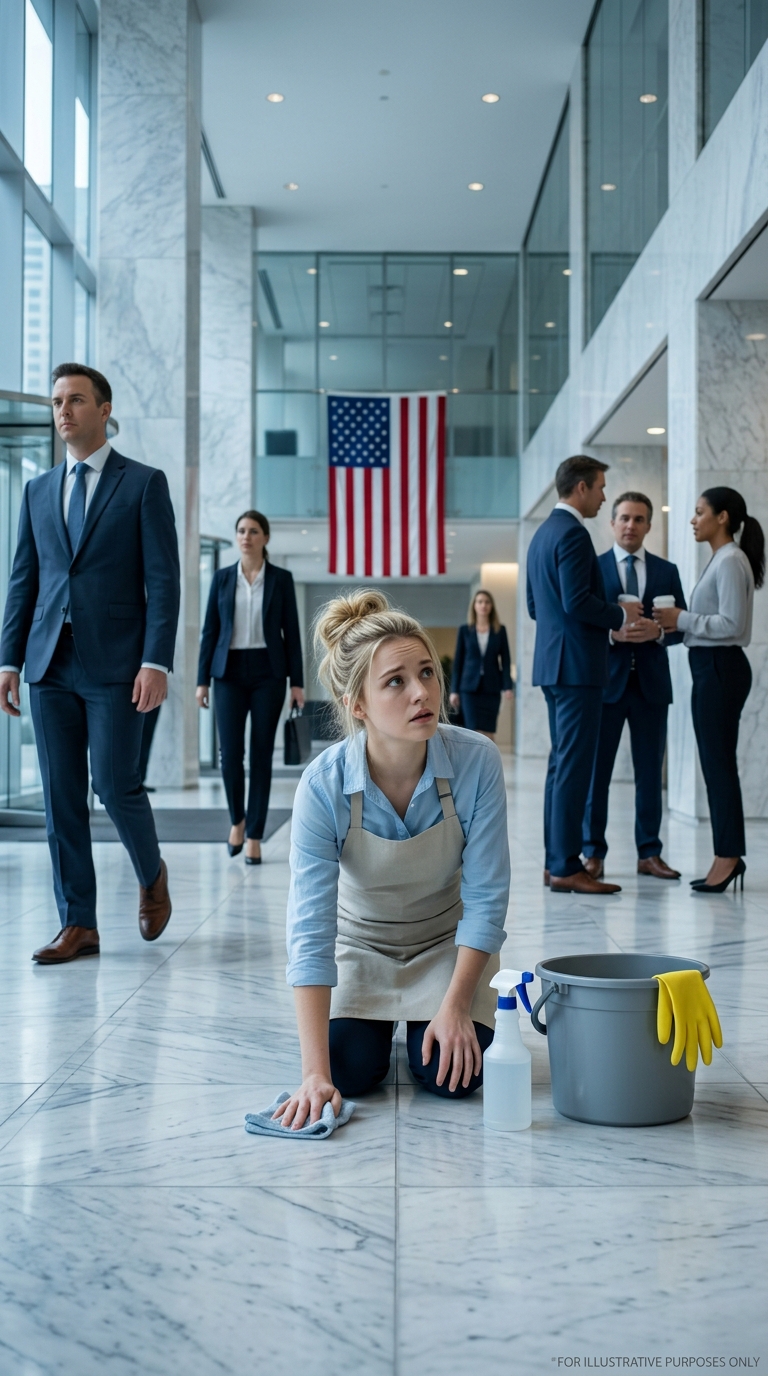
A man in a navy suit stepped directly into the wet section of floor I had just mopped, leaving muddy prints across the shine, then looked down at me as if I had caused him inconvenience by existing.
A woman tossed a coffee cup toward a trash can, missed by several feet, and kept walking.
Two young managers laughed when I bent to pick up paper clips under a conference table.
By ten in the morning, my back ached. By eleven, my hands smelled of bleach no matter how many times I rinsed them. By noon, I understood that no one in the building looked at janitors unless they wanted something cleaned.
My supervisor, Margaret Doyle, was a woman in her late fifties with silver hair pulled into a tight bun and tired green eyes that missed nothing.
“Keep your head down,” she told me while showing me where the supply closet was. “Do the work. Don’t argue. Don’t try to make friends with the office people. They don’t like it when we talk like we’re equal.”
I stared at her.
“Are we not?”
Margaret gave me a sad little smile.
“Not to them.”
She handed me a mop.
“Second floor first. Executive offices have to shine before lunch.”
Margaret worked with a rhythm that humbled me. She moved quietly, efficiently, without complaint. She knew which door hinges squeaked, which bathroom sink leaked, which manager screamed about dust but left food rotting in his own trash can. She knew the building like a priest knows a confessional.
At one o’clock, she took me to the employee cafeteria.
It was not the polished dining room my father had once shown me on the executive level, with leather chairs and filtered coffee. This cafeteria was in the back of the building near the loading bay. Fluorescent lights buzzed overhead. The tables were scratched. The food was cheap, hot, and served in small portions.
I carried my tray to a corner.
Before I sat, I heard my name.
“New girl’s cute.”
I froze.
Two women at the next table were talking as if I were not there. One had bright red lipstick and a badge that read Regina Cole, Office Manager. The other, Sylvia Banks, wore a tight smile and tapped long nails against her soda can.
“Too cute,” Sylvia said. “Brock will notice.”
Regina laughed.
“He always notices the new cleaners.”
My stomach tightened.
“Poor thing,” Sylvia said, not sounding sorry at all. “Does she know yet?”
“Not yet.” Regina stirred her iced tea. “But she will. Everybody learns how Brock runs the warehouse.”
They both laughed.
I stared down at my tray, suddenly unable to swallow.
Margaret sat beside me a moment later and saw my face.
“What did you hear?”
I hesitated.
“Who is Brock?”
Margaret’s mouth tightened.
“Brock Tanner. Warehouse supervisor.”
“And?”
“And you don’t go near him alone.”
That was all she said, but it was enough.
After lunch, we were assigned to clean the south warehouse after a shipment. Margaret had to handle the restrooms first, so she sent me ahead with a bucket and told me to start near the storage racks.
The warehouse was colder than the main building. High shelves rose like metal cliffs. Forklifts beeped in the distance. The air smelled of cardboard, motor oil, and dust. I told myself not to be dramatic. I told myself I was an adult. I told myself my father had not sent me here to be afraid of shadows.
Then the footsteps came.
Slow.
Heavy.
Deliberate.
I turned.
Brock Tanner stood between me and the door.
He was tall and broad, with a face that might have been handsome if not for the cruel amusement in his eyes. His badge hung crooked from his shirt pocket. He looked me up and down the way men look at cars they intend to test-drive.
“Well,” he said. “You’re the new one.”
I gripped the mop handle.
“Avery.”
“Avery,” he repeated, smiling. “Pretty name.”
“I’m here to clean.”
“I can see that.”
He took a step closer.
I stepped back.
His smile widened.
“You nervous?”
“No.”
“Don’t lie to me, sweetheart. I can smell fear from halfway across this warehouse.”
My back hit a shelf.
He kept coming.
“There are rules here,” he said softly. “Margaret probably gave you the polite version. I’ll give you the real one. People who cooperate have easy shifts. People who act difficult end up written up, blamed for missing inventory, or fired before payday.”
My heart slammed against my ribs.
“I haven’t done anything.”
“Not yet.”
His hand lifted toward my face.
I jerked away.
“Don’t touch me.”
For one second, his expression changed. The smile vanished. Something mean and flat replaced it.
“You think you’re better than me?”
I could have destroyed him with one phone call.
That was the first thought that burned through me.
One call to my father’s attorney. One call to Victor Ramsey, the acting CEO. One sentence: Do you know who I am?
But the will was iron. If I revealed myself, everything ended. My promise ended. My father’s lesson ended.
So I stood there with a mop in my hands, trapped in my own company, and for the first time in my life, my name could not save me.
Then a voice cut through the warehouse.
“Brock. Step away from her.”
Brock turned.
A man stood near the loading entrance, holding a toolbox. He was around thirty, tall, lean, with dark blond hair and calm gray eyes. His work shirt was plain, his jeans faded, but there was something steady about him that made the whole warehouse feel less dangerous.
His badge read Noah Hale, Mechanical Engineer.
Brock sneered.
“This doesn’t concern you, Hale.”
“It does if you’re harassing an employee.”
“I was explaining warehouse procedure.”
“Then explain it from six feet away.”
The silence that followed was sharp enough to cut skin.
Brock looked at Noah, then at me.
“You just made your first friend,” he said. “Bad choice.”
He walked away, but not before leaning close enough to whisper, “I’ll see you again, Avery.”
When he was gone, my knees nearly gave out.
The mop slipped from my hand and clattered against the concrete.
Noah picked it up and handed it to me.
“You okay?”
I nodded, though I was not.
“Does everyone know?” I asked.
His face darkened.
“About Brock? Yes.”
“And no one stops him?”
Noah looked toward the door Brock had used.
“People try. Then paperwork disappears. Complaints get turned around. Suddenly the victim has attendance problems, or inventory goes missing on her shift.”
Anger rose in me so fast I almost choked on it.
This was my father’s company.
This was his empire.
And under the polished reports, the awards, the charity events, the public speeches about family values and American manufacturing, women were being threatened in warehouses while managers laughed over lunch.
“Thank you,” I whispered.
Noah shrugged, but his eyes softened.
“Human decency shouldn’t be impressive.”
“It is when nobody else shows it.”
He looked at me for a second longer than necessary.
“Stay near people when you’re in the warehouse. And if Brock corners you again, make noise.”
I nodded.
That evening, I returned to my rented studio with my body sore, my hands raw, and my mind on fire.
I sat at the tiny kitchen table and opened a cheap spiral notebook.
On the first page, I wrote:
Brock Tanner — harassment, threats, warehouse power abuse.
Regina Cole — laughs about janitors, throws trash, protects bad culture.
Sylvia Banks — knows about Brock, says nothing.
Then I paused.
Below those names, I wrote one more.
Noah Hale — honest.
I stared at the page.
My father had told me I would see people without masks.
He had not warned me how ugly some faces would be.
And he had not warned me that one of the first people to treat me like a human being would be the kind of man I could not afford to trust.
PART 3
The second week hurt worse than the first because the shock had worn off.
Pain became routine.
My shoulders burned every morning. My knees complained when I knelt to scrub corners. My palms developed rough patches where the mop handle rubbed. At night, I soaked my hands in warm water and wondered how Margaret had done this for twenty-one years without becoming bitter enough to poison the coffee.
But Margaret was not bitter.
She was realistic.
“There are two kinds of people in a building like this,” she told me one morning as we cleaned the third-floor hallway. “People who know they’re being watched, and people who think no one important is watching.”
I glanced at her.
“Which are worse?”
“The second kind. They show you the truth.”
The truth came in small insults.
A marketing associate snapped her fingers at me when she spilled latte foam near her desk.
A finance manager told Margaret, “You people missed a spot,” while pointing at dust he had brushed off his own shoe.
Regina Cole dropped a half-full coffee cup into a trash can without a liner, then complained that the office smelled.
When I looked angry, Margaret shook her head.
“Don’t waste your face on them.”
“What does that mean?”
“It means some people want your reaction. Don’t give them the satisfaction.”
So I stayed quiet.
But I wrote everything down.
Every night, in my studio apartment, I filled pages with names, patterns, dates, and details. My notebook became more than a record. It became evidence. It became a map of the sickness inside Whitmore Manufacturing.
And then there was Noah.
I saw him twice a week in the engineering lab, a bright, cluttered room full of wires, metal parts, diagrams, and humming machines. He always worked late. While other engineers went home, Noah stayed bent over prototypes with the focus of a man trying to solve a problem the world had not yet admitted existed.
One afternoon, I was emptying trash when his department head stormed in.
Peter Ashford was the kind of middle manager who looked permanently offended by other people’s competence. He wore expensive glasses and carried a clipboard like a weapon.
“Hale,” he barked. “Tell me you’re not still modifying the controller design.”
Noah looked up.
“I’m improving sensor response time. It could reduce packaging defects by twelve percent.”
Ashford laughed without humor.
“We don’t need your little passion projects. We need you to follow specifications.”
“The specifications are outdated.”
“They are approved,” Ashford snapped. “Your job is not to think bigger than your title.”
The words struck me harder than I expected.
Your job is not to think bigger than your title.
Noah lowered his eyes.
“Yes, sir.”
After Ashford left, I kept wiping the counter even though it was already clean.
Noah noticed.
“You heard that?”
“I’m hard to miss when I’m cleaning five feet away.”
He smiled faintly.
“Most people manage.”
“What are you building?”
His face changed instantly. The exhaustion lifted. He showed me a small circuit board and explained, with careful enthusiasm, how the production lines wasted hours because the machines could not adjust quickly to different package sizes. His controller would help the line adapt automatically.
I understood more than I should have, so I pretended to understand less.
“That sounds important.”
“It could be.” His smile faded. “But Ashford doesn’t like ideas he can’t take credit for.”
“Why stay?”
His eyes moved to the window.
“My mother lives in Evanston. She has a degenerative heart condition. I need stable insurance, and I can’t move away. This place is frustrating, but it’s steady.”
There it was again.
Human decency.
Not dramatic. Not loud. Just a man giving up better opportunities because someone he loved needed him.
Later that night, I searched company archives from an unlocked office while pretending to dust shelves. It was reckless. It was probably illegal. It was absolutely necessary.
I found old project reports with Noah’s name buried in footnotes. Three years earlier, he had proposed an automated warehouse tracking system. Ashford rejected it as “impractical.” Sixteen months later, the company purchased almost the same system from an outside vendor for nearly two million dollars. Ashford had signed the approval and received a bonus for “modernizing logistics.”
I made copies.
The next morning, an anonymous envelope appeared on the desk of Human Resources.
Noah Hale’s original proposal.
Ashford’s rejection memo.
The later vendor contract.
A note in block letters:
CHECK WHO REALLY CREATED THE IDEA.
For the first time since entering the company, I felt my power return—not the power of my name, but the power of seeing what others thought hidden.
A week later, rumors spread.
HR was reviewing old intellectual property records. Ashford was furious. Noah looked confused when people started asking about his archived designs.
“You hear about this?” he asked me when I came into the lab.
“About what?”
“Somebody found my old proposal. HR wants to talk to me.”
“That’s good, right?”
“Maybe.” He studied me. “You look pleased.”
“I like when people get credit.”
He smiled slowly.
“You’re strange, Avery Voss.”
“So I’ve been told.”
“No. Strange in a good way.”
I turned away before he could see my face warm.
By the third month, I had learned the stories behind the uniforms.
Margaret raised two grandchildren because her daughter had vanished into addiction years earlier.
Dylan, a twenty-three-year-old loader, worked double shifts to support his younger brothers after their parents died in a crash near Milwaukee.
Grace Miller had cleaned executive bathrooms for fifteen years and still made almost the same hourly wage as new hires.
Eddie from maintenance skipped lunch twice a week to send extra money to his son stationed in Washington, D.C.
These people were not background. They were not labor cost. They were lives.
My father had known I needed to learn that.
What he could not have known was how quickly those lives would become mine.
I began helping in quiet ways.
A missing overtime sheet appeared on the payroll director’s chair.
A report about cafeteria food shortages reached a board compliance committee.
A typed complaint about Regina Cole’s treatment of janitorial staff was sent with exact dates and witnesses.
No one suspected me.
Why would they?
I was just the cleaner.
One evening, Margaret found me alone in the supply room writing in my notebook.
“You’re documenting,” she said.
I snapped it shut.
“Just thoughts.”
Margaret leaned against the doorframe.
“I don’t know what brought you here, Avery. But I know this. People like us don’t get many chances to be heard. If you ever find a way to make someone listen, don’t get scared and stop.”
I looked at her tired face, the deep lines beside her eyes, the strength she carried without applause.
“I won’t stop,” I said.
And I meant it.
By then, Brock had learned to avoid me when Noah was nearby. But he had not changed. He simply chose easier targets.
One afternoon, I saw a new janitor named Lily Price rush out of the warehouse with tears in her eyes.
Brock followed a minute later, smiling.
That night, I wrote his name again.
This time, I underlined it three times.
PART 4
The fourth month began with a storm over Chicago and a quiet war inside Whitmore Manufacturing.
Ashford was demoted after the internal review confirmed he had buried several employee inventions and reused parts of them for personal credit. The official announcement was cold and polite, but everyone knew. The man who told others not to think bigger than their titles had been caught standing on other people’s work.
Noah received a bonus.
When he found out, he came to the cafeteria looking stunned.
He sat across from me without caring that employees were staring.
“I got back pay for two approved designs,” he said.
I forced my face into surprise.
“That’s amazing.”
“They also want me to restart the adaptive controller project.”
“You deserve it.”
His eyes narrowed slightly.
“That’s exactly what you said before anyone else did.”
“Maybe I’m smart.”
“You are.”
The words were simple, but the way he said them made my pulse stumble.
He looked down at his tray.
“This money means I can schedule my mother’s surgery sooner.”
I forgot to pretend.
“Oh, Noah.”
His eyes lifted.
There was so much relief in them that I almost reached across the table.
“She has a real chance,” he said quietly. “For the first time in two years, she has a real chance.”
I smiled, and it took all my strength not to cry.
That was the day I understood something dangerous.
Helping from the shadows was not only justice.
It was intimacy.
I knew things about Noah he had not given to the world. His fear. His loyalty. His brilliance. His exhaustion. I knew how he rubbed his left temple when calculations frustrated him. I knew he drank black coffee after six because he could not afford to be tired. I knew he called his mother every day at 12:15 and lowered his voice when speaking to her, as if gentleness were a private language.
And I was lying to him every minute.
I told myself the lie had a purpose.
The will.
The promise.
The year.
But my heart did not care about legal conditions. My heart only knew that Noah looked at Avery Voss like she was real.
And she was.
That was the cruelest part.
The cleaner was not false. The sore hands were real. The exhaustion was real. The anger was real. My admiration for him was real.
Only my name was a locked door.
In the fifth month, I gained access to an unused basement workshop by asking Vincent Moore, the maintenance lead, if I could clean it after hours for extra time.
He shrugged.
“Knock yourself out. Nobody’s used that room since 2017.”
I cleaned it first.
Then I left the door unlocked.
Then I mentioned casually near the engineering lab that the basement workshop had working benches and nobody checked it after five.
Noah appeared there two nights later carrying a toolbox and wearing the expression of a starving man who had found bread.
“You did this?” he asked.
“I cleaned it.”
“You made it usable.”
“It was a room. Rooms are supposed to be used.”
He laughed softly.
“You’re impossible.”
From then on, the workshop became his secret place. He built prototypes there after hours. I would come in under the excuse of sweeping and find him testing circuits with a focus so alive it made the whole basement seem brighter.
One night, while rain beat against the narrow windows, he said, “Do you ever feel trapped?”
I leaned on my broom.
“Yes.”
He looked surprised.
“You?”
“Why not me?”
“I don’t know. You seem like someone who chose herself somehow.”
If only he knew.
He sat back, rubbing his hands over his face.
“I feel like I’m living a smaller life than I was supposed to. Then I hate myself for thinking that because my mom needs me. And loving her shouldn’t feel like a cage.”
“It doesn’t make you selfish,” I said. “It makes you human.”
He looked at me for a long moment.
“How do you always say the thing I need to hear?”
Because I listen, I thought.
Because nobody listened to me after my father died.
Because we are both lonely in different costumes.
But aloud, I said, “Lucky guess.”
He stood and walked closer.
“You are not like anyone here.”
Fear moved through me.
“Maybe you don’t know enough cleaners.”
“I know enough people.” His voice softened. “You see things, Avery. Most people only look.”
I turned away.
“You should get back to work.”
He did not move.
“Did somebody hurt you before you came here?”
The question nearly broke me.
“Yes,” I said after a moment.
He waited.
I thought of my father in the hospital bed, giving me everything and taking my old life away in the same breath.
“Someone I loved forced me to become someone stronger.”
Noah’s expression changed.
“That sounds painful.”
“It was.”
“And did it work?”
I looked at my hands, rough now, no longer soft and useless.
“I think it’s starting to.”
By the seventh month, changes were visible.
Grace Miller finally received a raise after an anonymous report showed she had been covering two vacant positions for nearly a year.
Dylan was promoted to shift lead after someone submitted evidence that he had been training new loaders without title or pay.
The cafeteria budget increased after a health and safety complaint forced management to inspect food quality.
Regina Cole lost her bonus after recordings of her mocking janitorial staff reached HR.
And Brock Tanner grew nervous.
He felt the building turning.
Men like Brock survive because silence protects them. But silence had begun cracking.
I spent three weeks building his file.
Lily gave me her story in the women’s restroom, whispering through tears.
Two former cleaners sent statements from Gmail accounts they had created just for that purpose.
Margaret gave me dates, names, patterns.
I placed a recorder near a warehouse shelf after Lily agreed to confront Brock only with other workers close enough to intervene. He threatened her on tape. He mentioned fake attendance write-ups. He joked about making women “understand who runs the warehouse.”
The file was thick by the time I finished.
Testimonies.
Audio.
Inventory irregularities.
Payroll manipulation.
Anonymous, printed, organized.
I placed it in a sealed envelope and left it on Victor Ramsey’s desk at dawn.
Victor had been my father’s closest business partner and was now acting CEO. He was cautious, formal, and not easily manipulated. I trusted him more than the others, though he had no idea the cleaner emptying his trash was Harrison Whitmore’s daughter.
Four days later, Brock Tanner was escorted out of Whitmore Manufacturing by security.
He shouted that people would regret it.
Nobody moved.
Nobody defended him.
Lily cried in the supply room. Margaret held her. Grace made coffee. Dylan said, “Whoever did this deserves a medal.”
I stood in the corner, holding a mop, feeling something I had not expected.
Not triumph.
Responsibility.
Because once you see what people suffer, you cannot unsee it.
And once you help them stand, you cannot pretend your work is done.
That night, Noah found me outside the building near the employee parking lot.
“Brock is gone,” he said.
“Yes.”
“Good.”
He looked at me carefully.
“You’re smiling.”
“Am I?”
“A little.”
“Maybe I believe in justice.”
Noah stepped closer.
“So do I.”
The wind off the lake was cold. He removed his jacket and placed it around my shoulders before I could object.
I should have given it back.
I should have stepped away.
Instead, I stood there wearing his jacket, staring at the man who had saved me on my first day, knowing I was falling in love with him in the one year I was forbidden to tell the truth.
PART 5
The eighth month brought the first real threat to Noah.
Ashford had lost status, credit, and comfort, but men like him do not blame their own corruption when consequences arrive. They search for someone honest enough to punish.
Noah was that person.
The accusation came on a Tuesday morning.
By noon, everyone knew.
Noah Hale was under investigation for stealing company design files and attempting to sell them to a competitor in San Diego.
I heard it from Sylvia Banks while I was wiping down glass doors outside Conference Room B.
“They found emails,” she whispered to Regina. “Contract drafts, attachments, everything.”
Regina’s eyes widened.
“Noah Hale? He doesn’t seem the type.”
“That’s always what people say before the quiet ones get exposed.”
I nearly dropped the spray bottle.
Noah was not a thief.
I knew it with the certainty of breath.
By three o’clock, he walked through the hallway looking pale and hollow. People avoided his eyes. Some pitied him. Some enjoyed the scandal. The same coworkers who had applauded his recent promotion now stepped aside as if honesty were contagious only until accused.
I found him in the basement workshop at six.
He sat on a stool, staring at nothing.
“Noah.”
He looked up.
“I didn’t do it.”
“I know.”
The speed of my answer startled him.
“How?”
“Because I know you.”
His jaw tightened.
“They have emails from my account. Attachments with my designs. A draft agreement. I don’t know how to prove I didn’t send them.”
“Who benefits?”
He gave a bitter laugh.
“Everyone knows who benefits. But knowing isn’t proof.”
Ashford.
Of course it was Ashford.
That night, I broke every rule of caution I had created for myself.
I entered Ashford’s office with the cleaning cart at 8:40 p.m. His computer was locked, but I had seen his password weeks earlier when he typed it carelessly while yelling at an assistant.
Inside his email, I found nothing.
Men like Ashford were arrogant, not stupid.
But in his deleted files, I found a folder labeled old vendor drafts.
Inside was a document history linked to the fake contract.
The author name had been changed to Noah Hale.
The original metadata showed Peter Ashford.
I copied it.
Then I checked login records from an office terminal I had seen IT use before. It took twenty terrifying minutes and a password written on a sticky note under a keyboard, but I found enough.
The so-called emails from Noah’s account had been sent from Ashford’s workstation through remote access.
I printed everything.
At 2:13 a.m., I slid a sealed evidence packet under the Legal Department door.
By morning, I was cleaning bathrooms on four hours of sleep.
By afternoon, Legal had called in outside forensic consultants.
By Friday, Noah was cleared.
Ashford was fired and referred for criminal investigation.
The official apology came during an all-department meeting. Noah stood stiffly while Victor Ramsey shook his hand. The room applauded, but Noah’s eyes searched the crowd.
He found me at the back, beside Margaret, wearing gray and holding a trash bag.
His face changed.
Not suspicion exactly.
Recognition without evidence.
Later, he came to the supply closet.
“You said the truth would come out.”
“It did.”
“You were very sure.”
“I had faith.”
“In me?”
“Yes.”
His eyes softened.
“Why?”
Because I love you, I thought.
Because I know your soul better than men who share your title.
Because I have risked everything for you and would do it again.
Instead, I said, “Because the main thing is not what people say about you. It’s what you do when no one is watching.”
Noah stared at me.
“That sounds like something a leader would say.”
I forced a laugh.
“Maybe I read too many library books.”
He did not laugh.
“Avery, who are you?”
The question landed between us like a dropped match.
I could not answer.
Not yet.
“Someone trying to survive the year,” I said.
“What year?”
My blood went cold.
I had slipped.
I turned toward the shelves and pretended to rearrange supplies.
“Just a hard year.”
He stepped closer.
“I won’t push. But I need you to know something.”
I looked at him.
“You are the only person in this building who never made me feel like a title. Not engineer. Not suspect. Not promotion. Just Noah.”
My throat closed.
“That’s because you were never just a title.”
He reached out slowly, giving me time to move away.
I did not.
His hand touched mine.
It was the smallest contact, almost nothing, but I felt it everywhere.
In the months that followed, Noah became head of development. He changed the department quickly—not with speeches, but with decisions. Junior engineers were allowed to present ideas. Credit was documented. Overtime was monitored. The basement workshop became an official innovation lab.
He gave people what Ashford had denied him.
Space.
Recognition.
Trust.
I watched from the edges, proud and heartbroken.
My own secret work continued. I built fair-pay proposals under anonymous names. I created a seniority adjustment report and left it for Finance. I sent safety violations to compliance. I helped Margaret’s department receive proper equipment after documenting how janitors had been using broken carts and diluted chemicals for months.
The company began to improve like a house slowly letting in daylight.
But every improvement brought the end closer.
And the end terrified me.
Because once the year was complete, I would inherit my father’s empire.
And I would have to tell Noah that the woman he trusted had been the daughter of the owner the entire time.
The eleventh month arrived with early spring rain.
One evening, Noah asked me to walk after work. We ended up beside the river, where downtown Chicago reflected in the dark water and the wind smelled like wet pavement.
He stopped under a streetlamp.
“Avery.”
I knew from his voice that something was coming.
“Yes?”
“I’m in love with you.”
Everything in me went still.
He exhaled, almost laughing at himself.
“I know this is complicated. I know you keep parts of yourself locked away. I know you’re carrying something you won’t tell me. But I love the woman I see. The one who works hard. The one who listens. The one who believes people deserve dignity when nobody is rewarding her for believing it.”
Tears blurred the lights behind him.
“I love you too,” I whispered.
His face changed with relief.
I stepped back before he could touch me.
“But tomorrow,” I said, voice trembling. “Tomorrow I have to tell you the truth.”
“Why tomorrow?”
“Because tomorrow is the last day.”
His eyes searched mine.
“The last day of what?”
I wiped a tear from my cheek.
“The year.”
He said nothing.
The wind moved between us.
“Please,” I whispered. “Trust me one more night.”
Noah looked hurt, confused, afraid—but he nodded.
“One more night.”
I went home and did not sleep.
At dawn, I put on the gray janitor uniform for the last time.
I stood in front of the mirror and looked at the woman my father had created by breaking my old life open.
She had rough hands.
Tired eyes.
A stronger spine.
And a heart that might lose the man she loved before the sun went down.
PART 6
My final morning as a janitor began quietly.
That felt wrong.
I expected thunder. Sirens. Some sign from the sky that a year of hidden life was ending. Instead, Chicago woke under clear blue light, and the train rattled past my studio window the same way it always did.
I folded my father’s letter and placed it in my pocket.
Then I went to work.
Margaret was waiting in the supply room.
She looked at my face and sighed.
“So today’s the day.”
I stared at her.
“You knew?”
“Not everything.” She picked lint from her sleeve. “But enough. Nobody takes a one-year janitorial contract unless there’s a story behind it. And nobody with your eyes belongs to only one room.”
I smiled through sudden tears.
“I never meant to lie to you.”
“You didn’t lie about the parts that mattered.”
I hugged her.
She stiffened, then hugged me back hard.
“You remember us,” she whispered. “When you go wherever you’re going next, don’t you dare become one of them.”
“I won’t.”
At ten o’clock, I walked to Victor Ramsey’s office.
His assistant blocked me with professional irritation.
“The executive team is in session.”
“Tell Mr. Ramsey that Avery Voss is here.”
She frowned.
“Janitorial requests go through facilities.”
I looked her in the eye.
“Tell him Harrison Whitmore’s daughter is here.”
The assistant turned white.
Two minutes later, Victor Ramsey opened the door himself.
He stared at me as if seeing a ghost in a gray uniform.
“My God,” he said. “Avery?”
“The year is complete.”
The executive conference room fell silent when I entered.
Twelve people sat around the table—people who had stepped over my wet floors, ignored my greetings, complained about trash bags, and discussed employees like numbers. Now they looked at me the way people look at a door they thought was locked from the other side.
Victor cleared his throat.
“Ladies and gentlemen, this is Avery Voss Whitmore, Harrison Whitmore’s daughter and legal heir.”
Nobody spoke.
The CFO dropped his pen.
I placed a folder on the table.
“Per my father’s will, I have completed one full year of employment at Whitmore Manufacturing under my mother’s surname, without revealing my identity. I am now assuming ownership.”
A board member named Charles Denton leaned back.
“This is absurd.”
“No,” I said calmly. “What’s absurd is how much I learned with a mop that I never would have learned in this room.”
His face tightened.
Victor watched me carefully, and I could see my father’s old trust in his eyes.
“What did you learn?” he asked.
I opened my notebook.
The one I had carried for twelve months.
The room seemed to shrink.
“I learned that our janitorial staff uses broken equipment and underdiluted chemicals because their supply budget was cut to improve quarterly numbers. I learned that warehouse overtime was misclassified as voluntary labor. I learned that Peter Ashford stole employee designs. I learned that Brock Tanner abused authority for years while multiple departments looked away. I learned that Regina Cole treated maintenance workers like furniture. I learned that the people with the least power often had the most integrity.”
No one moved.
I turned pages.
“I also learned that Margaret Doyle knows this building better than any operations consultant we’ve ever hired. That Dylan Reed can run a loading shift better than men twice his age. That Grace Miller has been doing the work of two employees for almost a decade. That Noah Hale is the kind of engineer this company should have built its future around years ago.”
At Noah’s name, my voice nearly broke.
I closed the notebook.
“My father sent me here to see the company without masks. I saw it. And I will change it.”
The meeting lasted three hours.
By the end, several executives looked afraid, several looked ashamed, and Victor Ramsey looked like he was trying not to smile.
At noon the next day, every employee at Whitmore Manufacturing was called to the main assembly hall.
Workers came in from production lines. Engineers stood in clusters. Office staff whispered near the walls. Maintenance employees gathered near the back, as they always did, though I had already decided that would change.
I stood behind the stage wearing a navy business suit for the first time in a year.
It felt strange.
Too clean.
Too soft.
My hands still looked like a janitor’s hands.
Good, I thought.
Let them.
Victor stepped to the microphone.
“Thank you all for coming. Today marks a new chapter for Whitmore Manufacturing. As many of you know, Harrison Whitmore’s final will contained an unusual condition. His daughter was required to work inside this company for one year before inheriting ownership.”
A murmur moved through the hall.
Victor turned.
“Please welcome Avery Voss Whitmore.”
I walked onto the stage.
For a second, nobody understood.
Then recognition moved through the crowd like electricity.
The cleaner.
The woman from the cafeteria.
The janitor from the third floor.
The quiet girl with the mop.
Margaret covered her mouth.
Grace started crying.
Regina Cole looked like she might faint.
Noah stood near the engineering team, motionless.
I took the microphone.
“My name is Avery Voss Whitmore. But for the past year, most of you knew me as Avery Voss from janitorial.”
The room went silent.
“My father believed that before I could lead this company, I had to understand it. Not from reports. Not from executive summaries. From the floor. From the bathrooms. From the break rooms. From the places where people speak honestly because they believe nobody powerful can hear.”
I looked across the hall.
“I heard you.”
Margaret was crying now.
“I saw employees humiliated. I saw workers underpaid. I saw talent buried. I saw fear protected by silence. But I also saw courage. I saw loyalty. I saw people working hard while others took credit. I saw dignity in places this company forgot to look.”
The applause began softly.
Then grew.
I raised one hand.
“Today, that changes.”
I announced the first reforms.
A wage review for all hourly workers.
Paid overtime audits.
A confidential reporting office independent from department heads.
Promotion pathways for maintenance, warehouse, cafeteria, and production employees.
A safety and dignity policy with real consequences.
Then I called Margaret Doyle to the stage.
She shook her head, crying, but came.
“This woman trained me,” I said. “She taught me how to clean floors, but more than that, she taught me how to notice what others ignore. Effective today, Margaret Doyle is Director of Facilities Care, with authority, staff, and a salary worthy of her experience.”
The hall erupted.
Margaret hugged me so tightly I almost laughed.
Next came Grace, Dylan, Vincent, Lily, and several others. Raises. Promotions. Formal apologies. Real changes.
Then I looked at Noah.
The hall followed my gaze.
“Noah Hale,” I said.
His face changed.
He did not move.
I stepped down from the stage and walked toward him with the microphone still in my hand.
People parted.
When I reached him, I no longer felt like an owner, an heiress, or a leader.
I felt like the terrified woman in the warehouse on her first day.
“Noah,” I said softly, though everyone could hear. “You protected me when you thought I was powerless. You believed in dignity when it cost you something. You stayed honest when lies would have been easier. This company owes you more than a title.”
His eyes were unreadable.
“And I owe you the truth.”
The silence was complete.
“I am sorry I hid who I was. I was bound by my father’s will, but I know that does not erase the hurt. What I want you to know is this: the woman who scrubbed floors beside you was real. The woman who listened to your dreams was real. The woman who loved you before you knew her name was real.”
My hand trembled around the microphone.
“You once told me actions matter more than words. For one year, my actions were all I had. I hope they showed you who I am.”
I lowered the microphone.
For a moment, Noah said nothing.
Then he stepped closer.
“I was angry,” he said, voice rough. “I still am, a little.”
A few people laughed nervously.
“But I thought about the woman I knew. The one who came in exhausted and still asked about my mother. The one who believed me when everyone else doubted me. The one who saw people nobody else saw.”
His eyes softened.
“You did lie about your name. But you never lied about your heart.”
The first tear fell before I could stop it.
Noah took my hand.
“And for the record,” he said, “I fell in love with Avery Voss. If Avery Whitmore has the same soul, I suppose I can learn to love her too.”
The hall exploded.
People clapped, cheered, laughed, cried. Margaret sobbed openly. Dylan whistled. Even Victor Ramsey wiped his eyes and pretended he had dust in them.
Noah pulled me into his arms.
For the first time in a year, I stopped hiding.
PART 7
Power feels different after you have cleaned around it.
Before that year, I thought leadership meant making decisions from the highest floor. Afterward, I understood that the highest floor often had the worst view.
I moved my office from the executive wing to the second floor, beside operations, where I could hear the building breathe. The board hated it. I did not care. I kept my father’s old desk, but I placed Margaret’s first mop handle on the wall beside it, sealed behind glass like a trophy.
Under it, I had a brass plate installed.
NO ONE IS INVISIBLE HERE.
Some people thought it was sentimental.
Those people did not last long.
Whitmore Manufacturing changed slowly, then all at once.
The janitorial staff received proper equipment, fair wages, and full benefits. The cafeteria became clean, bright, and affordable. Warehouse schedules were audited. Office managers went through mandatory leadership reviews. Anonymous complaints no longer vanished into department drawers. Every invention had a traceable credit record.
The first year after my inheritance, productivity rose.
Turnover dropped.
Profits increased.
The board stopped calling my reforms “emotional.”
They started calling them “strategic.”
I let them.
Noah’s adaptive controller became one of the company’s most successful internal innovations. It reduced defects, saved millions, and earned him national attention from manufacturing journals. He hated interviews but did them anyway because he wanted young engineers to know that good ideas could survive bad bosses.
His mother recovered well enough to visit the company that fall.
She was a small woman with silver-blond hair, a soft cardigan, and eyes that looked exactly like Noah’s. When he introduced me, she held both my hands and said, “So you’re the girl who saved my son before he knew he needed saving.”
I laughed through tears.
“He saved me first.”
She looked at Noah.
“That sounds like him.”
Our relationship was not instantly perfect. Real forgiveness never is. For months, Noah sometimes grew quiet when my world of wealth appeared unexpectedly—a private meeting in Washington, D.C., a charity dinner in San Diego, a house in Lake Forest larger than anything his family had ever known.
I learned not to rush him.
He learned not to punish me for a life I had not chosen but had finally begun to understand.
We built trust the way workers build machines: piece by piece, testing every connection.
One evening, nearly two years after my father’s death, Noah and I returned to the basement workshop where everything between us had become real before it became honest.
The room was no longer forgotten. It had new lights, organized benches, labeled tools, and a plaque naming it the Hale Innovation Lab.
Noah stood beneath the sign, shaking his head.
“You really named it after me.”
“You earned it.”
“I still think it’s too much.”
“You always think recognition is too much.”
He smiled.
“You always think justice is not enough.”
I looked around the room where I had once swept dust while hiding my heart.
“Maybe that’s why we work.”
He took my hand.
“I have something to ask you.”
I turned.
He was already reaching into his pocket.
“Noah.”
He lowered himself to one knee on the clean concrete floor.
No audience.
No cameras.
No glittering gala.
Just us, in the room where a janitor and an engineer had fallen in love beside unfinished machines and dangerous secrets.
“I loved you when you were holding a mop,” he said. “I loved you when you were hiding a name. I love you now when you carry a company on your back and still stop to ask Margaret if her knees hurt.”
I covered my mouth.
“I don’t want your money,” he said. “I don’t want your title. I want the woman who sees people. The woman your father hoped you would become. Avery, will you marry me?”
I said yes before he finished breathing.
We married the following spring in Chicago, not in a hotel ballroom or a private estate, but in the restored courtyard behind Whitmore Manufacturing. Employees brought flowers. Margaret walked me down the aisle because my father could not. Victor Ramsey cried harder than anyone. Noah’s mother danced carefully but joyfully under string lights.
On a small table near the front, I placed my father’s photograph.
Beside it lay his letter.
My Avery,
Do not be afraid of being unseen.
I was not unseen anymore.
But more importantly, neither were they.
Years later, when young executives asked why Whitmore Manufacturing trained every manager by assigning them one week each year to work alongside maintenance, cafeteria, warehouse, and janitorial teams, I told them the truth.
“My father gave me billions,” I said. “But first, he made me clean floors.”
They usually laughed, thinking it was a polished line.
It was not.
It was the story of how I lost my old life, found my real one, discovered the difference between power and dignity, and learned that an empire built on invisible people is only strong when its leader finally kneels low enough to see the floor.
On the tenth anniversary of my father’s death, I returned alone to his grave in Lake Forest.
The morning was cold and bright.
I knelt in the grass and placed one hand on the stone.
“Harrison Whitmore. Beloved Father. Builder. Teacher.”
For a long time, I said nothing.
Then I whispered, “You were right.”
The wind moved softly through the trees.
“I hated you for it at first. I thought you were punishing me. But you weren’t. You were giving me the only inheritance that mattered.”
I looked at my hands.
They were softer now than they had been during that year, but not the same as before. They still remembered.
“I hope I became worthy.”
Behind me, footsteps approached.
Noah placed a hand on my shoulder. Margaret stood beside him with flowers. Grace, Dylan, Lily, and dozens of employees had come too. Not because a calendar told them to honor a founder, but because the company he built had become a place where people mattered.
I looked at all of them and understood.
My father had not asked me to clean floors for a year so I could inherit his wealth.
He had asked me to clean floors for a year so I would never again step over the people who did.