PART 2
They were already seated when I entered, as if this were a restaurant and I were late with the main course.
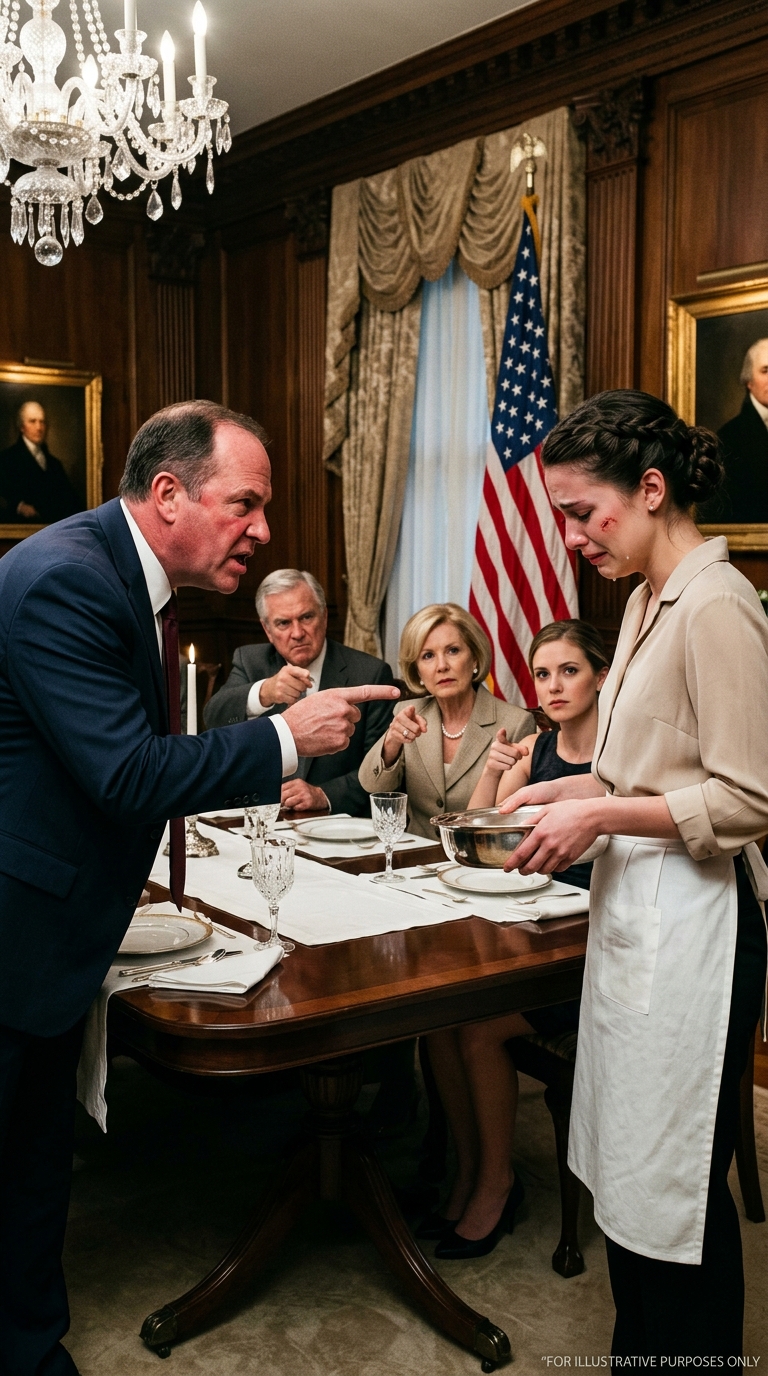
Ryan sat at the head of the table, one hand drumming impatiently against the glass surface. Evelyn sat to his right, her napkin spread across her lap with ceremonial importance. Harper had positioned herself beneath the warm glow of the pendant lamp, her phone angled as if she might record my humiliation for private amusement.
The dining room smelled faintly of expensive candles and arrogance.
Ryan’s eyes dropped to the covered platter in my hands.
“Finally,” he said. “That better not be one of your sad salads.”
Evelyn sniffed the air. “I don’t smell anything.”
“That’s because it’s not for your stomach,” I said.
Harper’s smile faltered. “What is that supposed to mean?”
I set the platter in the center of the table. The silver dome reflected their distorted faces—Ryan’s irritation, Evelyn’s suspicion, Harper’s bored cruelty. For a heartbeat, I savored the image. They looked like people peering into a future they were not ready to recognize.
Ryan reached for the lid.
“Enough drama,” he snapped. “Let’s see what you made.”
He lifted it.
Silence fell so suddenly the house seemed to hold its breath.
No steam rose from the platter. No roasted chicken, no pasta, no sauce, no warm bread. Just paper. Thick, official, devastating paper. Ryan stared at it without understanding at first, his eyes moving across the bold headings, the legal seals, my signature.
Then his face drained of color.
“What the hell is this?”
“Dinner,” I said. “Reality, served cold.”
Evelyn grabbed the bank statements first, perhaps because numbers felt less threatening than legal language. Her eyes narrowed as she read the highlighted transfers. Then they widened.
“This is private,” she whispered.
“No,” I said. “This is mine. My money. My accounts. My life.”
Harper snatched the divorce papers. She scanned the first page, then the second. Her mouth opened.
“Ryan,” she said, her voice suddenly thin. “She filed for divorce.”
Ryan slammed his fist on the table. “You filed for what?”
“I filed for freedom.”
He stood so fast his chair scraped backward and struck the wall.
“You don’t get to divorce me,” he said. “You don’t get to steal my house.”
“Your house?” I repeated.
I took the deed from the platter and held it up. “This house was purchased with my down payment, paid by my salary, maintained by my bonuses, protected by my credit, and legally belongs to me. Your name was removed after your attorney missed two deadlines and failed to dispute financial abandonment. My lawyer was thorough. Unlike you.”
Evelyn rose slowly, shaking with outrage. “You sneaky little snake. My son is the man of this home.”
“The man of this home hit me because I came home late from paying for it.”
Ryan rounded the table.
His hand curled into a fist.
For the first time that night, fear flashed in Evelyn’s eyes—not fear for me, but fear of what another mistake might cost him.
“Ryan,” she warned.
But he kept coming.
“You think a stack of paper makes you powerful?” he said. “You think you can embarrass me in my own dining room?”
I did not step back.
Instead, I pointed to the corner near the ceiling.
Ryan followed my finger.
A small black camera blinked red above the crown molding.
His body stopped mid-stride.
“The slap is recorded,” I said. “So is everything you said afterward. The footage is backed up to the cloud and already shared with my attorney. Touch me again, and the next paper you receive won’t be a divorce petition. It will be a police report.”
Ryan’s face twisted. Rage fought panic and lost.
Harper lowered the divorce papers.
Evelyn looked toward the camera as if it were a snake coiled above her head.
“You planned this,” Ryan said.
“No,” I replied. “You planned this every day you mistreated me and assumed I would never leave. I only documented it.”
For years, I had imagined this moment as explosive. I thought I would scream. Cry. Throw plates. Demand apologies. But standing there, watching the three of them shrink beneath the weight of their own behavior, I felt only a clean, sharp calm.
I pulled my phone from my pocket.
“At midnight,” I said, “the locks change electronically. Your access codes have already been disabled. Your belongings are packed in the foyer. You have ten minutes to leave.”
Harper laughed in disbelief. “You packed our stuff?”
“Yes.”
“You can’t just throw us out!”
“I can remove non-owners from my property after separation, especially after an assault.”
Evelyn clutched the back of her chair. “Where are we supposed to go at midnight?”
I looked at her silk robe, her manicured nails, the necklace I had paid for resting at her throat.
“That question would have moved me once,” I said. “Tonight, it bores me.”
Ryan’s expression changed. The anger softened into something calculated. He reached for my hand.
“Claire,” he said, suddenly gentle. “Come on. We’re tired. We all said things. You know how Mom gets when she’s hungry. You know I didn’t mean to hurt you.”
I looked at the red mark of my face reflected in the window behind him.
“You meant to hurt me,” I said. “You just didn’t expect me to stop letting you.”
He swallowed.
“Baby—”
“Don’t.”
The word cracked like ice.
I walked to the foyer and opened the coat closet. Three heavy black contractor bags sat inside, tied with zip ties. I dragged them across the floor one by one and dropped them near the front door.
Thud.
Thud.
Thud.
Harper rushed forward and tore open one bag. Clothes spilled out, wrinkled and crushed. A heel rolled across the marble. A makeup palette shattered.
“My things!” she screamed. “These are designer!”
“Some were designer,” I said. “Some were purchased with stolen access to my cards. I kept receipts.”
Evelyn stared at the bags as if they were corpses.
Ryan’s voice went low. “You really think you can do this?”
“I already did.”
Outside, thunder rolled over the hills.
Rain began striking the windows.
I opened the front door and cold air swept into the foyer.
“Leave,” I said.
Ryan looked past me into the night, then back at the house—the polished floors, the art, the staircase, the life he had mistaken for his own.
He did not move.
So I began counting.
“One.”
Harper sobbed.
“Two.”
Evelyn cursed me.
“Three.”
Ryan grabbed the first bag.
PART 3
The storm hit as they stepped outside.
It came down hard and sudden, one of those Southern California downpours that seemed impossible until the sky cracked open and emptied itself over the tiled roofs and palm-lined streets. Rain hammered the driveway, bounced off the hood of my SUV, and turned the walkway into a silver river beneath the porch lights.
Ryan dragged one trash bag behind him like a body.
Harper struggled with another, barefoot now because her heels kept slipping on the wet stone. Evelyn refused to carry anything at first, standing under the porch light with her chin raised as if dignity could function as an umbrella.
“Claire,” Ryan said through clenched teeth. “Open the garage. Give me the keys.”
“The SUV is mine.”
“I drive it.”
“You drove it because I allowed you to.”
His eyes flashed. “My wallet’s upstairs.”
“I know.”
“My ID is in it.”
“I know that too.”
He stared at me, realizing piece by piece how complete this was. The house. The car. The cards. The codes. The cameras. The documents. Every bridge he had used to walk over me had already been burned.
Harper wiped rain from her face. “This is insane. You’re insane.”
“No,” I said. “I’m organized.”
Evelyn pointed a shaking finger at me. “God sees what you’re doing.”
“He also saw what happened at 11:10.”
For one second, her face changed. Not guilt. Calculation. She looked toward the houses nearby, where curtains had begun to move.
Then she collapsed.
It was theatrical, almost graceful. One hand to her chest, knees bending, body sinking toward the wet porch as if she had rehearsed fainting for a stage play. Harper shrieked and dropped beside her.
“Mom! Mom, wake up!”
Ryan spun toward the street, suddenly aware of porch lights turning on up and down the block. The McAllisters next door opened their front door. Across the street, a retired judge named Mr. Palmer stepped onto his balcony in a robe. The neighborhood had an audience now, and Ryan knew how to perform.
“Help!” he shouted. “My wife has lost her mind! She’s throwing out my sick mother in a storm!”
His voice carried over the rain.
Harper wailed louder.
Evelyn remained dramatically limp, though one eye opened long enough to check whether anyone was watching.
I almost laughed.
Instead, I took out my phone and called the front gate.
“Captain Morales,” I said when the head of community security answered. “This is Claire Whitaker at 1842 Marigold Ridge. I have three people trespassing on my porch and causing a disturbance. Please send a team.”
Ryan heard me and rushed toward the door.
I stepped inside and held the door halfway closed.
“You wouldn’t dare,” he said.
“I counted to three.”
His face changed in the porch light. Rain ran down his forehead and along his nose. Without the warm house behind him, without my money dressing him, without my fear feeding him, he looked smaller.
Two security SUVs arrived within minutes, blue lights pulsing against the wet street.
Captain Morales stepped out first, broad-shouldered, calm, wearing a rain jacket over his uniform. He had worked the Rancho Vista gates for years. He had seen Ryan come home drunk. He had taken noise complaints from our neighbors after Ryan’s poker nights. He had signed for my certified legal letters when I was at work.
He looked at me, then at the three people on my porch.
“Mrs. Whitaker,” he said. “Are you safe?”
“Yes. I want them removed from my property.”
Ryan stepped forward. “This is my home.”
“No,” I said clearly, loud enough for every curious neighbor to hear. “It is not.”
Captain Morales glanced at the papers I held out, protected inside a plastic sleeve. He read the deed copy, then the temporary protective filing my attorney had prepared in case Ryan became violent.
His expression hardened.
“Mr. Holt,” he said to Ryan, “you need to leave the property.”
Ryan’s mouth fell open. “You’re taking her side?”
“I’m following documentation.”
“This is a private family matter.”
“Not once security is called to prevent trespassing after an assault.”
The word assault shifted the entire street.
I felt it ripple outward through the neighbors, through the rain, through Ryan’s posture. His shoulders stiffened. Harper stopped crying for half a second. Evelyn, miraculously, revived.
“I was worried,” Evelyn said quickly, sitting up. “My son is under stress. Claire is emotional.”
Captain Morales did not look impressed.
“Ma’am,” he said, “please stand.”
Ryan grabbed his bag with a sudden fury that had nowhere to go. Harper gathered spilled clothes from the porch, sobbing about ruined fabric. Evelyn rose slowly, leaning heavily on Harper while glaring at me with enough hatred to burn through glass.
As the guards escorted them down the driveway, Ryan turned back.
“You’ll regret this,” he shouted. “You think you can survive alone?”
I stood in the doorway, one hand on the frame.
“I’ve been surviving alone for years.”
He flinched.
For one moment, something like truth crossed his face. Then it vanished beneath humiliation.
The gates of Rancho Vista opened for the security SUVs and closed behind them.
The rain kept falling.
I shut the front door, slid the deadbolt, fastened the chain, and reset the alarm.
The house became quiet.
Not empty.
Quiet.
I walked into the kitchen, where the cutting board still sat clean on the counter and the chef’s knife lay beside it. I washed the knife, dried it carefully, and placed it back in the block.
Then I went upstairs.
Their rooms were stripped of anything personal. I had already scheduled cleaners for the morning and a locksmith for sunrise. In Ryan’s bedroom—because we had not truly shared a room in months—I found his wallet on the nightstand where I had seen it earlier. I picked it up, removed the secondary credit cards linked to my accounts, cut them in half, and placed his driver’s license in a sealed envelope for my lawyer.
No cruelty.
Just procedure.
At 1:07 a.m., my phone buzzed.
Ryan: Open the gate. Mom is freezing.
I blocked his number.
At 1:14, Harper called.
I blocked hers too.
At 1:22, an unknown number texted.
You are evil.
I blocked that one without answering.
Then, for the first time in five years, I took a shower without rushing because someone was yelling for towels, food, coffee, or attention.
I stood beneath the hot water and let the night rinse away.
When I finally climbed into bed, thunder still rolled beyond the windows. But inside the house, the only sound was my own breathing.
I slept like a woman who had escaped a fire.
PART 4
Ryan later told people that the worst part of that night was the rain.
He was wrong.
The worst part was hunger.
By the time Captain Morales dropped them outside the main gate, the storm had soaked through their clothes and into their bones. Ryan had no wallet, no car, no credit cards, and no idea how to be a man without my money arranging the world around him.
For the first hour, he raged.
He cursed me. He cursed the guards. He cursed the neighborhood, the weather, the legal system, and every woman who had ever “forgotten her place.”
Evelyn blamed him.
“You should have controlled her years ago,” she snapped, shivering beneath the awning of a closed dry cleaner. “I told you she was getting too confident.”
Harper hugged her trash bag and cried. Her mascara had run in black streams down her face. She kept checking her phone, but every rideshare request failed. Every card attached to her apps had been canceled. Her bank account had eleven dollars and sixty-three cents.
“Call your friends,” Ryan said.
“I am!”
“And?”
Harper stared at her phone. “They’re not answering.”
Of course they weren’t. Her friends liked rooftop brunches, not emergencies. They liked tagging Harper when she arrived in my SUV wearing clothes bought with my money. They had no interest in a soaked woman with no place to sleep.
At dawn, the storm passed.
They were huddled beneath the dry cleaner’s awning, stiff, dirty, and furious. A delivery driver arrived, saw them blocking the entrance, and told them to move. Ryan almost fought him until he noticed the driver was bigger.
So they walked.
Two miles to a gas station where Ryan washed his face in a public restroom and tried to make himself look employable. His shirt smelled sour. His pants were wrinkled. His eyes were bloodshot. But he still believed he had one card left.
His job.
He managed a regional sales team at Pacific Coast Office Supply, or at least that was the title he used at parties. In reality, he supervised a shrinking department and spent more time hiding mistakes than making sales. But a paycheck was a paycheck. If he could get to work, borrow money, maybe request an advance, he could put Evelyn and Harper in a motel for a few days.
He left them on a bench near a strip mall and walked to the office.
The receptionist looked startled when he entered.
“Rough morning?” she asked carefully.
“Car trouble,” Ryan muttered.
The elevator ride was worse. Two junior employees stepped in on the second floor and immediately stopped talking. One covered his nose with the back of his hand. Ryan stared at the elevator doors, jaw clenched.
When he reached his department, his assistant stood waiting beside his desk.
“Ryan,” she said, not meeting his eyes. “Mr. Calder wants you in Conference Room B. HR is there.”
His stomach dropped.
Conference Room B had no windows. That was intentional. It was where bad news happened.
The general manager sat at the head of the table. The HR director sat beside him with a navy folder. A third person sat near the wall: an internal auditor.
Ryan recognized the type immediately. Calm face. Sharp eyes. No sympathy.
“Ryan,” Mr. Calder said. “Sit down.”
Ryan did.
The HR director slid the folder forward.
“We’ve completed our review of your expense reports.”
Ryan forced a laugh. “Look, if this is about last quarter, there were some clerical issues. My wife used to help me organize—”
“Your wife no longer works with us as an external consultant on your department’s accounts,” the auditor said.
Ryan went still.
“She informed us last week that she had a conflict of interest and could not continue reviewing materials connected to your team,” the auditor continued. “After that, we reviewed the raw reports.”
The folder opened.
Fake client dinners.
Inflated mileage.
Duplicate hotel reimbursements.
Personal purchases marked as team supplies.
Small thefts, repeated often enough to become a $48,700 problem.
Ryan stared at the documents, and the room seemed to tilt.
For years, I had quietly cleaned up his financial messes. At first, I believed I was protecting our marriage. Then I told myself I was protecting our reputation. Eventually, I understood I was protecting a man who would never protect me.
So I stopped.
And without me, Ryan’s lies collapsed in less than a week.
“This is serious,” Mr. Calder said. “You are terminated for cause, effective immediately. No severance. Your final paycheck will be held pending legal review. If restitution is not arranged within forty-eight hours, we will refer the matter to law enforcement.”
Ryan’s mouth opened.
Nothing came out.
He begged after that. Not with dignity. Not with strategy. Just panic. He said his mother was ill. He said his wife had thrown him out. He said he had made mistakes under stress. He said he could fix it.
But men like Ryan never mean “fix it” as in repay what they stole.
They mean: make someone else carry the consequences.
Security escorted him out with a cardboard box containing a framed photo, three pens, a cracked phone charger, and a fake award he had bought online and displayed on his shelf.
Outside the office building, the morning sun had broken through the clouds.
Ryan stepped onto the sidewalk just as a black sedan pulled up to the tower across the street.
I got out wearing a cream power suit, my hair pinned neatly, sunglasses on, two assistants behind me carrying client files. I was there to present the completed audit that had kept me late the night before.
Ryan froze.
Our eyes met across the distance.
He looked like a man watching the elevator rise after the doors had closed on him.
I did not smile.
I did not wave.
I simply turned and walked into the building.
By noon, Ryan returned to Evelyn and Harper with no money, no job, no plan, and a cardboard box full of proof that he had lost the last thing he could still pretend was his.
That was when his real punishment began.
Because people who survive by feeding on one woman eventually turn on each other when she is gone.
PART 5
The bench where Evelyn and Harper waited stood beside a small public park near Mission Valley, shaded by a jacaranda tree that had dropped purple flowers onto the sidewalk. Under different circumstances, it might have been beautiful.
To Ryan, it looked like a courtroom.
Evelyn spotted him first. Her face lifted with desperate hope.
“Did you get money?”
Harper stood. “Please tell me you got us a hotel.”
Ryan lowered the cardboard box to the ground.
The dull thud told them everything.
Harper’s expression changed from hope to fear, then from fear to disgust.
“What happened?”
Ryan rubbed both hands over his face. “They fired me.”
Evelyn blinked. “What?”
“They audited my expense reports. They said I owe almost fifty thousand dollars.”
For a moment, neither woman spoke.
Then Evelyn slapped him.
It was not as hard as the slap he had given me, but it shocked him more. His mother, who had defended every failure, excused every lie, praised every mediocre achievement, struck him across the face in front of passing strangers.
“You stupid boy,” she hissed. “You stupid, useless boy.”
Ryan stared at her, stunned.
Harper laughed once, a sharp, ugly sound. “So that’s it? We’re homeless and you’re unemployed?”
“I was trying to keep us afloat!”
“With stolen money?” Harper shouted. “You always acted like you were some big provider. You were stealing from your job and living off Claire.”
“So were you,” Ryan snapped.
Harper recoiled. “Excuse me?”
“You heard me. Your clothes, your trips, your stupid skincare fridge, your Pilates membership. Who paid for it?”
“At least I didn’t commit a crime!”
“No, you just spent money you didn’t earn.”
Evelyn began crying, but even her tears were accusatory.
“I gave my life to my children, and this is how I end up? On a park bench? Hungry? Humiliated?”
“You gave your life to criticizing Claire while she paid your bills,” Ryan said bitterly.
Evelyn gasped as if he had stabbed her.
The family they had claimed was sacred cracked in public under the weight of hunger, shame, and truth.
By late afternoon, desperation forced action. Ryan pawned his watch for a fraction of its value. Harper surrendered her gold earrings only after a screaming argument that drew attention from a patrol officer. The cash bought fast food, bottled water, and one week in a motel so cheap the clerk did not ask many questions.
The room smelled of mildew and old cigarettes.
One bed.
A flickering lamp.
A bathroom door that did not close properly.
Evelyn sat on the edge of the mattress and cried silently into a towel. Harper stood in the center of the room holding her trash bag, looking as if she had been dropped into a foreign country without a passport.
“I can’t stay here,” she said.
Ryan collapsed into the chair. “Then sleep outside.”
“I mean it.”
“So do I.”
That night, Ryan tucked the remaining cash under his pillow.
Evelyn fell asleep muttering prayers that sounded like complaints. Ryan snored with one arm over his face. But Harper remained awake, staring at the cracked ceiling.
She had always believed beauty was a currency.
She was twenty-six, slim, polished, and skilled at becoming whatever rich men wanted for three dates. But poverty was fast. It stripped polish. It made hair greasy and eyes frantic. It made expensive clothes look like costumes.
By sunrise, she had made her choice.
Carefully, she slid her hand beneath Ryan’s pillow.
He stirred.
She froze.
His breathing deepened again.
She pulled out the envelope of cash, stuffed it inside her jacket, gathered her best clothes into one bag, and slipped out before dawn.
She did not leave a note.
When Ryan woke, his scream shook the motel room.
Evelyn sat up, confused. “What? What happened?”
“The money’s gone.”
“No.”
“Harper’s gone.”
Evelyn refused to believe it until she saw the empty corner where Harper’s bag had been. Then something inside her seemed to collapse. Not dramatically this time. Quietly. Permanently.
“My baby wouldn’t,” she whispered.
Ryan laughed, but there was no humor in it. “Your baby did exactly what we taught her to do. Take what she can and run.”
The motel owner evicted them before noon after receiving complaints about shouting and discovering they could not pay the required deposit extension.
That afternoon, Ryan and Evelyn found themselves on a bus bench with no cash, no food, and no Harper.
For the first time in his life, Ryan had no woman left to blame who was still within reach.
So he blamed me again.
He borrowed a stranger’s phone outside a grocery store and sent a message to my number.
Claire, please. Mom is sick. Harper ran off with our money. I know I made mistakes. Let us come home. I swear I’ll change. I still love you.
I was in my new office when the message arrived from an unknown number.
My cheek had healed by then, but the memory had not.
I read his words once.
Then I deleted them.
Blocked the number.
And returned to reviewing a merger file worth more than Ryan had earned in his entire life.
Within two weeks, my house was on the market.
Within three, it sold above asking.
I bought a penthouse downtown overlooking San Diego Bay, with floor-to-ceiling windows, quiet neighbors, secure elevators, and a kitchen where nobody yelled at me to cook.
The first morning there, I made oatmeal with berries, poured coffee into a white mug, and sat by the window while the city turned gold beneath the rising sun.
I posted one photo.
Caption: Peace tastes better when nobody at the table hates you.
Then I turned off my phone and enjoyed breakfast.
Not as revenge.
As freedom.
PART 6
Divorce court was quieter than I expected.
No dramatic objections. No shouting. No last-minute confession. No Ryan bursting through the doors to beg for forgiveness in front of strangers.
He did not appear at all.
My attorney, Grace Monroe, sat beside me in a navy suit and silver watch, calm as a surgeon. She had warned me that men like Ryan often vanished when accountability became official. They wanted control, not confrontation with evidence.
The judge reviewed the file.
Documented assault.
Financial abandonment.
Separate property.
Signed filings.
Video evidence.
Ryan’s failure to respond.
The gavel came down with a sound so small I almost missed it.
And just like that, the marriage that had consumed five years of my life ended in less than twelve minutes.
Outside the courthouse, Grace touched my shoulder.
“How do you feel?”
I looked up at the American flag moving in the dry California breeze above the courthouse steps.
“Like I can breathe.”
She smiled. “That’s a good start.”
I did more than start.
I rebuilt.
The energy I once spent managing Ryan’s moods went into work. The money I once wasted supporting Evelyn’s vanity and Harper’s laziness went into investments, therapy, travel, and sleep. I hired a personal trainer. I reconnected with old friends. I bought clothes in colors Ryan used to mock. I cut my hair shorter. I laughed louder.
And my career rose like it had been waiting for me to stop carrying dead weight.
Six months after the divorce, I was promoted to partner at the forensic accounting firm where I worked. Nine months after, I opened a consulting division specializing in corporate fraud investigations. Companies that once treated me like a quiet accountant began flying me to Chicago, Washington, D.C., and New York to uncover the rot beneath polished boardrooms.
Men twice Ryan’s size learned to sweat when I opened a folder.
But success did not heal me by itself.
I still woke some nights hearing the slap.
I still flinched if a man moved too quickly near my face.
I still found myself apologizing for things that did not require apology.
So I went to therapy every Wednesday at 5:30.
I sat on a gray sofa in an office overlooking Balboa Park and told the truth to a woman who did not interrupt, excuse, minimize, or ask what I had done to provoke him.
The truth was this: leaving Ryan did not instantly make me fearless.
It made me free enough to learn fear was not my natural state.
A year after the night of the platter, I founded The Whitaker House Foundation, a nonprofit supporting women rebuilding after domestic abuse. We offered emergency legal consultations, temporary housing grants, financial literacy classes, and counseling.
I funded the first year myself.
The launch event took place in a bright hall near the San Diego waterfront. White flowers lined the stage. A string quartet played near the entrance. Donors, attorneys, advocates, survivors, and local business leaders filled the room. Behind the podium hung a large American flag, not as decoration, but as a reminder that freedom meant nothing if women were trapped inside beautiful houses with locked smiles.
When I stepped onstage, applause rose around me.
For a moment, I saw myself as I had been that night: tired, slapped, silent in the foyer.
Then I saw myself now: standing beneath warm lights, wearing an ivory suit, my voice steady.
“My name is Claire Whitaker,” I said. “For years, I believed survival meant keeping the peace. Now I know peace built on silence is just another prison.”
The room became very still.
I did not tell every detail. I did not need to. The women in the audience understood the spaces between my sentences. They understood the dinners cooked through tears, the apologies made to avoid explosions, the bank accounts drained by people who called control love.
“Tonight,” I continued, “we open a door for women who have been told they have nowhere to go. There is somewhere to go. There is a life after fear. And sometimes the first step toward that life is not forgiveness. It is a locked door.”
Applause filled the hall again, louder this time.
After the ceremony, we held a community outreach event in the plaza outside. Food packages, hygiene kits, prepaid grocery cards, and information packets were stacked beneath white tents. I insisted on helping distribute them personally.
Grace warned me I did not have to.
I told her I wanted to.
The line moved slowly.
A young mother with two children.
An elderly veteran.
A woman hiding bruises beneath makeup.
A college student sleeping in her car.
I handed each person a package, looked them in the eye, and said something kind. Not grand. Not performative. Just human.
Then a man stepped forward pushing an old wheelchair.
His clothes hung from his body. His beard was uneven. His skin looked gray from sun and exhaustion. A sour smell clung to him. In the wheelchair sat an older woman wrapped in a stained blanket, her eyes cloudy, her once-proud mouth slack with confusion.
The man kept his head down.
I reached for a food package.
“Here you go, sir,” I said. “There’s also a grocery card inside.”
His hand trembled as he reached for it.
Then he looked up.
Time did not stop.
That only happens in movies.
In real life, recognition is quieter. Colder.
It arrives like a door closing in another room.
Ryan Holt stared at me with sunken eyes.
“Claire,” he whispered.
PART 7
For a second, the noise of the plaza faded.
Not because I still loved him.
Not because I hated him.
Because the mind is strange, and sometimes the past steps into daylight wearing the face of a ghost.
Ryan’s eyes filled with tears. His beard was patchy. His lips were cracked. The man who once stood in my foyer demanding dinner now stood in a charity line waiting for a meal from my hand.
In the wheelchair, Evelyn blinked at me without recognition at first. Then her cloudy eyes sharpened. Her mouth trembled. She tried to sit straighter, but her body did not obey the old arrogance.
“Claire?” she rasped.
I felt Grace move closer beside me.
A security volunteer also noticed the shift and stepped toward us, but I gave a small shake of my head.
Ryan swallowed. “I didn’t know this was your event.”
“I assumed that.”
He looked down at the food package, then back at me. “I’ve wanted to talk to you.”
“There’s a long line.”
His face crumpled.
“Please,” he said. “Just one minute. Mom’s not well. Harper disappeared. I haven’t heard from her in months. Everything fell apart after you—”
He stopped himself.
After you kicked us out.
After you stopped paying.
After you stopped protecting me.
After you finally chose yourself.
I waited.
Ryan’s eyes dropped to the ground. “After I ruined everything.”
It was the closest thing to honesty I had ever heard from him.
A year earlier, that sentence might have opened something in me. A wound. A memory. A dangerous little door marked Maybe.
Now, it opened nothing.
“I’m sorry,” he said. Tears spilled over. “I’m sorry for hitting you. For how I talked to you. For letting Mom and Harper treat you like that. I was angry. I was ashamed. I knew you were better than me, and I hated you for it.”
Evelyn made a small sound, half protest, half cough.
Ryan ignored her.
“I lost the job,” he continued. “The company came after me. I couldn’t pay. I did some time. Not long, but enough. When I got out, Mom was worse. I tried day labor. Shelters. Anything. I kept thinking if I could just see you, maybe—”
“Maybe what?” I asked.
He flinched at the calmness of my voice.
“Maybe you’d know I changed.”
I looked at him carefully.
Maybe he had changed. Maybe hunger had carved humility into him. Maybe prison had taught him what comfort never could. Maybe regret had followed him through nights on concrete and mornings without coffee.
But change did not create obligation.
His suffering was not a bill I owed.
“I hope you have changed,” I said.
Hope flickered in his eyes.
I placed the food package and grocery card in his hands.
“But not for me.”
The hope died.
Behind him, people in line shifted impatiently. A child cried. A volunteer called for more hygiene kits. Life continued, indifferent and busy.
Ryan looked at the package as if it were both mercy and punishment.
“Claire,” he whispered, “is there any forgiveness left?”
The question did not hurt.
That was how I knew I was free.
“Forgiveness is not a doorway back into my life,” I said. “It is a lock I removed from my own heart. I don’t hate you anymore, Ryan. I don’t think about you enough for that.”
His face shattered.
Anger would have been easier for him. Hatred would have meant he still mattered. My indifference left him nowhere to stand.
Evelyn reached toward me with a shaking hand. “Please,” she said, her voice thin. “We were family.”
“No,” I said softly. “You were people I survived.”
Grace touched my elbow, not to stop me, only to remind me I was not alone.
I turned to the volunteer beside me.
“Please help this gentleman move along,” I said. “There are others waiting.”
The volunteer nodded kindly. “Sir, this way.”
Ryan did not resist. He pushed Evelyn’s wheelchair out of the line and toward the edge of the plaza. Halfway there, he looked back.
I was already handing a package to the next woman.
The woman had a black eye hidden beneath sunglasses. Her hands shook when she took the bag.
“You’re safe here,” I told her.
She began to cry.
That mattered.
Ryan did not.
Later, after the event ended and the sun dipped orange over the bay, I stood alone near the railing outside the hall. The city lights were beginning to appear across the water. Behind me, volunteers packed boxes and folded tables. Somewhere in the distance, a street musician played a slow guitar melody.
Grace came to stand beside me.
“Are you okay?”
I watched a boat move across the harbor.
“Yes.”
“Seeing him like that…”
“I know.”
“And?”
I thought about the night at 11:10 p.m. I thought about the slap, the platter, the storm, the door closing. I thought about the woman I had been, carrying documents through the dining room like a weapon disguised as dinner.
Then I thought about the woman in the line with the sunglasses.
“I’m grateful,” I said.
Grace looked at me. “For what?”
“That I didn’t wait for him to become sorry before I became free.”
She smiled.
A black sedan pulled up to the curb. My driver stepped out and opened the door. Tomorrow, I had a flight to Washington, D.C., to speak at a financial independence conference for survivors. Next month, the foundation would open a second emergency housing unit in Chicago. My life was full—not perfect, not painless, but mine.
Before getting into the car, I looked once more at the plaza.
Ryan sat on a low wall across the street, feeding Evelyn from the charity meal. His shoulders shook. Maybe he was crying. Maybe he was laughing bitterly at the joke life had played on him. Maybe he was finally tasting the consequences he had once demanded I cook.
I felt nothing sharp.
No revenge burning in my chest.
No need to watch him suffer.
The best revenge had never been his ruin.
It was my peace.
It was the clean kitchen in my penthouse. The quiet mornings. The women helped. The money saved. The sleep without fear. The knowledge that the hand that struck me had lost forever the power to shape my life.
I got into the car.
As we pulled away, the city opened before me, bright and endless.
Behind me, Ryan became smaller in the rear window until he disappeared into the blur of traffic, lights, and distance.
I did not look back again.