PART 2
Grant tried to laugh.
It was a terrible mistake.
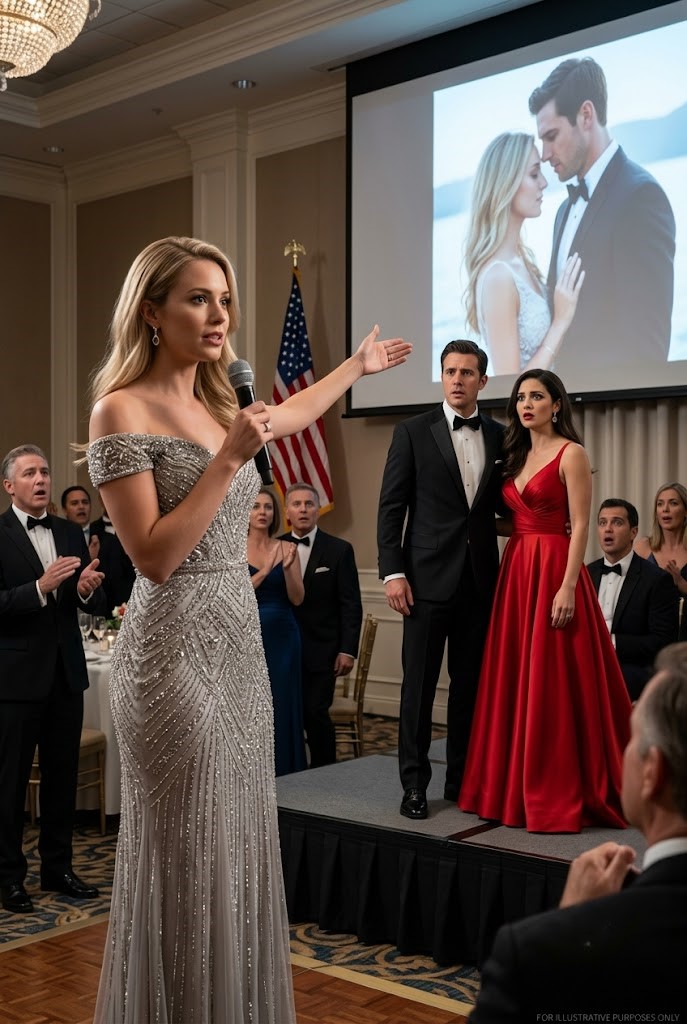
The sound came out thin and brittle, like glass cracking under pressure. Everyone in the ballroom heard it. Everyone saw the fear under it. Grant Whitmore, who had once commanded presidents to wait on conference calls, looked suddenly like a man who had walked confidently onto ice and heard the first break beneath his shoes.
“Claire,” he said, reaching for charm the way a drowning man reaches for air, “my wife has always had a flair for timing.”
Claire turned toward the audience.
“My husband has always had a flair for fiction.”
The room stirred.
Madison’s painted mouth opened. She looked from Claire to Grant, waiting for him to crush the interruption, to prove he was still the powerful man who had promised her a Malibu house, a film fund, and a life above consequence.
Grant stepped closer to Claire and lowered his voice, but the microphone still caught him.
“You need to get off this stage before you embarrass yourself.”
Claire looked down at his hand as he reached for her wrist.
“Touch me,” she said softly, “and I will start with the Cayman accounts instead of the mistress.”
Grant stopped.
The blood left his face.
A senator near the front table leaned toward his wife. A banker stopped lifting his champagne glass. A reporter from a financial network whispered, “Did she say Cayman accounts?”
Claire lifted the microphone from its stand.
“I apologize for interrupting my husband’s performance,” she said. “I know he worked very hard on it. The lighting, the speech, the public betrayal. Very theatrical.”
A nervous laugh moved through the ballroom.
Madison found her voice. “You’re making yourself look desperate.”
Claire looked at her for the first time.
Madison shrank under that gaze.
“You must be Madison Vale,” Claire said. “I recognize you from the invoices.”
Madison blinked. “Excuse me?”
“Fifty-eight thousand dollars at a jewelry store in Beverly Hills, charged to Whitmore Global as ‘executive client retention.’ Forty-three thousand dollars for a weekend in Aspen, listed as ‘logistics research.’ A private apartment in River North, monthly rent paid through a subsidiary my husband apparently believed no one would examine.”
The gasps were immediate.
Madison turned white.
Grant snapped, “Enough.”
Claire continued as if he had not spoken.
“And my personal favorite,” she said, “a red couture gown purchased this afternoon with a corporate card, categorized as ‘children’s literacy event décor.’”
The crowd stared at Madison’s dress.
Madison folded her arms across her chest as if she could hide the evidence by covering fabric.
“That’s a lie,” she whispered.
Claire opened her clutch and removed a folded sheet.
“No, Madison. It’s accounting.”
She held it up long enough for the cameras to zoom in.
Grant moved toward her. “Claire, you have no right to—”
“I have every right,” Claire said.
This time her voice cut through the ballroom like a blade.
Grant stopped again.
For twenty-three years, Claire had let him be loud. She had let him interrupt, perform, charm, dominate. In boardrooms, he would take the head chair and she would sit two seats down, quiet, listening, correcting disasters with a glance. People mistook that silence for softness.
Tonight, they learned the difference.
“I built this foundation,” Claire said. “I built the donor network. I built half the partnerships represented in this room. And since my husband has decided to turn a charity gala for children into a stage for adultery, fraud, and corporate theft, I think honesty would be refreshing.”
A man at table six began clapping once before his wife slapped his arm down.
Grant’s eyes darkened.
“You are angry,” he said. “I understand that. But this private marital issue—”
“This is not a private marital issue,” Claire said. “You made it public when you brought your mistress on stage. You made it criminal when you charged her lifestyle to my company.”
“My company,” Grant growled.
Claire looked at him then.
Really looked.
The entire room felt it.
“No,” she said. “That has always been your favorite lie.”
Grant’s nostrils flared. “I founded Whitmore Global.”
“With twelve employees, six unpaid invoices, and a warehouse lease you could not afford,” Claire replied. “My father’s trust paid your debts. My logistics model saved your shipping routes. My acquisition strategy tripled revenue in five years. My negotiations brought in the defense contracts. My risk analysis prevented the Phoenix collapse. And my silence allowed you to stand on magazine covers pretending you did it alone.”
The words landed harder than shouting.
Older board members looked away. They knew. Many of them had always known.
Grant saw their faces and panicked.
“You think people care about old history?” he said. “They care about leadership.”
“Then let’s discuss leadership.”
Claire opened her clutch again and removed a second document.
Grant saw the blue legal stamp on top.
His expression changed.
For the first time that night, he looked truly afraid.
Claire held the paper against her diamond bodice.
“At 4:17 p.m. today,” she said, “a petition was filed in Cook County court seeking an emergency injunction against Grant Whitmore, pending investigation into breach of fiduciary duty, corporate misappropriation, and fraudulent asset transfer.”
The room exploded into whispers.
Grant lunged for the microphone.
Claire stepped back with impossible calm.
“Careful,” she said. “The cameras love desperation.”
He froze, shaking with rage.
Madison whispered, “Grant, what is she talking about?”
He did not answer.
Claire turned toward the board table.
“Mr. Alden Pierce,” she said.
An elderly man with silver hair and a navy tuxedo rose slowly. He had known Claire’s father. He had also watched Grant grow greedy enough to mistake luck for brilliance.
“Yes, Mrs. Whitmore?”
Claire’s smile was small.
“Would you confirm for the room your receipt of the proxy filings delivered to the board this afternoon?”
Grant’s head snapped toward Alden.
Alden buttoned his jacket.
“I confirm receipt.”
Grant barked, “Sit down, Alden.”
Alden did not sit.
Claire’s voice remained steady.
“And would you also confirm that tonight’s gala venue was reserved under the Whitmore Foundation’s corporate governance clause allowing emergency shareholder proceedings during foundation events attended by majority voting representation?”
The ballroom went so quiet the chandeliers seemed to hum.
Alden nodded.
“I confirm.”
Grant looked at Claire as if she had become a stranger in front of him.
“What did you do?” he whispered.
Claire leaned toward the microphone.
“I accepted your invitation to discuss the future.”
Then she turned to the crowd.
“Ladies and gentlemen, before my husband continues introducing his mistress as the future of Whitmore Global, I believe the actual shareholders should have a voice.”
Madison took one step backward.
Grant stared at the board table.
Claire unfolded the final document.
“As of two hours ago,” she said, “with fifty-four percent of voting shares represented and certified, this gala is now an emergency shareholders meeting.”
The ballroom erupted.
Grant’s mouth opened.
Nothing came out.
Claire’s diamonds burned under the lights.
“And the first motion,” she said, “is the immediate removal of Grant Whitmore as CEO and chairman.”
PART 3
The word removal floated above the ballroom like smoke from a gunshot.
Grant stared at Claire, then at Alden Pierce, then at the faces of the board members seated near the front. They were not confused. They were not outraged. Some looked stunned, yes, but not betrayed.
That was what terrified him.
They were waiting.
Waiting for Claire.
Grant had built his life around the belief that power was performance. The bigger the room, the louder the speech, the brighter the smile, the more powerful the man. He had spent years collecting applause the way other men collected rare cars.
Claire had collected signatures.
“Impossible,” Grant said.
Claire’s expression did not change.
“Your favorite word when you fail to read documents.”
Grant turned toward Alden. “She has twenty-eight percent. I have forty-six. The rest are institutional.”
“Were,” Claire said.
His eyes darted back to her.
She let the pause stretch.
“For five years, Sterling House Investments has been acquiring passive blocks through secondary offerings, retirement fund exits, and private transfers. You dismissed Sterling House as a conservative regional firm from California.”
Grant’s lips parted.
Claire smiled.
“I founded it.”
The sound that moved through the room was not a gasp. It was something deeper, heavier, almost primitive. People understood ambition. They understood betrayal. But this was strategy on a scale so quiet and patient it felt biblical.
Grant whispered, “No.”
“Yes,” Claire said. “You were so busy buying Madison bracelets and naming yourself visionary of the year that you missed your wife becoming your largest shareholder.”
Madison gripped the edge of the podium.
“You told me she was weak,” she hissed at Grant.
Claire heard her and laughed softly.
It was not a kind laugh.
Grant spun toward Madison. “Shut up.”
That was the moment the room fully turned on him.
Not when he flaunted her. Not when Claire revealed the invoices. Not even when the shareholder coup began. It was when Grant spoke to the woman he had called his future with the same contempt he had once saved for his wife.
Madison saw it too.
Her lower lip trembled.
Alden Pierce cleared his throat.
“As senior independent director,” he said, “I second the motion for immediate removal of Grant Whitmore as CEO and chairman.”
Another board member stood. Patricia Monroe, a former federal judge from Washington, D.C., whom Grant had once called “decorative” after she challenged his debt projections.
“I support the motion,” Patricia said.
Grant pointed at her. “You have no idea what she’s doing.”
Patricia looked at Claire.
“I believe she knows exactly what she’s doing.”
One by one, they rose.
A technology investor from Seattle.
A pension fund representative from Boston.
A family office heir from San Diego.
People Grant had underestimated because they smiled at dinner and said little in meetings.
Claire watched each of them stand. Not with triumph. Not exactly. More with the solemnity of a surgeon watching the final infected tissue removed.
Grant’s voice rose. “This is illegal. This is a stunt. This is my company.”
Claire stepped closer to him.
“No, Grant. This is a company. Not a mirror.”
He flinched as if slapped.
She turned to the room.
“The proxies have been certified. The votes have been counted. The motion passes.”
Grant lunged.
Two security guards moved instantly, but Claire lifted one hand and stopped them.
Grant did not touch her. He stopped inches away, breathing hard, his face red, his eyes wet with rage.
“You think you can run it?” he spat. “You? You sat in offices and made spreadsheets while I built relationships. People trusted me.”
“No,” Claire said. “People enjoyed you. That is not the same thing.”
The cameras kept flashing.
Somewhere near the back, a guest whispered, “This is history.”
Claire picked up a tablet Nora had brought from backstage. She tapped the screen, and the ballroom screens changed. The foundation logo vanished. In its place appeared a clean document header:
PRELIMINARY FORENSIC REPORT: WHITMORE GLOBAL INTERNAL REVIEW.
Grant looked at the screen and went still.
Claire did not show the full report. She did not need to. The categories alone were devastating.
Unauthorized executive transfers.
Misclassified personal expenses.
Shell consulting entities.
Offshore holdings.
Falsified revenue timing.
Fraudulent asset restructuring.
Madison’s hands flew to her mouth.
Grant whispered, “Turn that off.”
Claire ignored him.
“This preliminary report was prepared by an independent forensic accounting firm over the last ninety days. A complete copy has been delivered to outside counsel, federal authorities, and the board.”
Grant turned toward the crowd, suddenly desperate. “These are allegations. My wife is emotional. She is angry because our marriage—”
Claire raised one eyebrow.
“You were about to kiss your mistress on my stage while calling me outdated. I believe emotion is not my weakness tonight.”
A ripple of laughter moved through the room, sharper now.
Grant’s control broke.
“She is nothing without me!” he shouted.
The words echoed.
Claire’s face became very still.
For the first time, the audience saw the wound beneath the diamonds.
Grant saw it too, and for one foolish second, he thought he had found a crack.
“You hear me?” he said, stepping closer. “Nothing. I gave you my name. I gave you this life.”
Claire lowered the microphone.
When she spoke, her voice was softer, and somehow every person leaned in.
“You gave me a cage,” she said. “I turned it into a command center.”
Then she lifted the microphone again.
“Security may escort Mr. Whitmore from the stage.”
Grant looked to the guards, expecting hesitation.
There was none this time.
Two men approached him.
He backed away. “Don’t touch me. I’ll sue every one of you.”
Alden said from the front table, “As of this moment, you have no authority over Whitmore security.”
Grant turned to Madison. “Tell them. Tell them this is madness.”
Madison stared at him.
Her mascara had begun to run.
“What happens to me?” she asked.
Claire answered before Grant could.
“That depends on how much you knew.”
Madison’s face collapsed.
The girl who had walked onto the stage believing she was being crowned suddenly understood she had been standing beside a burning building.
Grant saw her retreat.
“Madison,” he snapped.
She stepped away.
Then she ran.
Her red gown flashed across the stage like a wound before she disappeared into the side aisle, pushing past photographers who shouted her name.
Grant watched her go.
For the first time in years, he looked completely alone.
Claire turned back to the donors.
“I regret the disruption,” she said. “The children this foundation serves deserved better tonight. So did every person in this room who came here to do good. The bar remains open. The auction will continue. Every dollar raised tonight will go exactly where it was promised.”
She paused.
“And tomorrow morning, Whitmore Global begins again.”
The applause did not start everywhere at once. It began at Alden’s table, dignified and firm. Then it spread. Some clapped because they admired her. Some because they feared her. Some because they knew they were watching a woman rise from public betrayal and turn it into a corporate execution with perfect timing.
Grant was escorted off the stage under the lights he had designed for his victory.
Claire did not watch him leave.
She looked over the ballroom, over the donors, the cameras, the shocked faces, and the young women from the foundation staff crying quietly near the auction tables.
Then she stepped down from the stage, diamonds whispering behind her.
The coup was complete.
The war was not.
PART 4
The private reception room behind the ballroom had been prepared with white roses, silver trays, and untouched champagne.
It looked like a bridal suite.
Claire thought that was almost funny.
Nora closed the door behind her, shutting out the roar of the ballroom. On the other side, reporters were shouting questions. Guests were calling lawyers. Board members were speaking in urgent clusters. Somewhere in the hotel, Grant was probably threatening lawsuits, heart attacks, and divine punishment.
Inside the room, everything was calm.
Alden Pierce entered first, followed by Patricia Monroe and Miles Keaton, Claire’s attorney. Miles was tall, bald, and quiet, with the kind of face that made guilty people confess just to end the silence.
“That,” Alden said, “was the finest boardroom ambush I have ever witnessed.”
Claire removed one diamond earring and set it on the table.
“It was not an ambush. It was a correction.”
Patricia smiled. “Then it was a beautiful correction.”
Nora touched Claire’s shoulder. “The press is calling it the Diamond Gown Coup.”
Claire almost laughed.
Almost.
Miles opened his leather folder. “The U.S. Attorney’s office has confirmed receipt of the report. Detectives are on their way. They want to speak with Grant tonight.”
“Good,” Claire said.
“There is also the matter of Madison Vale. Hotel security says she tried to leave through the kitchen entrance. Federal investigators asked that she be detained for questioning, not arrested yet.”
Claire nodded.
“She will talk. People like Madison believe survival is loyalty.”
Alden studied Claire’s face. “Are you all right?”
There it was.
The question nobody had asked on stage.
Claire looked toward the window. Chicago glittered below, cold and magnificent, the river cutting black through towers of light. For twenty-three years, she had lived in a marriage that taught her to calculate pain like a business expense. How much humiliation could be absorbed? How much betrayal could be deferred? How much of herself could be hidden before she disappeared?
“I will be,” she said.
That was the most honest answer she had.
Miles slid another folder across the table.
“The divorce petition is ready. I can serve it tomorrow.”
“No,” Claire said. “Tonight.”
Nora looked alarmed. “Claire, you don’t have to face him again.”
“Yes,” Claire said. “I do.”
The room went quiet.
Claire picked up the folder.
“I let lawyers handle the company. I let accountants follow the money. I let investigators collect the lies. But this part is mine.”
Miles hesitated. “He may be unstable.”
Claire looked at him.
“He has been unstable for years. He simply used to be profitable.”
Alden chuckled once, then stopped when he saw her expression.
Claire walked out before anyone could argue.
The corridor behind the ballroom was chaos dressed in expensive fabric. Staff hurried with trays nobody wanted. Security spoke into wrist microphones. A young reporter tried to slip through a service door and was firmly removed. Claire passed them all, the diamond gown now less like armor and more like a signal flare.
People stepped aside.
At the end of the hallway, two security guards stood outside a small greenroom. One opened the door when he saw her.
Grant sat inside.
He had removed his bow tie. His tuxedo shirt was open at the throat. His hair, always perfect in public, had fallen across his forehead. He looked older than he had an hour before. Not humbled. Not yet. Just stripped of lighting.
He looked up.
His eyes burned.
“You planned this,” he said.
Claire stepped inside. The door closed behind her.
“Yes.”
“For how long?”
“Long enough.”
Grant laughed bitterly. “Of course. Saint Claire. The patient wife. The loyal partner. All a performance.”
“No,” she said. “The marriage was real. That was my mistake.”
He looked away first.
She placed the divorce folder on the table between them.
Grant stared at it.
“You are enjoying this,” he said.
Claire’s hands tightened once, then relaxed.
“No. That is what you would do. You enjoy humiliation. You enjoy making people smaller so you can feel tall. I am not enjoying this, Grant. I am ending it.”
He leaned forward. “You think you won? You just destroyed our name.”
“Our name?” Claire said. “You used our name to steal. You used our foundation to parade your mistress. You used our company as a wallet. I am not destroying the Whitmore name. I am separating myself from its collapse.”
“You can’t erase me.”
“I do not need to erase you. Federal prosecutors will document you.”
His face twisted.
For a second, she saw the boy he must have been before greed found him. Hungry. Afraid. Certain that love was something to dominate before it abandoned him.
“Why wasn’t I enough?” he whispered.
Claire stared at him.
The question was so monstrous, so perfectly backward, that it almost broke her calm.
“You had everything,” she said. “A wife who loved you. A company that trusted you. A foundation that made your name mean something. You were not satisfied because you never wanted enough. You wanted more than other people. More than truth. More than consequence.”
Grant’s eyes filled with tears.
“You made me feel small,” he said.
Claire’s voice softened, but not with pity.
“No, Grant. I stopped making myself smaller for you. You could not tell the difference.”
A knock hit the door.
Miles entered with two detectives in dark suits behind him.
Grant stood too fast. “What is this?”
The older detective opened a badge. “Grant Whitmore, we have a warrant for your arrest relating to fraud, wire transfer violations, and corporate misappropriation.”
Grant looked at Claire.
“You called the police on your husband?”
Claire picked up the unsigned divorce folder and held it out to him.
“No,” she said. “I gave evidence to the law. You did the rest.”
The detective stepped closer.
Grant’s voice cracked. “Claire. Please. We can fix this. I’ll give you the company. I’ll end it with Madison. We can go home.”
Home.
The word struck her harder than she expected.
She thought of their Lake Michigan penthouse, all glass and marble. The breakfast table where he read headlines about himself. The bedroom where she had stared at the ceiling and wondered when loneliness became marriage. The office where she built strategies he later claimed as inspiration.
“That place was never home,” she said.
The detectives took Grant by the arms.
He did not fight at first.
Then the cameras outside the hotel doors flashed through the hallway window, and pride returned like a disease.
“Don’t let them see me like this,” he hissed.
Claire looked at him one last time.
“You chose the stage.”
They led him out.
Claire stood alone in the greenroom, listening as the noise rose in the hallway. Reporters shouted. Cameras fired. Grant cursed once, then fell silent.
Nora appeared at the door.
“It’s over,” she said gently.
Claire looked at the empty chair where her husband had been.
“No,” she said. “Now I have to rebuild what he almost burned down.”
She reached behind her neck and unclasped the diamond necklace Grant had once given her for their anniversary with money she later discovered had come from a corporate bonus he approved for himself.
She set it on the table.
Then Claire Whitmore walked back into the storm.
PART 5
By morning, every screen in America seemed to carry the same image: Claire Whitmore in a diamond gown, standing under gala lights while her billionaire husband collapsed in real time beside his mistress.
The headlines wrote themselves.
BILLIONAIRE HUMILIATES WIFE—WIFE TAKES COMPANY ON STAGE.
THE DIAMOND GOWN COUP.
FROM BETRAYED WIFE TO CEO IN ONE NIGHT.
Grant’s mugshot appeared beside old magazine covers calling him a visionary. Madison Vale’s red dress became an internet symbol for expensive mistakes. Business channels replayed Claire’s calmest lines until they sounded like scripture.
But Claire did not watch.
At 7:30 the next morning, she walked into Whitmore Global headquarters in downtown Chicago wearing a black suit, flat shoes, and no diamonds.
The lobby went silent.
Employees lined the marble corridors. Some had been up all night. Some had cried from fear their jobs were gone. Some had spent years watching Grant reward flattery and punish competence. Now they watched Claire step through the revolving doors with Nora on one side and Miles on the other.
Claire stopped in the center of the lobby.
No podium. No spotlight.
Just her voice.
“I know you are afraid,” she said.
The honesty startled them.
“You are wondering if the company is safe. You are wondering whether your work has been poisoned by one man’s greed. You are wondering whether your families will pay for his crimes.”
People stared down from balconies.
Claire looked up at them.
“Your jobs are safe. Your work matters. And from this morning forward, Whitmore Global will be led with transparency, discipline, and respect.”
A man from operations wiped his eyes.
Claire continued.
“The era of ego is over. The era of repair begins now.”
That sentence traveled faster than any press release.
By noon, the board unanimously confirmed Claire as interim CEO. By Friday, interim was removed. She froze all questionable executive accounts, canceled vanity projects, opened an internal reporting hotline, and invited regulators into the building before they had to knock.
Investors panicked at first.
Then they studied her numbers.
Claire had prepared for the fall before anyone else saw the cliff. She had secured emergency credit lines, protected key contracts, and quietly met with major clients before the gala. By the end of the first week, three of Whitmore Global’s largest partners publicly affirmed their confidence in her leadership.
Grant’s loyalists resigned quickly.
The talented people he had ignored stayed.
Claire promoted a warehouse director from Detroit who had designed a more efficient distribution model Grant had called “too boring.” She made him head of North American logistics. She brought back a cybersecurity chief Grant had pushed out for questioning inflated projections. She gave Patricia Monroe authority to oversee governance reform.
At night, Claire returned not to the penthouse, but to a quiet apartment overlooking the Chicago River. It had white walls, a small kitchen, and no portraits of Grant.
The first night she slept there, she woke at 3:00 a.m. and reached across the bed out of habit.
No one was there.
The emptiness did not hurt the way she expected.
It felt clean.
Two weeks later, Grant was denied bail.
The judge cited flight risk, offshore holdings, and evidence destruction. Prosecutors described a pattern of deliberate fraud involving more than one hundred million dollars in misdirected funds, false revenue reports, and attempted corporate asset transfers.
Grant’s attorney blamed stress, marital breakdown, and “confusing executive structures.”
The judge did not laugh, but the courtroom felt like it wanted to.
Madison testified early.
She wore beige instead of red. She cried often. She claimed Grant had told her everything was legal, that the apartment was a business residence, that the jewelry was promotional, that Claire was “unstable and already leaving the company.”
Claire watched from the back row.
Madison never looked at her.
Outside court, reporters shouted, “Mrs. Whitmore, do you blame Madison Vale?”
Claire stopped.
For a moment, the country waited.
“She made choices,” Claire said. “So did he. But the architecture of the crime belonged to Grant.”
Then she walked away.
That sentence saved Madison from becoming the center of the story.
It also made clear who would remain there.
Three months after the gala, Grant pleaded guilty.
The evidence was too complete. Emails. Transfers. Recordings. Shell companies. False statements to lenders. Signed memos authorizing the secret restructuring. He had built a maze and left his fingerprints on every wall.
At sentencing, he asked to speak.
Claire sat in the front row, wearing gray.
Grant looked thinner. Smaller. The orange of the jail uniform made him seem like a man playing himself badly in a cheap movie.
“I lost my way,” he told the judge. “I let ambition blind me. I hurt people I loved.”
Claire lowered her eyes.
Loved.
He still wanted credit for the word.
The judge sentenced him to fourteen years in federal prison, restitution, asset forfeiture, and supervised release.
Grant turned once as officers led him away.
His eyes found Claire.
There was no apology in them.
Only disbelief that consequence had not made an exception for him.
Claire left the courthouse without comment.
That evening, she returned to the office. Nora found her standing in the executive suite Grant had once occupied. It was all dark wood, leather, oversized art, and a massive desk designed to make visitors feel small.
“What do you want to keep?” Nora asked.
Claire looked around.
“Nothing.”
Within a month, the office changed. The walls became brighter. The desk became simple. The heavy curtains came down. She filled the room with light, plants, and photographs from foundation schools, warehouses, shipping ports, and employees with their families.
She did not remove the past because it hurt.
She removed it because it lied.
The divorce finalized quietly.
Grant signed from prison.
Claire restored her maiden name: Claire Sterling.
The announcement was one paragraph.
But inside her, it felt like a door opening.
The Whitmore name had been a costume she wore for years while doing the work of a Sterling. Now she signed documents with her own name again, and every signature felt like breath returning to her lungs.
Six months after the gala, the board voted to rename the company.
Whitmore Global became Sterling Global.
The tower letters came down at dawn.
Claire watched from the street in a navy coat as workers removed Grant’s name piece by piece from the Chicago skyline. The old gold letters were lowered into trucks. The new silver letters rose slowly in their place.
STERLING GLOBAL.
People on the sidewalk stopped to take pictures.
Nora stood beside her with coffee.
“How does it feel?” she asked.
Claire looked up until the new name caught the morning sun.
“Like truth,” she said.
PART 6
Power changed Claire less than people expected.
It changed the room around her.
Men who had once spoken over her now waited for her to finish. Reporters who had described her as “elegant” began using words like “ruthless,” “strategic,” and “unshakable.” Former critics praised her discipline. Former friends of Grant claimed they had always respected her privately.
Claire found all of it useful and very little of it meaningful.
What mattered was the work.
Sterling Global stabilized faster than analysts predicted. The company recovered lost value, then gained more. Claire sold Grant’s failed luxury aviation project and reinvested the money into sustainable freight technology. She expanded employee education benefits. She created a compliance division with enough authority to frighten every executive who preferred shadows.
But the foundation mattered most.
The children’s literacy work had been Claire’s heart before Grant turned it into a backdrop for humiliation. She refused to let him stain it permanently. She renamed it the Sterling Foundation and moved its headquarters into a renovated building on the South Side of Chicago, where glass walls opened into classrooms, reading rooms, and training centers.
One cold afternoon in January, Nora entered Claire’s office with unusual caution.
“There’s someone here to see you.”
Claire looked up from a quarterly report. “Who?”
“Evan Whitmore.”
Claire’s pen stopped.
Grant’s son from his first marriage.
Evan was thirty-four, quiet, and unlike his father in almost every measurable way. He had avoided the family empire, built a modest education nonprofit in San Diego, and rarely attended Grant’s public events. Claire had always liked him, partly because he never asked her for anything.
“Send him in,” she said.
Evan entered wearing a dark coat and carrying a folder with worn edges. He looked tired. The scandal had carved shadows under his eyes.
“Claire,” he said. “Or should I say Ms. Sterling?”
“Claire is fine.”
They sat near the window. Below them, Chicago moved under a pale winter sky.
Evan took a breath.
“I’m sorry,” he said. “I know that isn’t mine to fix, but I’m sorry for what he did to you.”
Claire studied him.
“You are not responsible for your father.”
“I know,” Evan said, though his face suggested he did not fully believe it. “But the name follows me. Donors hear Whitmore and suddenly meetings disappear. Grants are frozen. Schools we support in rural California and Arizona are waiting on funding we may not be able to provide.”
He opened the folder.
“I didn’t come to ask you for money. I came to ask if you would write a letter. Something that says my organization had no connection to him.”
Claire looked at the folder but did not touch it.
“How many schools?”
“Seventeen active programs. Nine pending. Mostly reading access, teacher training, mobile libraries.”
“Annual budget?”
“Four point two million.”
“Needed to expand?”
He hesitated.
“To do it properly? Twenty million over five years.”
Claire nodded once.
Evan looked embarrassed. “I know it’s a lot.”
“No,” Claire said. “It’s small.”
He blinked.
She stood and walked to her desk. From a drawer, she removed a binder Nora had prepared weeks earlier. She had not known when Evan would come. Only that he eventually would. Good people often waited until desperation became permission.
She handed him the binder.
“The Sterling Foundation is looking for a flagship education partner in the American West. Your program is the strongest candidate.”
Evan stared at her.
“I don’t understand.”
“I am offering a partnership,” Claire said. “Not a rescue. Not charity. A ten-year commitment. Administrative support. Logistics support. Data systems. Funding starting at fifty million, with expansion if results justify it.”
Evan’s eyes filled.
“Why would you do that?”
Claire looked out at the city.
“Because your father tried to turn a legacy into a weapon. I would rather turn it into a bridge.”
Evan was silent for a long moment.
Then he said, “He told me once you were cold.”
Claire smiled faintly.
“He also told Madison she was the future.”
Evan laughed despite himself, then wiped his eyes.
“I don’t know how to thank you.”
“Do the work well,” Claire said. “That will be thanks enough.”
After Evan left, Nora stepped in.
“You planned that.”
Claire returned to her desk. “I prepare for likely outcomes.”
Nora gave her a look. “You prepared a fifty-million-dollar education partnership because your ex-husband’s son might someday walk in here asking for a letter?”
Claire signed the top page of the quarterly report.
“I prepared it because revenge is too small to live on.”
That evening, Claire visited the archival room where the Starlight Gown was stored.
The gown rested behind museum glass, cleaned and preserved. Without the gala lights, it looked quieter, almost peaceful. Thousands of diamonds slept against silver fabric.
For months, journalists had asked to photograph it. Museums had offered exhibitions. Designers had called it “the dress that dethroned a billionaire.”
Claire saw something different.
She saw the night she stopped asking the world to notice the truth and made the truth impossible to ignore.
Nora stood beside her.
“Do you miss it?” she asked.
“The gown?”
“The woman who wore it.”
Claire considered that.
“No,” she said finally. “She was necessary. But she was still fighting him.”
“And now?”
Claire touched the glass lightly.
“Now I am building beyond him.”
Her phone buzzed.
A message from Evan.
The first Sterling-Whitmore Education Partnership school had been approved in San Diego. A picture followed: children standing outside a small library, holding new books above their heads, grinning into the sun.
Claire stared at the photo longer than she expected.
Then she saved it.
There were victories applause could not understand.
PART 7
One year after the Diamond Gown Coup, Claire Sterling returned to the Grand Meridian Hotel.
Not for revenge.
Not for spectacle.
For the gala.
The ballroom had been transformed again, but this time Claire had personally chosen every detail. No crimson spotlight. No throne-like stage. No giant portraits of donors pretending generosity was sainthood. The room glowed in warm gold and white. American flags stood near the entrance and beside the foundation display, not as decoration for power, but as a reminder of public promise.
Children from foundation schools had written short essays about the first book that changed their lives. Those essays were printed in the program. Their photographs lined the walls.
Claire wore midnight blue.
No diamonds except small earrings that had belonged to her mother.
Nora found her near the stage before the doors opened.
“Ready?”
Claire looked across the empty ballroom.
The last time she had stood there, the room had smelled like champagne and betrayal. Tonight, it smelled faintly of roses, paper, and fresh paint from the children’s exhibit.
“Yes,” Claire said. “I think I am.”
The guests arrived slowly, then all at once. Some had been present the year before and entered with the reverence of people returning to a battlefield after the smoke cleared. Some were new donors who knew Claire only as the CEO who had turned scandal into reform and profit into purpose.
Alden Pierce attended with a cane and a proud smile.
Patricia Monroe brought her granddaughter.
Evan came with three teachers from the San Diego program, all overwhelmed by the scale of the evening.
Madison Vale did not come.
Grant could not.
At 8:00 p.m., Claire stepped onto the stage.
The applause rose before she spoke. She let it continue for a moment, then lifted her hand gently. The room quieted.
“One year ago,” she said, “many of you were in this room for a night none of us expected.”
A ripple of knowing laughter moved through the guests.
Claire smiled.
“I have been asked many times whether I regret that night. Whether I wish the truth had come out privately. Quietly. Politely.”
She paused.
“I do not.”
The room went still.
“Politeness is a virtue when it protects dignity. It becomes a prison when it protects corruption.”
Alden nodded once.
Claire continued.
“Last year, this foundation was used as scenery for ego. This year, it returns to its purpose. Children. Books. Teachers. Schools. Futures that deserve more than speeches.”
The screen behind her lit with images from Chicago, San Diego, rural Arizona, Detroit, and Washington, D.C. Children reading. Teachers training. Mobile libraries opening. Warehouses moving donated books through Sterling Global’s logistics network.
“We raised twenty-eight million dollars last year despite the chaos,” Claire said. “Tonight, before dinner has even been served, we have already surpassed forty million.”
The applause thundered.
Claire waited.
“And Sterling Global will match every dollar.”
People stood.
The ovation shook the room.
Claire looked out at them and felt something she had not felt the year before.
Not triumph.
Peace.
After her speech, the gala moved with warmth and purpose. Donors bid on art. Teachers spoke. Children recorded thank-you messages that made billionaires cry into linen napkins. Evan announced the opening of twelve new reading centers. Patricia’s granddaughter asked Claire if she had really worn “the famous superhero dress.”
Claire laughed.
“It was very heavy.”
“Were you scared?”
The question came with a child’s directness.
Claire knelt slightly so they were eye to eye.
“Yes,” she said. “But courage is not the opposite of fear. Courage is deciding fear does not get to choose for you.”
The girl seemed to think about that seriously.
Then she said, “I want a dress like that.”
Claire smiled. “I hope you never need one.”
Near the end of the evening, Nora approached with an envelope.
“This came by courier,” she said quietly.
Claire saw the return address.
Federal Correctional Institution, Oxford.
Grant.
She considered throwing it away unopened.
Instead, she stepped into a quiet hallway and opened it.
The letter was handwritten, uneven.
Claire,
I saw the article about the foundation. They let us read newspapers here. Evan was mentioned. You helped him. I do not know why.
I keep replaying that night. For a long time, I hated you for it. Now I think maybe I hated you because you showed everyone the truth I had spent my life outrunning.
I am not asking forgiveness. I know I do not deserve it.
But I wanted to say one thing without lawyers around it.
You were the best part of everything I ever built, and I was too small to honor that.
Grant
Claire read it twice.
Then she folded it carefully and placed it back in the envelope.
Nora watched her face. “Are you okay?”
Claire looked through the open ballroom doors. Evan was laughing with teachers. Alden was speaking to donors. Children’s photographs glowed under soft lights. The foundation’s future was alive in that room.
“Yes,” Claire said.
“What will you do with it?”
Claire held the envelope for a moment longer.
Then she walked to a small service alcove where a shredder sat beside a printer.
She fed the letter into the machine.
The paper vanished in thin white strips.
Nora raised her eyebrows.
Claire turned back toward the ballroom.
“Some apologies arrive too late to deserve storage.”
Together, they returned to the gala.
At midnight, after the last donors left and the staff began clearing tables, Claire stood alone on the empty stage.
The room looked smaller without the crowd.
A year ago, Grant had stood in that exact place and tried to reduce her to a discarded wife. He had believed betrayal was power because betrayal made noise. He had believed youth was future because youth photographed well. He had believed Claire’s silence meant there was nothing inside it.
But silence had held strategy.
Pain had held patience.
Humiliation had held a door.
Claire looked toward the grand entrance where she had appeared in diamonds and changed everything. She could almost see that version of herself standing there again, bright as a blade, wounded but unbowed.
She whispered, “Thank you.”
Then she turned off the stage lights.
The next morning, Claire flew to San Diego for the opening of the first Sterling Learning Center. Evan met her outside a renovated school building painted cream and blue. Children waited with books in their hands. Teachers stood beneath an American flag fluttering in the California sun.
A little boy handed Claire a pair of oversized scissors for the ribbon.
“Are you the lady who saved the books?” he asked.
Claire looked at Evan, then at the teachers, then at the children whose futures had become the only legacy worth fighting for.
“No,” she said gently. “I’m the lady who learned what was worth saving.”
The ribbon fell.
Children cheered.
Cameras flashed, but this time they did not feel like weapons.
Claire stepped inside the learning center as sunlight poured through the windows. Shelves of books lined the walls. New desks waited. A mural showed a city skyline turning into open road, then mountains, then a sky full of stars.
For the first time in years, Claire did not feel like she was entering a room prepared for someone else.
This future was hers.
Not because she had taken revenge.
Because she had taken back the truth.