My husband signed another woman’s surgery papers while I was bleeding six feet away.
Not a stranger.
Not a sister.
Not even someone who needed surgery first.
Khloe Reed had a bruise on her arm, a mild concussion, and the survival instincts of a woman who had spent ten years weaponizing weakness.
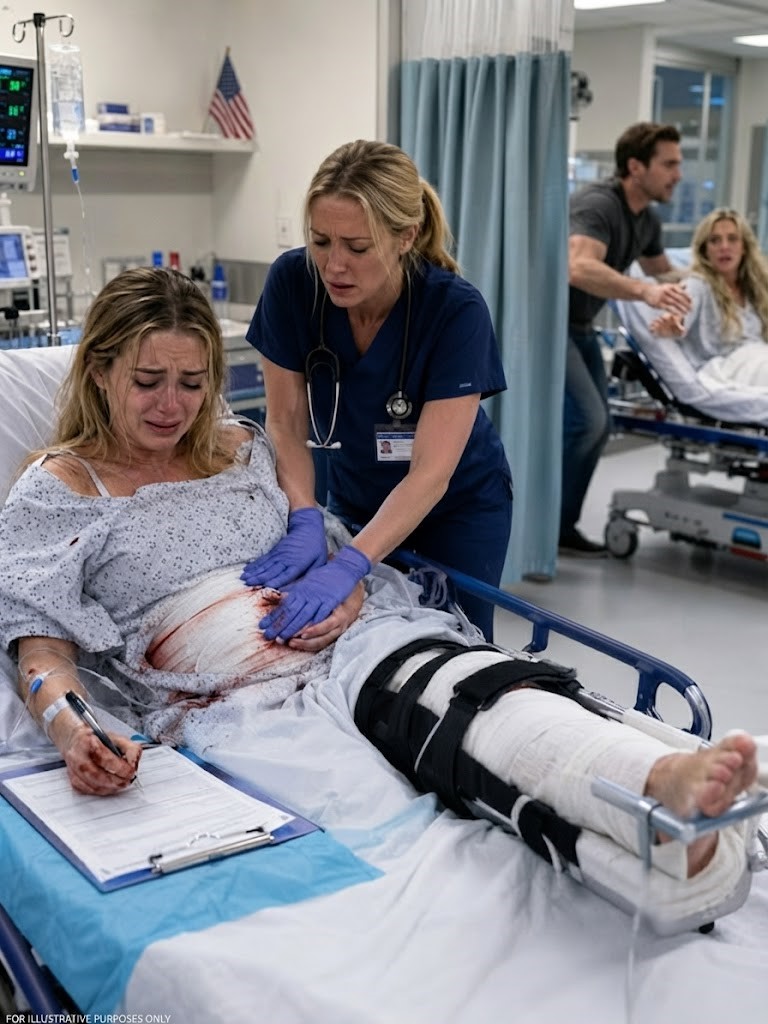
I had internal bleeding, a shattered right leg, and a nurse pressing both hands into my abdomen like she could keep my body from quitting by sheer willpower.
“Mr. Blackwood,” the nurse said, her voice sharp enough to cut through the ER noise. “Your wife needs consent for emergency surgery.”
Caleb Blackwood turned.
For one second, his eyes landed on me.
My hair was stuck to my face. My hand hung off the side of the gurney. Blood dripped from my fingers onto the hospital tile.
Then Khloe made a sound behind the curtain.
Small.
Soft.
Perfectly timed.
“Caleb,” she whimpered. “I can’t breathe.”
He turned back to her so fast it was almost impressive.
“Save Khloe first,” he told the doctor.
The nurse froze.
The doctor looked at him like he had just confessed to something illegal.
I didn’t scream. I didn’t beg. I didn’t do any of the things people imagine they would do when their marriage dies in public.
I just watched my husband choose.
Again.
Caleb and I had been married for three years. Three years of his mother calling me “practical,” which in Blackwood language meant useful but disposable.
Three years of Khloe calling him at midnight because she had insomnia, anxiety, chest pressure, a bad dream, a headache, a vague emotional disturbance, or whatever phrase got Caleb into his Range Rover fastest.
Three years of me being told, “Don’t make this harder than it has to be, Lucia.”
Funny thing.
When a nurse is trying to keep you alive, everything becomes very simple.
The doctor leaned over me.
“Mrs. Blackwood, can you sign for yourself?”
I tried to lift my right hand. Nothing happened.
My left hand shook when they put the pen between my fingers.
The paper was clipped to a plastic board. Surgical consent. Risk of death. Risk of permanent disability. Risk of complications.
Clean black letters.
No room for romance.
No space for excuses.
I signed my name with blood under my fingernail.
Lucia Sinclair Blackwood.
The last word looked wrong.
Maybe it always had.
As they rolled me toward the operating room, Caleb finally glanced over.
His jaw tightened, annoyed.
“Lucia,” he said, “don’t do this right now.”
Don’t do this.
I almost laughed, but breathing already felt like someone had parked a truck on my ribs.
Khloe’s curtain shifted.
“Caleb,” she said weakly, “go check on her.”
Of course she said that.
Khloe always performed kindness in front of witnesses.
Caleb bent toward her, his voice low.
“Don’t worry about Lucia. She’s stronger than you.”
There it was.
My whole marriage in six words.
I was strong, so I could wait.
I was strong, so I could be ignored.
I was strong, so I could sign my own life away while my husband held another woman’s hand.
The operating room lights hit my face.
A nurse asked if there was jewelry I wanted removed.
I looked down at my wedding ring.
The band was stuck around my swollen finger. I twisted it hard enough to tear the skin.
The nurse winced.
“Mrs. Blackwood, we can cut it later.”
“No,” I whispered.
I pulled until it came loose.
A thin line of blood marked the gold.
“Put it in a bag,” I said.
“Is it important?”
I looked at it on the metal tray.
Three years of being polite. Three years of eating Thanksgiving dinner beside people who discussed me like a hired manager. Three years of waiting for Caleb to turn around.
“Not anymore.”
The anesthesiologist told me to count backward.
Before I reached seven, someone outside shouted, “Miss Reed is stable.”
Caleb’s voice answered, flooded with relief.
“Thank God.”
Then everything went black.
## Part Two — Transfer
I woke up alone.
No husband.
No flowers.
No anxious billionaire pacing beside my bed like a guilty man in a Netflix finale.
Just fluorescent lights, a beeping monitor, and pain so specific it felt personal.
My abdomen was wrapped tight. My right leg was locked in a brace. My throat was raw.
A nurse appeared when I moved.
“Mrs. Blackwood?”
“Sinclair,” I said.
She blinked.
“What?”
“My name is Lucia Sinclair.”
She didn’t argue. Smart woman.
Dr. Evans came in with a tablet and the face of a man who had seen too many marriages collapse in hospital rooms.
“Your surgery was successful,” he said. “But recovery will be difficult. You’ll need a second procedure on the leg, and we’ll be watching for infection.”
“What about Khloe?”
He paused.
“Mild concussion. Soft tissue bruising. She’s in observation.”
Of course.
The woman Caleb had saved first needed an ice pack and attention.
I needed metal in my leg and a miracle.
“Has my husband been here?” I asked.
The nurse looked away.
Dr. Evans didn’t.
“No.”
I nodded.
A smaller woman might have cried.
I asked for my phone.
The screen was cracked, but it still worked. No missed calls from Caleb. No messages asking if I had survived.
There were three voicemails from his mother.
I played the first.
“Lucia, Khloe is very shaken. When you wake up, you should go comfort her. Caleb has enough stress.”
The second.
“Do not punish Caleb because he signed Khloe’s papers first. You know her health history.”
The third.
“A Blackwood wife handles crisis with dignity. Don’t embarrass this family.”
I stared at the phone.
Then I deleted “Caleb ❤️” from my pinned contacts.
Love looked ridiculous next to a man who needed a reminder to check whether his wife had made it out of surgery.
I called a number I hadn’t used in months.
Ara Bennett answered on the third ring.
She had been my mother’s best friend before cancer took Mom and business took everyone else. Ara lived in Switzerland now and ran a private rehabilitation clinic for people rich enough to pretend pain was a scheduling problem.
“Lucia?”
“I need help.”
Her voice changed immediately.
“What happened?”
“Car crash. Emergency surgery. Bad leg. Worse marriage.”
One second of silence.
Then, “Send me your chart.”
No panic. No lecture. No “marriage takes work.”
Just action.
I liked her for that.
The nurse photographed my records. Dr. Evans watched quietly as I arranged a medical transfer.
“You understand the risk?” he asked.
“Yes.”
“Your husband should be informed.”
“He should have been informed when I was dying.”
That ended the discussion.
By dusk, Ara’s medevac team had arrived. They moved like people who charged by the minute and earned it.
A nurse handed me a clear plastic bag.
Inside was my wedding ring.
“Do you want to put it back on?”
“No.”
The door opened.
Not Caleb.
Arthur, his assistant.
Arthur had the exhausted posture of a man paid well to clean up emotional crime scenes.
“Mrs. Blackwood,” he started.
“Miss Sinclair.”
His mouth shut.
Good.
“Mr. Blackwood sent me to check on you,” he said. “Miss Reed had a dizzy spell, so he couldn’t leave.”
I smiled.
It hurt my stitches.
“Tell him I’m touched. Truly. Nothing says devoted husband like outsourcing concern.”
Arthur looked at the floor.
I took the ring bag and placed it in an empty pill box.
“Give him this.”
Arthur stepped back like I’d handed him a grenade.
“Miss Sinclair, maybe you should wait until you’re less upset.”
“I signed a surgical consent form while bleeding internally. I think I’m qualified to make decisions.”
He took it.
As the medical team wheeled me out, we passed Khloe’s room.
The door was half-open.
Caleb sat beside her bed, one hand over hers.
Khloe’s voice drifted into the hallway.
“Is Lucia mad at me?”
Caleb answered without hesitation.
“She’ll get over it.”
The gurney kept moving.
I looked at his back.
That was how I would remember him.
Not his face. Not his hands. Not his wedding vows.
His back.
The elevator doors closed.
My phone buzzed.
A text from Caleb.
You’re awake. Go see Khloe. She’s crying.
I blocked him before the elevator hit the lobby.
At nine that night, Caleb finally remembered he had a wife.
By then, I was already on a private medical flight over the Atlantic.
## Part Three — The Bill Comes Due
Caleb found out I was gone from a nurse with excellent boundaries.
“Where is my wife?” he demanded.
“I’m sorry, Mr. Blackwood. Miss Sinclair has been transferred.”
“Transferred where?”
“Patient privacy laws prevent disclosure.”
“I’m her husband.”
Dr. Evans, apparently tired of billionaires using volume as a legal strategy, walked over.
“Interesting,” he said. “You remember that now.”
Arthur told me later that Caleb went pale.
Dr. Evans didn’t raise his voice.
He didn’t need to.
“When your wife needed emergency consent, you told us to prioritize Miss Reed. When your wife woke from surgery, you were still with Miss Reed. When your wife arranged transfer, you sent an assistant.”
Caleb said, “I didn’t know she was that badly hurt.”
“The nurse told you.”
“I panicked.”
“You panicked and still knew exactly who mattered to you.”
That sentence followed him home.
Three days later, he received an email from my attorney.
Subject: Dissolution of Marriage — Sinclair v. Blackwood.
Leo Thatcher had gone to college with me. At my wedding, he watched Caleb leave the reception for twenty-six minutes because Khloe “needed air.”
Leo had leaned toward me then and said, “Some men marry a wife and keep a shrine.”
I thought he was being dramatic.
Turned out he was being generous.
The divorce packet was clean, brutal, and itemized.
Premarital assets: separate.
Marital assets: divided under state law.
Funds from joint accounts spent on Khloe Reed: $542,000.
Medical memberships, hotel suites, jewelry, first-class flights, “wellness retreats,” and one Cartier bracelet purchased “for recovery support,” because apparently healing requires diamonds.
Family expenses I personally covered for the Blackwoods: $184,000.
Aspen wellness deposits. Country club charity gala payments. Private medical concierge fees for Caleb’s parents. Staff bonuses. Floral invoices. Auction purchases his mother called “family necessities.”
I had receipts.
Every spoiled person eventually meets a spreadsheet.
Caleb called Leo within six minutes.
“I want to speak to my wife.”
“Miss Sinclair declines direct contact.”
“She’s my wife.”
“Currently.”
Leo enjoyed that word.
Caleb’s mother, Eleanor Blackwood, found out at afternoon tea.
She opened the FedEx envelope in front of four relatives and Khloe, because she thought it was an apology gift.
The universe has taste.
“Divorce?” Eleanor snapped. “After one accident?”
Khloe sat on the cream sofa wearing a pale Chanel cardigan and the diamond bracelet I had bought Eleanor at auction.
Borrowed, obviously.
People like Khloe never stole.
They were “lent” things.
“She’s probably in pain,” Khloe said softly. “Maybe she doesn’t mean it.”
Eleanor slapped the papers onto the table.
“She means money. They always do.”
A relative murmured, “Caleb gave her the Blackwood name. What more does she want?”
A signature before surgery, maybe.
Too niche for that crowd.
When Caleb arrived, he read the packet without speaking.
His face changed when he reached the accounting pages.
“Mom,” he said, “Lucia paid for these.”
Eleanor adjusted her pearls.
“She was part of this family.”
“She paid for your Aspen retreat.”
“And recovered beautifully there, thanks to her planning.”
“Mom.”
“What?” Eleanor snapped. “You were busy. Someone had to handle things.”
Someone.
Not Lucia. Not your daughter-in-law. Not a woman recovering from the death of both parents while trying to build a marriage.
Someone.
That word would have hurt me once.
In Switzerland, I was too busy learning how to stand.
Physical therapy was not cinematic.
Nobody clapped after three steps.
Nobody played piano music while I gritted my teeth through sweat and nausea.
The therapist said, “Again.”
So I did it again.
My leg shook. My abdomen burned. My body made ugly, practical arguments against movement.
I moved anyway.
Ara watched from beside the window, arms crossed.
“You’re angry,” she said.
“Yes.”
“Good. Use it. Just don’t live in it.”
I liked that too.
On day ten, I turned off location sharing with Caleb.
The notification would have hit his phone in Manhattan after midnight.
Lucia Sinclair has stopped sharing location with you.
He texted me from a new number.
Turn it back on. I’m worried.
I deleted it.
A minute later, another text.
Don’t punish me like this.
I actually laughed.
The therapist looked over.
“Good news?”
“No. Just a man discovering he is not the main character.”
After that, I canceled everything.
His parents’ Aspen retreat membership.
The family florist account under my AmEx Platinum.
Khloe’s private clinic billing authorization.
The estate staff payroll access I had maintained because Eleanor “didn’t do spreadsheets.”
Within two hours, the Blackwoods noticed my absence.
Not emotionally.
Financially.
Eleanor left a voicemail.
“Lucia, the retreat says this month’s fee was declined. Are you seriously being petty while I’m under stress?”
Khloe left one too.
“My follow-up appointment was awkward because your member account froze. I hope you’re proud.”
I forwarded both to Leo.
He replied: Useful.
That was why I paid him.
The birthday gala came the following week.
Caleb’s grandmother was turning eighty at the Westchester Country Club, and Eleanor wanted me on video.
Not to celebrate.
To apologize.
Caleb called the night before.
I answered this time.
He was quiet.
“Lucia.”
“Caleb.”
“You don’t have to attend tomorrow.”
“Why? Your mother said the family needs closure.”
“She wants to humiliate you.”
“How sweet. A Blackwood tradition.”
He exhaled.
“You’re not well.”
“You finally noticed.”
Silence.
Then, “Please don’t do anything you’ll regret.”
I looked at the evidence folder on my laptop.
Hospital records.
Triage reports.
Voicemails.
Khloe’s Instagram posts calling me jealous and unstable.
Bank statements.
The ring.
“I won’t,” I said. “Regret was always your department.”
## Part Four — The Gala
The ballroom looked expensive enough to excuse bad behavior.
White roses. Gold chargers. Champagne towers. A jazz trio pretending nobody in the room was waiting for blood.
My face appeared on the big screen at 7:30.
I sat in a wheelchair at Ara’s clinic, my right leg braced, a beige cashmere wrap around my shoulders.
No heavy makeup.
No tragic lighting.
Just evidence in human form.
The room quieted.
Eleanor stepped forward, smiling like she had practiced in a mirror.
“Lucia, darling. We’re so glad your health allows you to join us. Tonight is about family and forgiveness.”
“Is it?”
Her smile twitched.
“Yes. Khloe has been very upset.”
Khloe stood beside Caleb in a soft pink designer dress. Tiny bandage on her arm. Perfect.
“Lucia,” she said, voice trembling on command, “I never wanted Caleb to choose. I hope you know that.”
I tilted my head.
“Then what a coincidence that he always did.”
A few people shifted in their chairs.
Eleanor’s tone sharpened.
“You have made this situation much uglier than necessary. Caleb cared for Khloe first because she has a delicate medical history. As his wife, you should understand.”
Caleb said, “Mom, stop.”
Eleanor ignored him.
“In front of this family, I want you to say you will withdraw the divorce and stop blaming Khloe.”
I looked into the camera.
“Absolutely. Let’s clear up everything.”
Leo clicked the first slide.
The ER triage report filled the screen.
Khloe Reed: Level Three. Mild concussion. Stable vitals. Observation recommended.
Lucia Sinclair Blackwood: Level One. Blunt abdominal trauma. Suspected internal hemorrhage. Open fracture. Immediate surgery required.
The jazz trio stopped playing.
Someone whispered, “Jesus.”
I held up the surgical consent form.
“My husband signed Khloe’s observation form at 2:51 p.m. I signed my own emergency surgery consent at 2:56 p.m.”
The scan showed my signature.
Crooked.
Shaky.
Blood at the edge.
“For anyone unfamiliar with trauma medicine,” I continued, “level one means doctors move fast because the patient may die. Level three means you monitor and maybe order imaging.”
Khloe grabbed Caleb’s sleeve.
“I didn’t know,” she said.
I looked at her.
“You were behind a curtain saying you couldn’t breathe.”
“I was scared.”
“Everyone in the ER was scared. Some of us also had internal bleeding.”
A woman at the front table covered her mouth.
Eleanor stepped forward.
“This is not appropriate for a birthday party.”
“You asked for family truth,” I said. “I brought documents. I know that’s considered vulgar in rooms where gossip usually does the job.”
Leo played the voicemail.
Eleanor’s own voice filled the ballroom.
“Do not punish Caleb because he signed Khloe’s papers first. A Blackwood wife handles crisis with dignity.”
The room went still.
Eleanor’s hand tightened around her champagne flute.
“You recorded me?”
“No. You left a voicemail. Technology did the rest.”
A few people looked away. Others stared straight at her.
Khloe clutched her chest and swayed.
“Caleb,” she whispered, “I feel sick.”
Old trick.
Reliable trick.
A classic.
Caleb looked at her.
For once, he did not move.
Khloe stumbled into the chair herself.
The humiliation did more damage than the fall.
Leo clicked the final slide.
A summary of Khloe’s last three years of medical reports. Personal information redacted. Relevant claims highlighted.
No diagnosed chronic heart condition.
No documented emergency cardiac event.
No medical basis for priority over a level-one trauma patient.
Khloe’s face changed.
Not fragile.
Caught.
“I was afraid,” she snapped. Then she remembered the room and lowered her voice. “I was afraid of losing Caleb.”
The sentence landed beautifully.
Half the ballroom heard it as confession.
Caleb turned toward her.
“Losing me?”
Khloe’s mouth opened.
Nothing useful came out.
At the head table, Caleb’s grandmother lifted her cane and struck the floor once.
Sharp.
“Enough.”
Eleanor flinched.
“Mother—”
“I said enough.”
The old woman looked at the screen.
“Lucia, this family wronged you.”
For the first time all night, I felt something loosen.
Not forgiveness.
Something cleaner.
A fact finally spoken out loud.
I nodded.
“Thank you.”
Then I looked at Caleb.
“The divorce offer expires in three days. After that, I file.”
His face was wrecked.
Too late, but wrecked.
I ended the call.
Ara handed me water.
“You handled that well.”
“I almost vomited twice.”
“Still counts.”
I leaned back in the wheelchair.
My whole body hurt.
But the pain felt honest.
Pain from healing.
Pain from cutting out rot.
Pain that didn’t ask me to make Khloe comfortable.
The gala destroyed the Blackwood version of the story by midnight.
By morning, country club gossip had upgraded from “Lucia is jealous” to “Khloe Reed may be insane.”
I enjoyed the efficiency.
Khloe tried to fix it.
Of course she did.
She posted a hospital selfie on Instagram with a caption about misunderstandings, emotional trauma, and “wives who mistake family love for betrayal.”
Leo saved it before she deleted it.
Then she flew to Switzerland.
Because women like Khloe never understood locks until they were on the wrong side of one.
She found me in the clinic café after therapy.
Cream coat. Barely touched makeup. Designer sadness.
“Lucia,” she said. “Can we talk?”
I glanced at the security camera.
Then at my phone.
Voice memo. Record.
“Talk.”
She sat across from me.
“What more do you want?”
“A divorce. My money. A functioning leg. Reasonable list.”
“You’ve tortured Caleb enough.”
I stirred my coffee.
“I’m in rehab learning how to walk. Caleb can survive emotional discomfort.”
Her mouth tightened.
“He loves me.”
“Then congratulations. You finally won the grand prize: a guilty man with no boundaries.”
Her mask slipped.
“You knew what we were. You knew he’d always take care of me.”
“Khloe, nobody put a gun to Caleb’s head and made him marry me at city hall.”
“He married you because I was abroad.”
“Then again, take it up with him. I don’t handle returns.”
She leaned in.
“You have no family, Lucia. No parents. No real backing. Without the Blackwood name, what are you?”
I tapped the phone.
“Recording you, apparently.”
Her eyes dropped to the screen.
“You little—”
A nurse stepped closer.
Khloe sat back.
Then she smiled.
“You think this matters? Caleb promised my brother he’d take care of me forever. Jared died because of him. That guilt owns him.”
I watched her.
There it was.
Not illness.
Not innocence.
A leash.
“As long as I bring up Jared,” she said, “Caleb softens. He always does. He owes my family.”
I stopped the recording.
Khloe realized too late.
“Delete that.”
“No.”
“You’ll regret this.”
I pushed my wheelchair back.
“Khloe, I almost died. Regret has to get in line.”
Leo sent the recording to Caleb first.
Not the media.
Not yet.
Caleb was in a board meeting when he listened.
Arthur told me everyone went silent when Caleb stood and walked out without a word.
He called Khloe.
She answered crying.
“Caleb, thank God—”
“You went to see Lucia.”
“I wanted to apologize.”
“You said I owed your family.”
Silence.
“Caleb, she provoked me.”
“You said you use Jared to make me soften.”
“I didn’t mean—”
“I heard your voice.”
Khloe’s crying became louder.
“Are you abandoning me?”
Caleb said something he should have said years earlier.
“I abandoned my wife first.”
Then he hung up.
## Part Five — The End of Waiting
Caleb flew to Switzerland the next day.
He waited outside Ara’s clinic in the snow wearing a coat too expensive for the weather and shoes too polished for humiliation.
Through the window, I saw him.
He saw me.
For three years, I had waited for Caleb.
At restaurants.
At charity galas.
In our foyer after midnight.
Outside Khloe’s hospital rooms.
Beside cold dinners and dying flowers.
Now he was the one standing outside a locked door.
Symmetry is not justice, but it has style.
Ara crossed her arms.
“Want security to move him?”
“No.”
“Want to see him?”
“Tomorrow.”
She looked surprised.
“Why?”
“Some endings need witnesses.”
The next morning, they brought me to the visitors’ lounge.
Caleb stood when I entered.
He looked thinner. Unshaven. Expensive misery still looks like misery.
“Lucia.”
“Sit down, Caleb.”
He sat.
His eyes went to my leg brace, then to the careful way I held myself because the abdominal wound still pulled when I breathed too deeply.
“Does it hurt?”
I stared at him.
“What a bold question.”
His face tightened.
“I’m sorry.”
“For which part?”
He swallowed.
“All of it.”
“That’s vague. Try harder.”
He looked down.
“For choosing Khloe at the crash. For not signing your consent. For not visiting you after surgery. For sending Arthur. For texting you to comfort her. For letting my family treat you like staff with a wedding ring.”
Better.
Still late.
I slid a folder across the table.
“Final divorce agreement. Sign it, or we go to court.”
His hand hovered over it.
“I don’t want a divorce.”
“I didn’t want to sign my own surgical consent. We all have bad days.”
He flinched.
“Lucia, give me one chance to fix this.”
“You can’t fix what required my near-death experience for you to notice.”
“I’ll change.”
“Yes. For a while. Guilt is very energetic at first.”
“That’s not fair.”
“No, Caleb. What wasn’t fair was lying on a gurney while my husband negotiated my place behind another woman’s mild concussion.”
His eyes filled.
A tear dropped onto the folder.
Once, that would have destroyed me.
Now it only made me tired.
He knelt beside my wheelchair.
“Please.”
I looked at him, calm as a locked door.
“When I took off my ring in the operating room, I wondered if you would regret it if I died.”
His jaw clenched.
“Lucia—”
“Then I realized I couldn’t build a life around whether you might feel bad after the damage was permanent.”
He didn’t speak.
I touched the folder.
“Sign, Caleb.”
He did not sign that day.
So I returned to New York three months later with a cane, a Prada tote, and enough evidence to make three PR teams sweat.
Caleb met me at JFK with white roses.
He had forgotten them on our first anniversary.
I had bought my own bouquet that night and threw it out when it wilted.
Now he remembered.
Perfect timing for a man who specialized in arriving after the funeral.
“I came to pick you up,” he said.
I glanced at the flowers.
“No, thank you.”
His face fell.
“My lawyer is waiting.”
“Let me come with you.”
“No.”
I walked past him.
He reached out.
Ara blocked his hand.
“Touching her without permission would be a poor choice.”
Ara was small, elegant, and terrifying. Caleb wisely stepped back.
Then Khloe made her final mistake.
She gave an interview.
A pop culture blog posted it under the headline:
BLACKWOOD DIVORCE DRAMA: CHILDHOOD FRIEND BREAKS SILENCE.
Khloe wore pale makeup and a soft sweater, looking like a luxury candle with a lawsuit.
“I never meant to hurt Lucia,” she told the camera. “Caleb and I are just family. I hope she stops punishing him because of me.”
The article called me cruel.
Jealous.
Money-hungry.
A wife using injuries for leverage.
Leo sent me the link while my dressing was being changed.
“Now?” he asked.
I looked at the screen.
“Now.”
The press conference was held three days later at the Plaza Hotel.
Not tabloids.
Real press.
Business reporters. Legal reporters. Society columnists. The kind who could turn a billionaire family’s mess into a permanent Google result.
Caleb attended.
His parents attended.
Khloe arrived late, wearing sunglasses indoors.
A choice.
Leo opened with facts.
Not feelings.
The ER audio played first.
The nurse’s voice was clear.
“Mr. Blackwood, Miss Sinclair needs a signature.”
Caleb’s voice answered.
“She’s conscious, isn’t she? Save Khloe first.”
The room went silent.
Then the triage reports appeared.
Then the consent form.
Then the financial records.
A reporter asked, “So Miss Reed did not require emergency surgery?”
“No,” Leo said. “Observation only.”
Khloe stood.
“I thought I was dying.”
I picked up the microphone.
“You were scared. I don’t dispute that. But fear is not a license to rewrite medical records.”
Another reporter asked about cyberbullying.
Leo displayed Khloe’s Instagram posts, her interview clips, and payment records connected to accounts that had spread false claims about me.
Khloe sat down.
Fast.
Eleanor Blackwood finally snapped.
“Lucia, must you destroy this family publicly?”
I looked at her.
“No. You destroyed it privately. I brought receipts.”
Camera shutters fired.
Caleb bowed his head.
I took out the ring box.
“This ring was removed on the operating table before emergency surgery. I survived that day. I intend to honor the woman who signed for herself when nobody else did.”
A reporter asked, “Are you certain you want the divorce? Mr. Blackwood appears regretful.”
Caleb looked up.
Everyone waited.
I stood with my cane.
My leg hurt.
I stood anyway.
“Regret is his business,” I said. “Divorce is mine.”
The quote ran everywhere by dinner.
The next morning, Caleb signed.
We met at the county courthouse at nine.
No family.
No Khloe.
No orchestra swelling in the background.
Just a judge, two attorneys, and a marriage reduced to signatures.
The judge asked, “Are both parties entering this agreement voluntarily?”
“I am,” I said.
Caleb was quiet.
“Mr. Blackwood?”
He looked at me.
For a second, I saw the man I used to wait for.
Then I remembered the ER hallway.
“I am,” he said.
The stamp hit the paper.
Small sound.
Final sound.
Outside on the courthouse steps, Caleb stopped me.
“Lucia.”
I turned.
“I did love you,” he said.
I believed him, strangely.
Not the way I needed.
Not the way that mattered.
“Maybe,” I said. “But you loved being needed more. Khloe made you feel heroic. I made you feel stable. Neither of those is the same as loving me.”
He looked destroyed.
I felt no pleasure in it.
Only release.
“You loved that I stayed,” I said. “Now I don’t.”
I walked down the steps.
My cane clicked against stone.
Behind me, Caleb did not follow.
The settlement moved quickly after that.
Caleb repaid the marital funds used on Khloe.
His grandmother reimbursed what I had spent on the estate and sent an apology letter through her attorney.
I accepted the wire transfer.
I did not open the letter.
Some apologies are better as bank confirmations.
Khloe’s family paid part of her liability to avoid court. Her social circle dropped her quietly, which is how rich people bury scandal when they can’t deny it.
She left for Europe.
Not for treatment.
For distance.
Caleb never married her.
That part surprised people.
It did not surprise me.
Khloe had been useful when she made him feel noble. Once she became evidence, the romance lost its lighting.
Six months later, my first solo exhibition opened in SoHo.
The theme was self-rescue.
The first painting showed a hospital hallway.
On one side, a man stood with his back turned toward a closed curtain.
On the other, a woman on a gurney reached for a pen.
Her hand was stained red.
The paper beneath it waited for a signature.
People stood in front of that painting for a long time.
One young woman asked me, “Did he ever turn around?”
I looked across the gallery windows.
Caleb stood on the opposite sidewalk.
He didn’t come in.
He just watched.
“Yes,” I told her. “He turned around.”
The young woman waited.
I smiled.
“But by then, she was already gone.”
On the final day of the exhibition, I placed my wedding ring in a small glass case.
The gold was clean except for one tiny dark mark that would not polish out.
Beside it, I wrote one sentence.
Removed on the operating table.
No explanation.
No accusation.
Just a fact.