She looked confused. “Sir?”
“Your name.”
“Hannah Reed.”
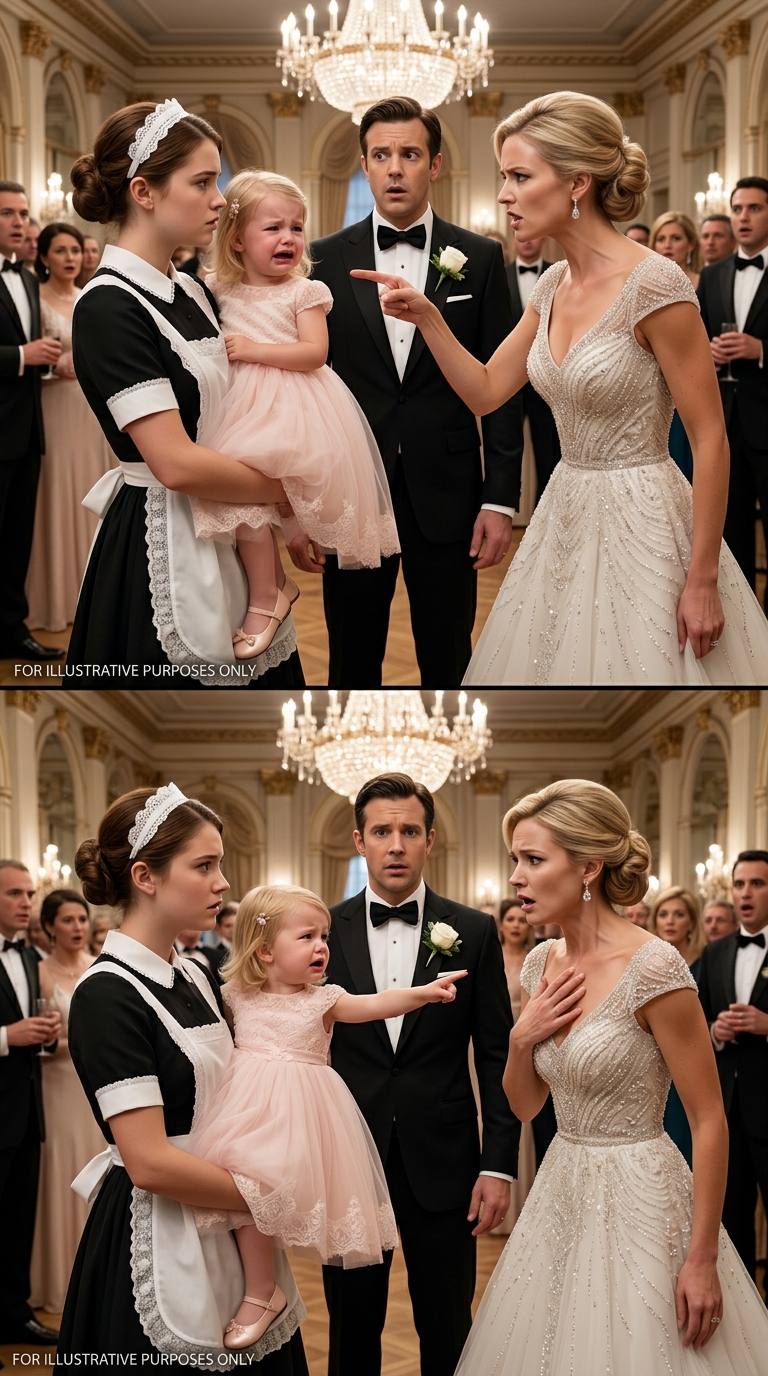
“Hannah,” he said. “Your daughter did nothing wrong.”
Her eyes filled instantly, though she did not let the tears fall. “Thank you, sir.”
Celeste made a soft sound behind him. “Nathan, you cannot be serious.”
He turned.
The ballroom was watching again. Every guest. Every waiter. Every musician. Every person who had moments ago pretended not to see a child cry.
“I’m completely serious,” he said.
Celeste’s eyes warned him not to embarrass her.
For eighteen months, that look had guided him. At dinners, fundraisers, interviews, private arguments, public smiles. It said, Not here. Not now. Remember who we are.
Tonight, for the first time, Nathan wondered who she meant by we.
He looked back at Hannah. “Come with me. Both of you.”
“Sir, I can go back to work. I don’t need—”
“You’re not going back to work tonight.”
Panic flashed across her face. “Please don’t fire me.”
The words came too quickly, too automatically.
Nathan felt the room hear them.
He lowered his voice. “I’m not firing you.”
She stared at him as if he had spoken a language she had forgotten.
“Come sit down somewhere quiet,” he said. “Your daughter has had enough of this room.”
Hannah hesitated only because poor people learn that kindness from powerful people often has a hook hidden inside it. But Lily was shaking in her arms, and that decided it.
She followed him out.
Behind them, Celeste stood in the center of her own engagement party, smiling as if cameras were still pointed at her, while the room slowly began to understand that something important had cracked.
In the small library off the east hall, the world softened.
The party became a muted throb beyond the walls. A fire burned low behind a brass screen. Rain tapped against the windows. Hannah sat on the edge of a leather chair with Lily curled in her lap, the stuffed rabbit pinned between them.
Nathan stood by the mantel, unsure what to do with his hands.
He had negotiated billion-dollar contracts without blinking. He had testified before Congress. He had fired executives twice his age. But he did not know how to apologize for a wound he had not personally delivered and still somehow owned.
“How long have you worked here?” he asked.
“Twenty-two months.”
“I didn’t know you had a daughter.”
Hannah gave a small, tired smile. “Most people here don’t know much about the staff unless something goes wrong.”
There was no accusation in it.
That made it worse.
“Where is her father?”
The smile disappeared. “Gone.”
“I’m sorry.”
“He left when she was seven months old. Sent money twice, then nothing. I stopped waiting after the first year.”
Lily lifted her head. “Mama, can we go home?”
“In a little bit, baby.”
Nathan crouched again, keeping distance this time. “Lily, do you like hot chocolate?”
She looked at her mother for permission.
Hannah nodded cautiously.
“Yes,” Lily whispered.
Nathan opened the library door and asked a passing waiter to bring hot chocolate, water, and something simple from the kitchen. Then he closed the door and faced Hannah.
“I need to ask something, and I don’t want you to answer like you’re afraid of losing your job.”
“That’s hard to promise, sir.”
Fair.
Nathan nodded. “Did Mrs. Bell know your sitter canceled?”
Hannah looked down.
That answer was enough.
“She knew,” Nathan said.
“She said everyone had problems, and tonight wasn’t the night for mine.”
“Why didn’t you use the employee childcare program?”
Hannah’s expression changed.
It was quick, but Nathan caught it.
“What?” he asked.
“There isn’t one anymore.”
He frowned. “Yes, there is. Harrington House has emergency childcare coverage for household staff and company employees working mandatory events. It was added last year through the Whitmore Family Initiative.”
Hannah stared at him.
The fire popped.
“Mr. Harrington,” she said carefully, “that program was canceled six months ago.”
“No, it wasn’t.”
She said nothing.
Nathan pulled his phone from his pocket, opened his company benefits portal, searched the internal policy, and felt irritation rise when he saw the childcare benefit still listed as active. Then he called his chief of staff.
It was nearly ten o’clock, but Martin Bellamy answered on the second ring.
“Nathan?”
“The emergency childcare benefit for household and event staff. Is it active?”
A pause.
“It should be.”
“Should be is not an answer.”
Another pause. “I’ll check.”
“Check now.”
Hannah looked like she wanted to vanish into the chair.
Lily had fallen quiet, thumb near her mouth, eyes half-closed from exhaustion.
While they waited, Nathan asked Hannah practical questions. Where she lived. How far she commuted. How often she worked late. Whether Lily attended daycare. Hannah answered with the flat precision of someone used to budgeting every hour, every dollar, every ounce of energy.
She lived in Bridgeport in a one-bedroom apartment with heat that worked most days. She took two buses and one train. Lily attended a subsidized daycare that charged late fees Hannah could not afford, which meant every delayed train became a crisis. Hannah worked six days a week and picked up catering shifts on Sundays when she could. She had not seen a doctor in fourteen months because Lily’s asthma medication came first.
Nathan listened.
At first, he listened with sympathy. Then with shame. Then with something colder.
Because none of this was inevitable. Not in his house. Not under his name. Not while he donated millions to conferences about dignity in labor and gave speeches about building humane systems.
His phone rang.
Martin’s voice was careful. “The benefit was suspended.”
“By whom?”
“Operational review through the Whitmore Family Initiative.”
Celeste.
Nathan did not say her name.
“Why wasn’t I told?”
“The review was categorized as a temporary budget reallocation. It was approved by the Initiative board.”
“And who chairs the board?”
Silence.
Nathan closed his eyes.
Martin said, “Celeste.”
Hannah shifted as if she had heard enough to know she should not be hearing any more.
Nathan thanked Martin, ended the call, and stared at the dark phone screen in his hand.
The hot chocolate arrived. Lily accepted it with two small hands and whispered thank you to the waiter. Hannah tried to refuse food until Lily’s stomach growled, and then she gave in.
Nathan watched the child eat a buttered roll in tiny bites.
“Why did she say that?” he asked quietly.
Hannah looked up. “What?”
“What Lily said in the ballroom. ‘I’m a person too.’ Where does a three-year-old learn that?”
Hannah stroked her daughter’s hair. Her face changed, softened and hurt at once.
“From me,” she said. “Every night before bed, I tell her, ‘You’re a person, Lily. You matter. No one’s money makes them more human than you.’”
Nathan could not speak.
“My mother used to clean offices,” Hannah continued. “She’d come home after midnight smelling like bleach, and people would still talk down to her like she was lucky to breathe the same air. I promised myself my daughter would never think being poor meant being less.”
Lily leaned against her mother, sleepy and safe now.
Nathan looked at them and felt, with sudden and almost physical force, the full emptiness of the house he owned.
All those rooms. All that marble. All that silence.
A house could be full of people and still have no humanity in it if the people with power refused to see anyone serving them as real.
The party ended just before midnight.
Nathan did not return to the ballroom except to thank the guests for coming. He did not make the toast Celeste had rehearsed with him. He did not kiss her for the photographers. He did not announce a wedding date.
Celeste waited for him in his study after the last car left.
She had changed out of the red gown into a silk robe, her hair brushed loose over her shoulders. She looked less like a fiancée than a queen displeased by weather.
“You humiliated me tonight,” she said.
Nathan closed the door. “That’s what you think happened?”
“I think a staff member’s child wandered into our engagement party, and instead of letting me handle it, you turned it into a morality play.”
“She’s three years old.”
“And her mother made a reckless choice.”
“Her mother made the only choice left after the childcare benefit was suspended.”
Celeste’s face did not change, but something behind her eyes tightened.
Nathan noticed.
He wondered how many times he had failed to notice before.
“The Initiative reviewed several programs,” Celeste said. “Temporary cuts were necessary.”
“To fund what?”
She crossed her arms. “Do not interrogate me like an employee.”
“I’m asking you as the man whose name is on the checks.”
“And I’m answering as the woman who has spent the last year making your public life manageable. You want to be adored by workers, respected by investors, welcomed by old families, praised by journalists, and still never read a binder. Someone has to make choices.”
“You cut childcare for staff who work mandatory events.”
“I postponed an underused benefit.”
“You canceled the one benefit that would have kept Lily out of that ballroom tonight.”
Celeste gave him a look of polished disbelief. “So this is about the child.”
“No,” Nathan said slowly. “This is about the fact that when she cried, you saw an inconvenience.”
Celeste’s voice cooled. “And you saw a chance to feel noble.”
The words landed cleanly.
A year ago, maybe even a month ago, they might have worked. Celeste knew where his shame lived. She knew how to touch it and make him defend himself until the original question disappeared.
Tonight, he was too tired to be managed.
“Do you feel sorry?” he asked.
“For what?”
“For scaring her.”
Celeste looked away first.
It was brief.
It was enough.
“She will forget it,” she said.
Nathan shook his head. “Children don’t forget being made small. They just grow around it.”
Something flickered across Celeste’s face, impatience sharpened by fear. “You’re being dramatic because some maid’s daughter said something sentimental in front of a room full of bored millionaires.”
“Her name is Lily.”
Celeste laughed once. “Of course. Now you know her name.”
“Yes,” Nathan said. “And yours looks different to me than it did this morning.”
Her expression finally cracked.
“You are not going to throw away eighteen months over this.”
“No,” he said. “I’m going to investigate eighteen months because of this.”
By morning, Nathan had not slept.
At six-thirty, he was in the east office with Martin, two attorneys, and the internal finance director of the Whitmore Family Initiative on video. The first hour revealed incompetence. The second revealed arrogance. The third revealed something worse.
The childcare program had not merely been suspended. Its funds had been diverted into “brand repositioning and donor visibility events” connected to Celeste’s social campaign. Staff transportation stipends had been delayed. A hardship fund for domestic employees had been frozen. The Initiative still advertised all three programs publicly.
Nathan sat through it all without raising his voice.
That frightened Martin more than yelling would have.
“Who approved the language stating the benefits remained active?” Nathan asked.
The finance director swallowed. “Ms. Whitaker’s office.”
“Who signed off on the event staffing policy requiring full attendance with no childcare exceptions?”
“Mrs. Bell submitted it after speaking with Ms. Whitaker.”
“And Mrs. Bell is Celeste’s aunt.”
No one answered.
Nathan leaned back.
There it was.
Not a single act of cruelty. A system of it. Wrapped in philanthropy language, protected by family names, hidden behind the assumption that the people affected would be too afraid to complain.
At nine-fifteen, Hannah arrived for work through the staff entrance, expecting disaster.
Instead, Mrs. Alvarez, the assistant estate manager, met her with red eyes and a folder.
“Mr. Harrington asked that you meet him in the small conference room.”
Hannah’s legs weakened.
She had spent the night replaying the ballroom again and again. Lily’s tears. Celeste’s voice. Nathan’s unexpected kindness. None of it changed the practical truth that rich people could be kind at midnight and still terminate you in the morning because inconvenience had a cost.
She found Nathan standing beside the conference table, looking as exhausted as she felt.
“Hannah,” he said. “Thank you for coming.”
“I was scheduled.”
“I know.” He gestured to a chair. “Please sit.”
She did, gripping her purse in her lap.
He did not sit immediately.
“I owe you an apology.”
That was not what she expected.
Her lips parted, but no sound came.
“Lily should never have been put in that position,” he continued. “You should never have been forced to choose between your job and your child’s safety. The emergency childcare program should have been available to you. It wasn’t because people with authority misused funds and hid the consequences from me.”
Hannah stared at him.
“I’m not telling you this to make excuses,” Nathan said. “The house is mine. The company is mine. The responsibility is mine.”
Her throat tightened. “Mr. Harrington, I don’t want trouble.”
“You didn’t cause any.”
“People like me usually cause trouble just by telling the truth.”
He absorbed that quietly.
Then he pushed the folder toward her.
“Effective immediately, your salary is being increased by fifty percent. You’ll receive back pay for every mandatory event worked after the childcare benefit was suspended. Lily has a place at the Harrington Early Learning Center in Stamford, fully paid. Your schedule will be adjusted around drop-off and pickup. Transportation support begins this week. Medical coverage for dependent care has been corrected, including Lily’s asthma medication.”
Hannah did not touch the folder.
She looked at it like it might vanish.
“I don’t understand,” she whispered.
“These are not gifts,” Nathan said. “They are corrections.”
Her eyes filled.
He kept his voice steady because hers could not be.
“I also want to make something clear. You are not required to be grateful for receiving what should have already existed. You are not required to forgive anyone. You are not required to make me feel better.”
A tear slipped down Hannah’s cheek before she could stop it.
She wiped it quickly, embarrassed.
“I’m sorry,” she said.
“Please don’t apologize.”
“I don’t know what else to do.”
Nathan looked at her and realized that apology had become a survival language for her. Sorry for needing work. Sorry for needing childcare. Sorry for crying. Sorry for being seen.
He thought of Lily saying, I’m a person too.
“I wrote Lily a letter,” he said, taking a smaller envelope from the folder. “She can read it when she’s older. Or you can throw it away. That’s your choice.”
Hannah held the envelope carefully.
“What does it say?”
“That she told the truth in a room full of adults who needed to hear it.”
Hannah broke then.
Not dramatically. Not loudly. She folded over the folder, one hand covering her mouth, tears falling onto the table. Nathan looked away to give her privacy, but she shook her head.
“No,” she said through tears. “Look at me.”
He did.
“I want someone to see me for once.”
The words entered the room and stayed there.
So Nathan did.
That afternoon, Celeste arrived at the estate with her mother, her aunt Mrs. Bell, and the family attorney.
It was a mistake.
They expected an emotional man who could be guided back toward reason, or at least pressured into silence for the sake of reputation. What they found was Nathan in the formal dining room with his legal counsel, Martin, and a stack of documents arranged with surgical neatness.
Celeste sat across from him in cream wool and pearls.
“This has gone far enough,” she said.
Nathan placed one document on the table. “The engagement is over.”
Mrs. Whitaker inhaled sharply. Mrs. Bell looked at the attorney. Celeste did not move.
“You don’t mean that.”
“I do.”
“Because of a child?”
“Because of what the child revealed.”
Celeste’s mouth tightened. “You are making a catastrophic mistake.”
“I almost did.”
Her eyes flashed.
Nathan continued, “The Initiative will issue corrected financial statements. The diverted funds will be restored from my personal accounts today and recovered through legal channels after audit. Mrs. Bell is no longer employed by this estate. The board will be restructured. Staff benefits will be independently administered. And if any person in your family contacts Hannah Reed or any other employee outside formal legal process, I will consider it harassment.”
Mrs. Bell stood. “How dare you speak to us that way?”
Nathan looked at her. “You told a single mother mandatory attendance mattered more than her child. Sit down.”
She did.
Celeste stared at him as if he had become a stranger in his own house.
“You think this makes you good?” she asked quietly.
“No.”
“Then what do you think it makes you?”
Nathan looked toward the windows, beyond them to the wet gardens and the gray afternoon. For most of his adult life, he had mistaken success for proof that he had escaped all the powerless parts of himself. But Lily’s question had not made him good. It had made him unable to keep pretending.
“Responsible,” he said.
Celeste laughed softly, but there was pain beneath it now. Real pain, maybe the first honest thing she had shown him all week.
“You loved me yesterday.”
“I loved who I thought you were.”
“And who am I?”
Nathan hesitated.
Cruel would have been easy. Monster, easier. But Lily had asked for humanity, not revenge.
“You’re someone who learned to value control over kindness,” he said. “And I was someone willing to call that elegance because it benefited me.”
Celeste looked down.
For a second, he thought she might cry. Instead, she picked up her purse and stood.
“You’ll regret this when the story turns on you.”
“Maybe.”
“It always does.”
“Maybe.”
She waited for him to soften.
He did not.
When she left, she took the smell of expensive perfume with her, but the house did not feel emptier. It felt, for the first time in years, like a room after a fever breaks.
Three weeks later, the story did turn.
At first, society pages whispered that Nathan Harrington had abandoned his fiancée over a servant’s child. Then business commentators speculated about mental strain. Then anonymous sources attempted to paint Hannah as manipulative, irresponsible, unfit.
Nathan expected it.
What Celeste did not expect was that Nathan had learned something from Lily too.
Tell the truth simply.
So he did.
He released a public statement without Hannah’s name. It acknowledged failures in Harrington’s employee support systems, announced an independent audit of the Whitmore Family Initiative, restored suspended benefits, and committed money to emergency childcare access for hourly workers across every Harrington facility in the Northeast.
He did not mention Celeste.
He did not need to.
The audit did the speaking.
When the first article came out, Hannah read it on her phone while sitting on the floor of her apartment, Lily asleep beside her with the rabbit under one arm. Hannah’s name was not there. Lily’s name was not there. No one had turned her daughter’s pain into entertainment.
For that alone, Hannah cried again.
Not because a rich man had saved her.
That was not the lesson.
She cried because, for once, a powerful person had fixed something without demanding the wounded person become part of the spectacle.
By December, Lily had started at the Harrington Early Learning Center.
On her first morning, she stood outside the classroom door in a purple sweater, her curls brushed, her rabbit tucked beneath her arm. The room was bright and warm, filled with blocks, books, tiny chairs, painted handprints, and children arguing cheerfully over a toy fire truck.
Lily looked up at Hannah.
“Mama,” she whispered, “is this place for kids like me?”
Hannah crouched, her heart folding and unfolding at once.
“For exactly kids like you.”
Lily considered that.
“Do I have to be invisible?”
Hannah’s breath caught.
For months, those words had haunted her. Stay invisible, baby. Just for tonight. She had said it to protect her daughter. She knew that. But protection and harm could sometimes wear the same coat.
She touched Lily’s cheek.
“No,” Hannah said. “Not ever again.”
Lily smiled then, small and bright, and walked inside.
Nathan watched from the hallway, unseen by Lily but not by Hannah. He had come to tour the center with the new director, but when he saw them, he stopped far enough away not to intrude.
Hannah stood and met his eyes.
For a moment, neither spoke.
Then she walked over.
“She asked if she had to be invisible,” Hannah said.
Nathan looked toward the classroom. Lily was showing her rabbit to another child, solemnly explaining its missing eye as if describing a war hero.
“What did you tell her?”
“The truth.”
He nodded.
Hannah studied him. He looked different than he had at the party. Less polished, maybe. More tired. More present.
“I read about the audit,” she said.
“I’m sorry it needed one.”
“So am I.”
He accepted that.
Hannah appreciated that he did not rush to fill the silence. Powerful people often feared silence because silence left room for answers they could not control.
“Nathan,” she said, using his first name for the first time.
He looked surprised but not displeased.
“Thank you for not using her name.”
“Of course.”
“No,” Hannah said. “Not of course. A lot of people would have.”
He nodded once. “She gave me something. I didn’t want to take anything else.”
Hannah looked back into the classroom.
“She asks about the red lady sometimes.”
Nathan’s expression tightened. “What does she ask?”
“If the red lady is still mad.”
“What do you tell her?”
“I tell her grown-ups can be wrong, and it isn’t a child’s job to fix them.”
Nathan looked down.
“That’s a good answer.”
“I’m learning.”
“So am I.”
A month later, Celeste sent a letter.
Not to Nathan.
To Hannah.
It arrived at the estate because Celeste did not have Hannah’s home address, and to her credit, she had not tried to find it. Hannah almost threw it away. Then she sat in the staff breakroom, the same room where Lily had fallen asleep the night of the party, and opened it.
The handwriting was perfect.
Hannah,
I have started this letter several times and hated every version because each sounded like an attempt to make myself appear better than I was.
I was cruel to your daughter.
There is no elegant way to say that. There is no social explanation, no stress, no misunderstanding that changes it. She was frightened, and I made her feel smaller because I felt embarrassed and wanted control.
I do not expect forgiveness. I am not asking for it.
I only want you to know that I remember what she said. I hear it at moments I wish I did not. That may be the first useful discomfort I have allowed myself in years.
Please tell Lily, only if you believe it will help her, that the red lady was wrong.
Celeste Whitaker
Hannah read it three times.
Then she folded it and put it back in the envelope.
That night, while Lily sat at their kitchen table coloring a rabbit with six ears and a crown, Hannah said, “Remember the red lady from the big house?”
Lily looked up.
“She wrote a letter. She said she was wrong.”
Lily frowned seriously. “For yelling?”
“Yes.”
“Did she say sorry?”
“In her way.”
Lily returned to coloring. “Okay.”
Hannah almost laughed. “Just okay?”
Lily shrugged, as if adults made everything too complicated. “She shouldn’t yell at kids.”
“No,” Hannah said softly. “She shouldn’t.”
“Maybe she didn’t have a mama teach her.”
Hannah froze.
There it was again.
Not innocence exactly. Something cleaner than that. A child’s ability to see harm without needing to become cruel in return.
“Maybe,” Hannah whispered.
Spring came slowly to Connecticut.
The Harrington estate changed in ways visitors noticed and ways they did not. The staff entrance was repaired and repainted. The breakroom received real chairs, a window seat, a refrigerator that worked, and a bulletin board covered with childcare schedules, transportation options, and emergency contacts. Wages changed. Policies changed. Mrs. Alvarez became estate director. Every mandatory event included paid childcare as automatically as it included catering.
Nathan changed too, though not as dramatically as gossip wanted.
He did not become a saint. He still worked too much. He still expected excellence. He still had a temper he had to manage and a habit of disappearing into strategy when feelings became inconvenient. But he learned names. He asked better questions. More importantly, he stayed long enough to hear the answers.
On the anniversary of the engagement party that never became a wedding, Harrington House hosted another event.
Not a gala.
A family dinner for employees.
No photographers. No donors. No society writers. Just long tables set in the garden with string lights overhead, barbecue from a local restaurant, children running across the lawn, and music that did not require anyone to pretend.
Hannah came with Lily, who wore a blue dress and insisted the rabbit needed its own ribbon.
Nathan stood near the garden steps, watching the lawn fill with people who had worked inside his house for years but had never before been invited to simply belong there.
Lily spotted him and ran over.
“Mr. Nathan!”
He crouched in time for her to crash into him with a hug that startled them both.
Hannah started forward, embarrassed, but Nathan lifted a hand slightly to say it was fine.
Lily stepped back and studied him. “You’re not having a fancy party?”
“No,” he said. “This one is better.”
“Because kids can come?”
“Exactly.”
She nodded, satisfied. “Good.”
Then she reached into the pocket of her dress and pulled out something folded and wrinkled. “I made you a picture.”
Nathan unfolded it carefully.
It showed a huge house, a tiny rabbit, many stick-figure people, and a sun so large it took up half the page. At the bottom, in crooked letters Hannah had clearly helped her spell, it said:
EVERYBODY IS A PERSON.
Nathan looked at it for a long time.
His throat tightened in a way that would once have embarrassed him.
“Thank you, Lily,” he said. “I’m going to keep this in my office.”
She leaned closer, lowering her voice like she was sharing a secret. “So you remember.”
He smiled. “So I remember.”
Later that evening, after the food had been eaten and the children were sticky with melted popsicles, Hannah found Nathan standing alone by the rose garden. For once, he did not look lonely. Just quiet.
“She changed your life,” Hannah said.
He looked toward Lily, who was chasing another child around a tree with her rabbit held high.
“Yes,” he said. “But not because she was magical.”
Hannah looked at him.
“Because she told the truth,” he said. “And because, for once, I didn’t look away fast enough.”
Hannah smiled faintly. “That’s not a bad start.”
“No,” Nathan said. “It isn’t.”
Across the lawn, Lily fell down, laughed, got back up, and kept running.
No one told her she did not belong.
No one told her to be invisible.
No one looked at her like a stain on the floor.
She was just a child in a garden, beneath warm lights, carrying a battered rabbit through the kind of evening every child deserves at least once: safe, wanted, and fully seen.
And if anyone at that party remembered the old ballroom story, they remembered it differently now. Not as the night a poor child embarrassed a rich woman. Not as the night an engagement ended. Not even as the night a billionaire discovered guilt.
They remembered it as the night a little girl asked the simplest question in the world.
I’m a person too. Why are you being mean to me?
The question had moved through marble halls, through bank accounts, through boardrooms, through pride, through shame, until it changed policies, ended a false love story, repaired a broken system, and gave one tired mother enough room to breathe.
It did not fix the whole world.
But it fixed the part of the world within reach.
And sometimes, that is where humanity begins.