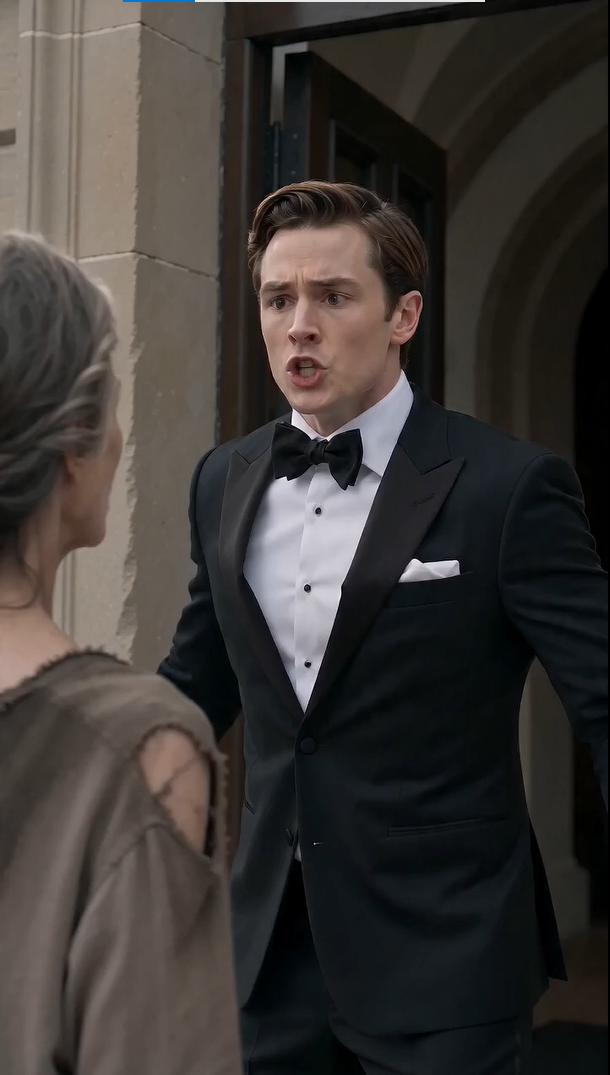
The groom couldn’t speak for a second.
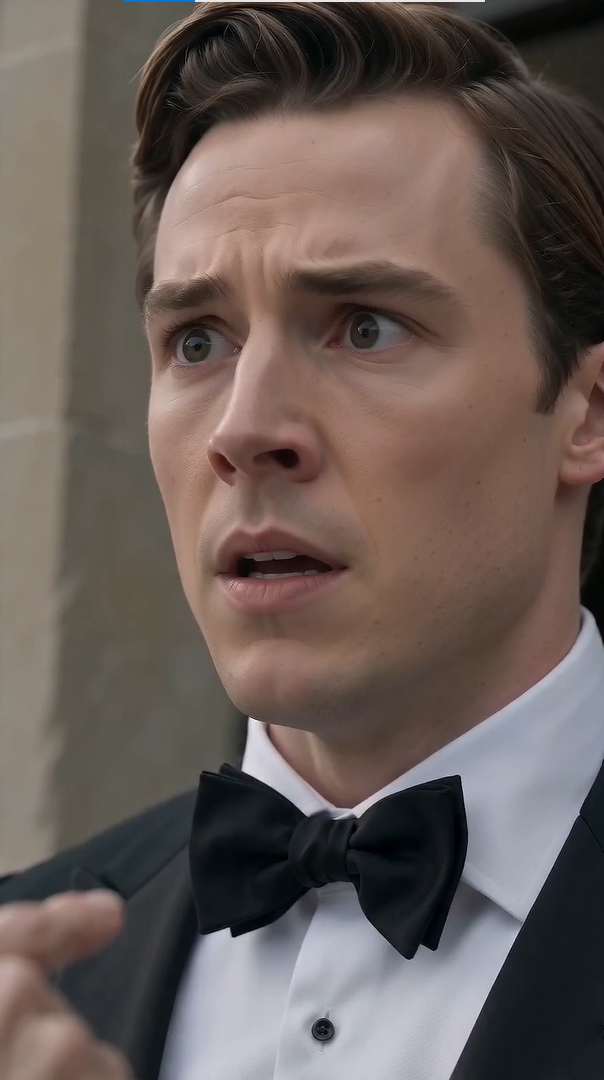
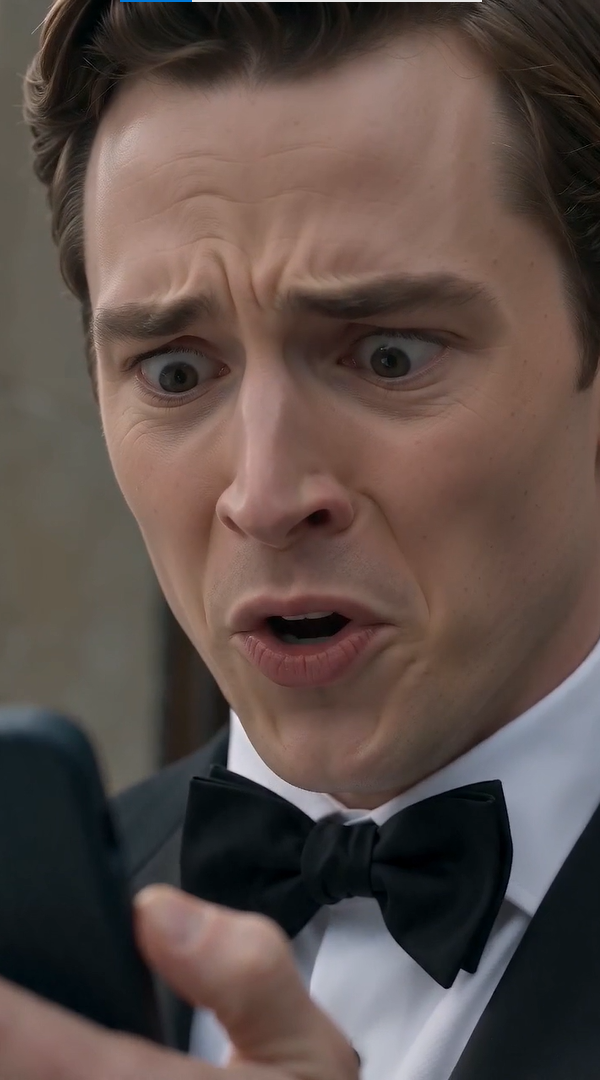
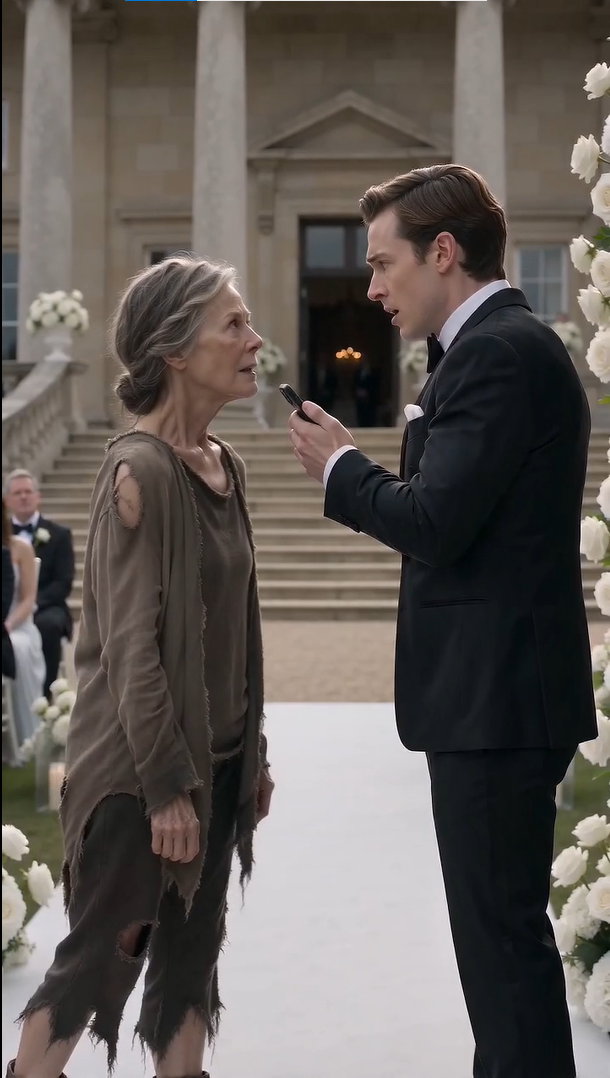
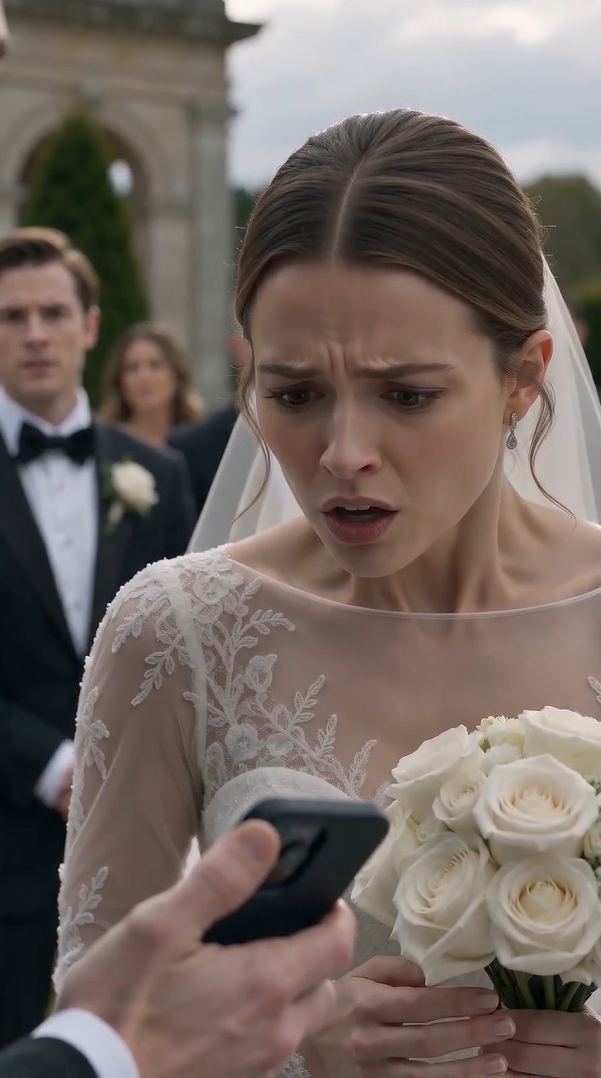
His lips parted, but no sound came out. He just stared at the woman, then back at the phone in his hand like he wanted reality to change if he looked twice.
The bride’s voice shook harder.
“Who is she?”
His throat tightened.
On the screen was an old photo. Faded. Grainy. But unmistakable.
A younger version of him.
And the woman beside him.
Not ragged. Not broken. Smiling.
Holding a newborn baby.
The bride stepped back like the ground had shifted under her feet.
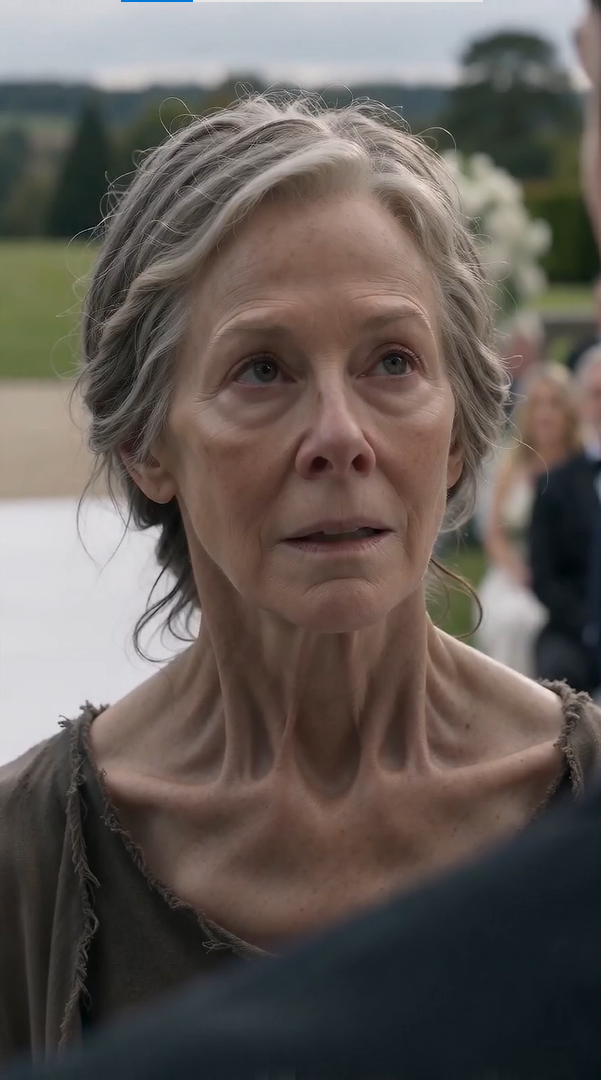
The guests stood frozen on the wedding steps, watching every breath, every glance, every tremor in his hands.
The beggar woman wiped her cheek with the back of her hand, but more tears kept coming.
“You said you’d come back,” she whispered. “You said you’d take care of us.”
The groom closed his eyes for one second.
When he opened them again, the shame was all over his face.
The bride stared at him in horror.
“Us?” she whispered.
The woman nodded, her body shaking now.
He looked away. That told the bride everything before he even spoke.
Then, finally, he forced the words out.
“She was… with me before.”
The bride’s breath caught.
The woman’s voice cracked. “Don’t do that. Don’t make me sound like a secret you forgot.”
He looked at her again, wrecked now.
She took one trembling step closer.
“You didn’t just leave me,” she said. “You left your son.”
A sound escaped the bride’s mouth — small, stunned, destroyed.
The groom went pale.
He tried to speak. “I didn’t know—”
But the woman was already shaking her head.
“You knew enough to disappear.”
The bride looked at him like she didn’t know his face anymore.
“Is it true?” she asked.
He couldn’t lie now. Not with the photo in his hand. Not with that woman standing in front of him. Not with all those eyes on him.
His silence was the answer.
The bride’s bouquet slipped from her fingers and fell onto the stone.
The woman reached into her coat with trembling hands and pulled out one more photo.
This one newer.
A thin little boy with his father’s eyes.
She held it toward him, crying openly now.
“He’s sick,” she whispered. “And before I let him believe his father never wanted him…”
Her voice broke.
“…I needed you to see his face.”
The groom took the photo with shaking fingers and stared at it like it was a mirror punishment had finally forced on him.
The bride stepped away from him slowly, tears running down her face.
Then she said the words that cut deeper than a scream.
“You weren’t standing at an altar today,” she whispered. “You were standing in front of your judgment.”
And this time, no one around them moved at all.
The groom looked at her, desperate now.
“Please,” he whispered. “Let me explain.”
The bride gave a broken laugh, but there was no humor in it.
“Explain what?” she asked. “That you forgot a woman? That you forgot a child? That you were about to promise me forever while your past was standing outside in torn shoes begging you to remember?”
His face twisted.
“I didn’t know he was sick.”
“But you knew he existed.”
The silence that followed was cruel.
He lowered his eyes.
The bride’s father stepped forward, anger burning across his face, but the bride lifted one hand to stop him.
“No,” she said quietly. “Let him answer.”
The groom swallowed.
“I was young,” he said, his voice barely above a whisper. “I was scared. I had nothing. Her family hated me. My family said she was trying to trap me. I thought if I left for a little while, I could come back when I had money.”
The woman in the old coat stared at him through tears.
“A little while?” she whispered. “Six years, Adrian. You call six years a little while?”
The name hit the crowd.
Adrian.
The groom flinched when she said it.
Not because it was his name.
Because she said it like someone who had once loved him enough to believe he would return.
The bride looked at the woman.
“What’s your name?” she asked softly.
The woman blinked, surprised that anyone had asked her anything with kindness.
“Leah,” she whispered.
The bride nodded slowly, tears still on her cheeks.
“And your son?”
Leah pressed the photo against her chest.
“Noah.”
The groom closed his eyes.
Noah.
The name seemed to pass through him like a blade.
He looked at the photo again.
The little boy was sitting on a hospital bed, his hair thin, his face pale, but his eyes bright in a way that made the pain worse. He looked like a child trying to smile so his mother wouldn’t cry.
“How sick?” Adrian asked, his voice breaking.
Leah shook her head.
“Don’t ask like a stranger.”
He looked up at her.
She stepped closer, pain sharpening every word.
“You don’t get to stand here in a wedding suit and ask me how sick like you’re hearing about someone else’s child. You should know his favorite color. You should know he hates carrots. You should know he sleeps with one sock on because he says both feet feel trapped.”
Adrian’s face collapsed.
“You should know,” she continued, crying harder now, “that every birthday he asked if his father was coming. And every year, I lied because I didn’t know how to tell a little boy that his father chose a better life and never looked back.”
The bride covered her mouth.
Several guests began wiping their eyes.
Adrian took one step toward Leah.
“I searched for you,” he said, but even he sounded ashamed of how weak it was.
Leah stared at him.
“Where?”
He had no answer.
She nodded painfully.
“That’s what I thought.”
He looked down.
“I was told you left the city.”
“I did,” she said. “Because I was pregnant, alone, and your landlord threw me out when the rent wasn’t paid.”
His eyes snapped up.
“What?”
“You stopped answering. Your number changed. Your friends said they didn’t know where you were. I waited at that old bus station for three nights because you once told me if we ever got separated, we would meet there.”
Adrian’s lips trembled.
“You waited?”
“With a baby inside me and no coat,” Leah whispered. “I waited until my feet bled.”
The bride’s eyes closed as if she couldn’t bear hearing more.
Leah’s voice grew smaller.
“And then I stopped waiting.”
A wind moved across the wedding steps, lifting the edge of the bride’s veil.
Nobody spoke.
The white flowers around the church doors suddenly looked cruel.
Adrian looked at Leah like he wanted to fall apart, but falling apart would have been too easy.
“Where is he?” he asked.
Leah held the photo tighter.
“At St. Mary’s Hospital.”
He turned immediately, as if his body had made the choice before his mouth could.
“I’m going.”
The bride’s father grabbed his arm.
“You are not leaving my daughter standing here in a wedding dress.”
The bride looked at her father.
“Let him go.”
Everyone turned to her.
Her voice trembled, but her eyes were clear now.
“If that child is sick, he should go.”
Adrian looked at her with tears in his eyes.
“Claire…”
She stepped back from him.
“Don’t.”
That one word stopped him.
She reached up with shaking hands and removed her veil.
The guests gasped softly.
Her mother began crying.
Claire held the veil for a moment, then placed it gently on the church steps beside the fallen bouquet.
“This wedding is over,” she said.
Adrian looked like he had been struck.
“Claire, please—”
“No.” Her voice broke, but she did not look away. “Today I was ready to become your wife. But I will not build my life on the bones of a woman you abandoned and a child you forgot.”
He covered his mouth, tears falling now.
Claire looked at Leah.
Then at the photo of Noah.
Her face softened through the pain.
“I’m sorry,” she whispered.
Leah’s lips trembled.
“You didn’t do this.”
“No,” Claire said. “But I almost married the man who did.”
Adrian lowered his head.
Claire turned to him one last time.
“Go see your son.”
He nodded, crying silently.
“But Adrian,” she added.
He looked up.
“If you go to that hospital only because you were exposed today, then don’t go at all. That boy doesn’t need a guilty man. He needs a father.”
The words landed harder than any slap.
Adrian looked at Noah’s photo again.
Then he looked at Leah.
“I’ll drive,” he said quietly.
Leah shook her head at first, instinctively.
For six years, she had learned not to trust his voice.
But she looked at the photo in his hand.
Then at the wedding crowd.
Then at the man who was finally stripped of every excuse.
“No,” she said. “I’ll come with you. But you don’t speak to him until I say.”
Adrian nodded immediately.
“Anything.”
Claire watched them walk down the steps.
The groom in his wedding suit.
The woman in the old coat.
The life he chose and the life he left standing inches apart.
At the bottom of the stairs, Adrian stopped and turned back.
Claire was still standing there, surrounded by white flowers, no bouquet in her hands, no veil on her head, and tears on her face.
“I’m sorry,” he said.
She looked at him for a long moment.
“I know,” she whispered. “But this time, be sorry in a way that changes something.”
Then she turned away.
Adrian followed Leah to the street.
The car ride to the hospital was almost silent.
Leah sat in the back seat, not beside him.
She held Noah’s photo in her lap and stared out the window, her face empty in the way people look when they have cried for too many years.
Adrian gripped the steering wheel so tightly his knuckles turned white.
Every red light felt like punishment.
Every second felt stolen.
Finally, he whispered, “What does he have?”
Leah didn’t answer right away.
Then she said, “A blood disorder. The doctors said he needs treatment I can’t afford. They’ve been helping where they can, but…”
Her voice broke.
“But money runs out before illness does.”
Adrian closed his eyes for half a second.
The expensive watch on his wrist suddenly felt obscene.
The wedding suit felt like a costume.
The car felt like proof of a life built while his son’s mother was counting coins for medicine.
“I’ll pay,” he said quickly. “For everything. Today. Right now.”
Leah’s eyes flashed in the rearview mirror.
“Money is not fatherhood.”
“I know.”
“No,” she said sharply. “You don’t. You think money can rush in and stand where you were missing. You think one signature, one hospital bill, one apology can cover six years of empty chairs.”
His eyes filled again.
“You’re right.”
Leah looked away.
“I don’t want your money because you feel ashamed.”
“Then take it because Noah needs it.”
That silenced her.
The truth was cruel, but it was still the truth.
She looked down at her hands.
“I hate that I need you now,” she whispered.
Adrian’s voice cracked.
“I hate that I made you.”
When they reached the hospital, Leah was out of the car before he had fully parked.
Adrian followed her through the entrance, past the smell of antiseptic, past the waiting families, past children with bandaged arms and tired mothers holding plastic bags of medicine.
Every step made something inside him shrink.
He had been worried about wedding flowers that morning.
His son had been lying under fluorescent lights.
Leah stopped outside a pediatric ward.
She turned to him.
“Listen to me,” she said.
He nodded.
“He knows about you. Not everything. I told him you were far away. I told him you had work. I told him one day, maybe…”
Her eyes filled.
“I told him kinder lies than you deserved.”
Adrian covered his face.
Leah stepped closer, her voice low.
“If you walk into that room, you do not break him again. You do not promise what you won’t keep. You do not cry so much that he comforts you. He’s a child. He’s tired. He is not here to heal your guilt.”
Adrian dropped his hands.
“I understand.”
Leah studied his face for a long moment.
Then she opened the door.
Noah was sitting on the bed near the window, drawing in a notebook. A thin blanket covered his legs. An IV stand stood beside him.
He looked up when the door opened, and his face brightened.
“Mom!”
Leah’s whole expression changed.
All the anger disappeared for one second and became pure love.
“My baby,” she said softly.
She went to him, kissed his forehead, checked his blanket, fixed his pillow, touched his cheek the way mothers do when they are trying to make sure their child is still real.
Noah smiled weakly.
“Did you get the medicine?”
Leah swallowed.
“Soon.”
Then Noah noticed Adrian standing by the door.
His small smile faded.
He looked at the wedding suit.
Then at the man’s face.
His eyes narrowed with a child’s serious curiosity.
“Who are you?”
Adrian’s throat closed.
Leah looked at him, warning in her eyes.
Adrian stepped closer slowly, then stopped a safe distance from the bed.
He bent slightly, not too much, not in a performance.
“My name is Adrian,” he said.
Noah stared at him.
“That’s my father’s name.”
Adrian almost collapsed right there.
Leah looked down.
Noah’s eyes widened.
He looked from his mother to Adrian.
Then back again.
His voice became smaller.
“Mom?”
Leah sat beside him and took his hand.
“Yes,” she whispered. “This is him.”
Noah went completely still.
Adrian had imagined many things in the few minutes since he learned the truth.
A hug.
Tears.
A child running to him.
But Noah only stared.
Not with love.
Not with anger.
With confusion so deep it made Adrian wish the floor would open.
“You came?” Noah whispered.
Adrian’s eyes filled.
“Yes.”
Noah looked at the window.
“Because I’m sick?”
Adrian swallowed hard.
“No.”
Leah looked at him.
Adrian corrected himself because the boy deserved honesty.
“I found out today that you were sick,” he said. “But I should have come long before today.”
Noah’s fingers tightened around his mother’s hand.
“Why didn’t you?”
The question was soft.
That made it worse.
Adrian opened his mouth.
No excuse survived Noah’s eyes.
So he told the truth.
“Because I was a coward.”
Leah closed her eyes.
Noah frowned.
“What’s that?”
Adrian sat slowly in the chair near the bed, but not too close.
“It means I was afraid to do the right thing, so I ran away. And because I ran away, I hurt your mother. And I hurt you.”
Noah watched him carefully.
“Did you know about me?”
Adrian’s tears slipped down before he could stop them.
“I knew your mother was going to have a baby.”
Noah looked down.
Leah’s lips trembled.
Adrian continued, voice breaking.
“I told myself I would come back. But I didn’t. And I will spend the rest of my life being sorry for that.”
Noah was quiet for a long time.
Then he asked, “Did you not want me?”
Adrian made a sound like pain had been torn from him.
He moved instinctively, but Leah’s look stopped him.
He stayed where he was.
“No,” he said firmly. “No, Noah. The wrong thing was never you. It was me.”
Noah’s eyes filled.
“You didn’t even know my name.”
Adrian covered his mouth.
“No,” he whispered. “I didn’t.”
Noah turned away, trying to hide his tears.
Leah pulled him close.
“It’s okay,” she whispered.
But Noah shook his head.
“It’s not.”
Leah cried silently into his hair.
Adrian sat there helplessly, finally understanding that regret was useless when it arrived after a child had already learned disappointment.
A doctor came in minutes later, surprised to see a man in a groom’s suit sitting beside the bed with a ruined face.
Leah stood quickly.
“Doctor, this is…”
She stopped.
For years, she had no word for him.
Adrian stood.
“I’m Noah’s father,” he said quietly.
The doctor looked at Leah for confirmation.
She nodded once, stiffly.
Adrian reached into his pocket and pulled out his wallet, cards, everything.
“I want every bill paid. Every treatment. Every specialist. Whatever he needs.”
The doctor looked uncomfortable.
“We can discuss finances outside—”
“No,” Adrian said, then softened his voice when Noah looked up. “Please. I just need to know he’ll be treated.”
Leah’s voice was quiet but sharp.
“He will be treated because he is a patient, not because you want to make a scene.”
Adrian nodded immediately.
“You’re right. I’m sorry.”
The doctor suggested they speak in the hallway.
Before Adrian stepped out, Noah’s small voice stopped him.
“Are you leaving?”
Adrian turned.
Noah tried to look like he didn’t care, but his face betrayed him.
Adrian’s answer came from the deepest part of him.
“No,” he said. “Not unless your mother asks me to.”
Noah looked at Leah.
Leah didn’t answer.
So Adrian added, “I’ll be right outside the door.”
Noah nodded, pretending that was enough.
In the hallway, the doctor explained everything.
The diagnosis.
The treatment plan.
The delays.
The costs.
The options they had been unable to pursue because Leah had been choosing between rent, food, and medicine.
Adrian listened as every word became another count against him.
By the end, he was crying again, but quietly now.
He made the calls.
Not dramatic calls.
Not calls meant to be witnessed.
He called his bank.
His lawyer.
A specialist.
The wedding planner.
The hotel.
The caterer.
By evening, the wedding reception money had been redirected to the hospital fund.
The honeymoon account went next.
Then the money for the new house he had planned to buy with Claire.
Every transfer felt like taking bricks from the life he had built on lies and laying them under the life he had abandoned.
Leah watched from the doorway, arms folded tightly.
When he finished, he turned to her.
“It’s done,” he said.
She nodded.
“Thank you.”
The words sounded painful for her.
Adrian looked down.
“You don’t have to thank me.”
“I know,” she said. “But I’m saying it for Noah. Not for you.”
He accepted that.
That night, Adrian stayed in the hospital corridor.
Leah did not invite him into the room.
He didn’t ask.
He sat in a plastic chair under a flickering light, still wearing his wedding suit, his tie loosened, his face hollow.
People passed and stared.
He deserved their stares.
Near midnight, his phone rang.
Claire.
He stared at the name for a long time before answering.
“Are you with him?” she asked.
Her voice was tired.
“Yes.”
“Is he very sick?”
Adrian closed his eyes.
“Yes.”
Claire was silent.
Then she whispered, “Good. Stay there.”
His tears returned.
“Claire, I destroyed everything.”
“No,” she said softly. “You revealed what was already broken.”
He pressed the phone to his forehead.
“I’m sorry.”
“I know.”
“I never meant to hurt you.”
“That’s the thing, Adrian,” Claire said. “Men always say that after hurting people. But not meaning to hurt someone doesn’t heal them.”
He had no answer.
She took a shaky breath.
“I returned the guests’ gifts. My parents are angry. Everyone is talking. But none of that matters compared to a sick child waiting for a father.”
Adrian cried silently.
“Claire…”
“Don’t ask me to forgive you tonight,” she said. “I can’t.”
“I won’t.”
“But I want you to listen to me.”
“I’m listening.”
“That boy will test every promise you make. Not because he is cruel. Because you taught him promises leave. So don’t make beautiful speeches. Show up tomorrow. Then the next day. Then the day after that.”
Adrian looked through the glass door at Noah sleeping beside Leah.
“I will.”
Claire’s voice broke.
“And don’t hurt Leah more than you already have.”
He closed his eyes.
“I won’t.”
“Goodbye, Adrian.”
He opened his mouth, but she had already hung up.
That goodbye was not angry.
That made it hurt more.
It sounded final.
Morning came.
Adrian was still there.
Leah opened the door slowly and found him asleep in the chair, his neck bent painfully, his suit wrinkled, his shoes still on.
For a second, something in her face softened.
Then she remembered six years.
Softness was dangerous.
She cleared her throat.
Adrian woke immediately.
“I’m here,” he said.
Leah looked at him.
“I see that.”
From inside the room, Noah’s voice called weakly, “Mom?”
Leah turned back.
Adrian stood, but didn’t move forward.
Leah looked at him once.
Then she said, “You can come in for ten minutes.”
To Adrian, it felt like mercy.
The first days were awkward.
Painful.
Small.
Adrian learned things he should have known years ago.
Noah liked blue because it reminded him of the sky outside their old apartment window.
He hated hospital pudding.
He loved dinosaurs but was afraid of dogs.
He asked too many questions when he was nervous.
He smiled more for his mother than for himself.
Adrian brought books.
Noah accepted them but didn’t say thank you at first.
Adrian brought pajamas.
Noah asked if they were expensive.
Adrian said, “They’re comfortable.”
Noah said, “That’s not what I asked.”
Adrian learned not to lie.
“Yes,” he said. “But I can return them if you don’t want them.”
Noah touched the soft fabric, then looked away.
“I want them.”
Leah stood by the window, hearing everything.
She did not praise Adrian.
She did not punish him.
She watched.
Weeks passed.
Treatment began properly.
Noah grew tired, then hopeful, then tired again.
Adrian came every day.
Sometimes Noah ignored him.
Sometimes he asked him to read.
Sometimes he fell asleep while Adrian was still mid-sentence.
Sometimes he woke up angry and said, “You can leave. You’re good at that.”
The first time he said it, Adrian broke.
Not in front of him.
He went to the hallway, leaned against the wall, and cried into his hands.
Then he washed his face and came back.
“I’m still here,” he said quietly.
Noah turned away.
But he listened.
Leah noticed.
A month later, Noah asked Adrian to stay during a painful procedure.
Leah stood on one side of the bed.
Adrian stood on the other.
Noah reached for his mother first.
Then, after a long hesitation, he reached for Adrian too.
Adrian stared at the small hand on his fingers like he had been handed the whole world.
When the pain came, Noah squeezed both their hands and cried.
Leah whispered comfort into his ear.
Adrian whispered, “You’re brave, son.”
Noah opened his tear-filled eyes.
It was the first time Adrian had called him that.
Son.
The word hung in the room.
Noah did not pull his hand away.
That night, Leah sat alone in the hospital cafeteria, staring at a cup of coffee she hadn’t touched.
Adrian approached slowly.
“Can I sit?”
She looked tired enough to disappear.
After a moment, she nodded.
He sat across from her.
For a while, neither spoke.
Then Leah said, “He used to draw you.”
Adrian’s throat tightened.
“What?”
“When he was four. Five. He would draw a man with no face. Just a tall person holding his hand. He would say, ‘That’s my dad, but I don’t know his eyes.’”
Adrian closed his eyes.
Leah looked at him.
“I hated you most on those days.”
“You should have.”
“I don’t need you to agree with everything I say.”
“I’m not trying to make you feel better.”
“Good,” she whispered. “Because you can’t.”
He nodded.
She looked down at her coffee.
“I loved you, Adrian.”
His face changed.
She continued before he could speak.
“Not the way children love. Not the way foolish girls chase promises. I loved you in a way that made me believe hunger would be temporary, shame would be temporary, waiting would be temporary.”
Her eyes filled.
“But you made me feel foolish for believing you.”
Adrian’s lips trembled.
“I was foolish. Not you.”
Leah let out a painful breath.
“I don’t know how to forgive you.”
“I’m not asking.”
“Then what are you doing?”
He looked toward the pediatric ward.
“Trying to become someone Noah doesn’t regret knowing.”
Leah stared at him.
For the first time, she didn’t look away.
Months passed.
The story spread beyond the wedding steps.
People talked.
Some called Adrian cruel.
Some called Leah brave.
Some blamed her for appearing at the wedding.
Some praised Claire for walking away.
But inside the hospital room, none of that mattered.
The world could argue.
Noah just needed to survive.
One afternoon, Claire came to the hospital.
Leah saw her first through the glass window.
The former bride stood in the hallway wearing simple clothes, no makeup, her hair tied back, holding a small gift bag.
Adrian stood from his chair, stunned.
“Claire?”
She looked at him, then through the glass at Noah.
“I didn’t come for you.”
He nodded.
“I know.”
Leah stepped out, guarded.
Claire turned to her.
“I’m not here to make anything harder.”
Leah studied her face.
Claire held out the bag.
“It’s just a blanket. My mother made it. She makes them for children in hospitals.”
Leah’s expression shifted.
“You didn’t have to.”
“I know.”
Claire’s eyes filled.
“I also wanted to say something to you.”
Leah waited.
Claire swallowed.
“I’m sorry that everyone watched your pain like a scene.”
Leah’s face softened a little.
Claire continued, “You were trying to save your son, and we all stood there in expensive clothes while your life broke open in public.”
Leah looked down.
“I didn’t want to do it there.”
“I know.”
“I went to his office first. His apartment. His old friend’s house. No one would let me through. Someone told me about the wedding.”
Claire closed her eyes.
“Then you did what you had to do.”
Leah nodded slowly.
Claire looked through the window again.
“How is he?”
“Fighting,” Leah said.
Claire smiled sadly.
“He looks strong.”
“He is.”
Adrian stood a few feet away, silent.
Claire finally looked at him.
There was pain there, but also distance now.
A door had closed.
“I hope you understand,” she said softly, “that being a good father now does not erase what you did.”
“I know.”
“But I hope you become one anyway.”
His eyes filled.
“I’m trying.”
Claire nodded.
Then Noah’s voice called from inside.
“Mom, who’s that?”
Leah turned.
Claire stepped back.
“I should go.”
But Noah was already looking at her.
Leah opened the door.
“Noah, this is Claire.”
Noah looked at the blanket in her hands.
“Are you Dad’s wedding lady?”
Everyone froze.
Claire blinked.
Then, unexpectedly, she laughed softly through tears.
“I guess I was.”
Noah frowned.
“Are you mad at me?”
Claire’s face broke.
“No, sweetheart. Never at you.”
He looked relieved.
“Good. Because I didn’t know.”
Claire walked closer and handed him the blanket.
“My mom made this.”
Noah touched it carefully.
“It’s soft.”
“She’ll be happy you think so.”
Noah looked at her with the blunt honesty of children.
“Did my dad make you sad?”
Claire’s eyes filled.
“Yes.”
Noah looked at Adrian.
“You should say sorry.”
Adrian covered his mouth.
Claire smiled sadly.
“He has.”
Noah looked back at her.
“Did it work?”
The room went quiet.
Claire shook her head gently.
“Not always. But sometimes apologies are still important.”
Noah thought about that.
Then he nodded.
“Thank you for the blanket.”
Claire touched his shoulder lightly.
“You’re welcome.”
When she left, Adrian followed her to the elevator.
“Claire,” he said.
She stopped.
He stood there, searching for words that would not be selfish.
Finally, he said, “Thank you.”
She nodded.
“I loved the man I thought you were,” she said.
He looked down.
“I know.”
“Become better than him.”
The elevator doors opened.
She stepped inside.
Before they closed, she added, “For Noah. Not for me.”
Then she was gone.
A year passed.
Noah got stronger.
Not all at once.
There were setbacks.
Fever nights.
Emergency calls.
Bills that Adrian paid quietly now, without announcement.
Arguments with Leah.
Long days when Noah hated everyone.
But there were also firsts.
The first time Noah laughed so hard he had to hold his stomach.
The first time he asked Adrian to bring him something not because he needed it, but because he wanted it.
The first time he said, “Dad, can you pass me the water?” and didn’t realize what he had said until Leah dropped a spoon.
Everyone froze.
Noah turned red.
Adrian’s eyes filled instantly.
Leah covered her mouth.
Noah rolled his eyes.
“Don’t be weird.”
Adrian nodded quickly, crying and smiling at the same time.
“I won’t.”
He was very weird about it for the rest of the day.
Leah pretended not to notice.
But that night, after Noah fell asleep, she stood in the hospital hallway and cried quietly.
Adrian found her there.
“Is he okay?”
She nodded.
“Yes.”
“Then why are you crying?”
She wiped her face.
“Because he said Dad.”
Adrian’s face softened.
“I heard.”
“I dreamed of that word for him,” she whispered. “And I hated that you got to hear it after everything.”
Adrian’s happiness faded into guilt.
“I’m sorry.”
Leah looked at him, exhausted.
“I know you are. That’s the problem.”
He didn’t understand.
She looked through the glass at Noah.
“For years, you were easy to hate. You were just the man who left. The man who didn’t care. The man I blamed when rent was due and medicine was late.”
Her voice trembled.
“But now you show up. You stay. You read dinosaur books badly. You sleep in chairs. You let him be angry. And I don’t know what to do with that.”
Adrian stood quietly.
Leah turned to him.
“I am not ready to forgive the man who left me.”
He nodded.
“But I am starting to trust the father who came back.”
His eyes filled.
For a long moment, neither moved.
Then Leah walked back into Noah’s room.
Adrian stayed in the hallway, holding those words like something fragile.
Two years after the wedding that never happened, Noah stood on a small stage at a charity event for the hospital.
His hair had grown back thicker.
His cheeks were fuller.
He still had tired days, but that evening, he stood straight in a blue shirt and held a paper with both hands.
Leah sat in the front row.
Adrian sat beside her.
Not as her husband.
Not as the man who had earned everything back.
Just as Noah’s father.
Claire was there too, across the aisle, with her mother and a group of volunteers who had helped fund the children’s ward.
Life had not turned into a fairy tale.
It had become something harder.
Something honest.
Noah looked at the crowd.
“My name is Noah,” he began. “When I was little, I thought fathers were like superheroes. Some kids had them. Some kids didn’t. I thought maybe mine was busy saving the world.”
A soft laugh moved through the room.
Noah looked down at his paper.
“Then I found out he wasn’t saving the world. He was lost in it.”
Adrian lowered his head.
Leah touched Noah’s medical bracelet around her wrist, the one she had kept from his worst treatment day.
Noah continued.
“I was angry when he came back. I still get angry sometimes. But my mom says people are not only the worst thing they did. They are also what they do after someone shows them the truth.”
Adrian’s eyes filled.
Noah looked at him.
“My dad did a very bad thing. But now he comes to every appointment. He learned my medicine names. He still reads dinosaur names wrong, but he tries.”
People laughed softly.
Noah smiled.
“And my mom is the strongest person I know. She didn’t just keep me alive. She kept my heart from becoming mean.”
Leah began crying.
Noah’s voice shook.
“I used to think my family was broken because my dad left. But now I think broken things can become different things. Not the same. Maybe never the same. But still good.”
He folded the paper.
Then he looked at Adrian.
“Dad, can you come here?”
Adrian froze.
Leah looked at him and nodded once.
He stood slowly and walked to the stage.
Noah reached into his pocket and pulled out the old hospital photo Leah had shown him on the wedding steps.
The one where he was thin and pale, trying to smile.
He handed it to Adrian.
“I hated this picture,” Noah said into the microphone. “Because Mom took it when we were scared. But she said she needed you to see my face.”
Adrian held the photo with shaking hands.
Noah pulled out another photo.
This one was new.
Noah standing between Leah and Adrian outside the hospital, smiling in the sunlight.
He held it up for the crowd.
“This is my face now.”
The room erupted in applause.
Adrian broke.
He knelt on the stage and pulled Noah into his arms.
Noah hugged him back.
Leah stood too, crying openly.
Claire wiped her eyes from across the aisle.
The applause went on, but for Adrian, the room had disappeared.
There was only his son in his arms.
Alive.
Warm.
Forgiving him in small pieces he did not deserve, but would spend his life honoring.
After the event, Adrian found Claire near the exit.
She was helping her mother fold programs.
“You look happy,” he said softly.
Claire smiled.
“I am.”
There was no bitterness in her voice now.
Just peace.
“I’m engaged,” she said.
Adrian blinked.
Then he smiled, truly this time.
“I’m glad.”
She looked across the room at Noah, who was laughing with Leah.
“You did it,” she said.
He shook his head.
“I’m still doing it.”
“That’s better.”
He nodded.
“I never thanked you properly.”
“You did,” Claire said. “By not running again.”
For a moment, they stood in silence.
Then she touched his arm gently.
“Take care of them.”
“I will.”
Claire smiled once more and walked away.
Adrian watched her go with gratitude and grief, knowing some losses were not punishments.
They were consequences.
And some consequences taught a man how to stop being selfish.
Later that night, Adrian drove Leah and Noah home.
Not to Leah’s old rented room with the leaking ceiling.
Not to the apartment Adrian first tried to buy her forgiveness with.
But to a small house Leah had chosen herself.
Adrian paid for it, but her name was on it.
She had insisted.
“This is Noah’s home,” she said. “Not your apology.”
He had accepted that.
The house had a little garden where Noah had planted tomatoes and forgotten to water them.
Inside, Noah fell asleep on the couch before finishing his soup.
Leah covered him with a blanket.
Adrian stood near the doorway, watching.
“He was good tonight,” he whispered.
Leah smiled softly.
“He was brave.”
Adrian looked at her.
“He gets that from you.”
She didn’t answer, but her face softened.
He picked up his coat.
“I’ll go.”
Leah looked at the sleeping boy.
Then at Adrian.
“You can stay for tea.”
He went still.
It was such a small offer.
But once, he had stood at an altar in front of hundreds and made promises that meant nothing.
Now one cup of tea in a quiet kitchen meant more than all of it.
“Are you sure?” he asked.
Leah gave him a tired look.
“It’s tea, Adrian. Not a marriage proposal.”
He laughed softly.
For the first time, she almost laughed too.
They sat at the kitchen table while Noah slept in the next room.
No grand speeches.
No dramatic apologies.
Just two people who had survived the worst version of their story and were learning how to speak without bleeding.
After a while, Leah said, “He loves you.”
Adrian looked down at his cup.
“I know.”
“Don’t make him regret it.”
His eyes lifted to hers.
“I won’t.”
She studied him for a long moment.
Then she nodded.
“I believe you.”
His breath caught.
Leah looked away quickly, as if she hadn’t meant to give him that much.
But she had.
And he knew better than to grab for more.
Years passed.
Noah grew taller.
Stronger.
Louder.
He became the kind of boy who complained about homework, left socks everywhere, and pretended not to like hugs before leaning into them anyway.
Adrian never missed a birthday after that.
Not one.
He attended school meetings, doctor visits, football games, and silly class plays where Noah forgot his line and shouted, “Wait, I know it!”
Leah laughed until she cried.
Adrian cried until Noah told him he was embarrassing.
Every year, on the date of the wedding that never happened, Adrian did not throw parties.
He visited the church steps alone in the morning.
Not to punish himself forever.
But to remember.
He would stand where Claire had dropped her bouquet, where Leah had held out Noah’s photo, where his life had split open in front of everyone.
Then he would go to the hospital and donate quietly to families who were waiting for money, medicine, miracles, or all three.
No name on the wall.
No speech.
Just help.
Because Claire had been right.
Being sorry had to change something.
One afternoon, many years later, Noah found the old photo in a drawer.
The one Leah had carried to the wedding.
He was older now, almost a young man, with his father’s eyes and his mother’s stubborn chin.
He brought it to Adrian, who was fixing a loose shelf in the kitchen and doing a terrible job.
“You kept this?” Noah asked.
Adrian turned and saw the picture.
His face softened.
“Yes.”
Noah looked at it.
“I looked really sick.”
Adrian put the screwdriver down.
“You were.”
Noah nodded.
“Mom looked scared in all the pictures from then.”
“She was.”
“You too?”
Adrian swallowed.
“Yes.”
Noah looked at him carefully.
“Do you still feel guilty?”
Adrian leaned against the counter.
“Every day.”
Noah frowned.
“I don’t want you to be sad forever.”
Adrian’s eyes filled.
“That’s not your job to fix.”
“I know. But I’m not little anymore.”
“No,” Adrian said softly. “You’re not.”
Noah looked down at the picture.
“I was angry at you for a long time.”
“You had the right.”
“I still get angry sometimes when I think about Mom waiting alone.”
Adrian nodded.
“So do I.”
Noah looked at him.
“But you stayed.”
Adrian’s mouth trembled.
Noah stepped closer.
“You stayed after the hospital. After I yelled. After Mom ignored you. After people talked. After it got hard.”
Adrian could barely breathe.
Noah held out the old photo.
“I don’t want this to be the picture we remember most.”
Then he reached into his pocket and pulled out a new one.
It was from his graduation.
Noah in a cap and gown.
Leah smiling proudly on one side.
Adrian standing on the other, crying as usual.
On the back, Noah had written three words.
You came back.
Adrian stared at it until the letters blurred.
Then Noah hugged him.
Not quickly.
Not awkwardly.
Fully.
Like a son who had carried pain, asked questions, judged honestly, and chosen love anyway.
Adrian held him with both arms.
“I’m proud of you,” he whispered.
Noah smiled against his shoulder.
“I know.”
From the doorway, Leah watched them.
Her eyes filled, but she didn’t interrupt.
Adrian saw her and reached out one hand.
She hesitated only a moment before taking it.
For years, people asked what happened after the wedding scandal.
Some wanted romance.
Some wanted punishment.
Some wanted a perfect ending tied with a ribbon.
But real life had not given them something perfect.
It had given them something true.
Claire found happiness with someone who honored her from the beginning.
Leah built a life where she no longer had to beg anyone to choose her son.
Noah grew up knowing the truth, not a pretty lie.
And Adrian learned that fatherhood was not a title given by blood.
It was a debt paid in presence.
Day after day.
Year after year.
Until the child who once asked if he had been unwanted finally believed he had always been worth coming home to.
The wedding bouquet had fallen on stone that day.
The vows had never been spoken.
The guests had left whispering.
But from the wreckage of that ruined ceremony, one sick little boy got his father back.
A betrayed woman got the truth spoken in daylight.
A bride was saved from marrying a lie.
And a man who had spent years running finally learned that judgment was not the end of his life.
It was the beginning of the first honest thing he had ever done.