The whole restaurant fell silent.
The elderly waitress stared down at him, her mouth slightly open, her hands trembling at her sides. “No…” she whispered. “That can’t be.”
But the man was already crying.
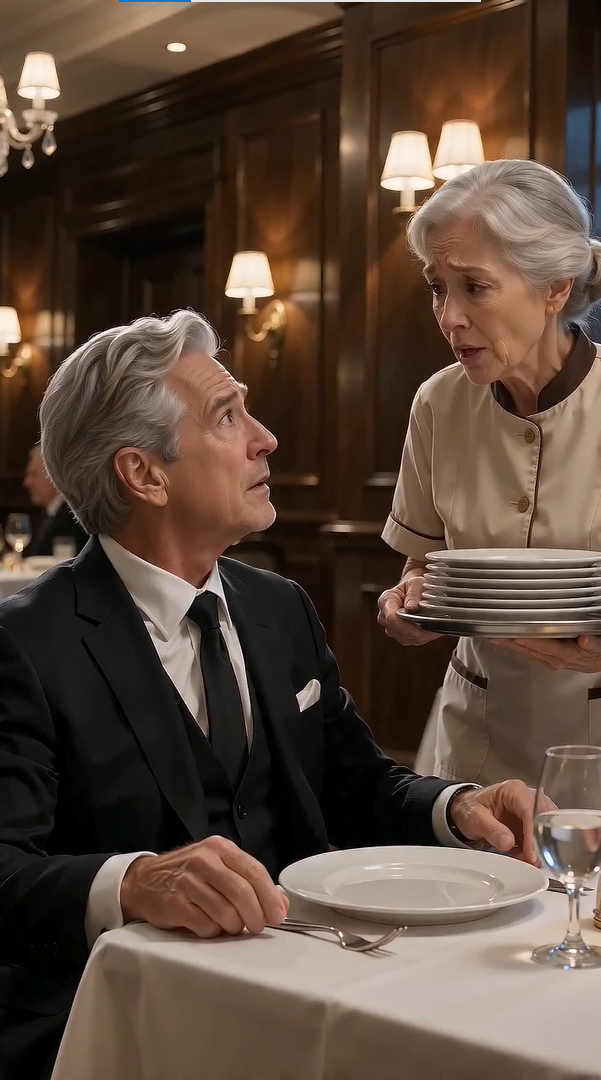
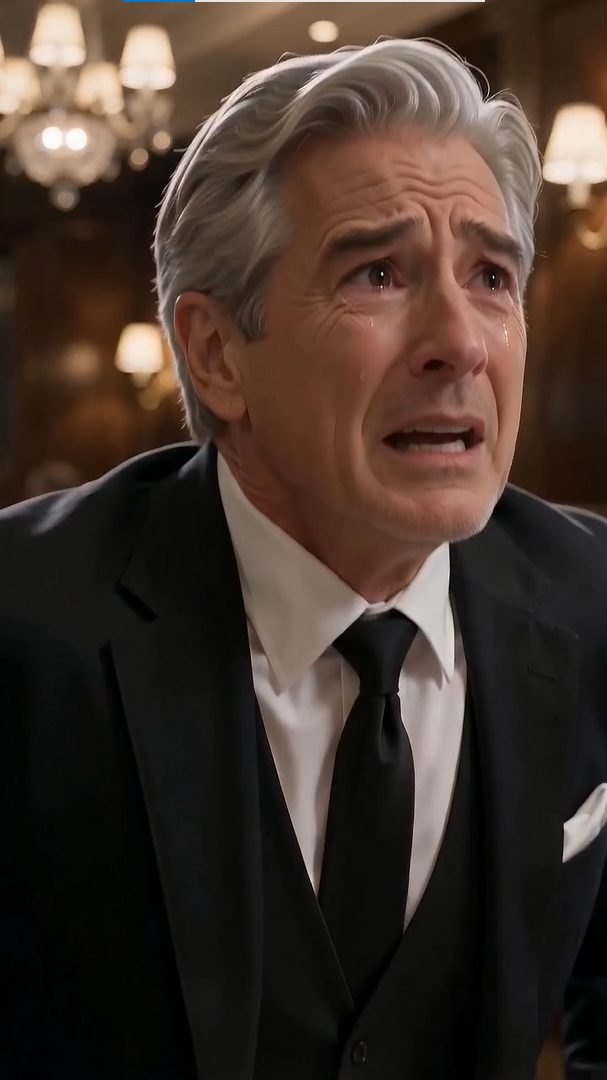
“I was that boy,” he said, looking up at her with tears in his eyes. “I was cold, hungry, and alone. And you were the only person who stopped.”
She covered her mouth with one hand.
“I never forgot your face,” he said. “Not once.”
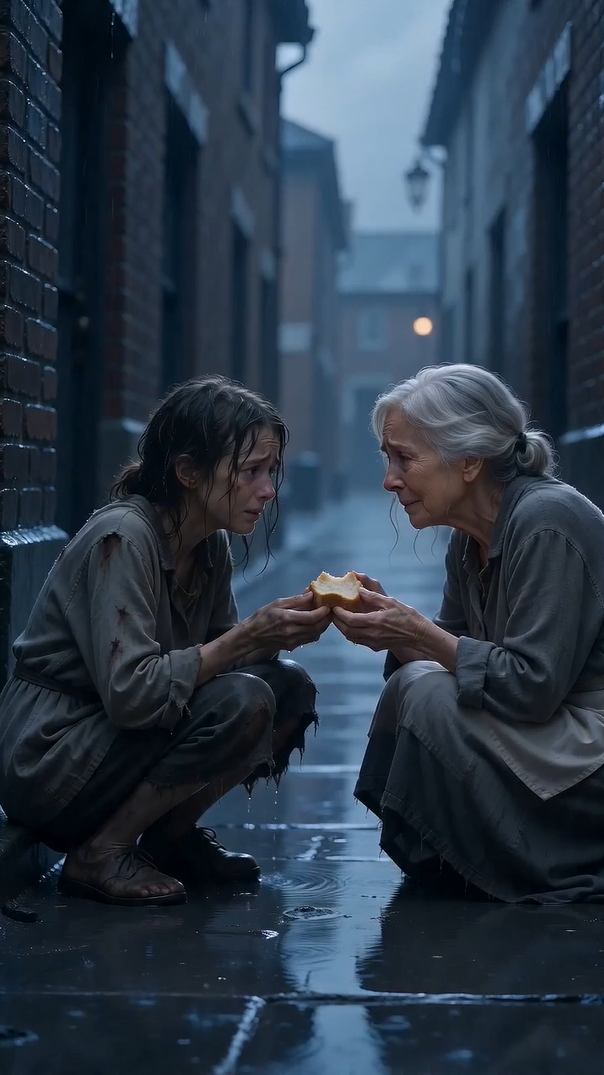
The memory hit her all at once. The alley. The rain. The child with hollow eyes trying to be brave.
Her knees weakened.
“Oh my God…” she breathed.
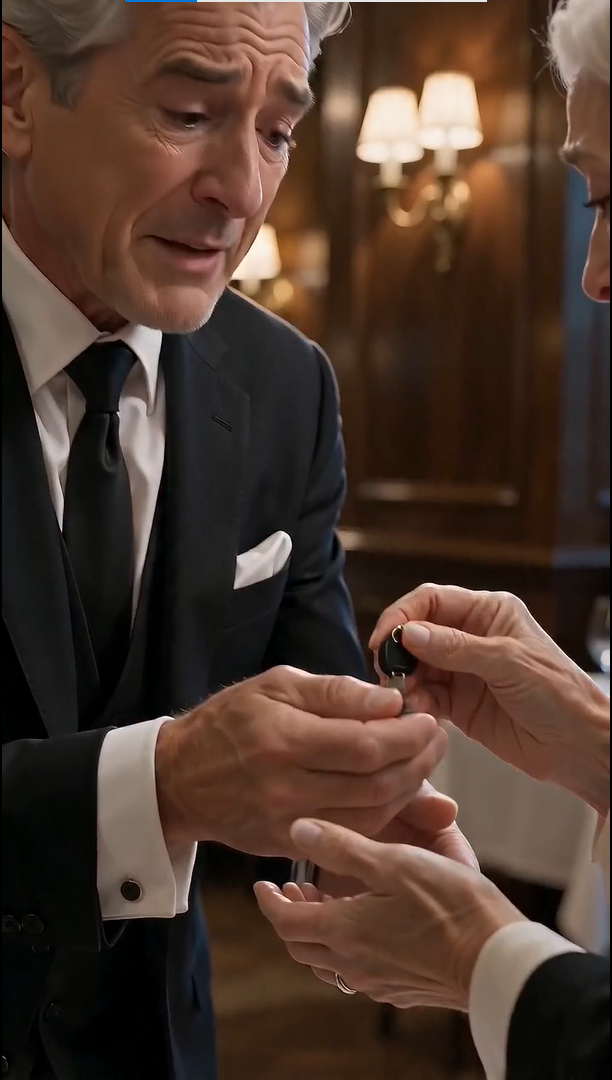
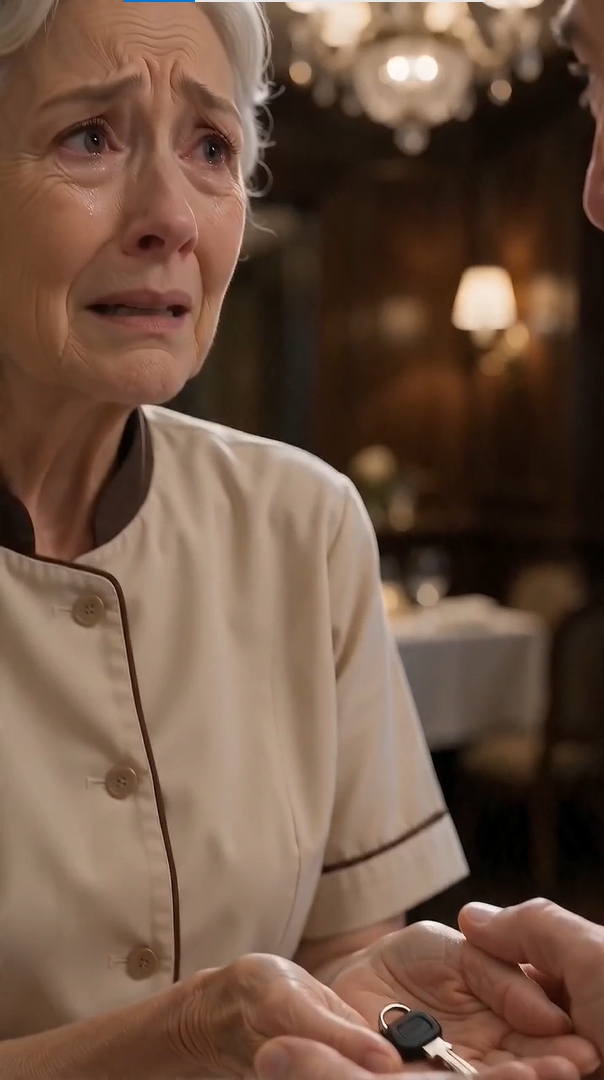
He reached into his coat pocket and pulled out a set of keys.
The metal shook in his hand.
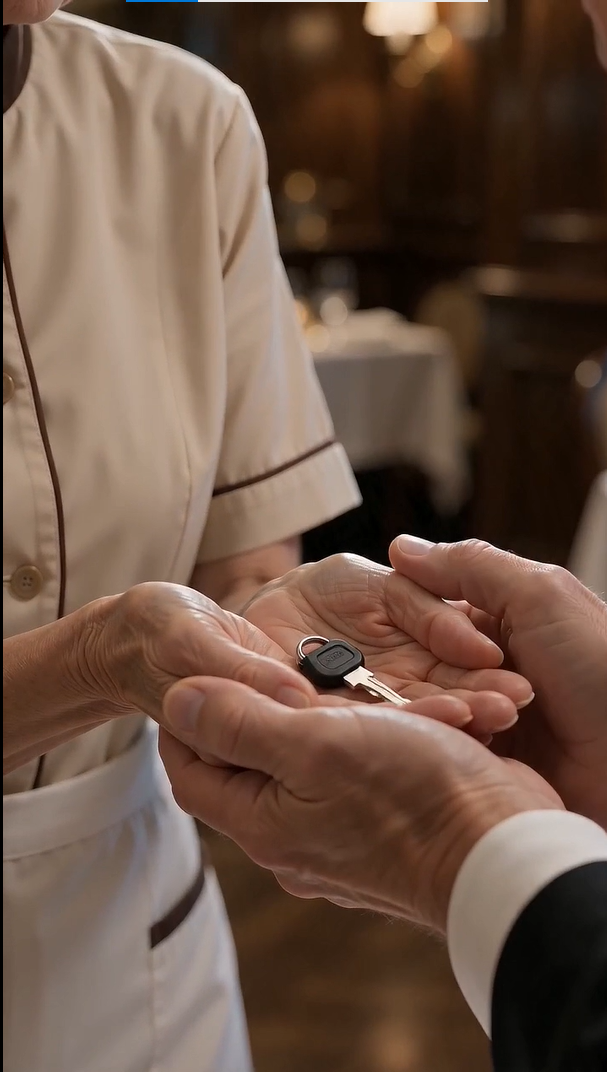
He took her fragile fingers and placed the keys gently into her palm, closing them there.
“You fed me,” he said, choking on the words. “When nobody else would. You saved more than my hunger that night. You saved my life.”
Tears spilled down her cheeks.
“Sir… I only gave you bread.”
He shook his head. “No. You gave me kindness when the world gave me nothing.”
The guests nearby were already standing now, watching in stunned silence, some with wet eyes, some holding their breath.
The waitress looked down at the keys in her hand, confused and overwhelmed. “What is this?”
He smiled through tears.
“You’ll never work another day,” he whispered.
Her lips parted.
He squeezed her hand softly and finished, voice trembling with gratitude, “Because this place is yours now.”
The old woman broke completely.
She dropped to her knees too, crying into her hands, and he caught her gently as the whole restaurant watched the moment that one piece of bread had finally come home.
For several seconds, nobody moved.
Not the guests.
Not the chefs standing frozen at the kitchen door.
Not the young servers who had spent the whole evening rushing between tables.
Even the music in the corner seemed to disappear under the weight of what had just happened.
The elderly waitress clutched the keys against her chest like they might vanish if she opened her hand.
“No,” she whispered again, shaking her head. “No, I can’t accept this. I can’t. This is too much.”
The man helped her sit in the nearest chair and knelt in front of her again, not caring that his expensive suit was pressed against the restaurant floor.
“It isn’t too much,” he said softly. “It isn’t even enough.”
She looked at him through tears. “I don’t even know your name.”
He smiled sadly.
“You asked me that night too.”
Her eyes widened.
He nodded. “I was too scared to answer. I thought if I told anyone my name, they’d send me back.”
The old woman pressed one trembling hand to her mouth.
“I remember,” she whispered. “You wouldn’t come inside. You just stood by the back door, soaked to the bone.”
His eyes filled again.
“And you didn’t ask questions. You didn’t call the police. You didn’t chase me away. You just gave me bread and soup.”
She shook her head, crying harder.
“I wanted to do more.”
“You did more than you know.”
He looked around the restaurant, then back at her.
“My name is Daniel.”
The old woman repeated it softly, like she was placing the missing piece of a memory back where it belonged.
“Daniel.”
He nodded.
“I was eight years old.”
Her face crumpled.
“Only eight…”
“My mother had died two weeks before. My father was gone before I could remember him. I ran from the shelter because the older boys kept stealing my food and hitting me when the workers weren’t looking.”
A quiet gasp moved through the room.
Daniel lowered his eyes for a moment, then continued.
“I didn’t know where to go. I slept near dumpsters. Under stairs. Behind shops. That night, I hadn’t eaten in two days.”
The old woman reached for his hand with both of hers.
“I saw you through the kitchen window,” she whispered.
He looked at her.
“You were taking out the trash.”
She nodded slowly, remembering every detail now.
“It was raining so hard. And you were standing under that broken awning, holding your arms around yourself. I thought you were going to faint.”
Daniel laughed once, but it broke halfway.
“I almost did.”
“I brought you the bread first,” she said, her voice trembling. “Then soup. Then I gave you my old scarf.”
His eyes softened.
“I kept that scarf for years.”
The old woman’s lips parted.
“You did?”
He nodded. “It was the first thing anyone had given me that wasn’t thrown at me or handed over with disgust. I slept with it every night.”
A woman at one of the tables began to cry openly.
The old waitress looked down at Daniel’s hands.
“But after that night… I never saw you again.”
Daniel nodded slowly.
“The next morning, a man from a small church found me behind the bus station. He and his wife took me in. They helped me go to school. They gave me a home.”
He looked at her with tears in his eyes.
“But I always remembered that before they found me, you did.”
The old woman closed her eyes.
“All these years…”
“All these years,” he whispered, “I searched for you.”
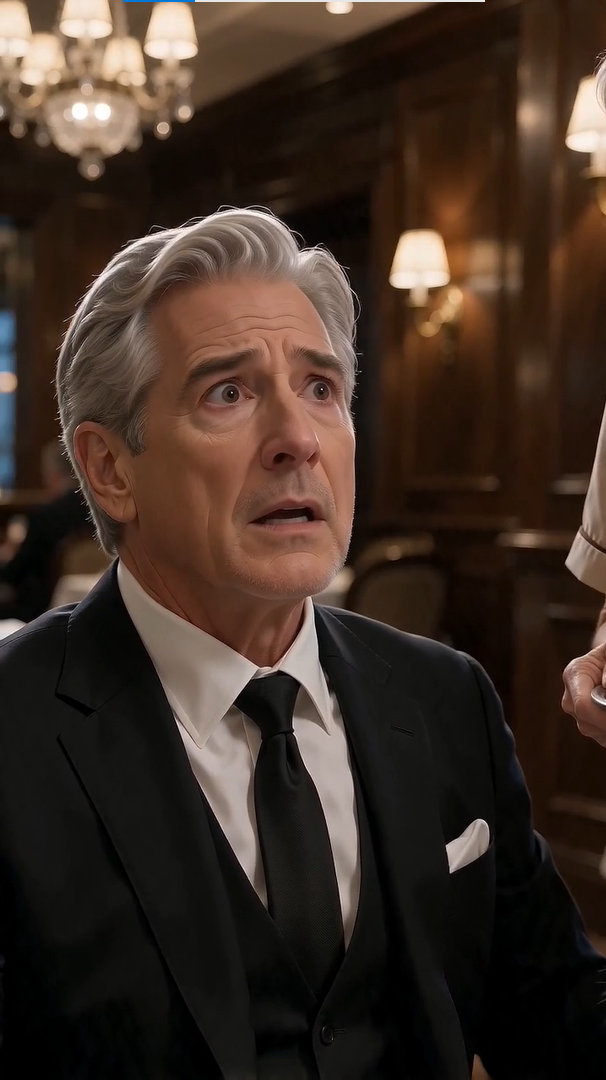
She opened her eyes again.
Daniel looked toward the restaurant windows, where the night lights reflected softly on the glass.
“When I became successful, I hired people to look for the woman who worked at the old diner on Mason Street. But the diner had closed. Records were gone. The owner had died. Nobody remembered the staff list.”
The old woman smiled sadly.
“Places like that don’t keep people’s names. Just their hours.”
Daniel nodded.
“But I kept looking. Every city I visited, every small restaurant I passed, I looked at the waitresses. I looked for your face.”
She shook her head in disbelief.
“You remembered me after one night?”
Daniel squeezed her hand.
“When you are starving, you remember food. But when you are forgotten, you remember kindness.”
The old woman cried silently.
Daniel looked at the keys in her palm.
“Three months ago, I came here for dinner. I almost left before dessert. Then I saw you carrying plates from the kitchen.”
Her eyes widened.
“You saw me before tonight?”
He nodded.
“I froze. I knew it was you. Older, yes. Tired, yes. But it was the same face. The same eyes.”
She lowered her head, overwhelmed.
“I had no idea.”
“I asked the manager about you,” Daniel said. “He told me your name was Clara. He told me you had worked here for fifteen years. He also told me you refused to retire because you still had rent, medical bills, and a grandson you were helping through school.”
Clara’s face turned red with embarrassment.
“Sir, I never asked anyone for—”
“I know,” Daniel said gently. “That’s why I’m here.”
She looked around the restaurant in panic.
“But this place is expensive. Beautiful. I don’t know how to run something like this.”
Daniel smiled.
“You already have.”
She blinked.
He looked toward the kitchen.
“Every server here told me the same thing. That when someone is short on rent, you help quietly. When a dishwasher’s child is sick, you cover their shift. When a new girl cries in the storage room because a customer humiliated her, you sit with her until she can breathe again.”
Clara’s tears kept falling.
Daniel’s voice grew softer.
“They told me this restaurant has managers. Owners. Chefs. Accountants. But the heart of this place has always been you.”
Clara looked at the young servers near the kitchen.
One by one, their faces broke.
A young waitress stepped forward, wiping her eyes.
“It’s true, Miss Clara,” she whispered. “You bought my son’s medicine when I couldn’t.”
A busboy raised his hand slightly.
“You paid my exam fee and told me not to quit school.”
One of the cooks swallowed hard.
“When my mother died, you brought food to my house for a week.”
Clara covered her face.
“Stop,” she cried softly. “Please, stop.”
But Daniel shook his head.
“No. Let them say it. You spent your life doing good in corners where nobody clapped.”
He stood and turned to the whole room.
“Tonight, she gets to hear it.”
The restaurant was silent for only one breath.
Then the applause began.
Soft at first.
Then louder.
Guests stood from their tables. Staff came out from behind counters. Even the chef removed his hat and clapped with wet eyes.
Clara sat there with the keys against her chest, trembling under the weight of a love she had never expected back.
Daniel knelt again.
“I bought this restaurant last month,” he said. “Quietly. Legally. Completely.”
Clara shook her head, still stunned.
“And today, the papers were finalized. It belongs to you.”
She stared at him.
“But why this restaurant?”
“Because this is where I found you again,” he said. “And because no one who has spent her whole life serving others should end it begging for shifts.”
Clara’s lips trembled.
“I don’t need a restaurant, Daniel. I’m old.”
He smiled through tears.
“Then don’t run it as a restaurant if you don’t want to.”
She looked confused.
Daniel reached into his coat again and pulled out a folder.
He opened it and placed it gently on the table.
“I also set up a fund. Enough to keep the restaurant running, pay every staff member properly, clear your debts, cover your medical care, and help your grandson finish school.”
Clara let out a broken sob.
“And if you agree,” Daniel continued, “we can turn part of this place into something else during the day.”
“What?” she whispered.
“A kitchen for children who need meals. For families who are hungry. For people like I was.”
The entire room went still again.
Daniel’s voice broke.
“I don’t want what you did for me to end with me. I want it to keep feeding people.”
Clara looked at him like her heart could not hold one more thing.
“You remembered one piece of bread,” she whispered.
Daniel shook his head.
“No. I remembered the woman who handed it to me like I mattered.”
Clara reached for his face with trembling fingers.
For a moment, Daniel was not a successful man in a fine suit.
He was that little boy again.
Cold.
Hungry.
Waiting by the back door.
And Clara, who had spent her life carrying plates for strangers, touched his cheek like she should have done years ago.
“My poor child,” she whispered.
Daniel closed his eyes.
Something inside him, something that had stayed eight years old for decades, finally gave way.
He leaned forward and rested his head in her lap.
The old woman bent over him, crying into his hair.
“I’m sorry,” she kept whispering. “I’m sorry I didn’t do more.”
Daniel shook his head against her knees.
“You did enough to keep me alive.”
The restaurant stayed quiet around them, protecting the moment.
Later that night, after the guests had gone and the staff had slowly returned to the kitchen, Clara sat at a table near the window with Daniel across from her.
The keys lay between them.
She kept touching them, then pulling her hand away.
“I still feel like this is a dream,” she said.
Daniel smiled gently.
“I brought lawyers. Accountants. Everything is real.”
Clara gave a shaky laugh.
“I don’t even own a proper pair of shoes for meetings.”
“Then we’ll get you shoes.”
She looked at him with sudden seriousness.
“No.”
Daniel paused.
“I don’t want to become someone else,” she said. “I don’t want people calling me ma’am and pretending I’m better than them because I have keys now.”
Daniel’s expression softened.
“Then don’t.”
Clara looked toward the kitchen.
“I want everyone to keep their jobs.”
“They will.”
“I want the kitchen to feed children.”
“It will.”
“And I want one table near the back door,” she whispered.
Daniel went still.
Clara’s eyes filled again.
“For anyone who comes hungry and ashamed. No questions. No payment. Just food.”
Daniel stared at her.
Then he nodded slowly.
“We’ll call it Clara’s Table.”
She tried to smile, but tears fell again.
“No. Call it The Back Door Table.”
Daniel’s lips trembled.
“Why?”
“Because sometimes,” she whispered, “the people who need kindness most are too afraid to come through the front.”
Daniel broke all over again.
The next morning, the news spread.
A wealthy businessman had given a restaurant to an elderly waitress.
People called it unbelievable.
A miracle.
A publicity stunt.
Reporters gathered outside before lunch.
Daniel refused to speak to them unless Clara agreed.
She almost said no.
Then she looked through the glass and saw a little boy standing behind the reporters, holding his mother’s hand, staring at the restaurant like he was hungry.
Clara stood slowly.
“Open the door,” she said.
The manager blinked.
“We’re not ready yet.”
Clara picked up the keys.
“We are now.”
For the first time, she unlocked the restaurant herself.
The reporters surged forward, but Clara lifted one hand.
“Wait.”
Her voice was not loud, but somehow everyone listened.
She walked past the cameras and went straight to the little boy.
His mother looked embarrassed and tried to pull him back.
“I’m sorry,” the woman said quickly. “We’re just passing.”
Clara smiled.
“Has he eaten?”
The mother’s eyes filled instantly.
She tried to answer, but couldn’t.
Clara held out her hand to the boy.
“What’s your name?”
“Mateo,” he whispered.
“Well, Mateo,” Clara said, her voice shaking but warm, “there’s a table inside with your name on it.”
The boy looked at his mother.
His mother began crying.
Daniel stood in the doorway, watching.
And for a moment, he saw himself.
The same hunger.
The same fear.
The same small shoulders trying to carry too much.
Clara brought the boy and his mother inside.
The cameras followed, but Daniel stopped them at the door.
“Not this part,” he said.
One reporter protested. “People want to see—”
Daniel’s face hardened.
“People in need are not entertainment.”
The reporter fell silent.
Inside, Clara took Mateo to a quiet table near the back door.
She brought bread first.
Then soup.
She set it down gently, exactly as she had done years ago.
The little boy stared at it.
“Do we have to pay?” he asked.
Clara’s eyes filled.
“No, sweetheart.”
He looked suspicious.
“Why?”
She glanced at Daniel.
Then back at the boy.
“Because someone once taught me that one meal can change a life.”
Daniel turned away, wiping his eyes.
Weeks passed.
The restaurant changed slowly.
The sign outside stayed the same, but below it, in smaller letters, Daniel had a new line added.
Home of The Back Door Table.
At first, people came because of the story.
They wanted to see the waitress who had become an owner.
They wanted pictures.
They wanted the emotional moment.
But Clara was not interested in becoming famous.
She still came in early.
Still tied her apron herself.
Still checked on the kitchen.
Only now, when someone told her she should sit and rest, she smiled and said, “I’m not working. I’m home.”
Daniel came every evening.
Not as a guest.
Not as a businessman.
As someone who had found a missing piece of his life.
He helped carry boxes. He sat with children while their parents filled out assistance forms. He washed dishes once and broke three plates.
Clara scolded him so sharply that the whole kitchen laughed.
“You may own half the city,” she said, pointing a spoon at him, “but you do not own the right to destroy my plates.”
Daniel raised both hands.
“Yes, ma’am.”
Everyone laughed again.
And Daniel loved it.
He loved being corrected.
He loved being useful.
He loved sitting at the back table at the end of the night with Clara, drinking tea that was always too sweet because she insisted life was bitter enough.
One evening, she asked him the question she had been holding for weeks.
“Did you ever find your father?”
Daniel’s smile faded.
“No.”
Clara’s face softened.
“I’m sorry.”
“He left before I was born,” Daniel said. “Maybe he died. Maybe he started another life. I stopped searching years ago.”
Clara nodded slowly.
“And your mother?”
Daniel looked down at his tea.
“She was kind. Tired. Sick most of the time. She used to tell me that the world would be gentle one day.”
His voice shook.
“She died before it was.”
Clara reached across the table and took his hand.
“It became gentle through you.”
Daniel looked at her, surprised.
She squeezed his fingers.
“You could have become hard. Many do. Hunger can make people cruel. Loneliness can turn the heart into stone.”
She smiled through tears.
“But you came back with keys.”
Daniel swallowed hard.
“I almost didn’t.”
Clara frowned gently.
“What do you mean?”
He looked toward the dark windows.
“For years, I was angry. I wanted to become rich enough that nobody could look down on me again. I wanted expensive rooms, expensive clothes, expensive silence.”
He gave a sad laugh.
“And I got it. All of it. But I was still that boy in the rain.”
Clara listened quietly.
“When I found you,” Daniel whispered, “I didn’t know whether to thank you or blame you for being the only good memory I had.”
Clara’s eyes filled.
“Blame me?”
“Because remembering you reminded me how lonely I had been.”
He looked at their joined hands.
“But then I saw you working here, smiling at people who barely looked at you, and I realized something.”
“What?”
“You didn’t save me because you had plenty. You saved me because you had a heart.”
Clara looked away, crying softly.
Daniel continued, “That night, you were probably tired. Underpaid. Ignored. But you still saw me.”
Clara wiped her tears.
“My husband had died that year,” she admitted quietly. “I had no children. No family nearby. I was drowning in bills. I was angry at life.”
Daniel looked at her with surprise.
She gave him a small, sad smile.
“When I saw you outside that door, I thought, ‘There is someone colder than me tonight.’ So I brought you bread.”
Daniel’s face softened.
“So we saved each other.”
Clara squeezed his hand.
“Maybe we did.”
Months turned into a year.
The Back Door Table served thousands of meals.
Children came after school.
Elderly people came when their checks ran out.
Single mothers came quietly, ashamed at first, then smiling when Clara greeted them by name.
Daniel expanded the fund.
Other restaurants joined.
A program began.
Then a foundation.
But no matter how large it grew, Clara insisted on one rule.
“Never make hungry people prove they are hungry.”
Daniel wrote it on the wall near the kitchen.
One year after that night, the restaurant held a small anniversary dinner.
No celebrities.
No fancy donors.
Just staff, families, children, and people whose lives had been touched by one table near the back door.
Clara wore a soft blue dress instead of her uniform.
Daniel had bought it for her, but she had made him return the first three because they were “too expensive and too shiny.”
When she walked in, everyone clapped.
She shook her head, embarrassed.
“Oh, stop that,” she said, but her eyes were wet.
Daniel stood near the front, holding a microphone.
Clara pointed at him immediately.
“No long speeches.”
Everyone laughed.
Daniel smiled.
“I’ll try.”
She narrowed her eyes.
“I mean it.”
He nodded, then turned to the room.
“One year ago, I came here to repay a debt.”
His voice softened.
“But I learned something. Real kindness can’t be repaid. It can only be passed on.”
Clara looked down at her hands.
Daniel continued, “When I was eight years old, I thought the world had no place for me. Then a waitress opened a back door and handed me bread. She didn’t know my name. She didn’t know my story. She didn’t know if I would ever become anything.”
His eyes filled.
“She simply decided that a hungry child mattered.”
The room went silent.
“Everything good I have done since that night began with her.”
Clara shook her head, crying.
Daniel lifted a small box from the table.
“I gave her keys once,” he said. “Tonight, I want to give her something else.”
Clara looked alarmed.
“Daniel…”
He smiled gently and opened the box.
Inside was an old scarf.
Faded.
Carefully folded.
Worn thin with time.
Clara’s breath caught.
Daniel’s voice broke.
“I told you I kept it.”
She slowly stood.
The room blurred through her tears.
Daniel walked to her and placed the scarf in her hands.
“I had nothing from my childhood,” he whispered. “No photographs. No toys. No home. But I had this.”
Clara touched the old fabric like it was sacred.
“I remember this,” she cried. “It was green.”
“It still is,” Daniel said softly. “Just tired.”
She laughed through her tears.
Then he handed her a small framed photograph.
It showed the restaurant’s back door.
The table beside it.
And a line engraved beneath the picture.
For every child who is still waiting to be seen.
Clara pressed the frame to her chest.
The room stood and clapped again, but this time she didn’t tell them to stop.
She just cried.
Daniel wrapped his arms around her carefully.
And she held him back.
Not like a waitress and a customer.
Not like an old woman and a wealthy man.
Like a mother holding the son life had brought back to her late, but not too late.
Years passed.
Clara grew weaker.
Her steps slowed.
Her hands shook more.
Daniel hired nurses, but she still visited the restaurant whenever she could.
She would sit at the back table, wrapped in the old green scarf, watching children eat.
Sometimes a child would ask, “Are you the lady from the story?”
Clara would smile.
“No,” she would say. “I’m just Clara.”
But everyone knew.
One winter evening, Daniel found her sitting by the back door after closing, looking at the rain outside.
He sat beside her.
“You’ll catch a cold,” he said.
She smiled.
“You sound like me now.”
He laughed softly.
For a while, they watched the rain together.
Then Clara whispered, “Do you ever think about that night?”
Daniel looked at the wet alley behind the restaurant.
“Every day.”
“Does it still hurt?”
He thought about it.
Then he nodded.
“A little.”
Clara’s eyes filled.
“I wish I had taken you home.”
Daniel turned to her.
“I used to wish that too.”
She looked at him.
“And now?”
He smiled gently.
“Now I think maybe you gave me exactly what you could. And maybe that was enough to lead me here.”
Clara leaned her head back against the chair.
“I’m tired, Daniel.”
His heart clenched.
“I know.”
“But I’m not sad.”
He reached for her hand.
She squeezed his fingers weakly.
“I had no children,” she whispered. “I used to think no one would remember me.”
Daniel’s eyes filled.
“Clara, there are children all over this city who will remember you.”
She smiled.
“And you?”
His voice broke.
“I remembered you first.”
She closed her eyes, still smiling.
“That’s enough.”
Daniel lifted her hand and kissed it.
“No,” he whispered. “It never will be.”
Clara passed away peacefully months later.
The whole city seemed to mourn her.
People came to the restaurant with flowers, letters, photographs, and stories.
A man said Clara had fed him when he lost his job.
A woman said Clara had helped her leave a dangerous home.
A young doctor said he was only in medical school because Clara once paid his application fee and told him he was too smart to quit.
Children drew pictures of bread, soup, and a small table near a back door.
Daniel stood through all of it, accepting every story like another piece of her legacy.
At the memorial, he did not wear a black suit.
He wore the old green scarf.
When he stood to speak, his hands shook.
“I spent years thinking I came back to repay Clara,” he said. “But Clara never kept accounts of kindness. She never asked who deserved help. She never asked what she would get in return.”
He looked at the crowd.
“She taught me that the smallest mercy can travel farther than we ever live to see.”
His voice cracked.
“One piece of bread became a restaurant. One bowl of soup became a foundation. One woman’s kindness became thousands of full plates.”
He looked toward the front row, where children from The Back Door Table sat holding flowers.
“And one frightened boy became a man who finally understood that success means nothing if it doesn’t open a door for someone else.”
Years later, the restaurant still stood.
The sign changed only once.
Clara’s.
And beneath it, the words she had chosen remained.
The Back Door Table.
Every evening, the table near the back door was kept ready.
Bread.
Soup.
A clean napkin.
No bill.
No questions.
On the wall above it hung the framed photograph Daniel had given Clara, and beside it, in a glass case, was the old green scarf.
People often stopped to read the small plaque beneath it.
This scarf belonged to Clara, who once fed a hungry boy in the rain.
He came back years later with keys.
She gave them back to the world.
And sometimes, when Daniel visited late at night after everyone had gone, he would sit at that table alone.
He would look at the back door.
At the rain when it came.
At the chair where Clara used to sit.
And he would whisper the same words every time.
“Thank you for seeing me.”
Then he would stand, turn off the lights, and leave the kitchen ready for morning.
Because somewhere, there was always another child.
Another mother.
Another old man.
Another lonely soul too ashamed to come through the front.
And because of Clara, the back door never closed.