
The lingerie was folded beneath my husband’s passenger seat like a confession he had grown too arrogant to hide.
It was black lace, delicate and expensive, with a narrow satin ribbon caught beneath the metal rail. When I pulled it free, the fabric released a faint jasmine scent into the car.
I knew that perfume.
Vanessa Crane wore it to every company dinner, every planning meeting, and every casual visit to our home. She used enough that the scent stayed behind after she left, clinging to curtains and chair cushions as if she wanted to mark every room she entered.
Rain tapped steadily against the car roof.
For several seconds, I remained crouched beside the open passenger door, holding the lingerie between two fingers.
My heart did not break loudly.
There was no dramatic rush of tears. No scream. No sudden urge to call Lucas and demand an explanation.
The pain arrived quietly, almost politely.
A hollow pressure formed beneath my ribs.
Then my mind became very clear.
Lucas had asked me to take his car to be detailed before his promotion banquet.
“Make sure they clean everything,” he had said that morning.
He stood in front of our bedroom mirror adjusting a blue silk tie while practicing the smile he used on executives, wealthy clients, and people he wanted to believe he respected.
“Tomorrow night has to be perfect.”
I looked at the black lace in my hand.
“Yes,” I whispered to the empty car. “It does.”
Lucas and I had been married for eight years.
We met at a corporate charity dinner when he was still a junior project manager at Ellington Development Group. I worked for Ashford Capital, the investment firm that had provided much of Ellington’s original funding.
At the time, I was a forensic accountant.
Not the dramatic television kind who stormed into offices and uncovered secret vaults.
Most of my work involved spreadsheets, procurement records, vendor relationships, and transactions designed to look too boring to examine closely.
Fraud rarely arrived wearing a mask.
Usually, it appeared as an invoice with a familiar logo, a payment approved late on a Friday, or a consulting firm nobody wanted to question because the amount seemed small compared with the overall project.
I liked the work.
Numbers were honest once you knew how to ask them the right questions.
Lucas said that was what first attracted him to me.
“You notice everything,” he told me on our third date.
Years later, he would behave as if I noticed nothing.
Our courtship moved quickly.
He was ambitious, attentive, and endlessly interested in the life he believed we could build together.
He sent flowers to my office.
He remembered how I took my coffee.
He listened when I talked about my father’s death and held my hand without trying to fill the silence.
When he proposed, he said, “You make me want to become the man you already think I am.”
I believed that sentence meant humility.
I did not understand it was a warning.
After we married, I left Ashford Capital.
Lucas said the decision was mine, but he made the alternative sound selfish.
His career required dinners, travel, and constant networking. He said two demanding jobs would leave us living like strangers.
I had already been considering a change. My mother’s health had declined, and I wanted more control over my schedule.
So I became an independent financial consultant and gradually reduced my client list.
Then I became the person who managed everything around Lucas’s ambition.
I edited his speeches.
Organized dinners.
Remembered clients’ spouses and children.
Made sure his parents received birthday gifts that appeared to come from him.
When he forgot an important anniversary, I created excuses.
When his spending exceeded his salary, I used part of my savings to settle credit cards because he promised the next promotion would change everything.
His parents called me sweet.
They also called me simple.
At family dinners, his mother, Diane, would look at my plain dresses and say, “Emma never needed much. That must make life so easy for Lucas.”
His father, Robert, once raised his wineglass and said, “Behind every successful man is a woman sensible enough not to compete with him.”
Everyone laughed.
I smiled because Lucas squeezed my knee beneath the table.
Later, in the car, he said, “They’re old-fashioned. Don’t make it bigger than it is.”
That became a pattern.
Someone insulted me.
Lucas explained why reacting would make me unreasonable.
Vanessa entered our lives three years before the promotion banquet.
She was hired as Lucas’s executive assistant after his previous assistant retired.
Vanessa was thirty, polished, and socially fearless. She knew how to make flattery sound like professional observation.
She told Lucas he had “executive presence.”
She told Diane that her jewelry collection deserved a magazine feature.
She told me my quiet lifestyle was “adorable.”
The first time she visited our home, she walked through the living room slowly, looking at the photographs and furniture.
“What a cozy little place,” she said.
The house had four bedrooms.
Lucas laughed.
“Emma likes things understated.”
Vanessa smiled at me.
“It suits you.”
I knew she had meant the sentence as a small insult.
I ignored it.
At first, her relationship with Lucas looked entirely professional.
She managed his schedule efficiently and corrected problems before they reached him. His work became easier.
He praised her constantly.
“Vanessa understands urgency.”
“Vanessa anticipates what I need.”
“Vanessa knows how executive offices operate.”
When I pointed out that she called after ten at night, he accused me of insecurity.
“She works harder than anyone else on the team.”
“I didn’t say she didn’t.”
“Then what are you saying?”
“That most scheduling questions can wait until morning.”
He sighed.
“You don’t understand the pressure I’m under.”
That sentence ended many conversations.
I began noticing other things.
Hotel receipts during trips where Lucas claimed to have stayed with colleagues.
Restaurant charges for two people on evenings he said he had eaten alone.
A silk scarf in the back of his closet that was not mine.
He explained each item with effortless confidence.
The hotel had upgraded him.
The restaurant charge included a client.
The scarf belonged to Vanessa, who had accidentally packed it with presentation materials.
I wanted to believe him.
Trust did not disappear with one suspicious receipt.
It eroded through repeated explanations that required me to doubt my own instincts.
By the time I found the lingerie, the marriage had become a room filled with smoke while Lucas kept telling me nothing was burning.
I photographed the garment exactly where I found it.
Wide shot.
Close-up.
The metal seat rail.
The surrounding carpet.
Then I placed the lingerie inside a clean evidence bag from the small office kit I still kept in a filing cabinet at home.
Old habits.
Gloves.
Labels.
Tamper seals.
I wrote the date, time, location, and condition on the bag.
Only after that did I take the car to the detailing shop.
The employee at the counter asked whether I wanted the interior deep-cleaned.
“Every inch,” I said.
When I returned home, Lucas was seated at the dining table with his laptop open.
He had arranged printed pages around his dinner plate.
Vanessa’s name flashed across his phone three times while we ate.
Each time, he turned the screen facedown.
“Work?” I asked.
“Always.”
He did not blink.
I smiled.
“You must be exhausted.”
He reached across the table and patted my hand the way someone might reassure a loyal dog.
“Just two more days, Emma. After the promotion, everything changes.”
He was right.
“What are you working on?” I asked.
“My acceptance speech.”
“You don’t know officially that you have the position.”
He smiled.
“I know.”
Lucas had been competing for the role of regional executive vice president for nearly six months.
The promotion would place him in control of Ellington’s largest redevelopment division.
His closest competitor was Priya Nair, a disciplined executive with more operational experience and a reputation for reading every page of every report.
Lucas called her difficult.
I liked her.
“She doesn’t understand relationships,” he told me.
“She understands project risk.”
“She lacks vision.”
“She asks where the money is going.”
“That is not vision.”
I looked at him across the table.
“No. It is management.”
His smile tightened.
“Which is why you left corporate work.”
The insult was small enough that he could deny it later.
I lifted my coffee.
“You asked me to review the speech.”
“I was going to.”
He slid the pages toward me.
For the next hour, I corrected his grammar, removed repeated phrases, and softened a section where he took personal credit for his team’s performance.
He watched me work without noticing the stillness in my face.
At ten thirty, he went upstairs to shower.
His phone remained beside the laptop.
It buzzed.
A preview appeared.
Can’t stop thinking about the car. Did she notice anything?
The message disappeared when the screen locked.
I sat motionless.
The evidence bag waited inside the locked drawer of my office.
I did not need the message to confirm the affair.
Still, it told me Vanessa knew she had left something behind.
It also told me they had discussed my likelihood of finding it.
Lucas believed I would overlook whatever happened inside his car.
Or notice and remain quiet.
I opened his laptop after midnight.
The password field appeared.
For years, Lucas used variations of our anniversary date.
Three months earlier, he changed it.
I had seen him enter the password once from across the desk.
Eight characters.
A capital letter.
Numbers.
That evening, I tried Vanessa’s birthday.
Her employee file listed May 14.
Vcrane0514
The desktop opened.
The insult of the password hurt more than I expected.
He had converted her name into a key and assumed I would never think to use it.
At first, I searched for evidence of the affair.
There was plenty.
Deleted messages recovered through synchronized backups.
Photographs taken in hotel rooms.
Dinner reservations.
Private jokes about me.
One exchange dated six months earlier read:
Vanessa: Does the perfect wife know you’re still here?
Lucas: Emma knows whatever I need her to know.
Vanessa: That sounds cruel.
Lucas: She prefers comfortable lies.
I stared at the words.
He had taken my trust and described it as cowardice.
Another exchange:
Vanessa: What will you do after the promotion?
Lucas: Move carefully. I need the house and her Ashford connections until the transition is secure.
Vanessa: You said she doesn’t work with them anymore.
Lucas: People still answer her calls.
He had not merely stayed because divorce was inconvenient.
He believed I remained useful.
That realization removed something from the pain.
I stopped seeing Lucas as a confused husband who had made selfish choices.
He was managing me like an asset.
I copied the messages to an encrypted drive.
Then I searched his corporate folders.
The first irregularity appeared inside a directory labeled Vendor Optimization.
There were invoices from a company called Crane Strategic Solutions.
The name was obvious enough that I almost dismissed it as legitimate.
Vanessa’s surname was Crane.
Her cousin, Eric Crane, owned a registered consulting company.
According to public records, Crane Strategic Solutions had been formed fourteen months earlier.
It had no employees beyond Eric.
No office.
No public clients.
Yet Ellington had paid it more than nine hundred thousand dollars for vendor analysis, procurement coordination, and market research.
Several invoices used identical language.
Some billed for work completed on days when Eric’s social media showed him vacationing overseas.
I kept searching.
Lucas had approved every payment.
Vanessa had prepared the supporting documents.
A hidden spreadsheet showed percentages beside each transfer.
Forty percent went to an account labeled L.
Twenty-five percent to V.
Fifteen percent to E.
The remainder appeared to cover taxes and future expenses.
L.
Lucas.
V.
Vanessa.
E.
Eric.
The affair was no longer the worst discovery.
They were stealing from Ellington.
Worse, some of the false vendor expenses had been charged to redevelopment projects funded partly through municipal grants and federal community investment programs.
That changed the legal stakes.
Company fraud could become wire fraud, conspiracy, false claims, and misuse of public funds.
I sat in the dark office until dawn.
The rain stopped sometime before four.
Lucas came downstairs at six thirty wearing running clothes.
I had closed the laptop and returned it to its original position.
He found me in the kitchen making coffee.
“You’re up early.”
“I couldn’t sleep.”
“Nervous about tomorrow?”
“Should I be?”
He smiled.
“Important people will be watching.”
He kissed my forehead.
“Wear something pretty.”
I looked at him over the rim of my cup.
“I will.”
After he left for his run, I called Mara Bell.
Mara had worked with me at Ashford Capital.
She was now general counsel for a financial investigations firm and had the useful habit of responding to strange phone calls without wasting time on disbelief.
She answered at six forty-eight.
“Emma?”
“I need an attorney.”
“Personal or business?”
“Both.”
“Are you safe?”
“Yes.”
“Is Lucas?”
“For now.”
A pause.
“What did you find?”
“An affair and suspected corporate fraud involving a shell vendor.”
“Do not explain further over this line.”
“I copied records.”
“Stop accessing the laptop.”
“I already did.”
“Preserve what you have without altering the files.”
“I photographed the original evidence.”
“Original evidence?”
“Lingerie beneath his passenger seat.”
Mara was silent for two seconds.
“That is impressively careless.”
“He asked me to detail the car.”
“That is almost insulting.”
“It is completely insulting.”
“Can you come to my office?”
“In an hour.”
“Use your own vehicle. Do not tell him where you’re going.”
Mara’s office occupied the ninth floor of a quiet building near downtown.
She listened without interrupting while I described everything.
Then she examined the files on the encrypted drive.
Her expression changed as she moved from the messages to the invoices.
“This is significant.”
“How significant?”
“Potentially criminal.”
“I know.”
“Public money?”
“Some project funding appears to include federal grants.”
She leaned back.
“Then we do not confront Lucas.”
“I wasn’t planning to.”
“You were going to the banquet with a silver gift box.”
I stared.
“How did you know?”
“You have the same expression you wore before we confronted the Fairmont procurement director.”
“That was twelve years ago.”
“You enjoy packaging evidence.”
“I enjoy clarity.”
“You enjoy theater when people underestimate you.”
That was also true.
Mara continued.
“We need independent forensic verification. We also need to determine whether your access to the laptop was lawful.”
“It is a jointly used home computer.”
“Is it owned by Ellington?”
“No. Personal device.”
“Password protected?”
“Yes.”
“Did you have permission to access it?”
“We have always used each other’s devices.”
“Document examples.”
“I can.”
“Do not distribute medical, intimate, or unrelated personal material.”
“I only copied the relevant messages and financial files.”
“Good.”
“What about the banquet?”
“You can attend.”
“And the gift?”
“No public accusations before investigators preserve company systems.”
“What if the company announces his promotion?”
“That is a corporate decision.”
“Mara.”
“I understand why you want to stop it.”
“He could gain approval authority over larger budgets.”
“Then we notify the proper people before the banquet.”
“Who?”
“Ellington’s board audit chair, outside counsel, and potentially federal investigators.”
I looked at the city through her window.
“The banquet is tomorrow.”
“That may work in our favor. Executives will already be gathered.”
“I don’t want Lucas warned.”
“Neither do I.”
By noon, Mara had contacted Ashford Capital’s current compliance director through protected channels.
Ashford still held a major investment interest in Ellington.
The compliance director, Jonah Reed, remembered me from my forensic-accounting years.
We met that afternoon in a secure conference room.
Jonah reviewed a sample of the records.
He did not smile once.
“Lucas has been under internal scrutiny for three months,” he said.
I stared.
“For what?”
“Cost irregularities and attempts to bypass vendor-review controls.”
“Why was he still being considered for promotion?”
“The review was confidential and incomplete.”
“Did Priya raise concerns?”
Jonah hesitated.
“That is also confidential.”
“She did.”
His silence confirmed enough.
I placed the evidence bag containing the lingerie on the table.
Jonah looked at it.
“That is not relevant to the company investigation.”
“It explains why his assistant may be more than an employee following orders.”
Mara nodded.
“It supports motive and relationship context, but we should separate personal misconduct from financial evidence.”
Jonah examined the messages where Lucas discussed using my Ashford connections.
His eyes lifted.
“He believed you still had influence.”
“Apparently.”
“Do you?”
“Not in the way he imagined.”
Jonah leaned back.
“Your original deferred investment interest remains active.”
I looked at Mara.
She raised an eyebrow.
When I left Ashford Capital, I retained a small equity participation from early investment funds.
I rarely reviewed it beyond annual statements.
“What does that mean here?” I asked.
Jonah answered.
“One of those funds holds indirect voting rights in Ellington’s parent structure.”
“How many?”
“Enough that your conflict must be disclosed before any board action involving Lucas.”
I almost laughed.
Lucas stayed married partly because he believed I might be useful to Ashford.
He did not know I had actual financial standing.
Jonah continued.
“We need your consent to separate your personal interest from the investigation.”
“You have it.”
“Would you be willing to provide a sworn statement?”
“Yes.”
“And testify if necessary?”
“Yes.”
Mara touched the evidence drive.
“The banquet?”
Jonah looked at the clock.
“The board planned to announce the promotion tomorrow night.”
“Lucas?”
“Yes.”
“Has the decision been finalized?”
“Not formally.”
“Can you stop it?”
“The audit committee can suspend the process.”
I felt the first small movement of relief.
“Do it.”
Jonah shook his head.
“Not yet.”
“Why?”
“We need to preserve company devices and monitor one pending payment.”
My stomach tightened.
“What payment?”
“Crane Strategic Solutions submitted a final invoice for four hundred fifty thousand dollars.”
Lucas planned to approve it after the promotion announcement.
The payment would likely move the following morning.
Investigators wanted the transaction to proceed far enough to document intent without allowing the money to disappear.
“So the banquet continues,” I said.
“Yes.”
“And Lucas believes he is being promoted.”
“Yes.”
“What do you want me to do?”
“Behave normally.”
Mara looked at me.
“That may be the hardest assignment.”
I ignored her.
Jonah continued.
“Attend as planned. Do not disclose the fraud. Do not give Lucas any indication that his accounts are being reviewed.”
“What about Vanessa?”
“The same.”
“And afterward?”
“Once the evidence is preserved and the payment authorization is captured, the board will act.”
I looked at the silver bracelet on my wrist.
“I already bought a gift box.”
Mara sighed.
Jonah looked confused.
“What gift box?”
“Nothing illegal.”
That evening, Lucas practiced his promotion speech in front of our bedroom mirror.
He wore his tuxedo shirt without the jacket and held an empty glass as a prop.
“Leadership is not a title,” he recited. “It is the willingness to take responsibility before anyone asks.”
I sat on the bed.
“Strong opening.”
“You think?”
“It tells people what they want to hear.”
He smiled.
“That’s the point of a speech.”
“No. It should be the point of leadership.”
He looked at me through the mirror.
“Don’t become philosophical the night before my biggest career moment.”
“Your biggest so far.”
“Exactly.”
Vanessa called.
He took the phone into the bathroom.
The door did not close completely.
I heard only fragments.
“Yes.”
“Tomorrow.”
“No, she doesn’t know.”
“Wear the green one.”
When he returned, I was folding a beige dress across the chair.
He looked at it.
“Not that.”
“You said wear something pretty.”
“It’s too plain.”
“You usually like it.”
“Tomorrow is different.”
He opened my wardrobe and selected a silver-gray gown I had worn once to an investment dinner.
“This one.”
The dress was elegant and understated.
It also made me look like the version of myself he had spent years hiding.
Not sweet.
Not decorative.
Controlled.
“Fine,” I said.
He kissed my cheek.
“Perfect wife.”
The words felt like an insult now.
The next morning, while Lucas was at the office, I prepared the silver gift box.
Inside, I placed no original financial evidence.
Mara had forbidden that, correctly.
Instead, the box contained three things.
The sealed evidence bag holding the lingerie.
A printed photograph of it beneath the passenger seat.
And a simple card.
Congratulations, darling. Tonight everyone will meet the man you chose to become.
I did not know whether I would give it to him publicly.
The box was a promise to myself more than a plan.
At four that afternoon, Jonah sent a coded message confirming that Ellington’s systems were under legal preservation.
Investigators had secured the relevant emails, payment records, and access logs without alerting Lucas or Vanessa.
The banquet could proceed.
The event took place in the Grand Meridian Hotel’s largest ballroom.
Ellington had reserved the space months earlier for its annual leadership dinner.
Round tables covered in white linen filled the room. Gold lights reflected in tall glass centerpieces. A raised stage stood beneath the company logo.
Lucas and I arrived together.
He held my waist while photographers took pictures.
“Smile,” he whispered.
I did.
Vanessa stood near the registration table wearing an emerald dress.
The green one.
Her eyes moved from Lucas to me.
Then to the silver box in my hands.
“What’s that?” she asked.
“A surprise.”
Her expression shifted.
“For Lucas?”
“Who else?”
She smiled, but the question remained in her eyes.
Lucas’s parents arrived shortly after us.
Diane wore dark red silk and enough diamonds to require their own security plan.
She kissed Lucas, then looked at my dress.
“You finally wore something suitable.”
“Good evening, Diane.”
Robert shook Lucas’s hand.
“Tonight changes the family.”
Lucas smiled.
“That’s the plan.”
His family believed the promotion had already happened.
Vanessa believed she would soon become the executive vice president’s partner in private, if not publicly.
Lucas believed the room existed to reward him.
Only a few people knew otherwise.
Mara sat at a table near the rear.
Jonah stood beside Ellington’s outside counsel.
Priya Nair arrived alone and nodded politely when she saw me.
Her face revealed nothing.
Lucas moved through the ballroom accepting congratulations before anyone formally announced the result.
He allowed people to believe certainty was the same as fact.
During dinner, he barely ate.
He kept checking his phone beneath the table.
Vanessa sent messages from six seats away.
Each time, he hid the screen from me.
Diane leaned closer.
“Emma, you must be so proud.”
“I’m interested to see what happens.”
She laughed.
“You sound as though there is any doubt.”
“There is always doubt before an official decision.”
“Lucas said the board meeting was only a formality.”
Lucas smiled at his mother.
“It is.”
At eight thirty, Ellington’s chief executive, Arthur Bell, walked onto the stage.
The room quieted.
Arthur spoke about the company’s growth, community investments, and upcoming redevelopment plans.
Then he thanked the executive leadership team.
Lucas sat straighter.
Vanessa placed one hand on her champagne glass.
Diane reached for Robert’s arm.
Arthur continued.
“This year, the board has conducted an extensive review of the regional executive structure.”
Lucas’s smile appeared.
“Leadership,” Arthur said, “requires performance, integrity, and confidence in the systems that support our work.”
At the word integrity, Jonah looked toward me.
Arthur paused.
“Because a confidential compliance matter remains under review, the board has decided to postpone tonight’s promotion announcement.”
Silence swept through the ballroom.
Lucas did not move.
For several seconds, his face remained fixed in the smile he had prepared for applause.
Then the meaning reached him.
He turned toward Vanessa.
Her skin had gone pale.
Diane whispered, “What did he say?”
Robert leaned toward Lucas.
“Is this about Priya?”
Arthur continued speaking, but nobody at our table listened.
“The board will provide further information to relevant parties after the review concludes.”
Polite applause followed.
Lucas stood abruptly.
His chair struck the table.
“What review?”
Several guests turned.
Arthur looked toward him.
“Lucas, please sit down.”
“I was told the decision was final.”
“You were told you were under consideration.”
“This is humiliating.”
Diane touched his sleeve.
“Sit.”
He pulled away.
Across the room, two men in dark suits approached Vanessa.
One showed credentials.
Not police officers in dramatic uniforms.
Corporate investigators accompanied by federal agents.
They asked her quietly to come with them.
Her champagne glass slipped from her hand and struck the carpet without breaking.
Lucas watched.
Then looked at me.
For the first time that night, he saw the silver box again.
“What did you do?”
The room had not fully understood yet.
Nearby conversations stopped.
I remained seated.
“What do you mean?”
He pointed toward Vanessa.
“Why are they taking her?”
“You should ask them.”
His face changed.
“You knew.”
I stood slowly.
Diane looked between us.
“Knew what?”
Lucas lowered his voice.
“Emma.”
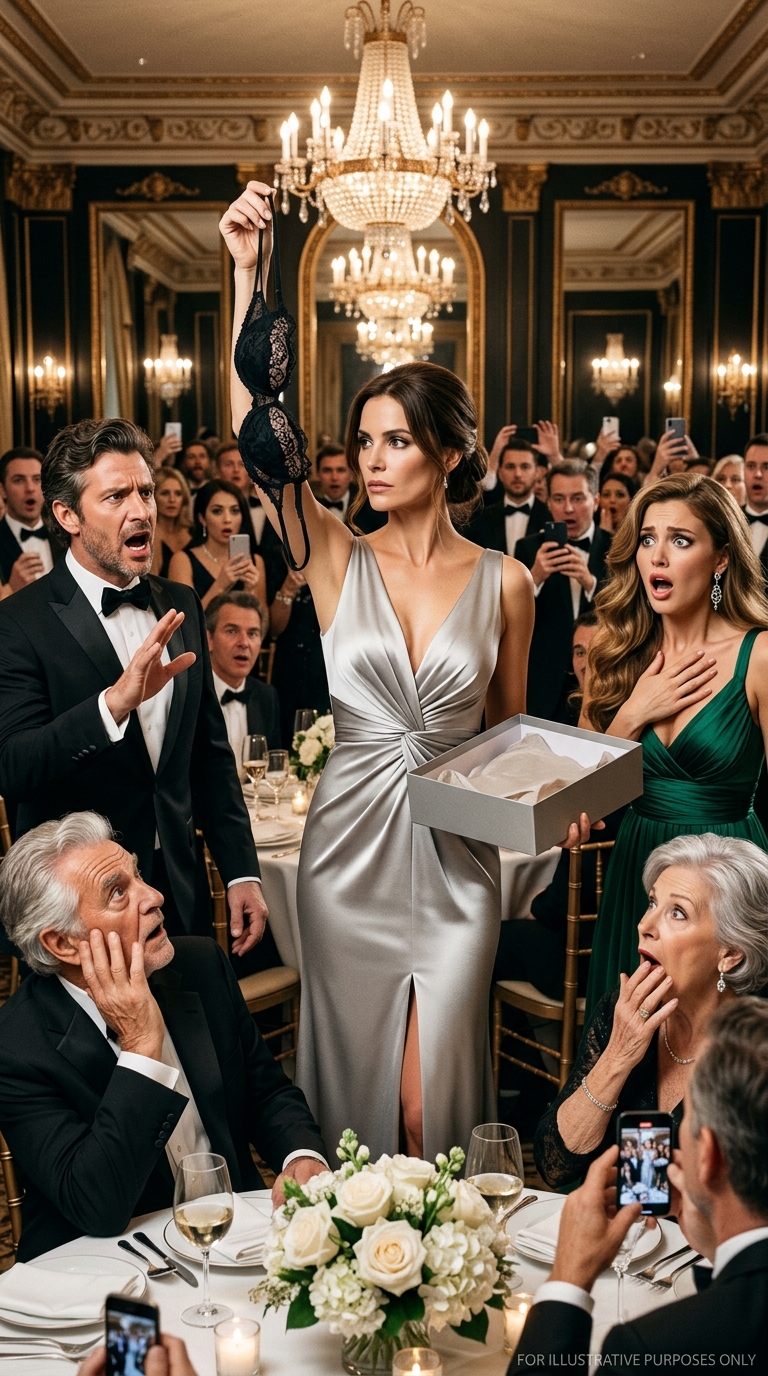
I picked up the silver box.
“Congratulations, darling.”
His eyes fixed on it.
“My surprise gift is showing everyone the man you really are.”
The sentence was quiet.
The nearest tables heard it anyway.
Diane stood.
“What is inside that box?”
I placed it on the table.
Lucas grabbed it before I could open it.
He tore the silver ribbon and lifted the lid.
The evidence bag rested on top.
Black lace.
Jasmine perfume, now faint but unmistakable.
Vanessa saw the box from across the room.
She stopped walking.
One agent said something to her.
She looked away.
Lucas stared at the lingerie.
His face emptied.
Diane gasped.
Robert swore under his breath.
“What is that?” Diane demanded.
Lucas closed the box.
“Nothing.”
I took it back and removed the photograph.
“I found it beneath the passenger seat of his car.”
Diane looked at her son.
“Whose is it?”
Nobody answered.
She turned toward Vanessa.
Recognition spread slowly across her face.
“Oh.”
The single word carried more disgust than any speech.
Lucas leaned close to me.
“You brought this here?”
“You asked me to make sure the car was cleaned.”
“You are trying to destroy me.”
“No.”
“You contacted the board.”
“I provided evidence through counsel.”
His eyes widened.
“What evidence?”
That was the moment he understood the affair was not the whole problem.
I saw him search my face.
Messages.
Invoices.
Passwords.
Files.
“How much did you take?” I asked.
His voice dropped.
“You accessed my computer.”
“Answer.”
“That was private.”
“So was our marriage.”
He looked around the ballroom.
Phones had appeared.
Guests were whispering.
Mara approached.
“Emma, do not discuss the financial evidence publicly.”
Lucas stared at her.
“Who are you?”
“Her attorney.”
He laughed bitterly.
“Of course.”
Robert stepped closer.
“Lucas, what financial evidence?”
Lucas ignored him.
“You planned this.”
“I planned to attend your banquet.”
“You knew they would cancel the promotion.”
“Yes.”
His face twisted.
“You smiled at me for two days.”
“You lied to me for years.”
“That is not the same.”
“No. It required much more effort.”
Diane began crying quietly.
Not for me.
For the public collapse of her son’s image.
“Someone needs to explain,” she said.
Jonah arrived beside Mara.
“Mr. Hale, you are required to surrender all Ellington devices and access credentials.”
Lucas looked at him.
“On whose authority?”
“The audit committee and outside counsel.”
“You cannot seize my personal property.”
“We are requesting company equipment. Federal agents have separate legal authority regarding specified evidence.”
Lucas’s hand moved toward his jacket pocket.
A federal agent stepped closer.
“Please do not access or alter the device.”
“I’m calling my lawyer.”
“You may do so after the device is preserved according to the warrant.”
The word warrant changed everything.
Robert sat down heavily.
Diane covered her mouth.
Lucas looked toward Vanessa.
She was crying now.
He shouted across the room.
“Do not say anything.”
Every remaining conversation stopped.
The agent beside Vanessa answered calmly.
“She has already requested counsel.”
Lucas realized he had made the scene worse.
He turned back to me.
“Come outside.”
“No.”
“We are husband and wife.”
“For the moment.”
His eyes narrowed.
“You would throw away eight years over an affair?”
“The affair is only one item.”
“You don’t understand the financial files.”
“I understood them before you learned what a shell vendor was.”
That sentence startled him.
Lucas had always described my former career as bookkeeping.
He knew I worked at Ashford.
He never understood what I had done there because he rarely asked questions whose answers might make someone else more impressive.
“What did you find?” Robert asked.
Mara responded.
“That should be discussed with counsel.”
Lucas pointed toward me.
“She stole confidential information.”
“I preserved evidence from a personal device used inside our shared home,” I said. “Your lawyers can argue access later.”
“You think you’re clever.”
“No. I think you became careless.”
Arthur Bell took the stage again and asked guests to remain calm while the company handled a private legal matter.
The banquet was effectively over.
People began leaving in clusters.
Some avoided our table.
Others stared openly.
The photographers stopped taking official pictures, though phones continued recording.
Lucas’s promotion speech remained folded inside his jacket.
He had practiced it for two days.
He never delivered a word.
The agents escorted Vanessa to a private meeting room for questioning.
Lucas was not immediately arrested.
Instead, he was served with documents requiring preservation of records and notified that he had been suspended from Ellington pending investigation.
He surrendered his work phone and laptop.
When he finally left the ballroom, his parents followed him.
I did not.
Mara drove me home.
The silver box rested on my lap.
“You departed from the plan,” she said.
“I did not mention the fraud publicly.”
“You displayed intimate evidence in a room full of people.”
“Yes.”
“Lucas may claim invasion of privacy or intentional humiliation.”
“I know.”
“Do you regret it?”
I looked at the black lace through the clear bag.
“Partly.”
“That is not a legal answer.”
“I wanted him to feel exposed.”
“He was exposed.”
“I enjoyed it for approximately ten seconds.”
“And afterward?”
“I felt tired.”
Mara nodded.
“Revenge has poor endurance.”
“Is that professional wisdom?”
“No. Personal.”
At home, the house felt different before anything had physically changed.
Lucas’s shoes remained near the entryway.
His coffee cup sat beside the sink.
A jacket hung over the dining chair.
The ordinary objects looked offensive.
I packed a bag and stayed at a hotel.
Mara arranged for a family-law attorney to file emergency financial protections the next morning.
Lucas had access to joint accounts.
Given the fraud investigation, we could not assume he would leave them untouched.
By noon, the accounts required dual authorization.
By evening, Lucas had sent thirty-seven messages.
The first were angry.
You embarrassed me in front of the entire company.
You had no right to access my laptop.
You have destroyed my career.
Then came bargaining.
Vanessa manipulated the invoices.
I only approved what she prepared.
The affair was a mistake, not a relationship.
Then blame.
You stopped acting like a wife years ago.
You cared more about being correct than being close.
You made me feel small.
The final message read:
Come home and we can control the story together.
Even then, he thought the problem was the story.
Not the conduct.
I did not respond.
The investigation widened over the following weeks.
Forensic auditors confirmed that Crane Strategic Solutions had received more than 1.7 million dollars in false or inflated payments.
Lucas personally received approximately six hundred thousand through accounts and benefits disguised as consulting reimbursements.
Vanessa received more than four hundred thousand.
Eric Crane kept the remainder.
The final four-hundred-fifty-thousand-dollar invoice had been designed to move money immediately after Lucas’s promotion.
The new position would have given him broader approval authority and greater credibility if anyone questioned the payment.
Priya had raised concerns months earlier.
Lucas responded by describing her as hostile, uncooperative, and resistant to leadership.
He attempted to remove her from major projects.
Her documentation helped investigators understand the pattern.
Vanessa cooperated first.
Her attorney negotiated a meeting with federal prosecutors.
She admitted the affair and false invoices but claimed Lucas designed the scheme.
Lucas claimed Vanessa created the vendors and manipulated his trust.
Eric blamed both of them.
Their unity collapsed as soon as loyalty stopped protecting money.
Lucas came to the hotel one week after the banquet.
He waited in the lobby because I had instructed staff not to provide my room number.
I met him in a public seating area with my divorce attorney present.
He looked exhausted.
No tie.
Unshaven.
For years, I had imagined seeing him reduced after a betrayal.
The reality made me sad.
Not because I wanted the marriage back.
Because I remembered the man he had once hoped to become.
He sat across from me.
“You brought a lawyer.”
“Yes.”
“I’m your husband.”
“That is why I brought one.”
His mouth tightened.
“I need to know what you gave them.”
“Financial records, messages, and photographs relevant to the investigation.”
“You copied private conversations.”
“Some concerned company payments.”
“Others did not.”
“The intimate messages establish the undisclosed relationship between you and the employee approving false invoices.”
He leaned back.
“You sound like a prosecutor.”
“I was a forensic accountant.”
“I know.”
“No, Lucas. You knew the phrase. You never cared what it meant.”
He looked down.
“Were you waiting for this?”
“For what?”
“To prove you were smarter than me.”
“No.”
“You always corrected my speeches.”
“You asked me to.”
“You corrected my stories in front of people.”
“When they were factually wrong.”
“You made me feel examined.”
I stared at him.
“You stole company money and slept with your assistant because I made you feel examined?”
“I’m saying the marriage was not perfect.”
“No marriage is.”
“You withdrew.”
“I stopped arguing because every concern became an attack on your ambition.”
“You never admired me.”
“I paid your debts, edited your speeches, hosted your clients, and reorganized my life around your career.”
“That isn’t admiration.”
“What did you want?”
He looked toward the lobby windows.
“I wanted to feel like I was enough.”
The sentence might once have reached me.
Now it revealed the structure beneath everything.
Lucas had not wanted love.
He wanted constant confirmation that he was the most impressive person in the room.
Vanessa provided that.
So did the promotion.
So did money.
When each source of confirmation required dishonesty, he chose dishonesty.
“You were enough before you started stealing,” I said.
He looked at me.
“Do you still love me?”
I considered lying.
“Yes.”
His eyes filled.
“But love does not make you safe to remain married to.”
“I can fix this.”
“You cannot repair fraud by making promises to me.”
“I mean us.”
“There is no us separate from what you chose.”
He rubbed both hands across his face.
“Vanessa meant nothing.”
“That does not help.”
“It should.”
“You risked our marriage for someone who meant nothing?”
He closed his eyes.
“I said the wrong thing.”
“No. You said the convenient thing.”
He leaned forward.
“If I plead guilty, I could go to prison.”
“Yes.”
“You say that so calmly.”
“What response would help?”
“I don’t know. Fear?”
“I am afraid.”
“For me?”
“For the employees, investors, and families connected to those projects. For what this will do to both our lives. For the person I became while protecting your image.”
His face hardened.
“So you are the victim now.”
“I am one of them. Not the only one.”
He stood.
“I will not let you take the house.”
“The lawyers will handle property.”
“My parents helped with the down payment.”
“My savings covered more than half, and the records exist.”
“Everything is records with you.”
“Yes.”
“People are more complicated than numbers.”
“Numbers revealed what your words concealed.”
He left without saying goodbye.
The divorce took fourteen months.
Lucas contested almost every issue.
The house.
Savings.
My business income.
Whether the Ashford investment interest counted as marital property.
During discovery, he learned the value of my deferred equity.
His reaction confirmed that money remained central even while his criminal case developed.
“You hid millions from me,” he said during mediation.
“I disclosed the investment in our premarital financial statements and annual tax filings.”
“You never said what it might become.”
“Neither of us knew.”
“You let me think you were dependent on me.”
“I paid household expenses for years.”
“That is not what I mean.”
He meant status.
He believed I had allowed him to feel superior under false pretenses.
The settlement followed our existing agreements and financial records.
I retained my separate investment assets.
The house was sold.
Joint funds were divided after accounting for money Lucas had used to support the affair.
He received far less than he expected.
The criminal case moved more slowly.
Vanessa pleaded guilty to conspiracy and wire fraud.
Her cooperation reduced her sentence.
Eric also pleaded guilty.
Lucas initially maintained his innocence.
Then investigators found voice messages where he instructed Vanessa to split invoices and avoid procurement thresholds.
One recording captured him saying:
“Once I have the promotion, nobody will question vendors I personally approve.”
He accepted a plea agreement shortly before trial.
Wire fraud.
Conspiracy.
False claims related to publicly supported projects.
He received six years in federal prison and was ordered to pay restitution.
At sentencing, Diane sat behind him.
Robert sat beside her.
I attended because I had provided evidence and was recognized as an affected party.
Lucas spoke before the judge.
He described ambition, pressure, and poor judgment.
Then he apologized to Ellington, investors, employees, and his family.
He looked at me.
“I betrayed my wife in ways that went beyond the affair. I used her support while resenting her strength.”
The courtroom remained quiet.
“I told myself I deserved more because I was working harder than everyone else. The truth is that I wanted rewards without limits.”
It was the most honest speech he ever gave.
No polished phrases.
No mirror practice.
No applause.
The judge asked whether he understood that the false payments affected publicly funded redevelopment projects.
“Yes.”
“Some of those projects served low-income residents.”
“I understand.”
“Do you?”
Lucas lowered his head.
“Not enough when I made the decisions.”
The sentence mattered.
It did not erase anything.
After sentencing, Diane approached me outside the courtroom.
She looked older.
“Are you satisfied?”
“No.”
“My son is going to prison.”
“Yes.”
“You helped put him there.”
“I provided evidence.”
“You could have handled the affair privately.”
“The affair was not the crime.”
“You wanted to humiliate him.”
“At the banquet, yes.”
She seemed surprised by the admission.
I continued.
“I regret making his exposure part of my emotional revenge. I do not regret reporting fraud.”
Diane’s eyes filled.
“He loved you.”
“I believe he did.”
“Then how could you do this?”
“Love does not require protecting theft.”
She shook her head.
“You sound very sure.”
“I spent years being told certainty made me cold. Sometimes certainty is simply what remains after the facts stop changing.”
She walked away.
Ellington recovered much of the stolen money through restitution, insurance, and seized assets.
Priya became regional executive vice president.
Her first major action was expanding procurement oversight and protecting employees who raised compliance concerns.
She contacted me after the sentencing.
“I should thank you,” she said.
“No.”
“You provided what we needed.”
“You had already raised concerns.”
“They called me difficult.”
“I know the experience.”
She smiled.
“Would you consider consulting on the new controls?”
At first, I declined.
Returning to corporate investigations felt like allowing Lucas’s betrayal to choose my future.
Then I reconsidered.
The work had once belonged to me before marriage narrowed my identity.
I accepted a limited engagement.
That project led to others.
Within two years, I rebuilt a forensic-accounting practice focused on procurement integrity, related-party transactions, and whistleblower protections.
I hired two analysts.
Then five.
Mara became outside counsel.
She reminded everyone that she deserved credit for preventing me from placing original evidence in a gift box.
The story of the banquet spread publicly after court records became available.
Articles called me the quiet wife who destroyed her cheating executive husband.
I disliked the framing.
I had not destroyed him.
He built the evidence.
I opened the door.
There was a difference.
The dramatic version also treated the lingerie as the central discovery.
It was emotionally central.
Legally, it mattered far less than the invoices and approvals.
Still, people preferred black lace to procurement thresholds.
One interviewer asked whether I felt empowered when I held up the evidence bag.
“No,” I said.
“What did you feel?”
“Humiliated.”
The interviewer looked surprised.
“But you turned the tables.”
“Discovering your husband’s betrayal does not become dignified because you reveal it publicly.”
“Do you regret attending?”
“No.”
“Do you regret the gift box?”
“Parts of it.”
“What parts?”
“I made my pain into a spectacle because I wanted him to experience one.”
“Did he deserve it?”
“That is not the same as asking whether it helped me.”
The answer was published, though the headline ignored it.
Years passed.
Lucas wrote from prison twice.
The first letter focused on legal appeals and financial disputes.
I did not answer.
The second arrived three years into his sentence.
Emma,
I spent a long time telling myself you enjoyed discovering what I did because it allowed you to become important again.
That story protected me from admitting you had always been important and I needed you to seem smaller.
I resented how easily you understood things I struggled to control. Instead of learning from you, I called your competence coldness.
Vanessa praised me because she wanted access. You challenged me because you expected honesty.
I chose the praise.
I am sorry.
Lucas
I read the letter in my office after everyone left.
For years, I had wanted him to understand that exact truth.
When he finally did, I felt no victory.
Only grief for the years we could not recover.
I wrote one response.
I appreciate the apology. Continue becoming accountable without expecting access to me.
He did not write again.
Vanessa served less than three years.
After release, she changed her surname and worked outside corporate finance.
I never contacted her.
Once, I saw her in a grocery store.
She noticed me at the same moment.
We stood at opposite ends of an aisle filled with coffee.
Her face changed.
Mine probably did too.
She walked away.
I let her.
Not every unfinished relationship requires a final conversation.
Robert died while Lucas remained incarcerated.
Diane sold the family home and moved closer to relatives.
She sent me one card after his death.
Robert regretted what happened. He never knew how to say it.
I placed the card in a drawer.
People often use death to deliver apologies on behalf of those who avoided them while alive.
I did not reject the message.
I did not let it rewrite him either.
The silver gift box remained in my closet for years.
The lingerie stayed in legal evidence storage until every appeal and civil matter concluded.
When it was returned, I considered throwing it away immediately.
Instead, I opened the evidence bag one final time.
The jasmine scent was gone.
The fabric looked ordinary.
That surprised me.
For years, the lingerie had represented an entire betrayal.
Without the perfume, the car, and Lucas’s lies, it was simply cloth.
I cut off the label, destroyed the item, and recycled the box.
Not ceremonially.
No fire.
No speech.
I needed storage space.
That ordinariness felt healthier than revenge.
At forty-six, I began dating again.
His name was David Chen.
He worked as an urban planner and had no interest in executive banquets.
On our fifth date, I told him about Lucas.
Not every detail.
Enough.
David listened.
Then asked, “What did you miss most after the marriage ended?”
The question caught me off guard.
Most people asked what I hated, what I learned, or whether I still felt angry.
“I missed having someone in the kitchen,” I said.
He nodded.
“Even him?”
“Sometimes.”
“That makes sense.”
No dramatic reassurance.
No promise that he would never hurt me.
Just room for a complicated answer.
We moved slowly.
When he left his phone on the table, I did not check it.
Not because trust required blindness.
Because suspicion should respond to evidence, not become a permanent lifestyle.
When concerns arose, I asked.
He answered.
Sometimes imperfectly.
We argued without turning every disagreement into a verdict on character.
That felt unfamiliar.
Years later, we married in a small courthouse ceremony.
Mara attended.
Priya attended.
No promotion speeches.
No silver box.
Afterward, we ate dinner at a restaurant with twelve friends.
David gave a toast.
He thanked me for reading every contract he signed and for occasionally allowing him to assemble furniture without reviewing the instructions.
People laughed.
So did I.
The joke did not make me smaller.
That was the difference.
Lucas was released after serving most of his sentence.
I learned through formal victim-notification channels.
He moved to another state and worked for a small nonprofit helping people reenter employment after incarceration.
Some former Ellington employees accused him of using redemption as another performance.
Perhaps he was.
Perhaps performance can become practice if someone repeats it honestly enough.
I did not investigate.
His life no longer required my supervision.
A decade after the banquet, Ellington invited me to speak at an ethics conference.
The event took place in the same Grand Meridian ballroom.
I almost declined.
Then I accepted because avoiding the room gave it too much authority.
The chandeliers remained.
The stage had been redesigned.
The table where Lucas opened the silver box no longer existed.
During my talk, I spoke about organizational silence.
Not my marriage.
Not lingerie.
Systems.
“How does fraud continue?” I asked the audience.
“Not only because dishonest people hide it. It continues because other people accept explanations that make their own lives easier.”
I described duplicated invoices, related-party vendors, approval thresholds, and leaders who punish questions by calling the questioner difficult.
Priya sat in the front row.
Afterward, a young analyst approached me.
“How do you know when suspicion becomes enough to act?”
“You usually do not begin with accusation,” I said. “You begin with preservation.”
“Preserve what?”
“Facts. Records. Context. Your own ability to think before the person you suspect tells you what your observations mean.”
She nodded slowly.
I thought of the passenger seat.
Black ribbon.
Jasmine.
The quiet moment when betrayal entered without sound.
The discovery did not make me powerful.
What mattered was what I did after.
I did not destroy evidence.
I did not warn people before records were preserved.
I sought counsel.
I separated personal pain from financial wrongdoing as carefully as I could.
I made mistakes.
The banquet confrontation was one of them, at least partly.
Still, imperfect action stopped greater harm.
That complexity became the lesson I carried forward.
For years, I believed the defining sentence of my marriage was Lucas saying, “After the promotion, everything changes.”
Later, I thought it was my whisper at the banquet.
“Now everyone will see the man you really are.”
Neither was entirely accurate.
No single event reveals a whole person.
Lucas had been generous sometimes.
Loving sometimes.
Afraid often.
Dishonest repeatedly.
He was not only the man in the evidence files.
He was also the man who once sat beside me after my mother’s surgery and slept upright because I was afraid to be alone.
Human beings do not become simple because they betray us.
That truth does not make staying safe.
It makes leaving sadder.
The person Lucas became had been built through thousands of decisions.
Small deceptions.
Unquestioned entitlement.
Praise preferred over accountability.
The promotion banquet did not create him.
It removed the lighting that made him appear different.
My own identity returned in the same way.
I had not stopped being a forensic accountant when I became his wife.
I had stopped using that part of myself because our marriage rewarded me for being agreeable.
The files did not give me intelligence.
They reminded me I still trusted it.
That was the real gift hidden inside the silver box.
Not revenge.
Recognition.
The moment I stopped seeing myself through the eyes of a man who needed me smaller.
Years afterward, when people asked whether I had known about the affair before finding the lingerie, I always gave the same answer.
“I knew something was wrong. I did not yet allow myself to know what.”
There is a difference.
Sometimes evidence does not introduce the truth.
It removes our final excuse for avoiding it.
The lingerie did that.
The invoices did more.
They showed me that Lucas’s betrayal was not limited to romance.
He had used my labor, money, reputation, and silence while privately mocking the trust that made those things possible.
He believed I preferred comfortable lies.
For a while, maybe I did.
Comfort can feel like peace when the alternative threatens the entire structure of a life.
But peace built on someone else’s secrecy is only delay.
The banquet ended.
The promotion vanished.
The marriage ended.
The criminal case concluded.
Years passed.
What remained was not the satisfaction of his face changing when he opened the box.
That memory faded.
What remained was the moment beneath the passenger seat.
My hand holding black lace.
Rain on the roof.
A choice forming quietly inside me.
I could confront him immediately and let him explain.
I could place the garment back and continue living inside doubt.
Or I could trust what I saw long enough to learn what else had been hidden.
I chose the truth.
Not gracefully.
Not without anger.
Not without enjoying consequences more than I am proud to admit.
But completely.
Lucas once told me everything would change after his promotion.
He was wrong about the promotion.
He was right about everything else.