The first piano chord shook the room.
Not loudly.
Deeply.
Like the ballroom itself had been waiting for her.
The waitress tied the worn shoes with careful fingers. One ribbon was frayed at the end, and when she touched it, her face changed for half a second.
The woman in silver noticed.
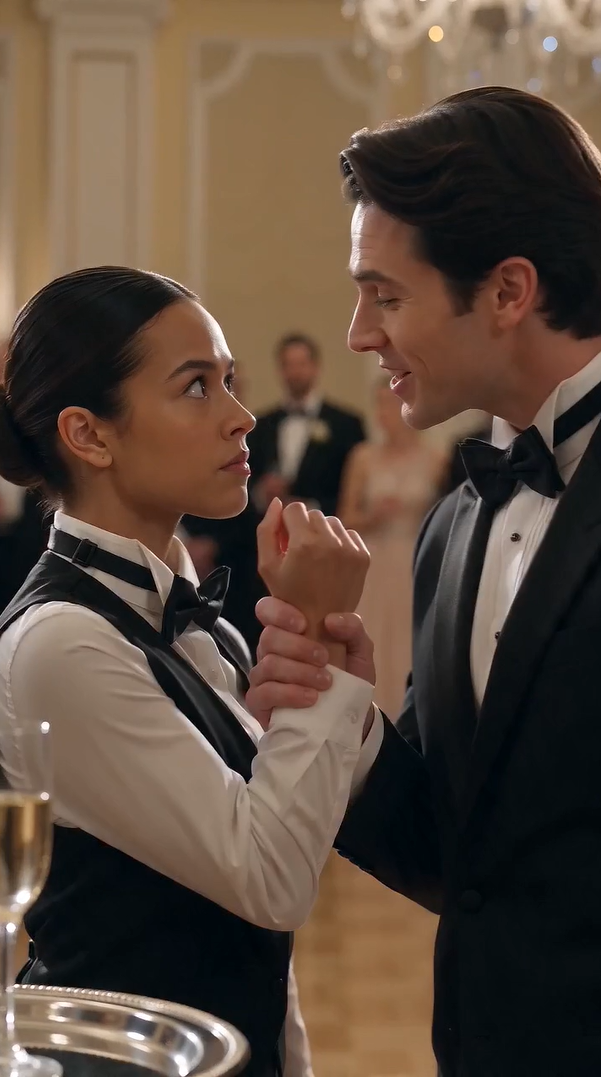
So did Alex.
The event director stepped behind him with a microphone, eyes cold.
“This gala was created in memory of Celeste Moreau,” he said.
The waitress closed her eyes at the name.
The guests turned silent.
Celeste Moreau had been the greatest dancer the city ever lost.
The woman who vanished after a scandal.
The woman Alex’s family had quietly erased from the foundation posters.
The waitress opened her eyes and stepped into the music.
At first, her movement was small.
A single turn.
A breath.
A hand reaching toward someone who was no longer there.
Then the dance broke open.
Not perfect like a performance.
Human.
Raw.
Like grief had learned how to move.
Her uniform skirt swayed under the chandelier lights. Her old shoes whispered across the marble. Every step looked like someone trying to come back from being humiliated, hidden, and renamed.
Alex stared at her now.
Not mocking.
Afraid.
The woman in silver whispered, “Who is she?”
The event director answered into the microphone.
“Celeste’s daughter.”
The room inhaled at once.
The waitress turned on the final note and stopped directly in front of Alex.
Her chest rose and fell.
Her eyes were wet.
“My mother was supposed to open this gala ten years ago.”
Alex’s face drained.
“She ran away,” he whispered.
The waitress shook her head.
“You made everyone believe that.”
The director lifted an old envelope.
“Tonight, we found her letter.”
The waitress looked at the guests, then at the rich man who had tried to turn her into entertainment.
“My mother didn’t disappear because she failed.”
Her voice trembled, but her chin stayed high.
“She disappeared because your family told her a poor dancer didn’t belong beside people like you.”
Alex couldn’t speak.
The waitress looked down at the worn shoes.
“She died teaching me that the floor does not belong to the people who own the room.”
Then she looked up, tears finally falling.
“It belongs to the person brave enough to step into the light.”
For a long moment, no one breathed.
The music had stopped, but something in the room kept moving.
Shame.
It passed from face to face.
Across diamond necklaces.
Across polished watches.
Across hands that had clapped for the wrong people for too many years.
Alex looked at the waitress like he was seeing her for the first time.
Not as the girl carrying champagne.
Not as the joke he had dragged into the center of the room.
Not as someone he could embarrass for applause.
As a daughter.
As a witness.
As the living proof of a story his family had buried.
“What is your name?” he asked quietly.
The waitress wiped her cheek with the back of her hand.
“Maya.”
Alex swallowed.
“Maya Moreau?”
She nodded.
The name hit the ballroom harder than the music had.
A few older guests looked down at their tables.
They remembered Celeste.
Some had watched her dance.
Some had whispered about her downfall.
Some had repeated the rumor because it was easier than asking who had started it.
The woman in silver took a step away from Alex, her confident smile gone.
The event director unfolded the letter with shaking hands.
His voice changed when he began to read.
It was no longer the voice of a man running a gala.
It was the voice of someone carrying a promise.
“To whoever still remembers me,” he read, “I did not leave because I was weak. I did not leave because I was ashamed of my work. I left because powerful people decided my dream was dangerous.”
The room went still.
Maya closed her eyes.
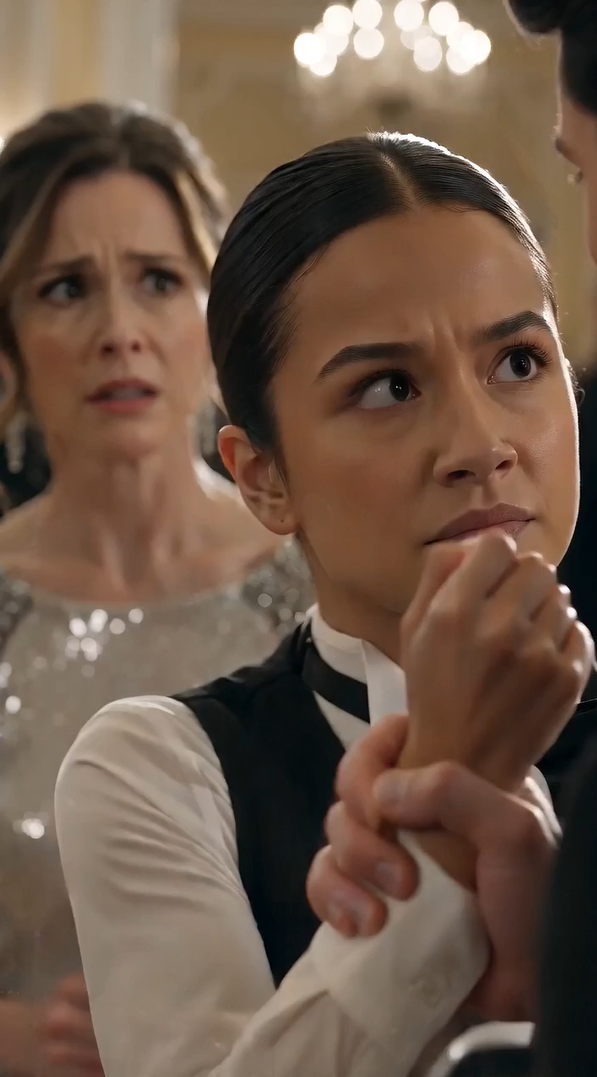
She had heard parts of that letter before, but never like this.
Never under chandeliers.
Never in the same ballroom where her mother had been destroyed.
The director kept reading.
“They smiled at me in public and locked the door in private. They told me the city loved my talent but not my name. They told me I could dance for their guests, but I could never stand beside them. And when I refused to bow, they gave the world a story it was willing to believe.”
A woman at the back covered her mouth.
Alex turned pale.
His father’s name was not spoken yet.
But everybody felt it coming.
The director’s hands trembled around the paper.
“They called me difficult. They called me unstable. They said I broke contract. They said I ran from the stage. The truth is simple. I was removed.”
Maya’s breath broke.
She remembered her mother at the kitchen table, tying those worn shoes with swollen fingers, whispering, “One day, baby, you will dance where they said I could not stand.”
Back then, Maya had not understood.
She had only known the small apartment.
The unpaid bills.
Her mother teaching children for cash in church basements.
The way Celeste would smile when music played, then turn away before the tears came.
The director read the last lines slowly.
“If this letter is ever found, do not use my name for another rich night of speeches. Do not let them raise money over my grave while hiding what they did to me. Give the floor to someone who knows what it costs to be told she does not belong.”
He lowered the letter.
No one clapped.
No one dared.
Alex looked at the envelope like it had opened a grave in front of him.
“My father said she walked out,” he whispered.
Maya looked at him.
“Your father said many things.”
His jaw tightened, not in anger now, but in pain.
“I was a child.”
“So was I.”
That sentence struck him silent.
Maya’s voice softened, but it did not lose its strength.
“I was six when my mother stopped dancing on big stages. I was eight when I heard women at a market call her a disgrace. I was ten when I watched her sell her costumes one by one to pay rent.”
Her eyes moved across the ballroom.
“And every year, your family held this gala in her name.”
A murmur spread through the guests.
Maya turned back to Alex.
“You raised money with her picture once. Then you removed even that. Her face disappeared from the program. Her name became a theme. A memory without a body. A story without truth.”
Alex looked toward the huge banner hanging behind the stage.
Celeste Moreau Foundation Gala
For Young Artists
The words suddenly looked wrong.
Clean.
Expensive.
Empty.
Maya followed his gaze.
“My mother used to stand outside buildings like this with me and say, ‘Listen closely.’”
Her voice cracked.
“She would make me listen to the music coming through the walls. Then she would say, ‘They can close the door, but they cannot stop the song from reaching us.’”
Tears filled her eyes again.
“She died before she saw me dance in a real theater.”
Alex looked down.
Maya took one step closer.
“But tonight, you thought it would be funny to make the waitress dance.”
His face twisted.
The words were too true.
The whole room remembered it now.
His casual laugh.
The woman in silver saying, “Let her try.”
The guests turning their chairs.
Maya standing there with a tray in her hand, cheeks burning, while Alex pointed to the center of the ballroom and said, “Since you keep staring at the floor, show us what you can do.”
He had expected her to stumble.
He had expected the room to laugh.
He had expected to turn a poor girl into a moment of entertainment.
Instead, he had handed Celeste Moreau’s daughter the very floor her mother had been denied.
Alex’s voice came out rough.
“I didn’t know.”
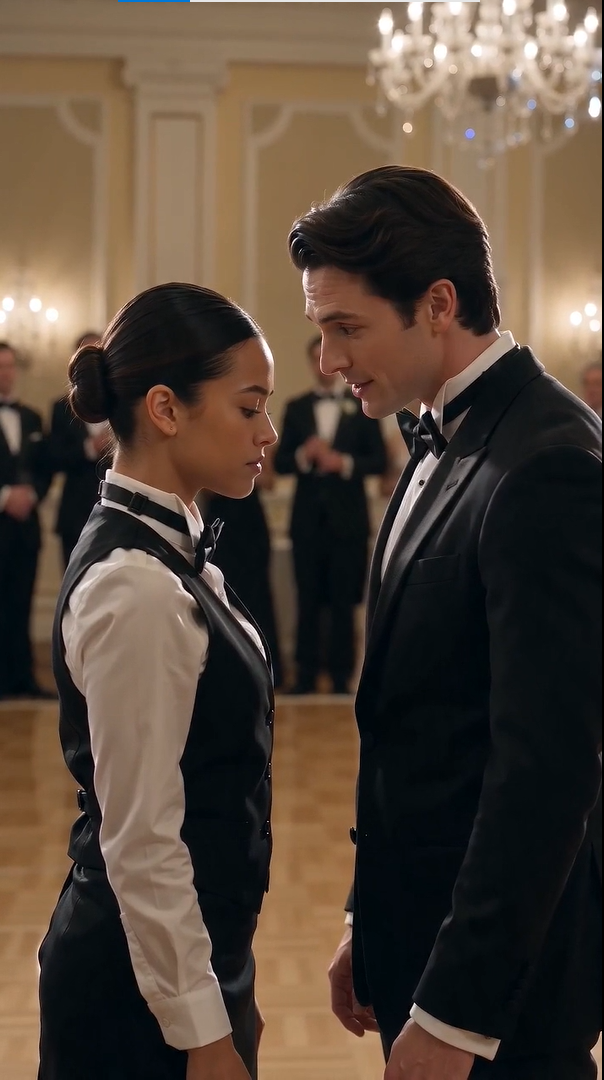
Maya stared at him.
“No. You didn’t care.”
A few people shifted uncomfortably.
Alex closed his eyes.
For once, nobody rushed to save him from the truth.
The woman in silver tried to recover the room.
“This is emotional, of course,” she said carefully. “But we should be careful before blaming an entire family over an old letter.”
Maya turned to her.
The woman lifted her chin.
“I mean, no one here knows what really happened.”
The event director looked at her.
“I do.”
The woman froze.
He lowered the microphone for a second, then lifted it again.
“I was assistant stage manager that year.”
Gasps broke across the room.
He looked at Maya.
“I’m sorry.”
Those two words almost broke her.
Not because they fixed anything.
But because someone who had seen the truth was finally saying it out loud.
The director faced the guests.
“I watched Celeste arrive that night. She was ready. She was wearing these shoes. She had practiced until her feet bled. Then Mr. Laurent’s office called her upstairs.”
Alex stiffened at his father’s name.
The director continued.
“She came back twenty minutes later with her face white. Security followed her. They took her pass. They took her costume. They told staff she had become hysterical and was not fit to perform.”
His voice shook with shame.
“I said nothing.”
Maya’s lips trembled.
The director looked directly at her.
“I was young. I was afraid of losing my job. But that is not an excuse. I have carried that night for ten years.”
He lifted the envelope.
“When the archive room flooded last week, we moved old storage boxes. I found this letter sealed inside a costume bag. Her handwriting. Her shoes. Her truth.”
Maya looked down at the shoes on her feet.
Her mother’s shoes.
Worn.
Frayed.
Still holding the shape of a woman who had danced through pain.
Alex turned toward the director.
“Why didn’t you tell me?”
The director’s face hardened.
“Would you have listened this morning?”
Alex opened his mouth.
Nothing came out.
Because the answer was no.
That morning, he had walked through the ballroom complaining about flower arrangements and donor seating. He had passed Maya three times without seeing her. When she dropped a spoon, he had looked at her like she was part of the floor.
He had not been cruel in a dramatic way.
That was worse.
His cruelty had been casual.
Practiced.
Inherited.
He looked at Maya.
“I’m sorry.”
She did not soften.
“Do you know what sorry means when it comes ten years late?”
Alex swallowed.
“No.”
“It means you don’t get to ask for forgiveness before you make the truth louder than the lie.”
The room absorbed that.
Alex looked at his guests.
His donors.
His family’s friends.
People who had built whole lives around polite silence.
Then he looked at the banner again.
For the first time, he seemed to understand that money could not clean a name it had helped ruin.
He walked toward the stage.
The woman in silver grabbed his arm.
“Alex, don’t.”
He looked at her hand.
Then at her face.
Something final passed through his eyes.
“Let go.”
She did.
He stepped onto the stage and took the microphone from the director.
His hand was shaking.
The guests watched him.
Maya watched him too, but not with hope.
With warning.
Like she was giving him one chance to become different from the men who raised him.
Alex stood under the lights.
“My family founded this gala in Celeste Moreau’s name,” he said. “Tonight, I learned that my family also helped destroy her career.”
A shocked murmur moved through the room.
He kept going.
“I repeated the lie because it was convenient. I benefited from a story I never questioned. And tonight, I humiliated her daughter on the same floor where her mother should have been honored.”
His voice broke slightly.
He looked at Maya.
“I cannot undo what my father did. I cannot give Celeste Moreau back the years she lost. I cannot give you back your mother.”
Maya’s face tightened, but she did not look away.
Alex turned to the crowd.
“But I can stop this foundation from hiding behind her name.”
The room went quiet again.
The woman in silver whispered, “Alex…”
He ignored her.
“Every record connected to Celeste Moreau will be opened. Every board member will receive this letter tonight. The foundation will issue a public correction before morning.”
Some guests began looking at one another nervously.
Alex’s voice grew stronger.
“And from this moment forward, the gala will no longer be run by my family alone. The first seat on the new artist board belongs to Maya Moreau, if she chooses to accept it.”
Maya’s eyes widened.
Alex looked at her.
“Not as an apology gift. Not as charity. As the rightful heir to the woman whose name built this room.”
Maya stared at him.
Her chest rose and fell.
Part of her wanted to say no.
Part of her wanted to leave, carrying her mother’s shoes and never looking back.
Because dignity did not always mean accepting a place at the table that once refused to feed you.
But then she thought of her mother.
Not the broken version the city had whispered about.
The real one.
Celeste laughing barefoot in the kitchen.
Celeste tapping rhythms on the windowsill during rain.
Celeste telling Maya, “When they close a door, learn the shape of the key.”
Maya looked around the ballroom.
The floor was still the same.
The chandeliers were still too bright.
The guests were still rich enough to forget pain by morning.
But now the letter was out.
The truth had entered the room.
And truth, once spoken in the right place, has a way of refusing to leave.
Maya stepped toward the stage.
Alex came down immediately, as if he knew he had no right to stand above her.
He offered her the microphone.
She took it.
For a second, all she could hear was her own heartbeat.
Then she looked at the guests.
“My mother did not want revenge,” she said.
Her voice shook, but she did not stop.
“She wanted a floor.”
She looked down at the marble.
“She wanted poor children to dance without being told their dreams were too expensive. She wanted girls from small apartments to enter through the front door. She wanted artists to be judged by their work, not their last name.”
Her fingers tightened around the microphone.
“If this foundation keeps her name, then it will do what she wanted.”
The room listened.
No one interrupted.
“No more galas where workers serve food under a woman’s name while children like her daughter cannot afford lessons. No more speeches about opportunity from people who never had to fight for one. No more hiding the truth because it makes rich people uncomfortable.”
Alex lowered his head.
Maya looked at him.
“If I accept that seat, it will not be to decorate your board.”
He nodded.
“I understand.”
“No,” she said softly. “You don’t yet.”
He looked up.
“But you will.”
Then she turned back to the room.
“Tonight’s donations will fund dance training for children who cannot pay. Staff wages for every worker in this building will be reviewed. And my mother’s full story will be printed in next year’s program, not as scandal, but as truth.”
The director wiped his eyes.
Maya took a breath.
“And one more thing.”
The guests waited.
She looked toward the back of the ballroom, where waiters, cleaners, and kitchen staff had gathered quietly near the doors.
People in black uniforms.
People holding trays.
People who had frozen in place when Maya began to dance.
People who knew exactly what it felt like to be invisible in a beautiful room.
Maya lifted her chin.
“Open the doors.”
The security guards looked confused.
Alex turned.
“Open them.”
The doors were opened.
The staff did not move at first.
They were too used to being told where not to stand.
Maya’s voice softened.
“Please come in.”
Slowly, one by one, they entered.
A dishwasher with wet sleeves.
A young server still holding a stack of plates.
A cleaner with tired eyes.
A cook wiping his hands on a towel.
They stepped onto the marble like they expected someone to stop them.
No one did.
Maya looked at them and smiled through tears.
“My mother used to say the floor belongs to whoever has the courage to step into the light.”
She looked back at the pianist.
“Play it again.”
The pianist nodded.
The first chord returned.
This time, it did not shake the room like a warning.
It rose like a door opening.
Maya placed the microphone down.
She stood in the center of the ballroom in her waitress uniform and her mother’s old shoes.
Then she began to dance again.
But this time, she was not alone.
The director stepped back.
The staff watched.
The guests watched.
Alex watched.
And slowly, a little girl from the kitchen staff, maybe ten years old, stepped forward from beside her mother.
She had been hiding behind a dessert cart.
Her eyes were wide.
Her shoes were plain.
Maya saw her.
Without stopping the dance, she reached out one hand.
The girl looked at her mother.
Her mother nodded, crying quietly.
The girl stepped into the light.
Maya guided her through one simple turn.
The room broke.
Not into laughter.
Into tears.
Because everyone understood.
This was what Celeste had been denied.
Not fame.
Not applause.
Permission.
A place.
A hand reaching back.
When the music ended, Maya knelt in front of the girl.
“What’s your name?”
“Sofia,” the girl whispered.
Maya smiled.
“Do you dance?”
Sofia shook her head.
“I just watch.”
Maya’s eyes filled again.
“So did I.”
Sofia looked at the worn shoes.
“Are those magic?”
Maya laughed softly through her tears.
“No, sweetheart.”
She touched the frayed ribbon.
“They’re proof.”
“Proof of what?”
Maya looked toward the letter in the director’s hand.
Then toward Alex.
Then back at the child.
“That someone can be pushed out of the light and still leave enough behind for her daughter to find the way back.”
Sofia stared at her like she would remember that forever.
Maybe she would.
Maybe one sentence would save her years later, the way her mother’s words had saved Maya.
Alex stepped forward slowly.
He did not interrupt.
He waited until Maya stood.
Then he said, “I’ll resign as chair tonight.”
The woman in silver gasped.
Maya studied him.
“Running away is not the same as changing.”
Alex looked startled.
She continued.
“You don’t get to make one speech, step down, and leave others to clean the room your family built.”
His face tightened with shame.
“What do you want me to do?”
“Stay,” Maya said. “But not above anyone. Stay and do the work. Sit in the meetings where people tell you the truth. Sign the checks. Open the records. Face the families your father silenced. Learn what your name cost other people.”
Alex nodded slowly.
“I will.”
Maya held his gaze.
“If you don’t, I’ll make sure the city knows.”
For the first time that night, Alex almost smiled.
Not because it was funny.
Because she meant it.
And he knew she should.
“I believe you,” he said.
The woman in silver turned to leave.
Maya saw her.
So did half the room.
For one second, the woman looked like she might say something sharp, something polished, something cruel enough to recover her pride.
But no one was standing with her now.
So she walked out silently, her silver dress shining under lights she had done nothing to earn.
No one followed.
The gala did not continue the way it had been planned.
The auction was canceled.
The speeches were thrown away.
The champagne still sat on tables, but no one seemed thirsty for celebration anymore.
People lined up to speak to Maya.
Some apologized.
Some cried.
Some tried too hard.
Maya listened to some and walked away from others.
She owed no one comfort.
Near midnight, when the ballroom finally emptied, Maya returned to the center of the floor.
The chandeliers had been dimmed.
The staff had gone home.
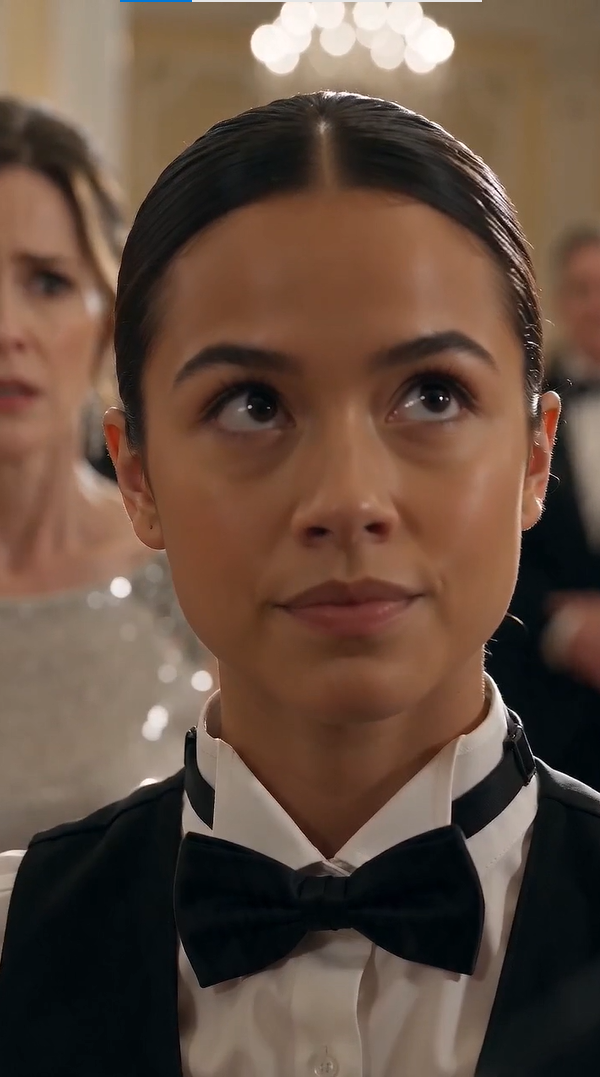
Alex stood near the stage, speaking quietly with the director.
The letter lay safely in a glass case now, waiting to be copied, scanned, and released.
Maya sat on the marble and untied the shoes.
Her feet hurt.
Her whole body hurt.
But not the way it had hurt when she walked in that evening carrying drinks while people looked through her.
This pain felt alive.
Like a wound finally cleaned.
She touched the frayed ribbon and whispered, “I did it, Mama.”
The director heard her.
He came closer slowly.
“I should have helped her,” he said.
Maya didn’t look up.
“Yes.”
He flinched.
She tied the ribbons together and placed the shoes in her lap.
“But you helped tonight.”
His eyes filled.
“It wasn’t enough.”
“No,” she said. “It wasn’t.”
Then she looked at him.
“But it was something.”
He nodded, accepting the small mercy without asking for more.
Alex approached a few minutes later.
He had removed his bow tie. His face looked tired, stripped of its earlier arrogance.
“I called the board,” he said.
Maya stood.
“And?”
“Emergency meeting tomorrow morning. You’ll receive the documents tonight. The donation report, staff contracts, archive access, everything.”
Maya studied him.
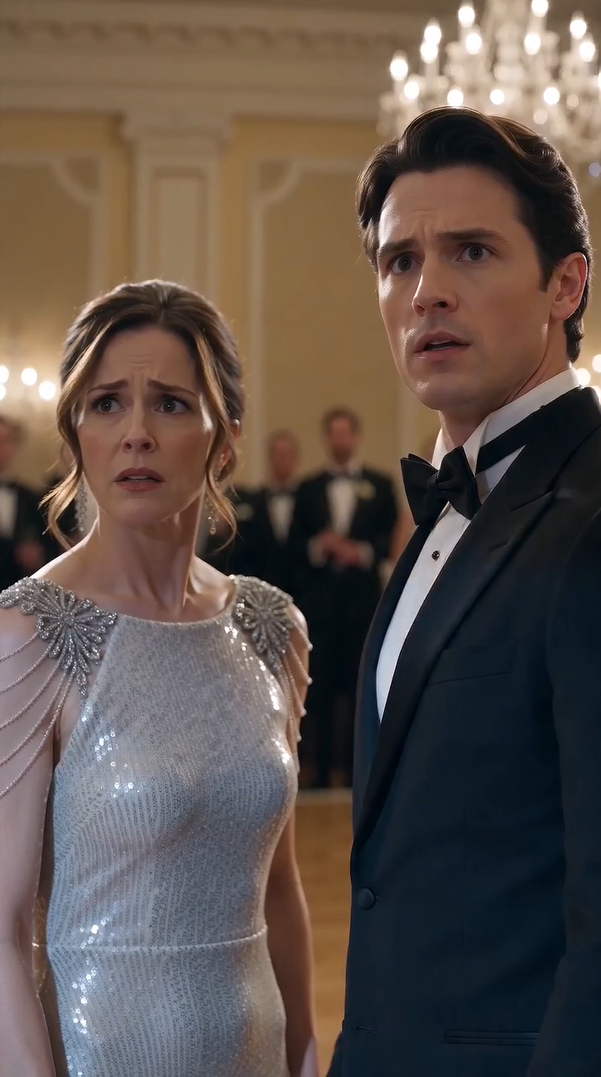
“Good.”
He looked at the shoes.
“May I ask something?”
She waited.
“Did your mother know you would come here?”
Maya’s eyes softened.
“She wanted to.”
“What happened?”
Maya looked toward the tall windows.
“She got sick.”
Alex lowered his head.
“I’m sorry.”
“She was tired before she was sick,” Maya said. “There’s a difference.”
He looked at her.
“She spent years trying to prove she was not what your family said she was. That kind of lie eats a person. Even when people stop talking, you still hear it.”
Alex swallowed hard.
“My father died believing he protected our name.”
Maya looked back at him.
“He protected a lie.”
Alex nodded.
This time, he did not defend him.
That mattered, but only a little.
The next morning, the city woke up to the truth.
The foundation released Celeste Moreau’s letter in full.
The headline spread faster than anyone expected.
Forgotten dancer’s daughter exposes decade-old scandal at gala.
But Maya hated that headline.
So did thousands of people who had seen the video of her dance.
By afternoon, another line began to appear everywhere.
The floor belongs to the brave.
Old videos of Celeste resurfaced.
Interviews.
Reviews.
Photos of her leaping across stages with fire in her eyes.
People who had once whispered now posted tributes.
Some were sincere.
Some were guilty.
Some were late.
Maya read only a few.
Then she closed her phone.
She had spent enough of her life watching strangers decide who her mother was.
Now she had work to do.
The first board meeting was ugly.
Truth usually is.
Some donors threatened to leave.
Maya let them.
One board member said the foundation should avoid “negative history.”
Maya asked him if he meant her mother.
He resigned before lunch.
Alex sat through all of it.
He looked uncomfortable.
Good.
Maya did not need him comfortable.
She needed him useful.
By the end of the week, changes had begun.
The foundation’s name stayed, but its mission was rewritten.
Celeste Moreau’s full story was placed on the website.
A paid training program opened for young dancers from low-income families.
Free studio hours were created.
The staff received raises.
The gala workers were offered contracts that did not treat them like disposable shadows.
And in the main hall, where wealthy guests once stood under Celeste’s name without knowing her truth, her worn shoes were placed inside a glass case.
Not cleaned too much.
Not made perfect.
Maya insisted on that.
“The frayed ribbon stays,” she said.
A plaque was placed beneath them.
Celeste Moreau
Dancer. Mother. Teacher.
Denied the floor in 2016.
Returned through her daughter in 2026.
Below that, in smaller letters, were the words Maya had spoken.
The floor does not belong to the people who own the room.
It belongs to the person brave enough to step into the light.
One year later, the gala opened again.
But everything was different.
The first rows were not reserved for donors.
They were reserved for students.
Children in borrowed shoes.
Mothers in work uniforms.
Fathers holding flowers bought from corner shops.
Teachers who had taught in church basements and community centers with cracked mirrors.
Maya stood backstage, no longer in a waitress uniform.
She wore a simple cream dress, one she had bought herself after three months of teaching.
Her mother’s shoes were not on her feet.
They were in the glass case where they belonged.
Her own shoes were new.
Soft.
Strong.
Chosen by her.
Alex stood near the curtain with a program in his hand.
He was not the host anymore.
He was listed as board treasurer.
Below Maya.
He looked at her.
“Ready?”
Maya smiled faintly.
“No.”
He nodded.
“That sounds honest.”
She almost laughed.
The director appeared beside them, eyes wet before anything had even begun.
The lights dimmed.
The audience quieted.
Maya stepped onto the stage.
For a second, she saw it all again.
The tray in her hand.
The laughter.
The woman in silver.
Alex smirking.
The old shoes waiting.
Her mother’s name hanging like a decoration over a lie.
Then she breathed.
That night was not where her story ended.
It was where it stopped hiding.
She walked to the microphone.
“My mother once told me that a closed door is not always the end,” Maya said. “Sometimes it is the place where your daughter learns to knock louder.”
A soft sound moved through the crowd.
Maya looked at the children in the front row.
“Tonight is not for the people who already believe they belong. Tonight is for the ones who stand outside windows and listen to the music through the walls.”
Her voice trembled, but her smile stayed.
“The door is open now.”
Then the curtain rose.
Dozens of young dancers stepped into the light.
Sofia was among them.
The little girl from the kitchen.
Her hair was tied back.
Her shoes were plain.
Her face was terrified.
Maya caught her eye from the side of the stage and nodded.
Sofia nodded back.
The music began.
Not loudly.
Deeply.
Like the room remembered.
And this time, when the children moved across the floor, no one laughed.
No one asked who they belonged to.
No one asked whether they had the right name, the right money, the right blood, the right story.
They danced because they were there.
Because the floor was open.
Because Celeste Moreau had not vanished after all.
She was in the turn of every child who had been told no.
She was in the ribbon of every shoe tied with shaking fingers.
She was in Maya’s tears as she watched from the wings, one hand pressed against her heart.
When the final note ended, the children froze in place.
For one second, the room stayed silent.
Then the applause rose.
Not the sharp, empty applause of rich people honoring themselves.
This was different.
This sounded like release.
Maya looked toward the glass case.
Her mother’s shoes rested under the light.
Old.
Frayed.
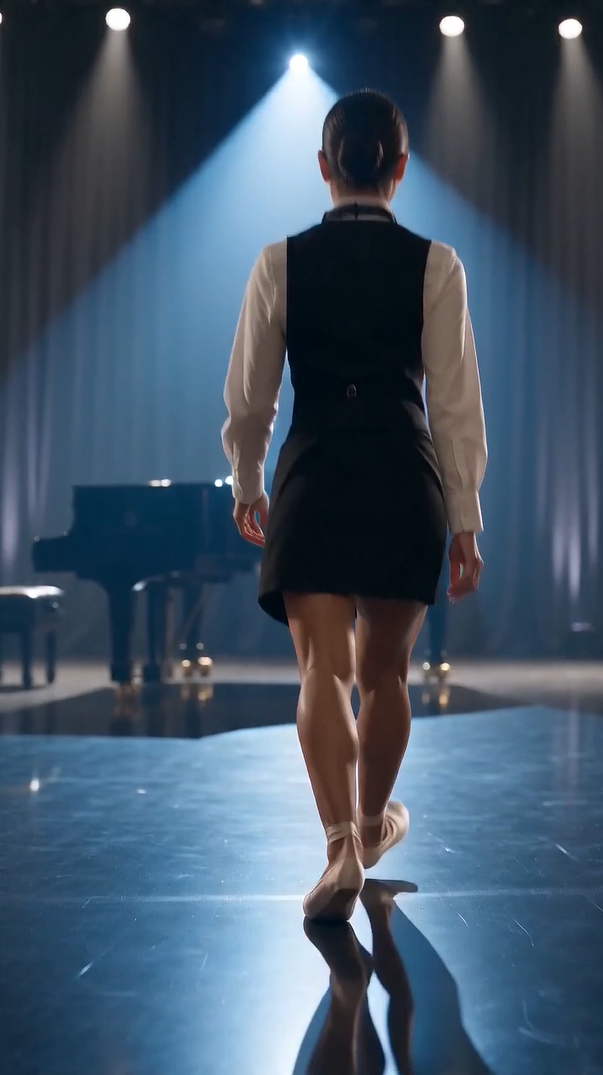
Beautiful.
For years, people had said Celeste Moreau disappeared.
But Maya knew the truth now.
Some women do not disappear.
They are buried under lies until their daughters become brave enough to dig them out.
And that night, as Sofia ran into her mother’s arms and Alex stood quietly in the back clapping with tears in his eyes, Maya finally felt the weight leave her chest.
Not all of it.
Grief never leaves completely.
But enough.
Enough to breathe.
Enough to dance.
Enough to live without carrying her mother’s shame, because it had never belonged to her mother in the first place.
After the gala, Maya walked alone to the center of the ballroom.
The lights were low.
The chairs were empty.
The marble floor reflected her softly.
She took off her new shoes and stood barefoot where she had once been mocked.
Then she turned once.
Slowly.
Freely.
No audience.
No challenge.
No rich man’s laughter.
Just her, the music still echoing in her bones, and the memory of a woman who had taught her that dignity can survive even when the world tries to rename it.
Maya looked up at the chandeliers and whispered,
“You have the floor now, Mama.”
And for the first time in ten years, the ballroom felt honest.