PART 1
“Of course… only a man in a wheelchair would decide to marry a failure like Lucía.”
Her father’s laughter cut through the reception hall like the sudden sound of shattering glass.
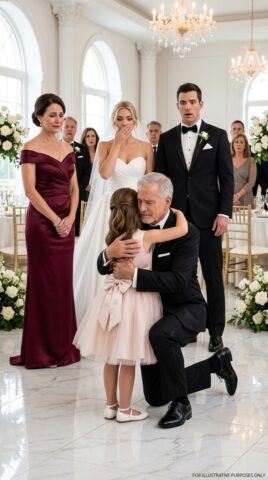
Lucía Alcázar couldn’t finish her vows. She clutched her bouquet tightly, her fingers ice-cold and her throat constricted. In front of her, beneath an elegant arch of white roses at a magnificent estate in Querétaro, 180 guests seemed to stop smiling at almost the exact same moment.
Some lowered their eyes.
Others pretended to check their phones.
No one seemed to know how to react.
Ernesto Alcázar, her father, raised his champagne glass with the arrogant confidence that had always defined him.
“Let’s make a toast to my eldest daughter,” he declared, glancing at Mauricio, the groom, seated in his wheelchair. “The only woman capable of turning a complicated situation into an even more depressing marriage.”
Teresa, Lucía’s mother, raised two ring-covered fingers to her mouth.
But she wasn’t trying to hide her embarrassment.
She was holding back a smile.
Sofía, Lucía’s younger sister, didn’t even bother.

She let out a sharp, openly cruel laugh.
Lucía felt as though the marble floor were disappearing beneath her heels.
Mauricio, however, remained perfectly still.
One hand rested on the brake of his wheelchair. He wore an impeccable dark blue suit and watched Ernesto with a surprisingly calm expression.
Lucía had learned to recognize that calm.
Mauricio only became that quiet when he had already made a decision.
For thirty-one years, the Alcázar family had taught Lucía to remain in the shadows.
Sofía had always been the perfect daughter.
Private schools.
Designer clothes.
Trips to Miami.
Photographs at glamorous social events.
And eventually, the prestigious position of vice president at Alcázar Industrial, the automotive components company the family proudly presented as one of its greatest achievements.
Lucía, on the other hand, was “the serious one.”
“The strange one.”
“The one who didn’t know how to make herself presentable.”
She was given the spreadsheets.
The endless audits.
The nights spent at the office correcting mistakes.
Lucía prepared detailed reports that Sofía presented the next morning during meetings as though they were entirely her own work.
But there was one truth no one ever said aloud.
The inventory forecasting system that helped the company survive the difficulties following the pandemic had been created by Lucía.
She had designed the platform that reduced major losses, reorganized logistics routes, identified abnormal purchasing patterns, and corrected years of inefficiency.
Yet during meetings, Ernesto always repeated the same sentence.
“Sofía has extraordinary vision.”
Sofía smiled.
Lucía silently slid the new charts and reports she had prepared beneath the table.
Everything changed when Lucía discovered something far more serious.
Duplicate purchase orders.
Inventory recorded in the system that apparently did not exist.
Bank financing obtained through reports containing falsified data.
Lucía gathered the documents and took them directly to her father.
Ernesto didn’t even examine the evidence.
He dropped the folder onto his desk.
“Don’t assume that knowing how to use a spreadsheet means you understand business,” he told her. “You’re an employee, Lucía. You’re not an important Alcázar.”
Two weeks later, Sofía accused her of sharing confidential information.
Lucía was fired for alleged “professional misconduct.”
Teresa told her friends that her daughter was going through a difficult period.
Ernesto explained to his associates that Lucía was intelligent, certainly, but far too fragile to handle the pressure of a major company.
Within weeks, Lucía lost her job.
Then her reputation.
And, for a while, even her ability to defend herself.
She met Mauricio Rivas seven months later at a charity dinner supporting neurological rehabilitation programs in Mexico City.
Mauricio told her he was undergoing rehabilitation after a serious spinal injury caused by an accident in the mountains.
He didn’t ask intrusive questions.
He didn’t stare at her hands when they began to tremble.
He simply listened to her speak.
Logistics.
Corporate debt.
Accounting irregularities.
Supply chains.
“You don’t sound like someone who’s been defeated,” he told her that evening.
Lucía raised an eyebrow.
“Then you aren’t listening carefully enough.”
Mauricio smiled.
“On the contrary. I may be listening too carefully.”
When they announced their engagement, the Alcázar family suddenly developed an almost surprising interest in Lucía’s life.
Ernesto immediately wanted to meet Mauricio.
Teresa began asking questions about his wealth and investments.
Sofía started sending him private messages.
She pretended to be concerned about his health, mobility, and future.
“A man like you needs a strong woman,” Sofía whispered to Mauricio one week before the wedding.
She had no idea Lucía was standing behind the office door.
“Not someone who collapses under the slightest pressure,” she added.
Mauricio simply replied:
“Interesting. I was thinking exactly the same thing.”
The Alcázars were convinced Mauricio was wealthy but easily influenced.
They believed his wheelchair made him vulnerable.
Most importantly, they were certain Lucía would eventually lower her head, just as she always had.
That was why they had invited everyone.
Bankers.
Investors.
Important clients.
Local officials.
Suppliers from Nuevo León and Querétaro.
Ernesto wanted to turn the wedding into a display of the Alcázar family’s prestige.
Teresa dreamed of perfect photographs for social media.
Sofía seemed determined to push Lucía into the background one final time.
Lucía allowed them to put every piece into place.
Now, standing at the altar, Mauricio turned slightly toward her.
“Do you want me to stop him now?” he asked quietly.
Lucía looked at her father, who was still smiling with his glass in his hand.
She looked at her mother, motionless among the guests.
Then she looked at Sofía.
“Not yet,” she whispered. “Let them finish.”
Ernesto took another step toward the altar.
“Lucía has always had a passion for difficult causes,” he declared. “Stray animals. Abandoned projects. Impossible situations. And now she’s found a husband who can’t even stand beside her.”
Several guests shifted uncomfortably in their chairs.
Mauricio slowly tightened his fingers around the brake of his wheelchair.
Then the enormous doors to the hall opened.
Twelve people in dark suits entered silently.
Lawyers.
Executives.
Bank representatives.
And a woman carrying a folder marked with a notarial seal.
The smile disappeared from Ernesto’s face.
Sofía turned pale.
For the first time since the ceremony began, Lucía raised her eyes.
What happened next completely transformed the atmosphere of the wedding.
Because the Alcázar family was about to discover that while everyone considered Lucía the weakest person in the family, she had spent months reconstructing a truth none of them wanted to see.
And that truth had just walked into the room.
PART 2
The first person to step forward was Samuel Cárdenas, the corporate attorney Ernesto Alcázar had trusted for more than ten years.
He was the man who intervened in the most delicate situations, managed internal conflicts, and transformed complicated problems into seemingly flawless contracts.
But that day, Samuel did not walk toward Ernesto.
He went directly to Mauricio.
“Mr. Rivas,” he said, handing him a black folder. “The transfer was finalized at nine o’clock this morning. The deeds, powers of attorney, and notifications have been signed.”
Ernesto gave a dry laugh.
“Samuel, what is this performance?”
Samuel didn’t even look at him.
Sofía crossed her arms, trying to recover her usual confidence.
“The transfer of what?”
Mauricio opened the folder resting on his lap, although he appeared to know every detail inside it already.
“Alcázar Industrial,” he replied.
The silence came so suddenly that even the violinist stopped playing.
Teresa grabbed Ernesto’s arm.
“What did he say?”
Mauricio looked directly at Lucía’s family.
“I said that, as of this morning, Alcázar Industrial has a new owner.”
Ernesto slowly lowered his glass.
The anger on his face gave way to calculation.
Then, for the first time, something appeared in his eyes that Lucía had almost never seen before.
Concern.
“That’s impossible,” Ernesto declared. “No bank would approve a sale without my authorization.”
A bank representative stepped forward.
“This was not a voluntary sale, Mr. Alcázar. A procedure established under the financial agreements was initiated following serious defaults, compromised personal guarantees, and the submission of evidence concerning possible financial irregularities.”
Those words immediately changed the atmosphere in the room.
Sofía turned toward Lucía.
“You,” she said angrily. “You did this.”
Lucía did not answer immediately.
For months, she had imagined this moment.
In her imagination, she had always been trembling.
Reality was different.
She had discovered something surprising.
The truth felt much lighter when you no longer had to hide it.
“I only preserved what you were trying to erase,” she replied.
For eight months, Lucía had reconstructed deleted files, recovered communications, compared altered inventory reports, and analyzed financing documents obtained using apparently inaccurate data.
Every evening, while Teresa called to accuse her of being ungrateful and Sofía posted every wedding detail on social media, Lucía followed the money.
Meanwhile, through his own investment group, Mauricio had acquired a significant portion of the distressed debt connected to Alcázar Industrial.
Every excessive loan Ernesto approved became another problem.
Every unsustainable expansion Sofía demanded added another risk.
Every contradictory document left a trail.
They thought Lucía was choosing flowers.
Lucía was gathering evidence.
Sofía stormed toward the altar.
“You stole confidential information.”
“No,” Lucía replied. “I preserved documents created while I was employed by the company. Then I submitted them through my attorneys because my internal report had been ignored.”
“There was no internal report,” Sofía snapped.
Samuel looked up.
“Exactly.”
Everyone turned toward him.
“Because the company had no legitimate internal oversight committee, despite documents provided to banks and investors claiming otherwise.”
A murmur moved through the room.
Ernesto tried to regain control by raising his voice.
“This is nothing more than a family dispute. Alcázar Industrial remains profitable. Tomorrow, my attorneys will clear this up.”
Another man, a representative of an investment fund, opened his own folder.
“The credit facilities were subjected this morning to an accelerated repayment procedure established in the contracts. The personal guarantees linked to the financing are already under review.”
Teresa made a small sound.
“Personal guarantees?”
Samuel answered calmly.
“The San Pedro house. The Valle de Bravo residence. Three vehicles. Two investment accounts. And certain family holdings used as collateral.”
Sofía stepped backward.
“My apartment has nothing to do with this.”
Lucía finally looked at her.
“Your apartment belongs to a company controlled by the group. So does your vehicle. And the corporate cards you use.”
Sofía opened her mouth.
No words came out.
Ernesto, however, was still searching for a weakness.
“Mauricio can’t manage a company like this. He bought a factory he doesn’t even understand.”
Mauricio smiled faintly.
“I wasn’t interested in the machinery.”
Ernesto stared at him.
“I invested in the company because of its logistics platform,” Mauricio continued. “The platform Lucía created and Sofía later registered as though it were her own project.”
The color disappeared from Sofía’s face.
“That’s a lie.”
Samuel produced another document.
“An independent technical examination identified Lucía’s original digital signatures, later modified versions, altered dates, and software modules reproduced without clearly established authorization. A civil action was filed yesterday. This morning, a report concerning the alleged computer-related irregularities was also submitted to the appropriate authorities.”
Teresa turned toward Lucía, her eyes filled with anger and tears.
“How could you do this to your sister?”
Lucía held her gaze.
“With patience,” she replied. “The difference is that I didn’t need to lie.”
Sofía made a sudden movement toward her, but two security officers immediately stepped between them.
Ernesto lowered his voice.
“Tell me how much you want.”
Lucía looked around the hall.
All those people had been invited by her father to display the Alcázar family’s prestige and power.
Bankers.
Investors.
Clients.
Business associates.
The very people in front of whom Ernesto had just tried to humiliate her.
“I already told you,” Lucía replied. “I simply want the truth to come out in front of everyone you invited to watch me lower my head.”
No one spoke.
Then Mauricio slowly reached for the brake on his wheelchair.
And released it.
Lucía looked at him.
Ernesto took a step backward.
Because the part of the story that would change everything…
had not even begun.
PART 3
Ernesto had never lost control in front of other people.
But that day, seeing Lucía finally standing with confidence, he reacted with anger.
“You ungrateful girl! Everything you know, you learned because of me.”
Lucía looked at him.
“No. I learned everything despite you.”
Then the unthinkable happened.
Mauricio placed his hands on the armrests of his wheelchair and stood.
His legs trembled, but he remained on his feet.
“You saw my wheelchair and assumed I was weak,” he said. “You saw Lucía’s kindness and mistook it for fragility.”
Samuel opened the folder.
Ernesto was removed from management.
Sofía lost every position she held.
And the company’s finances would undergo independent audits.
“We’re your family,” Teresa pleaded.
“Being family doesn’t erase what you did,” Lucía replied.
Sofía begged her for forgiveness.
“You’re going to destroy me.”
Lucía shook her head.
“No. I’m simply going to stop supporting you.”
Shortly afterward, the wedding ceremony resumed.
“I promise never again to make myself smaller so other people can feel important,” Lucía declared during her vows.
Six months later, Lucía was leading innovation at the newly restructured company, and her work was finally receiving the recognition it deserved.
One year later, Mauricio asked her:
“Do you regret anything?”
Lucía smiled.
“Only that I kept my eyes lowered for so long.”
Because justice does not always arrive with noise.
Sometimes, it simply waits for everyone else to finish laughing…
and then lets the truth speak.