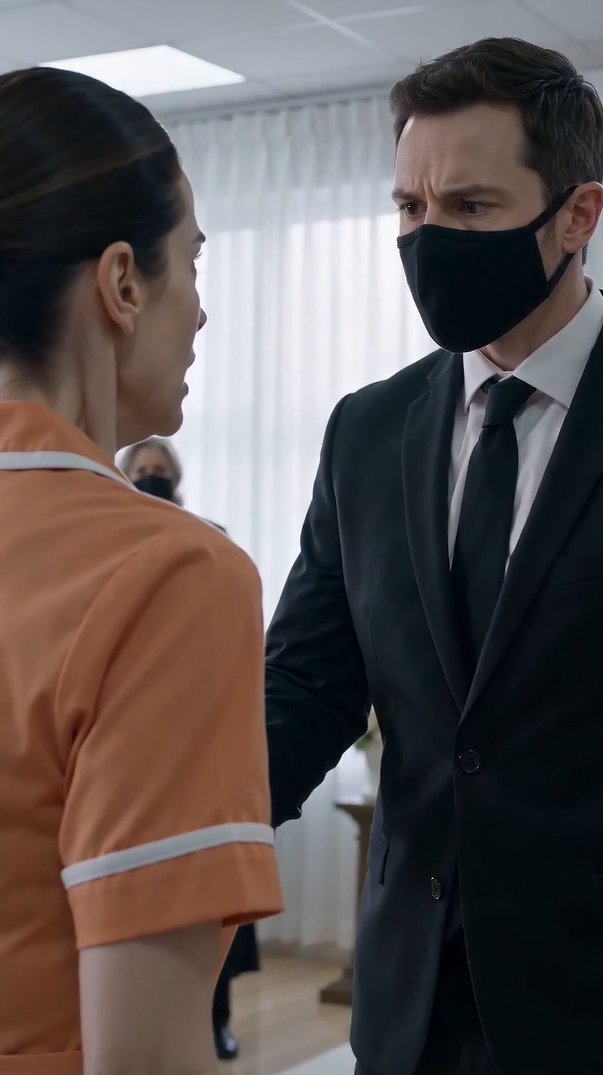
The husband stepped backward so fast he knocked into the flower stand.
White petals scattered across the carpet.
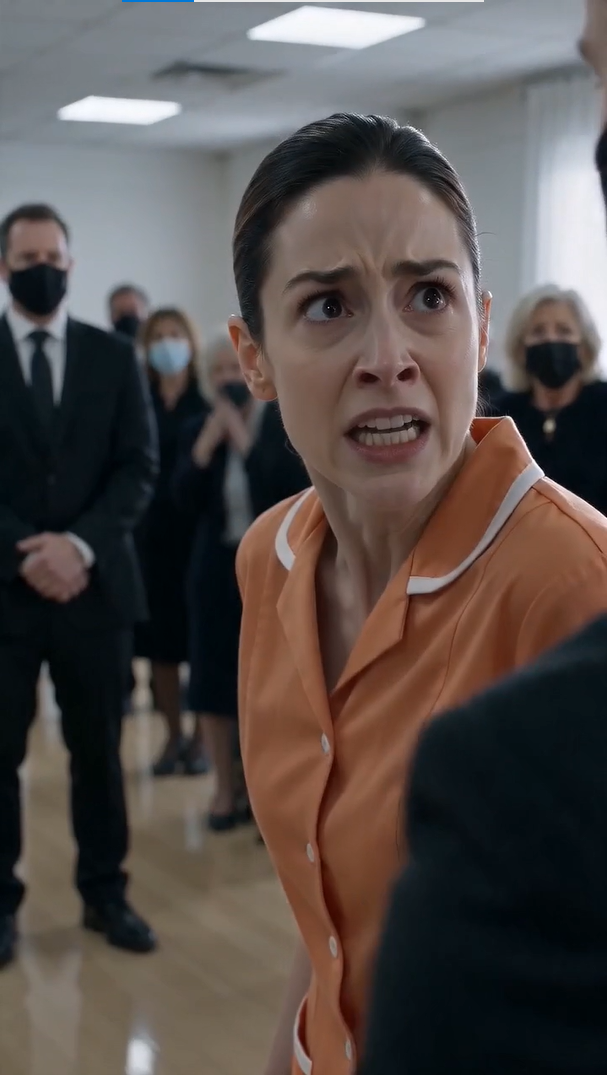
The maid dropped to her knees and pulled at the coffin lid with both hands.
“Help me!” she screamed.
For the first time, the mourners moved.
Not toward the husband.
Toward the coffin.
The funeral director stood frozen, face white.
The maid turned on him.
“Open it!”
His hands shook as he unlatched the side hinge.
The lid lifted.
Inside, the woman lay pale under white satin, eyes half-open, lips blue, one hand still curled near where the phone had been hidden.
She was breathing.
Barely.
The room changed from funeral to crime scene in one breath.
The maid touched her face gently.
“Madam, stay with me.”
The woman’s eyes moved.
Slowly.
Toward the husband.
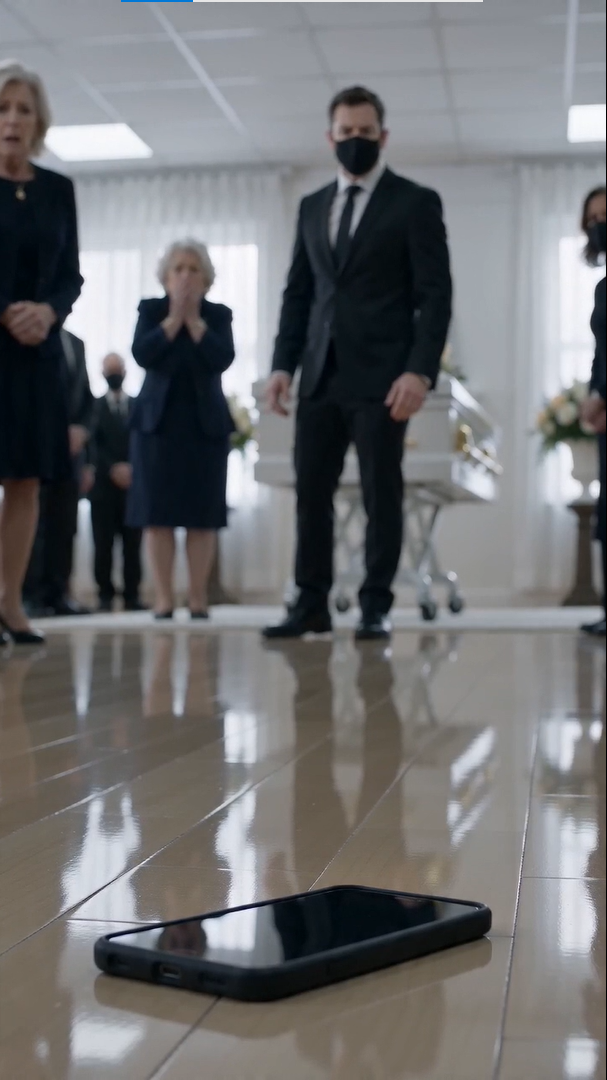
The smartphone kept recording on the floor.
The husband whispered, “She’s confused.”
The maid looked at him with pure hatred.
“She was inside a coffin.”
The older woman in black gripped her pearl necklace.
“She was declared dead.”
The maid picked up the phone.
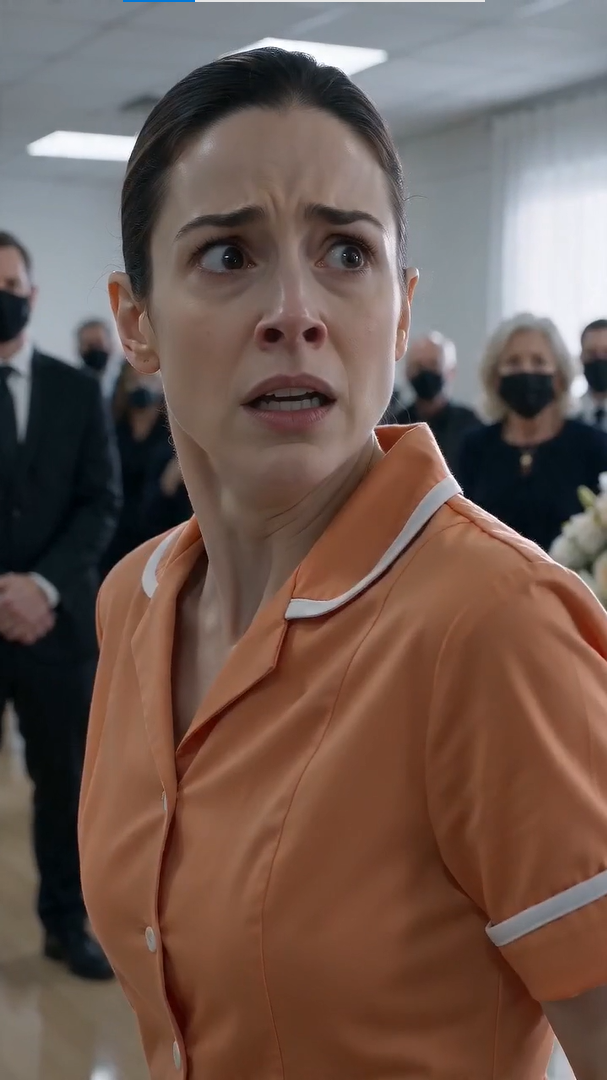
Her hand trembled as the recording replayed.
At first, only muffled sound.
A glass being placed on a table.
The husband’s voice.
Soft.
Loving.
Fake.
“Drink it. The doctor said it will help you sleep.”
Then the woman’s voice.
Weak.
“Why is my chest cold?”
The husband again.
“Because you trusted me.”
A mourner screamed.
The husband lunged for the phone.
The maid stepped back, holding it to her chest.
The funeral director finally moved, blocking him with one shaking arm.
The woman in the coffin forced out one more whisper.
“Pearls…”
Everyone turned.
The older woman touched her necklace.
Her face drained of color.
The maid looked at the side table.
A pearl necklace had been placed there beside the framed portrait.
She lifted it.
One pearl was cracked open.
Inside was a tiny folded note.
The woman had hidden it before the drink took her voice.
The maid unfolded it with shaking fingers.
“If I am ‘dead’ before Tuesday, my husband did it. My aunt helped him.”
The older woman in black stepped back.
The husband stared at her.
“You promised you destroyed that.”
The room heard it.
All of it.
The security camera in the corner rotated toward them.
The maid looked from the phone to the note to the woman still breathing in the coffin.
Then she said the words no one in that room would forget:
“She didn’t come back from death.”
Her voice broke.
“She came back with witnesses.”
Sirens began outside.
The husband looked at the door.
Blocked.
Mourners stood in front of it now.
The maid held the woman’s cold hand and leaned close.
“You’re not alone anymore.”
The woman blinked once.
A tear slid into her hairline.
And the phone kept recording.
The sirens grew louder.
Red and blue lights flashed through the tall windows of the funeral hall, washing over the white flowers, the polished coffin, the husband’s ruined face.
He looked around the room like a trapped animal.
The same people who had bowed their heads for his grief now stared at him with disgust.
His mouth opened.
Closed.
Opened again.
“My wife was sick,” he said. “She wasn’t herself. You all know she had anxiety. She wrote strange things. She imagined things.”
The maid rose slowly.
For years, people in that house had spoken over her.
They had told her to clean, to leave, to stay quiet, to not ask questions.
But not now.
Not while the woman who had once defended her was lying half-alive inside her own coffin.
“She wasn’t imagining the locked bedroom door,” the maid said.
The husband froze.
The aunt’s pearl necklace trembled against her throat.
The maid turned toward the mourners.
“Three nights ago, Madam called for me from upstairs. When I went to her door, it was locked from the outside.”
The older woman in black snapped, “You’re lying.”
The maid looked at her.
“No. You were standing in the hallway when I tried to open it.”
The aunt’s face tightened.
The maid’s voice grew stronger.
“You told me Madam needed rest. You said if I cared about my job, I would go back downstairs.”
The husband pointed at her.
“She’s a servant. She wants money.”
A bitter laugh escaped the maid’s throat.
“Money?”
She looked at the coffin.
“She paid for my son’s surgery when I had nothing. She gave my daughter schoolbooks. She let me sit at her table when my mother died.”
Her eyes filled, but she did not lower them.
“You think I came here for money? I came here because she was the only person in that house who treated me like I was human.”
The room went silent.
The woman in the coffin made a faint sound.
Everyone turned back to her.
Her lips moved, but no words came.
The maid bent close.
“Don’t speak, madam. Save your strength.”
The woman’s eyes shifted again.
Toward the phone.
Toward the note.
Toward the husband.
The maid understood.
She held up the phone higher.
“It’s still recording.”
The husband’s face went gray.
Police officers entered the hall with paramedics behind them.
The mourners parted, but nobody moved away from the door.
Not fully.
Not until the officers stepped inside.
The first officer looked at the open coffin, then at the pale woman breathing inside it.
For a second, even he looked shaken.
The paramedics rushed forward.
“Everyone step back.”
The maid refused to let go of the woman’s hand.
A paramedic looked at her gently.
“Ma’am, we need space.”
The maid nodded, but before she stepped away, the woman’s cold fingers tightened around hers.

Weakly.
Almost nothing.
But enough.
The maid bent down again.
“I’ll follow you,” she whispered. “I promise.”
Only then did the woman let go.
The paramedics lifted her carefully from the coffin.
Her body was limp, her skin cold, her breathing shallow. One of them placed an oxygen mask over her face. Another checked her pulse and shouted instructions no one else could understand.
The husband tried to move toward her.
An officer stopped him.
“Stay where you are.”
“She’s my wife,” he said quickly. “I should go with her.”
The maid turned around.
“No.”
The word cracked across the room.
The officer looked at her.
The maid held out the phone and the note.
“He tried to bury her alive.”
The officer took both carefully.
The husband’s voice rose.
“This is madness. She was declared dead. Ask the doctor.”
The aunt suddenly looked toward the side exit.
Only for half a second.
But the maid saw it.
So did the officer.
“Don’t let her leave,” the maid said.
The aunt stiffened.
“I am an old woman. I need air.”
The officer stepped in front of her.
“You can breathe right here.”
A few mourners whispered.
The husband’s face tightened with rage.
Not fear now.
Rage.
He looked at the maid like he could not believe she had ruined everything.
“You should have stayed in the kitchen.”
The maid took one step toward him.
For a moment, everyone thought she might slap him.
She did not.
She only looked at him and said, “That’s where I heard you planning it.”
His eyes widened.
The aunt gasped.
The maid’s voice shook, but every word was clear.
“You thought I didn’t understand because you spoke softly. You thought I was polishing silver and not listening. But I heard you say Tuesday. I heard you say once the papers were signed, everything would be yours.”
The husband shouted, “Enough!”
The officer grabbed his arm.
The husband tried to pull away.
“Take your hands off me.”
But the room had changed.
There was no grieving widower anymore.
No respected husband.
No man people felt sorry for.
There was only a man standing beside a coffin his living wife had just been lifted from.
And there was no way to make that look innocent.
The paramedics rolled the woman toward the door.
As they passed the husband, her eyes opened again.
For one painful second, she looked at him.
He tried to soften his face.
To become the man he had pretended to be.
“My love,” he whispered.
The woman’s eyes filled with tears.
But there was no love in them now.
Only horror.
And something stronger.
Survival.
She lifted one trembling hand from under the blanket.
Not toward him.
Toward the maid.
The maid rushed beside the stretcher and took it.
The husband watched his wife choose the servant over him in front of everyone.
That broke his mask completely.
“You ungrateful woman,” he spat.
The room froze.
The officer twisted his arm behind his back.
The husband cried out.
The aunt covered her mouth.
The maid stepped between him and the stretcher.
“Say one more word,” she whispered, “and I will play the rest of that recording for every camera outside.”
He went silent.
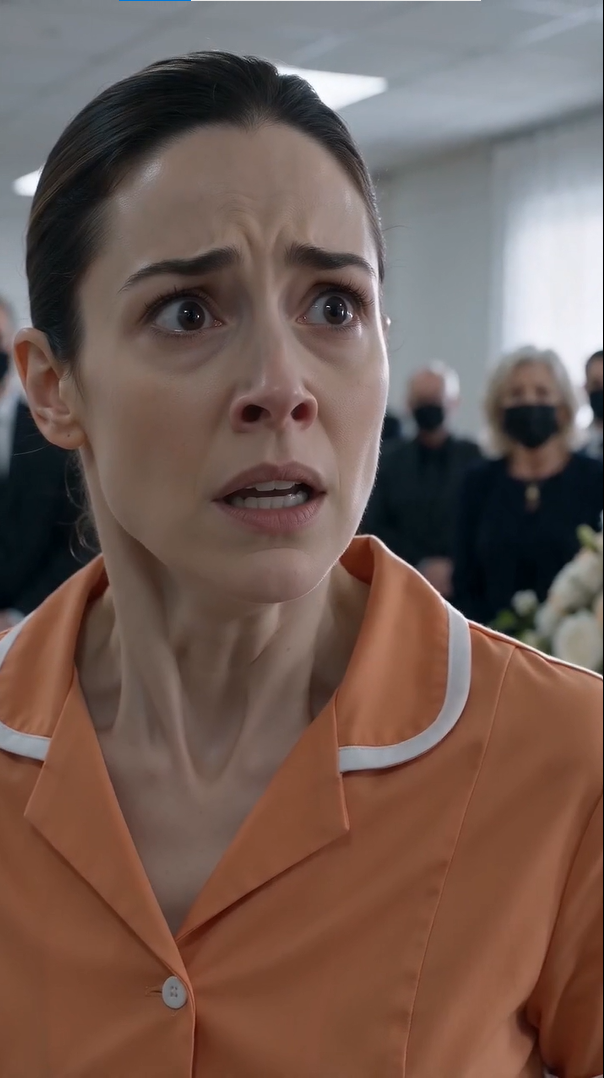
The stretcher disappeared through the funeral hall doors.
The maid went with it.
Behind her, the husband and the aunt were placed in handcuffs.
The sound of metal closing around their wrists echoed louder than the church bell outside.
That was the moment the mourners understood.
They had not attended a funeral.
They had attended an attempted murder.
At the hospital, the woman did not wake properly for hours.
Machines beeped beside her bed.
Clear tubes ran into her arm.
A nurse adjusted blankets around her body, trying to bring warmth back into skin that had spent too long under satin meant for the dead.
The maid sat in the corner with bloodshot eyes.
Her uniform was wrinkled.
Her hands still smelled faintly of funeral lilies and coffin wood.
A detective came and went.
Doctors asked questions.
The maid answered everything she knew.
The drink.
The locked door.
The husband’s sudden kindness.
The aunt moving around the house like she owned it already.
The doctor who came late at night and left without meeting anyone’s eyes.
The funeral arrangements made too quickly.
The way the husband had refused an open casket at first, then changed his mind only because the aunt said people would talk.
That was the mistake that saved her.
The maid had not planned to scream.
She had not planned to open the coffin.
She had only walked close enough to say goodbye.
Close enough to place one hand on the satin.
Close enough to hear it.
A breath.
So faint she thought grief had made her imagine it.
Then she heard the phone vibrate inside the coffin.
One tiny buzz.
Like the dead calling back.
She had screamed before anyone could stop her.
Now she sat beside the hospital bed and stared at the woman she had almost lost.
Near dawn, the woman’s fingers moved.
The maid shot to her feet.
“Madam?”
The woman’s eyelids fluttered.
A doctor rushed in.
The maid stepped back, pressing both hands to her mouth.
The woman opened her eyes slowly.
Confused.
Terrified.
Her breathing quickened.
The heart monitor began to race.
The doctor leaned over her.
“You’re safe. You’re in the hospital.”
The woman tried to speak.
Only a rough sound came out.
The maid stepped closer, crying now.
“You’re safe. He’s not here.”
The woman turned her head toward her.
Recognition came slowly.
Then pain.
Then memory.
Her eyes filled.
The maid took her hand.
“I heard you,” she whispered. “In the coffin. I heard you.”
The woman’s lips trembled.
A tear slid down her cheek.
She squeezed the maid’s hand weakly.
The doctor warned her not to speak yet.
But she forced one word through cracked lips.
“Phone?”
The maid nodded.
“With the police.”
“Note?”
“With them too.”
The woman closed her eyes.
Relief passed across her face, but it did not stay long.
The terror returned.
Not loud.
Not dramatic.
The terror of someone remembering that the person who kissed her forehead had also watched her disappear into a coffin.
The maid bent close.
“He can’t touch you now.”
The woman looked at her.
The maid repeated it, firmer this time.
“He can’t touch you now.”
For the first time since she woke, the woman’s breathing slowed.
The next few days brought the truth out piece by piece.
It was uglier than anyone imagined.
The husband had been drowning in debt.
Hidden loans.
Failed investments.
A life built on appearances and lies.
The woman’s inheritance had been protected by a clause he could not reach unless she died while they were still married.
The aunt had helped because she believed the family fortune should never have gone to her niece.
She had smiled at Sunday dinners, kissed her cheek, adjusted her necklace, and waited for the right moment to betray her.
The doctor had signed the papers after taking money.
He said he believed she was gone.
No one believed him.
The recording caught more than anyone expected.
The husband talking while she faded.
The aunt whispering, “Make sure the maid doesn’t come upstairs.”
The doctor saying, “Her pulse will be almost impossible to detect.”
The husband replying, “Almost is good enough for a grieving house.”
The detective played that part for the woman later, after asking if she was sure.
She nodded.
When she heard it, she did not cry.
That frightened the maid more than tears would have.
The woman just stared at the wall.
Silent.
Still.
As if part of her had been left inside the coffin and had not found its way back yet.
That night, the maid stayed beside her bed.
“You should sleep,” the woman whispered, her voice still weak.
The maid shook her head.
“I slept enough when I thought you were dead.”
The woman turned her head slowly.
“You saved me.”
The maid looked down.
“I almost didn’t.”
“What do you mean?”
The maid swallowed.
“I almost stayed in my place.”
The woman’s eyes softened.
The maid cried silently now.
“When I heard the sound, I thought, no. They’ll say I’m mad. They’ll say I’m making a scene. They’ll say a maid should not touch the coffin. For one second, I almost stepped back.”
Her voice broke.
“One second.”
The woman squeezed her hand.
“But you didn’t.”
The maid covered her face.
“I was so scared.”
“So was I,” the woman whispered.
The maid looked at her.
The woman’s eyes filled.
“I woke up in the dark.”
The maid stopped breathing.
The woman stared at the ceiling as the memory dragged her under.
“I couldn’t move. I could hear voices, but they were far away. I thought I was dreaming. Then I smelled flowers. I heard prayers.”
Her lips trembled.
“I tried to scream, but my throat wouldn’t work.”
The maid began to cry harder.
The woman continued, each word painful.
“I felt the phone near my hand. I had hidden it before the drink made me weak. I don’t know how I reached it. I pressed something. Anything. I just wanted proof.”
She turned toward the maid.
“Then I heard your voice.”
The maid sobbed.
The woman’s face crumpled.
“I thought, if anyone will hear me, it will be her.”
The maid lowered her head onto the woman’s hand and wept like a child.
For years, people had treated her loyalty like labor.
Like something bought.
But this was not loyalty.
This was love.
The quiet kind.
The kind no one puts in wills or speeches.
The kind that stands close enough to a coffin to hear one breath everyone else missed.
Weeks passed before the woman returned home.
But it was not the same home.
The husband’s clothes were gone.
The aunt’s portraits were removed.
The bedroom was changed completely because she could not sleep where he had handed her that glass.
The maid walked through each room with her, opening curtains, letting light in, removing anything that smelled of the lie.
At the top of the stairs, the woman stopped.
Her hands began to shake.
The maid reached for her.
“We can go slowly.”
The woman looked toward the bedroom door.
“I used to think this house was quiet because it was peaceful.”
Her voice trembled.
“It was quiet because everyone was afraid to say the truth.”
The maid did not answer.
The woman turned to her.
“Were you afraid of him?”
The maid hesitated.
Then nodded.
“Yes.”
“Why didn’t you tell me?”
The maid looked ashamed.
“You loved him.”
The woman’s eyes filled.
“I thought I did.”
“No,” the maid said softly. “You loved the man he acted like.”
That sentence stayed in the room.
Heavy.
Merciful.
True.
The trial began four months later.
By then, the woman could walk without help, but entering the courtroom felt harder than standing.
The husband sat at the defense table in a dark suit.
He looked thinner.
Older.
But when he saw her, his eyes still searched for weakness.
He expected fear.
He expected tears.
He expected the woman who had once apologized when he was cruel.
He did not find her.
She walked past him with the maid beside her.
Not behind her.
Beside her.
That made people look.
The husband looked too.
His jaw tightened.
On the first day, his lawyer tried to paint the woman as fragile.
Emotional.
Unstable after grief.
The old words.
The familiar trap.
But then the phone recording was played.
The courtroom listened to his loving voice turn into a confession.
Drink it.
The doctor said it will help you sleep.
Why is my chest cold?
Because you trusted me.
No one moved.
The husband stared at the table.
The aunt cried into a tissue, but nobody believed her tears.
Then the maid took the stand.
She wore a simple dress the woman had bought for her, though she had argued for twenty minutes that it was too expensive.
Her hands shook when she raised them for the oath.
The husband watched her with pure hatred.
But she did not lower her eyes.
The lawyer asked, “Isn’t it true that you disliked my client?”
The maid answered, “No.”
The lawyer looked pleased.
Then she continued.
“I feared him. There is a difference.”
The courtroom went silent.
The lawyer shifted.
“You were employed by the household. You depended on them financially, correct?”
“Yes.”
“So you had reason to please the woman who paid you?”
The maid looked at the woman, then back at the lawyer.
“I had reason to stay quiet. That would have pleased everyone more.”
The lawyer stopped smiling.
She told the court about the locked door.
The hidden phone.
The breath inside the coffin.
The cracked pearl.
The note.
She told them how the husband had lunged for the phone.
How the aunt tried to leave.
How the woman had reached for her hand on the stretcher.
When she finished, the courtroom was still.
Then the woman took the stand.
Her voice was not loud.
It did not need to be.
She spoke of small things first.
The way her husband started controlling her medicine.
The way her aunt told her she was forgetful.
The way both of them made her doubt her own mind.
The way they smiled in front of guests and punished her in private with silence, fear, and little lies.
Then she spoke of the night.
The glass.
The coldness.
The darkness.
The coffin.
The prayers.
The phone under her hand.
The one breath the maid heard.
By the time she finished, even the judge looked shaken.
The husband was found guilty.
So was the aunt.
So was the doctor.
When the verdict came, the woman did not smile.
She only closed her eyes.
The maid reached for her hand.
This time, in a courtroom full of people, the woman held it without shame.
Outside, cameras waited.
Reporters shouted questions.
“How do you feel?”
“What do you want to say to your husband?”
“How did you survive?”
The woman stopped on the courthouse steps.
For a long moment, she said nothing.
Then she turned toward the maid.
The maid looked terrified by the cameras.
The woman took her hand.
“I survived,” she said, “because the person everyone ignored was the only one listening.”
The reporters went quiet.
The woman looked into the cameras.
“My husband had money. My aunt had status. The doctor had a title. But none of them had mercy.”
Her voice shook, but she continued.
“She had no power in that house, and still she did what powerful people were too afraid to do. She opened the coffin.”
The maid began crying.
The woman squeezed her hand.
“So if you remember anything from this, remember this. Never judge a witness by the uniform they wear. Sometimes the truth is standing in the corner, carrying your tea, hearing everything.”
The clip spread everywhere.
People called it a miracle.
The woman hated that word at first.
A miracle sounded clean.
What happened to her was not clean.
It was betrayal.
It was fear.
It was darkness pressing against her face while people prayed above her.
But slowly, she understood something.
The miracle was not that she had breathed inside the coffin.
The miracle was that someone heard.
Months later, the funeral hall reopened after repairs and investigation.
The owner invited the woman privately to collect anything she wanted from that day.
She almost refused.
But the maid said, “Maybe you should take back what belongs to you.”
So they went together.
The hall was empty now.
No flowers.
No mourners.
No coffin.
Just sunlight falling across the carpet where white petals had once scattered.
The woman stood in the center of the room and trembled.
The maid stood beside her.
Not touching.
Just there.
The funeral director came forward, ashamed.
“I have apologized many times,” he said quietly. “I know it isn’t enough.”
The woman looked at him.
“No. It isn’t.”
He nodded.
“But you blocked him,” she said.
His eyes lifted.
“In the end, you blocked him.”
Tears filled his eyes.
“I should have checked more carefully.”
“Yes,” she said.
Her honesty hurt, but it was fair.
Then she looked toward the place where the coffin had been.
“I want the pearls.”
The maid opened her bag and took out a small box.
Inside lay the broken pearl necklace.
The aunt’s fake symbol of grief.
The woman lifted it carefully.
For years, pearls had meant family dinners, polite cruelty, old money, old rules, women smiling through pain.
Now one cracked pearl had carried her truth.
She touched the broken one.
Then she said, “I’m going to keep this one.”
The maid looked at her.
“Why?”
The woman smiled sadly.
“Because it broke in the right place.”
The maid understood.
After that, the woman did something no one expected.
She sold the house.
Not because she was weak.
Because healing does not always mean staying where you survived.
Sometimes it means leaving the room that tried to become your grave.
With part of the money, she bought a smaller home full of light.
No locked doors.
No heavy curtains.
No long dining table where lies could sit dressed as family.
The maid moved with her, but not into a servant’s room near the laundry.
The woman gave her the sunny room upstairs and handed her the key.
The maid stared at it.
“I work for you.”
The woman shook her head.
“You saved my life.”
“That doesn’t mean I should take this.”
“No,” the woman said gently. “It means you should stop sleeping beside the cleaning supplies.”
The maid’s face crumpled.
No one had ever said it that plainly.
No one had ever looked at the smallness she had accepted and called it unfair.
“I don’t know how to live like that,” she whispered.
The woman held out the key.
“Then we both learn.”
They did.
Slowly.
The woman learned to sleep again.
At first, only with every light on.
Then with the door open.
Then one evening, during rain, she slept through the night for the first time.
The maid cried when she found her still sleeping at sunrise.
Not from fear.
From relief.
The maid learned to sit at the table without jumping up when a cup was empty.
She learned to say what she wanted for dinner.
She learned that rest did not have to be earned by exhaustion.
They were not mother and daughter.
Not sisters.
Not exactly friends in the simple way people use the word.
They were something made by survival.
Two women who had seen the coffin open.
Two women who knew that a breath can be a prayer if someone hears it.
One year later, on the anniversary of the funeral that never became a funeral, the woman stood in a small community hall.
Not a ballroom.
Not a church.
Not a place filled with people pretending grief was polite.
The room was full of domestic workers, nurses, cleaners, caregivers, and women who had been told too many times to stay quiet.
The maid sat in the front row, uncomfortable with attention.
On the wall behind the woman was a simple sign.
The Open Coffin Fund
Emergency help for women whose warnings were ignored
The woman stepped to the microphone.
Her hands shook slightly.
They always did when rooms went quiet.
But this time, she did not mistake shaking for weakness.
“My name does not matter as much as what happened to me,” she began.
The room listened.
“I was poisoned by a man who called me his wife. I was betrayed by a woman who called herself family. I was declared dead by a doctor who sold his oath.”
The maid wiped her eyes.
The woman continued.
“But I am alive because someone without title, money, or protection heard one small sound and decided it mattered.”
She looked at the maid.
Everyone followed her gaze.
The maid tried to look down.
The woman smiled gently.
“She opened the coffin. But before that, she opened her mouth in a room that wanted her silent.”
The room erupted in applause.
The maid covered her face.
The woman waited.
Then she lifted a small glass case from the table beside her.
Inside was the cracked pearl.
The room grew quiet again.
“This pearl carried the note that helped prove the truth,” she said. “It was broken before anyone believed me.”
She touched the glass.
“For a long time, I thought broken things were useless.”
Her voice softened.
“I was wrong.”
She looked at the women in the room.
“Sometimes broken things are the only reason the truth gets out.”
The maid stood then.
She had not planned to speak.
The woman looked surprised.
The maid walked slowly to the microphone.
Her hands were shaking worse than they had in court.
“I was afraid that day,” she said.
Her voice was quiet, but the room leaned in.
“I want people to know that. I was not brave because I had no fear. I was brave because fear was not the only thing in me.”
The woman’s eyes filled.
The maid looked at the crowd.
“I had love too. And anger. And memory. I remembered every time she had protected me when no one was watching. So when I heard that breath, I thought, if I stay quiet now, I will become one of them.”
She wiped her cheek.
“So I screamed.”
The room stood.
Not for the rich woman.
Not for the scandal.
For the scream.
For the sound that had turned a funeral into a rescue.
Years passed.
The story became known in the city.
People told it in different ways.
Some said the woman rose from the dead.
Some said the maid found a secret recording.
Some said the husband confessed in front of everyone.
But the woman always corrected them.
“I did not rise from the dead,” she would say.
“I was never dead. I was unheard.”
And the maid, older now, would add with a small smile,
“So I made noise.”
The cracked pearl remained in the hall of the foundation.
Beside it, the phone was displayed.
Still scratched from falling on the funeral floor.
Still holding the recording that changed everything.
Underneath were the words:
She came back with witnesses.
But in the woman’s new home, there was another frame.
Smaller.
Private.
It held a photo from the day after the trial.
The woman and the maid standing on the courthouse steps, holding hands, both crying, both alive.
Beneath it, the woman had written:
The one who heard me breathing.
And every morning, when sunlight filled the house, she would pass that frame and remember the darkness inside the coffin.
Not to live there again.
But to honor the sound that escaped it.
One breath.
One witness.
One scream.
Enough to bring a buried truth back into the light.