PART 2
For three seconds, no one breathed.
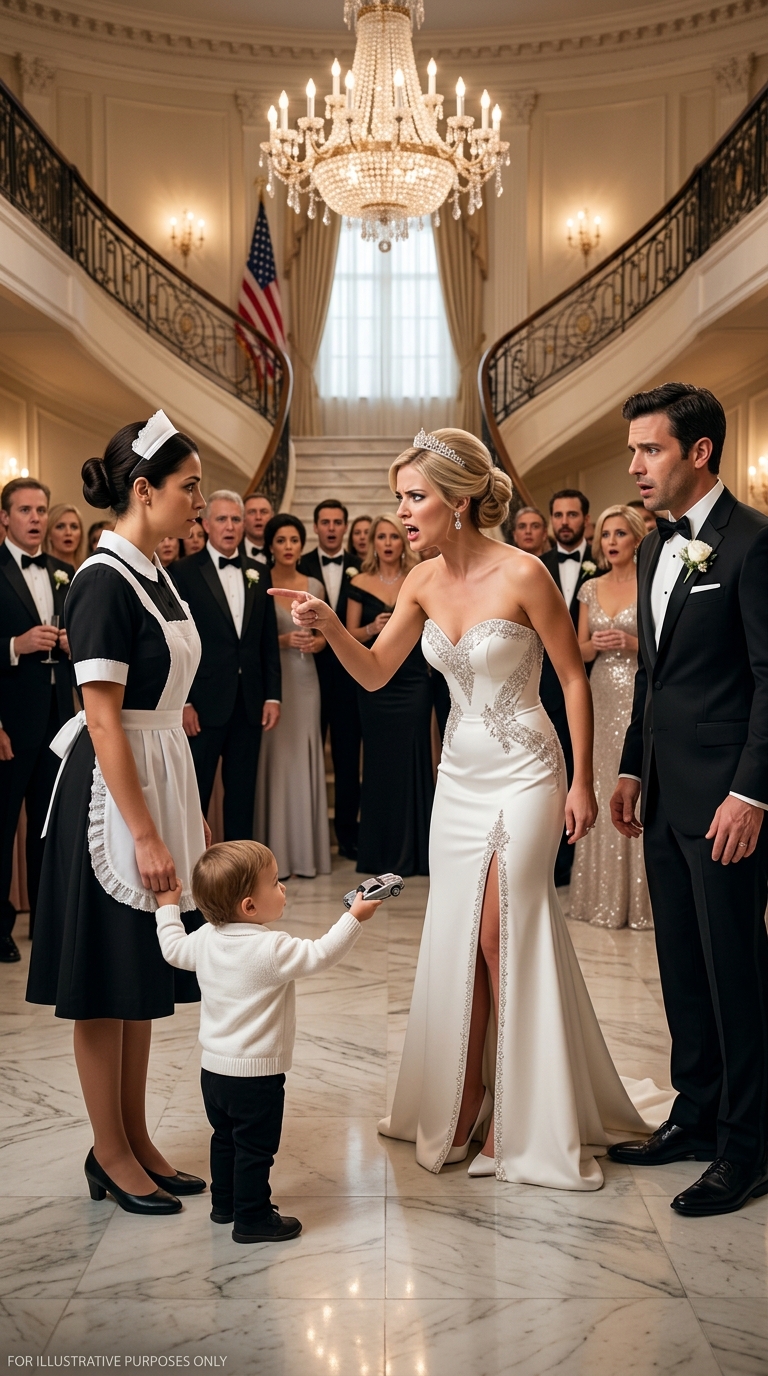
Emily stared at Caleb as if he had spoken in a language only her bones understood.
Harper’s eyes narrowed. “Tell you what?”
Caleb did not look at her. “Everyone out.”
Mr. Donovan moved first, guiding the stunned staff away from the foyer. The cook disappeared toward the kitchen. The maids slipped back through the dining room doors. Harper stayed exactly where she was.
“I’m not going anywhere,” she said.
Caleb finally turned to her. “Harper.”
One word. No anger. No performance. Just a line drawn so clearly that even Harper, who had crossed every line in that house for months, knew not to step over it.
Her lips tightened. “Fine.”
She walked toward the stairs, but stopped halfway up.
“This better not be what I think it is,” she said.
Caleb did not answer.
When the upper hallway door closed behind her, the mansion felt bigger and emptier than before.
Emily was still holding Maddie. The little girl’s face was buried against her mother’s neck, one fist closed around a torn piece of Emily’s apron. Her little body had gone limp with exhaustion.
Caleb stepped closer, but slowly, carefully, as if approaching a wounded animal.
“How long?” he asked.
Emily closed her eyes.
“Caleb, please.”
“How long have you known?”
She opened her eyes again, and tears spilled before she could stop them. “Since San Diego.”
The name struck him like a blow.
San Diego.
Four years earlier, before the Wall Street Journal profiles, before the Washington contracts, before he became the man every ambitious woman in Chicago wanted to marry, Caleb Whitmore had spent six weeks in California fighting to save his company. The deal that made him a billionaire had almost died in a hotel conference room overlooking the bay.
And in the middle of that brutal, sleepless season, he had met Emily Parker.
She had not been a housekeeper then. She had been working for a catering company at a naval foundation gala, carrying trays of champagne for men who barely looked at her. Caleb had found her in a service hallway at midnight, sitting on an overturned crate, holding one broken heel in her lap and laughing at herself because crying would have ruined her mascara.
He remembered everything.
The blue dress she had worn under her catering jacket. The small scar near her left eyebrow. The way she had looked at him like he was a man, not a headline. They had talked until the staff manager came looking for her. Then they had seen each other again. And again. And again.
It had lasted only eighteen days.
But some lives change in less.
“I tried to reach you,” Emily whispered. “When I found out I was pregnant, I called the number you gave me. I left messages. I sent an email. I even came to the office once, but security wouldn’t let me upstairs.”
Caleb’s face went pale.
“I never got any messages.”
“I know that now.”
His eyes sharpened. “What does that mean?”
Emily looked toward the stairs, then back at him.
“Your assistant. The one in San Diego. Rachel Moss.”
Caleb’s expression hardened. “Rachel was fired three months after that deal.”
“She called me first,” Emily said. “She told me you were engaged to someone else. She said you knew about the baby and wanted nothing to do with either of us. She offered me money to disappear.”
The words seemed to drain the warmth from the foyer.
Caleb whispered, “Money?”
Emily nodded. “I didn’t take it.”
His hand closed around the broken cufflink so tightly that the sharp edge cut his palm.
Emily saw the blood. “Caleb.”
He looked down as if surprised to find himself human.
“She lied to you,” he said.
“I know that now,” Emily repeated. “But back then? I was twenty-six. Pregnant. Alone. My father had just died, my mother was gone, and I had no one. I believed her because believing her hurt less than hoping for you and being wrong.”
Caleb looked at Maddie.
The child’s eyes were closed now. Her lashes rested against cheeks still wet with tears.
“She’s mine,” he said.
Emily’s voice broke. “Yes.”
The word did not explode. It did not echo. It simply entered the room and changed every object in it.
The staircase was no longer just a staircase. It was the place a father had heard his daughter being thrown away.
The broken cufflink was no longer just silver. It was the first thing his child had tried to give him.
And Emily was no longer only the quiet housekeeper who polished his home and folded his shirts and made herself invisible.
She was the woman who had carried his daughter alone.
Caleb sat down on the bottom step like his legs had forgotten how to hold him.
“Her name is Maddie?” he asked.
“Madeline Rose Parker.”
“Rose?”
Emily smiled through tears. “Your mother’s name was Rose. You told me that in San Diego.”
Caleb pressed his bloody hand against his knee.
“You remembered.”
“I remembered everything.”
He looked away, but not before she saw his eyes fill.
For four years, Emily had imagined this moment a thousand different ways. In some versions he was angry. In others he laughed in her face. In the worst versions, he looked at Maddie and felt nothing. She had prepared herself for rejection, accusation, disbelief.
She had not prepared herself for grief.
Caleb looked like a man standing at the edge of a life he should have lived.
“I missed her first word,” he said.
Emily nodded.
“Her first steps.”
Another nod.
“Her first birthday.”
“Caleb—”
“No.” He shook his head. “Don’t make this smaller. I missed everything.”
The front door windows glowed with gray Chicago morning light. Outside, Lake Michigan wind pushed hard against the old trees lining the long private drive.
Upstairs, a door opened.
Harper stood on the landing now, fully dressed in a cream suit, diamond ring flashing on her hand. She had not gone far. Of course she had not. Her face was a polished mask, but her eyes were wild.
“Well,” she said softly. “Isn’t this touching?”
Emily stiffened.
Caleb stood.
Harper descended the stairs one slow step at a time. “So the maid has a secret baby, and suddenly I’m the villain because I don’t want a lie living under my roof?”
“Stop,” Caleb said.
“No, you stop.” Her voice trembled now, but not with weakness. With fury. “Do you have any idea how humiliating this is? The whole city is waiting for our wedding. My mother has already given interviews. The governor’s wife is hosting the bridal luncheon. And now what? I smile beside you while everyone whispers that your housekeeper had your child?”
Emily turned to leave. “I’ll take Maddie downstairs.”
Caleb caught her arm gently. “No. Don’t run from this.”
Harper laughed. “Of course. Let’s all stand here and protect Emily.”
Caleb’s voice dropped. “You screamed at a three-year-old.”
“I screamed because nobody tells me anything in this house!”
“Maddie did not do that to you.”
Harper’s face twisted. For one second, the beauty slipped, and something raw stared out.
“You think I don’t know that?”
The confession stunned them both.
Harper looked away first.
PART 3
Harper Vale had been trained since childhood never to lose control.
Her mother, Caroline Vale, had been a Washington, D.C. fundraiser with perfect hair and a smile sharp enough to cut ribbon. Her father had been a judge who believed emotions were useful only when staged properly. Harper grew up in rooms where women whispered behind champagne glasses and men decided futures over cigars. She learned early that beauty could open doors, but composure kept them open.
So when she said, “You think I don’t know that?” in Caleb Whitmore’s foyer, she hated herself for it.
Because it was the first honest thing she had said in months.
Caleb stared at her. “Then why?”
Harper’s laugh came out broken. “You want the pretty answer or the real one?”
“The real one.”
She looked at Emily, then at Maddie sleeping in her arms, and her eyes filled with something that might have been shame if pride had not fought so hard to strangle it.
“The real one is that I saw her before you did.”
Emily frowned. “What?”
Harper gripped the staircase railing. “I saw the resemblance. Months ago. Those eyes. That stubborn little chin. The way she watches everything like she’s memorizing the room. I saw it, and I told myself I was insane because the alternative was unbearable.”
Caleb’s voice was low. “Why didn’t you ask me?”
“Because I was afraid you would look at her and know.”
The words hung in the air.
Emily’s anger, which had been quiet beneath her fear, finally rose. “So you punished my daughter because she looked like him?”
Harper flinched as if slapped.
“I didn’t mean—”
“You crushed something in front of her. You told her to get out of a house where she has slept since she was a baby. You made her feel like garbage because you were scared.”
Harper’s jaw clenched, but no defense came.
Caleb looked at Emily with surprise. In four years, he had heard her say “yes, sir,” “of course,” and “I’ll take care of it.” He had never heard the steel underneath.
Emily’s arms tightened around Maddie. “I have been polite because I needed this job. I have been quiet because my daughter needed a roof. But do not stand there and talk about unbearable. You have no idea what that word means.”
Harper’s eyes flashed. “You think I don’t?”
Emily stopped.
A strange silence followed.
Caleb watched Harper’s face and recognized, too late, that there was another secret in the room.
“What happened?” he asked.
Harper shook her head. “Not here.”
“Yes,” Caleb said. “Here.”
She looked toward the staff hallway, then toward the front windows, as if searching for an escape.
Finally, she said, “Eight months ago, I went to a fertility specialist.”
Caleb blinked.
Emily’s anger faltered.
Harper kept her eyes fixed on the marble floor. “I didn’t tell you because I thought it would be a simple appointment. Some tests, some advice, some elegant little solution rich people pay for quietly. Instead, the doctor told me there were complications. Severe ones. She said biological children would be unlikely.”
Caleb’s face changed. “Harper.”
“Don’t.” She raised one hand. “Don’t look at me like that. I couldn’t stand it then, and I can’t stand it now.”
“Why didn’t you tell me?”
She laughed softly. “That question is popular in this house today.”
Caleb stepped down from the stairs. “I would have been there.”
“Would you?” she asked. “You were in Singapore. Then D.C. Then Dallas. Then locked in your office trying to win a contract everyone said you’d lose. I told myself I’d tell you when things slowed down. But things never slowed down, Caleb. You don’t slow down. You disappear into work and come back with apologies expensive enough to decorate a room.”
He absorbed that like a man recognizing a wound he had caused without intending to.
Harper wiped beneath one eye with the edge of her finger. “Then I saw Maddie. This perfect little girl moving through your house like a ghost of the life I was terrified I’d never have. And the worst part was not that she might be yours.”
“What was the worst part?” Emily asked quietly.
Harper looked at her.
“That she was easy to love.”
Emily’s face softened despite herself.
Harper shook her head, angry at her own tears. “I hated that. I hated how she laughed in the kitchen. I hated how the staff smiled at her. I hated that Caleb would pause at the doorway when she sang to that stuffed dog. I hated all of it because none of it belonged to me.”
Maddie stirred in Emily’s arms. Her eyes opened halfway.
“Mommy?” she mumbled.
“I’m here, baby.”
Maddie looked toward Caleb. Her gaze settled on his bleeding hand.
“Boo-boo,” she whispered.
Caleb looked down.
Before anyone could move, Maddie stretched one small hand toward him.
Emily hesitated, then stepped closer. Maddie reached out and touched the back of Caleb’s hand with two fingers, careful as a butterfly.
“Boo-boo,” she said again.
Caleb’s breath caught.
Harper turned away.
In that tiny gesture, the whole room shifted. Maddie did not know about San Diego or lies or fertility clinics or wedding announcements. She knew only that someone was hurt.
And she wanted it fixed.
Caleb knelt again, this time not as a billionaire or an employer or a fiancé caught between women, but as a father meeting the shape of his own failure.
“You’re right,” he said to Maddie. “I need a bandage.”
Maddie nodded solemnly, then looked at Harper.
For a terrifying second, nobody moved.
Harper stared at the child she had wounded.
Maddie, still half asleep, lifted the broken cufflink piece from Caleb’s palm. She held it toward Harper.
“Don’t step,” she said.
Harper broke.
She covered her mouth and turned away, but the sob escaped anyway. It was not pretty. It was not elegant. It was not controlled. It was the sound of a woman whose cruelty had finally shown her the ugliest room inside herself.
Emily did not forgive her then.
Caleb did not comfort her.
Some moments are not for forgiveness. Some are for truth.
And truth had just entered the Whitmore mansion like a storm.
PART 4
By noon, the story had not reached the city, but the house felt as though the whole world already knew.
The wedding planner called three times. Harper ignored the calls.
Caroline Vale sent a message asking whether the florist could replace white orchids with gardenias because “orchids look too sterile in photographs.” Harper threw her phone onto the bed and watched it bounce against a silk pillow.
Downstairs, Caleb sat in his private office with Emily across from him and Maddie asleep on the leather couch under a cashmere blanket that cost more than Emily’s first car.
A first-aid bandage wrapped Caleb’s palm.
Between them on the desk lay documents Emily had carried in an old blue folder for years: Maddie’s birth certificate, hospital records, two printed emails she had sent to Caleb’s old assistant, and a handwritten note from Rachel Moss telling her to “accept reality with dignity.”
Caleb read the note three times.
Each time, his face grew colder.
“I’ll find her,” he said.
Emily shook her head. “I don’t want revenge.”
“This isn’t revenge.”
“What is it, then?”
“Accountability.”
Emily gave him a tired smile. “That’s what powerful people call revenge when they have lawyers.”
Caleb looked up.
For a second, San Diego returned between them. The service hallway. The broken heel. The woman who had teased him because he looked lonely in a five-thousand-dollar suit.
“You always did that,” he said.
“What?”
“Made me tell the truth.”
Emily looked away. “I haven’t done that in a long time.”
“No,” Caleb said. “You’ve been surviving.”
The word landed gently, but it still hurt.
Maddie shifted on the couch, hugging her stuffed dog, Biscuit. Caleb watched her with a hunger that made Emily’s chest ache. Not romantic hunger. Not possession. Something deeper and sadder.
A father trying to memorize what he had already missed.
“She likes pancakes shaped like stars,” Emily said quietly.
Caleb turned to her.
“She hates carrots unless I call them bunny fries. She gets scared of hand dryers in public bathrooms. She knows the alphabet until Q, then she invents letters. When she’s tired, she rubs the left corner of her blanket against her cheek.”
Caleb listened without moving.
“Her first word was light,” Emily continued. “Not mama. Not dog. Light. There was a lamp in our apartment in San Diego with a cracked shade. Every time I turned it on, she would point and say it.”
Caleb’s throat worked. “Light.”
“She had pneumonia when she was eighteen months old. I sat in the ER for nine hours because my insurance hadn’t gone through yet. She kept asking for apple juice, and I only had enough cash for one bottle from the machine, so I kept watering it down to make it last.”
Caleb closed his eyes.
Emily stopped. “I’m not telling you to hurt you.”
“Yes, you are,” he said, opening his eyes. “And you should.”
She stared at him.
“I need to know what my absence cost,” he said. “Even if it wasn’t my choice. Even if I didn’t know. I need to know.”
Emily’s anger dissolved into something more complicated.
“You can’t buy those years back.”
“I know.”
“You can’t walk in today and decide you’re her father because blood says so.”
“I know that too.”
“She doesn’t know you.”
Caleb nodded.
“But she could,” Emily said.
His eyes lifted to hers.
“That’s not a promise,” she added quickly. “It’s not forgiveness. It’s not us becoming some perfect family because one dramatic morning happened in a foyer.”
“I’m not asking for perfect.”
“What are you asking for?”
“A beginning.”
Emily looked at Maddie, then at the Chicago skyline beyond the office windows. The mansion sat in Lake Forest, north of the city, behind black iron gates and acres of winter trees. From the outside, it looked like safety. For years, Emily had known better. Safety was not marble or money. Safety was knowing no one could take your child from your arms.
“Then we need rules,” she said.
“Name them.”
“No lawyers threatening me.”
Caleb nodded.
“No custody surprises.”
“Never.”
“No using money to make decisions for her without asking me.”
“Agreed.”
“And Harper does not come near her unless I say so.”
Caleb hesitated.
Emily’s eyes hardened. “That one is not negotiable.”
“I know.”
There was a knock at the door.
Mr. Donovan entered carefully. “Sir, Ms. Vale’s mother is at the gate.”
Caleb and Emily both looked at him.
“She says she has a meeting with the wedding planner,” Mr. Donovan added. “And she is demanding to know why Miss Vale is not answering her phone.”
Caleb stood. “Keep her at the gate.”
Mr. Donovan looked relieved. “Yes, sir.”
But before he could leave, Harper appeared behind him.
Her makeup was gone. Her hair was pulled back. She looked younger, and somehow more dangerous because she had stopped pretending not to bleed.
“Let her in,” Harper said.
Caleb frowned. “This is not the time.”
“No,” Harper said. “It’s exactly the time.”
Emily rose. “Maddie and I should go.”
Harper looked at the sleeping child and then at Emily. Her voice was quiet.
“You don’t have to leave the room because my mother is coming.”
Emily studied her, unsure what kind of trap this was.
Harper turned back to Caleb. “You want honesty? Then let’s have all of it.”
Fifteen minutes later, Caroline Vale swept into the mansion wearing a navy coat, pearls, and the expression of a woman arriving to correct other people’s incompetence. She stopped in the office doorway when she saw Emily.
“Why is staff sitting in here?” Caroline asked.
Harper’s laugh was small and bitter.
“Hello to you too, Mother.”
Caroline looked at Caleb. “What is going on?”
Caleb did not answer.
Harper did.
“The wedding is off.”
Caroline’s face went still.
Then she smiled.
Not warmly.
“Don’t be ridiculous.”
Harper’s voice trembled, but she did not look away. “I’m not being ridiculous. I’m being honest for the first time in my life.”
Caroline’s eyes moved to Maddie on the couch.
Then to Emily.
Then to Caleb.
She understood faster than anyone expected.
“Oh,” she said. “How vulgar.”
Emily’s spine straightened.
Caleb stepped forward. “Mrs. Vale, choose your next words carefully.”
Caroline ignored him and looked at Harper. “You will not throw away your future because a maid made herself useful in the wrong bed.”
Harper went white.
Caleb’s voice cut through the room.
“Get out of my house.”
The words froze everyone.
The same words Harper had screamed at a child that morning now returned like judgment.
Caroline blinked. “Excuse me?”
Caleb opened the office door.
“You heard me.”
PART 5
Caroline Vale did not leave quietly.
Women like Caroline never left quietly because quiet exits suggested defeat, and defeat was something she believed happened only to people without proper tailoring.
She threatened Caleb with newspapers, donors, lawsuits, and social ruin. She reminded Harper of family obligations, wedding deposits, political connections, and the “humiliation” of being replaced by a housekeeper. She called Emily opportunistic. She called Maddie unfortunate.
At the word unfortunate, Harper stepped between her mother and the couch.
“Don’t talk about her,” she said.
Caroline stared at her daughter as if seeing a stranger.
Harper’s hands shook, but she held her ground. “You can hate me. You can judge me. You can call me weak the way you always do. But you do not get to stand in this room and aim your poison at a child.”
For the first time that day, Emily felt something close to respect.
Caroline’s eyes narrowed. “You sound emotional.”
Harper smiled sadly. “I know. Terrifying, isn’t it?”
Caleb signaled to security.
Caroline left with two guards walking behind her and fury burning red beneath her diamonds.
By sunset, the Whitmore mansion had entered a strange state of truce.
The wedding planner was dismissed. The flowers were canceled. The bridal luncheon was postponed with a vague statement about “private family circumstances.” Caleb’s publicist nearly had a stroke. Harper sat in the library for an hour, staring at her engagement ring before sliding it off and placing it on the table.
Emily saw it happen from the hallway.
Harper looked up. “You can come in.”
“I wasn’t spying.”
“Yes, you were.”
Emily almost smiled. “A little.”
Harper looked back at the ring. “I thought it would feel like dying.”
“Does it?”
“No.” She touched the diamond once. “It feels like taking off shoes that were beautiful and too small.”
Emily entered slowly but stayed near the door.
Harper’s eyes were swollen. “I owe you an apology.”
“Yes,” Emily said.
Harper let out a breath. “I’m sorry for what I said to Maddie. I’m sorry for what I said to you. I’m sorry I made your job feel unsafe. I’m sorry I used my pain like a weapon and pointed it at the smallest person in the room.”
Emily did not rush to forgive her. Forgiveness, she had learned, was too often demanded by people who wanted relief from consequences.
“Thank you for saying that,” she said.
Harper nodded, accepting the distance.
“I’m leaving tonight,” she said. “Not because Caleb told me to. Because I need to become someone I can stand to be alone with.”
Emily studied her. “Where will you go?”
“D.C. for a while. Then maybe Seattle. I have a friend who runs a foundation for girls aging out of foster care. She’s been asking me to help for years.”
“That sounds good.”
“It sounds like punishment,” Harper said. “Which probably means it’s good.”
Emily looked toward the window. Outside, snow had begun to fall, soft and silver against the dark lawn.
“My daughter may remember today,” she said. “Maybe not clearly, but in her body. In the way children remember fear.”
Harper’s face crumpled.
“I know.”
“So don’t apologize because you want peace.”
“I don’t deserve peace.”
“No,” Emily said. “You deserve the chance to do better. That’s different.”
Harper covered her mouth, but this time she did not turn away from her tears.
Later that evening, Maddie woke from her nap hungry and confused.
Emily carried her into the kitchen, where Mrs. Alvarez, the cook, had made star-shaped pancakes even though it was nearly seven at night. Caleb stood awkwardly beside the counter like a man trying to enter a country without knowing the language.
Maddie sat in her booster seat, hair messy, cheeks flushed from sleep.
Caleb placed a small plate in front of her.
“Stars,” he said.
Maddie looked at the pancakes, then at him. “You made?”
“I supervised.”
Mrs. Alvarez snorted. “He burned the first four.”
Caleb looked betrayed. “That was confidential.”
Maddie giggled.
It was the first laugh since the scream in the foyer.
Emily turned away quickly, pretending to reach for syrup.
Caleb heard the small sound she made anyway.
After dinner, he asked if he could read Maddie a book. Emily said yes, but stayed in the room. Caleb sat on the far end of the kitchen sofa with Maddie beside Emily, not touching him yet, not ready. He read Goodnight Moon like it was a contract negotiation at first, stiff and precise.
Maddie corrected him twice.
“No, cow jump moon.”
“You’re right,” Caleb said solemnly. “The cow jumps over the moon. My mistake.”
By the third page, his voice softened.
By the fifth, Maddie leaned closer to see the pictures.
By the last page, Emily saw Caleb’s hand resting open on his knee, not reaching, just waiting.
Maddie looked at it for a long moment.
Then she placed the broken silver cufflink in his palm.
Caleb stared.
Emily whispered, “She kept it?”
Maddie nodded. “Fix.”
Caleb closed his fingers around it.
“I will,” he said. “I promise.”
The next morning, Harper left.
She came downstairs in jeans, a gray sweater, and no makeup. Two suitcases waited by the door. Snow dusted the front steps. The American flag above the porch moved slowly in the cold wind.
Maddie stood beside Emily, clutching Biscuit.
Harper crouched several feet away, careful not to come too close.
“Hi, Maddie,” she said.
Maddie hid behind Emily’s leg.
Harper nodded as if she deserved nothing else. “I’m sorry I scared you.”
Maddie watched her.
Harper reached into her coat pocket and pulled out a small velvet pouch. She placed it on the floor between them and slid it gently across the marble.
Inside was a silver charm shaped like a star.
“I didn’t step on this one,” Harper said softly.
Maddie stared at the charm.
Then she looked at Harper and said, “No yell?”
Harper’s face broke open.
“No yell,” she whispered. “Never again.”
She stood, looked once at Caleb, then at Emily.
“I hope you all find a way through this,” she said.
Then Harper Vale walked out of the Whitmore mansion, not as a villain defeated, not as a bride abandoned, but as a woman finally beginning the long punishment of becoming honest.
PART 6
Six months later, the mansion no longer felt like a museum.
There were fingerprints on the glass doors leading to the garden. A box of crayons lived in the breakfast room. Caleb’s once-perfect office contained a small pink chair beside the bookshelf and a stack of picture books between aerospace reports. Mrs. Alvarez complained daily about stepping on toy animals and secretly bought more.
Emily and Maddie moved out of the basement apartment and into the east guest wing after Caleb insisted the staff quarters were not appropriate for his daughter. Emily resisted for two weeks, then agreed under strict conditions: she would pay symbolic rent, keep her own schedule, and continue working only until she finished her certification in early childhood education.
Caleb agreed to everything.
He also began therapy, which shocked everyone who knew him except Emily.
“You need someone who is not me to hear your guilt,” she told him one night after Maddie fell asleep on the couch during a thunderstorm.
Caleb looked at her. “Is that what I do?”
“Yes.”
“I’m sorry.”
“That too.”
He smiled faintly. “I apologize too much?”
“You apologize when you should act, and act when you should sit still. Therapy might help with that.”
So he went.
At first, fatherhood looked strange on him. He scheduled parenting books into his calendar. He asked Emily whether Maddie’s preference for purple cups had psychological significance. He bought educational toys so advanced that Maddie used the wooden counting set as pretend soup ingredients.
Slowly, he learned.
He learned that Maddie hated the crust on toast but would eat it if cut into triangles. He learned she called helicopters “sky bugs.” He learned that when she said “carry me,” she often meant “I am overwhelmed and don’t know how to say it.” He learned that love was not a dramatic declaration. It was remembering the purple cup.
The paternity test, when it came, confirmed what everyone already knew.
Caleb framed nothing. He made no announcement. He simply placed the paper in a locked drawer and asked Emily what she wanted Maddie’s last name to be.
Emily stared at him. “You’re asking?”
“She has had your name her whole life.”
“She’s your daughter.”
“She’s your daughter too.”
In the end, they chose Madeline Rose Parker-Whitmore.
The name appeared first on a preschool application.
Emily cried over the form in the parking lot and blamed allergies.
The city eventually learned pieces of the story, as cities always do. The canceled wedding became gossip. A blurry photograph of Caleb carrying Maddie through a hospital entrance during a winter ear infection became a headline. “Mystery Child with Whitmore Billionaire,” one site wrote. Another speculated about scandal.
Caleb wanted to sue everyone.
Emily said no.
“We tell the truth once,” she said. “Then we live it.”
So Caleb released one statement.
“My daughter, Madeline, is a private child and will be protected as such. Her mother, Emily Parker, has my full respect. We ask for privacy as our family adjusts.”
The statement lasted three sentences and detonated across Chicago society.
Caroline Vale gave one anonymous quote to a gossip columnist and was publicly identified within an hour. Harper, from D.C., posted nothing. But two days later, a package arrived for Maddie.
Inside were twenty children’s books, all about brave girls, difficult feelings, and saying sorry.
There was no note.
Emily knew anyway.
One afternoon in June, Caleb took Maddie to the lakefront. Emily came too, because trust was growing but not complete, and because Maddie still reached for her first when seagulls flew too close.
They walked along a quiet stretch north of the city. Sunlight flashed on Lake Michigan. Families spread blankets on the grass. Joggers passed. Somewhere nearby, a child laughed so hard his father started laughing too.
Maddie ran ahead, then turned back.
“Daddy, look!”
The word stopped Caleb cold.
Emily stopped too.
Maddie did not seem to notice what she had done. She was pointing at a kite shaped like a red dragon.
“Look, Daddy!”
Caleb looked at Emily as if asking whether he had imagined it.
Emily’s eyes filled, but she smiled.
“Go look,” she said.
He went.
That night, after Maddie fell asleep, Caleb found Emily on the back terrace. Fireflies blinked over the lawn. The mansion behind them glowed warm instead of cold.
“She called me Daddy,” he said.
“I heard.”
“I didn’t earn that yet.”
Emily looked at him. “Children don’t use love like a paycheck. They don’t wait until the balance is fair.”
He leaned against the railing. “Do you?”
The question was quiet enough to be missed.
Emily did not miss it.
For months, something had been moving between them, careful and patient. Not the reckless spark of San Diego, though that memory still lived beneath their skin. This was slower. Built from pancakes, doctor visits, preschool forms, hard conversations, apologies, and boundaries honored when nobody was watching.
“I’m trying not to be afraid of you,” she said.
Caleb closed his eyes.
“I deserve that.”
“No,” Emily said. “Don’t make it noble. Fear isn’t something you deserve. It’s something I learned. And I’m trying to unlearn it.”
He nodded.
She looked at the dark lawn. “I loved you once.”
His breath caught.
“I know.”
“I hated you too.”
“I know that too.”
“I’m not ready to decide what comes next.”
Caleb turned toward her. “Then we don’t decide tonight.”
Emily looked at him.
That was the difference now. The old Caleb would have tried to solve the uncertainty, buy it, organize it, win it. This Caleb could stand beside her inside it.
From inside the house, Maddie’s voice called sleepily, “Mommy?”
Emily turned immediately.
Caleb stepped back to let her pass.
Then Maddie called again.
“Daddy?”
Both of them froze.
Emily looked at Caleb and, for the first time that night, laughed through her tears.
“Well,” she said, “she decided something.”
PART 7
One year after the scream in the foyer, Caleb held a small birthday party in the garden.
Not a society event. Not a charity spectacle. No photographers, no champagne sponsors, no senators. Just Mrs. Alvarez, Mr. Donovan, a few preschool parents, two children from Emily’s certification program, and a magician who made Maddie laugh so hard she fell backward into Caleb’s lap.
The Whitmore mansion wore summer differently. The hedges were softer. The fountain sparkled. The American flag above the porch lifted in the warm wind. A long table under the oak trees held cupcakes with silver star toppers, because Maddie had never forgotten the charm Harper sent.
On the table beside the cake sat a small glass box.
Inside it was Caleb’s father’s cufflink, repaired by a jeweler so carefully that the crack remained visible only if you knew where to look.
Caleb had chosen not to erase the break.
“Some things should show where they were mended,” Emily said when he brought it home.
So it stayed that way.
Maddie, now four, wore a yellow dress and white sneakers. She ran across the grass with Biscuit tucked under one arm, shouting instructions at children twice her size.
Caleb watched from beneath the oak tree.
Emily came to stand beside him, beautiful in a simple blue dress, her hair loose around her shoulders.
“She’s bossy,” he said.
“She’s yours.”
“She’s kind,” he said.
Emily smiled. “She’s mine.”
Their shoulders touched.
Neither moved away.
A black car pulled up near the front drive just after the cake was served.
Caleb stiffened. He recognized the D.C. plates first.
Emily followed his gaze.
Harper stepped out of the car holding a wrapped gift.
She looked different. Her hair was shorter. Her clothes were simpler. She seemed nervous in a way the old Harper would have considered unforgivable.
“I invited her,” Emily said.
Caleb turned. “You did?”
“She wrote me a letter three months ago. A real one. Not polished. Not dramatic. She asked if she could send Maddie a birthday gift. I told her she could bring it herself if she understood Maddie didn’t owe her affection.”
Caleb studied her. “And you’re okay with this?”
“No,” Emily said honestly. “But I think I’m strong enough for it.”
Harper approached slowly, stopping several feet away.
“Hi,” she said.
Caleb nodded. “Harper.”
Emily said, “Thank you for coming.”
Harper’s eyes flicked toward Maddie, who was busy showing another child how to put gummy worms on cupcakes.
“She got tall,” Harper said softly.
“Children do that,” Emily replied.
Harper smiled a little. “So I’ve heard.”
Maddie noticed her then.
For a moment, the garden seemed to hold its breath.
Harper crouched, just as she had a year earlier, but this time she did not offer a charm or apology as a shield. She simply waited.
Maddie walked over with frosting on her chin.
“You bring present?” she asked.
Harper laughed, surprised. “I did.”
“Is it loud?”
“No.”
“Good. I don’t like loud.”
Harper’s eyes filled. “I remember.”
Maddie accepted the gift and ran back to the table.
That was all.
It was not forgiveness in a movie sense. No swelling music. No embrace. No perfect healing. But Emily saw Harper close her eyes as if that small ordinary exchange had given her more mercy than she expected to receive.
Later, Harper stood beside Emily near the roses.
“I work with girls now,” Harper said. “In D.C. Foster youth, mostly. Teenagers. They terrify me.”
Emily smiled. “Teenagers do that.”
“They can smell fake from across a room,” Harper said. “First week, one of them told me I apologized like a press release.”
“She sounds smart.”
“She is.” Harper looked toward Maddie. “I’m learning.”
Emily nodded. “Good.”
Harper took a breath. “I know saying sorry doesn’t undo it.”
“No,” Emily said. “It doesn’t.”
“I’ll keep saying it anyway. Not because I expect anything. Because it should be said.”
Emily looked at her for a long time.
Then she said, “That’s a better place to start.”
At sunset, after the guests left and Mrs. Alvarez packed leftover cupcakes into containers, Maddie fell asleep on Caleb’s shoulder in the garden chair. Her silver star charm hung around her neck. One hand rested against his jacket, sticky with sugar.
Emily sat beside them.
The repaired cufflink box lay on the table, catching the last light.
Caleb looked down at Maddie. “I used to think legacy meant buildings, contracts, patents, things with my name on them.”
Emily leaned back. “And now?”
“Now I think it means whether she feels safe when she walks into a room.”
Emily’s eyes softened.
“That’s a good legacy.”
Caleb looked at her. “I want to build it with you.”
The old Emily might have stepped back. The frightened Emily might have named every reason love was dangerous. The lonely Emily might have mistaken the offer for rescue and hated herself for wanting it.
But the woman sitting in the summer dusk had survived. She had told the truth. She had demanded rules. She had watched Caleb keep them.
So she reached across the space between their chairs and took his hand.
Not as a promise to forget.
Not as permission to rush.
As a beginning.
Maddie stirred, opened one sleepy eye, and saw their hands joined.
She smiled.
“Fixed,” she whispered.
Caleb laughed softly, but his eyes shone.
Emily looked at the repaired cufflink, the silver star, the child between them, and the house that had once felt like a place where silence survived. Now it held laughter, boundaries, apologies, and the unfinished work of love.
Nothing about their life was simple.
That was why it was real.
Years later, people in Chicago would still whisper about the billionaire whose fiancée screamed at the maid’s toddler and lost a wedding before breakfast. They would make the story smaller because gossip always does. They would forget Emily’s courage, Harper’s shame, Caleb’s grief, and Maddie’s tiny hand reaching toward a bleeding palm.
But inside the Whitmore house, nobody forgot.
The repaired cufflink stayed in the glass box near the front stairs. Not hidden. Not displayed for guests. Just present.
A reminder that one cruel sentence can break a life open.
And one brave truth can begin to mend it.