PART 2
By midnight, Lena’s face was already on the internet.
She sat in the back of Grant Ashford’s black town car, watching Washington monuments blur past the tinted window, while her borrowed heels lay abandoned on the floor. Her phone buzzed nonstop in her clutch.
Marissa: LENA WHAT DID YOU DO?
Unknown number: Are you really married to Grant Ashford?
Another unknown number: Comment for Capital Society Daily?
Lena turned the phone face down against her knee.
Grant sat beside her, silent, one hand at his temple. The controlled billionaire from the ballroom seemed to have cracked at the edges. His tie was loose. His hair was no longer perfect. The man looked less like a magazine cover and more like someone who had accidentally set his own life on fire.
“So,” Lena said, “do your fake wives usually trend before dessert?”
Grant exhaled. “This was not my intention.”
“You asked a stranger to pretend to be your wife in front of half of Washington.”
“I expected a small misunderstanding.”
“A small misunderstanding is calling someone the wrong name. You invented a marriage.”
“You helped.”
“You looked desperate.”
“I was desperate.”
“That part was obvious.”
He turned toward her. “Lena, I know this is absurd. I can have my team issue a correction tonight. We can say there was confusion, a private joke taken out of context.”
“Would anyone believe that?”
Grant said nothing.
Lena looked at him. “That blonde woman won’t.”
“No,” he admitted. “Vivienne won’t.”
The car stopped at a red light near the Capitol. Outside, flags snapped in the cold night wind.
Grant’s phone vibrated. He read the screen, and the last color drained from his face.
“What?” Lena asked.
He turned the phone toward her.
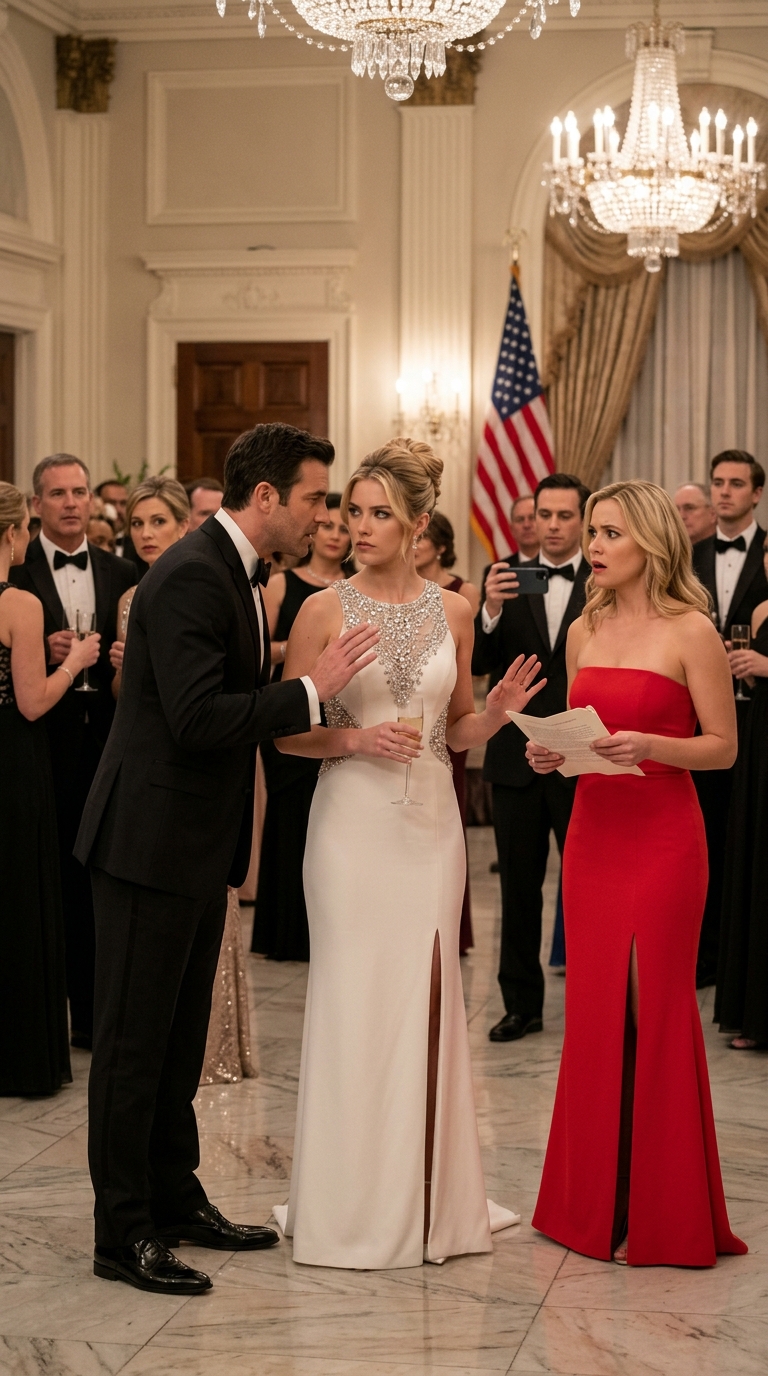
Headline: GRANT ASHFORD DEBUTS MYSTERY WIFE AT MERIDIAN GALA.
Below it was a photo of them. Grant’s hand on her back. Lena smiling up at him like she belonged there. Like she loved him.
Lena stared at the image. “I look convincing.”
“You were convincing.”
“That’s because I lie well under pressure. It’s a tragic talent.”
Another message appeared on his screen.
His assistant: Press requests are escalating. Investors asking for confirmation. Vivienne’s people are calling.
Grant closed his eyes for one second. When he opened them, the decision was already there.
“I need this to continue.”
Lena laughed once. “Absolutely not.”
“For a short period.”
“No.”
“A few weeks.”
“Grant.”
“A month at most.”
She stared at him. “You want me to keep pretending to be your wife?”
“Yes.”
“To reporters?”
“Yes.”
“To your investors?”
“Yes.”
“To that woman who looks like she eats secrets for breakfast?”
Grant hesitated. “Vivienne is complicated.”
“Vivienne is a murder mystery wearing perfume.”
His mouth twitched again. “You’re very quick.”
“I’m very unemployed. I have time.”
That slipped out before she could stop it.
Grant’s expression changed. Not pity. Not judgment. Something quieter.
“You lost your job?”
Lena looked away. “Recently.”
“And your apartment?”
Her eyes snapped back to him.
He raised both hands slightly. “You mentioned rented dress, borrowed shoes, and you looked like someone calculating cab fare during a billionaire gala.”
“Observant.”
“It’s part of my work.”
“Do you always analyze people like financial reports?”
“Usually.”
“That sounds lonely.”
His silence answered.
The car pulled up in front of the Ashford Regent Hotel, a sleek glass tower near Pennsylvania Avenue. Lena recognized it immediately. Rooms there cost more per night than her old monthly rent.
“I arranged a suite for you,” Grant said. “No obligation. Just somewhere safe tonight, away from reporters.”
Lena stared at the hotel. “You arranged this before asking me?”
“I assumed you might need it.”
“You assumed right, which is annoying.”
He looked down. “If you agree to continue, I’ll compensate you. Properly. Housing, legal protection, employment connections if you want them. You can set terms.”
She hated how tempting that sounded.
Her life was a mess of cardboard boxes, unpaid bills, and betrayal. Evan had not only cheated; he had taken their shared savings, claiming he had “contributed more.” Her old boss had sent a three-line termination email. Her mother in Ohio still thought Lena was doing fine because Lena had lied and said the move was “exciting.”
Now a billionaire was offering her a roof and time.
All she had to do was become someone else.
“No contract that treats me like property,” she said.
Grant straightened. “Never.”
“No decisions about me without asking me.”
“Agreed.”
“No kissing for cameras unless I approve.”
His eyebrows rose. “That was not on my planned agenda.”
“Good.”
“No humiliating me with etiquette tests. I don’t know which fork does what, and I don’t care.”
“I can teach you.”
“I didn’t ask to be improved.”
He nodded. “Fair.”
“And when this ends, it ends cleanly. You don’t make me disappear like a problem.”
Something flickered in his eyes. “I wouldn’t.”
“You don’t know what you’d do when your reputation is on the line.”
That landed harder than she expected.
For a moment, neither of them spoke.
Then Grant said, “You’re right. So put it in writing.”
Lena studied him. “You’re serious.”
“Completely.”
The chauffeur opened the door. Cold air rushed in.
Lena stepped out barefoot, heels in one hand, borrowed dress brushing against the hotel curb. Cameras flashed from across the street.
“Mr. Ashford! Mrs. Ashford! Is it true?”
Grant moved instantly, shielding her with his body.
Lena looked up at him.
He wasn’t pretending in that moment. The protectiveness was too fast, too instinctive.
“Come on,” he murmured.
As they crossed the lobby, guests turned. Phones lifted. Whispers followed.
In the elevator, Lena finally breathed.
“This is insane,” she said.
“Yes.”
“Your life is insane.”
“Yes.”
“And mine apparently got bored and joined it.”
Grant looked at her then, really looked. “You can still walk away.”
The elevator doors opened to a private floor.
Lena thought of Evan. The eviction notice. Her empty bank account. Vivienne’s poisonous smile. The way the elite had laughed when Lena fought back.
Then she thought of Grant saying please.
“I’ll do it,” she said.
His eyes widened slightly.
“But from now on,” Lena added, stepping into the hallway, “I’m not your fake wife.”
“What are you?”
“Your temporary equal.”
Behind them, Grant’s phone buzzed again.
He looked at the message.
Vivienne Cross had posted one sentence online:
Interesting how some wives appear only when men need saving.
Lena smiled slowly.
“Oh,” she said. “She wants a war.”
Grant looked at her. “You’re not afraid?”
“I’m terrified.”
“Then why are you smiling?”
“Because she thinks I’m weak.”
Lena walked toward the suite, barefoot and furious.
“She’s about to find out I’m not.”
PART 3
The first week of Lena Whitaker’s fake marriage to Grant Ashford felt like being pushed onto a Broadway stage without a script while everyone in the audience held a camera.
On Monday morning, she woke in a hotel suite larger than her childhood home to find three garment racks waiting in the living room. Navy dresses. Ivory blouses. Black evening gowns. Shoes arranged by heel height. A white American flag pin sat in a velvet box, “optional for congressional brunch,” according to the note attached.
A woman with silver hair and red glasses stood beside the racks, tapping on a tablet.
“You must be Lena,” the woman said.
“I must be having a nervous breakdown.”
“I’m Nora Bell, Mr. Ashford’s executive assistant.”
“Does Grant always send wardrobes to women before breakfast?”
“Only wives.”
“Fake wives?”
Nora looked over her glasses. “Especially those.”
Lena decided immediately that she liked her.
Nora handed her a schedule. “Today: private briefing at ten, lunch with foundation trustees at noon, photo opportunity at three, embassy reception at seven.”
Lena stared at the page. “When do I panic?”
“I blocked out fifteen minutes at four-thirty.”
“Perfect.”
The briefing took place in Grant’s penthouse office overlooking the city. His home occupied the top two floors of a historic building near Dupont Circle, all glass, leather, dark wood, and silence. It looked expensive enough to make noise illegal.
Grant stood at the head of a conference table while Nora explained the official story.
They met in Chicago.
They dated quietly for eight months.
They married in San Diego.
They wanted privacy because Grant’s business life was already public.
“Eight months?” Lena asked.
Grant looked up. “Too long?”
“Too short. You seem like the kind of man who would date someone for three years before admitting he liked her.”
Nora made a note. “Good point. Eighteen months.”
Grant frowned. “Is that necessary?”
“It’s more believable,” Lena said. “You look emotionally slow.”
Nora made another note. “Emotionally cautious.”
“Same thing,” Lena said.
Grant stared at her across the table.
She smiled sweetly.
By noon, they were seated at the Hay-Adams for lunch with trustees of the Ashford Clean Future Foundation. The dining room was filled with quiet power: gray suits, pearl necklaces, and people who said “impact” every fourth sentence.
Lena wore the navy dress because Nora had threatened her with “visual consequences” if she chose the red one.
“Mrs. Ashford,” said a trustee with a senator’s haircut, “Grant tells us you work in communications.”
“I did,” Lena said. “Now I’m between disasters.”
Grant coughed into his water.
The trustee laughed politely, unsure if he was allowed.
Lena continued, “I mean opportunities. Between opportunities.”
A woman across the table smiled. She had kind eyes, brown skin, and a sharp intelligence that cut through the room. “I prefer disasters. They’re usually more honest.”
“Thank you,” Lena said. “Finally, someone reasonable.”
The woman extended a hand. “Avery Chen. Director of community programs.”
“Lena Whitaker.”
Grant’s eyes flicked toward her.
“Ashford,” she corrected. “Still adjusting.”
Avery’s smile deepened. “I like you.”
Grant leaned toward Lena. “Please don’t tell them about the forks.”
“There are five forks, Grant.”
“For five courses.”
“That is not a defense. That is evidence.”
The table laughed.
And that was how it went.
Lena tripped over rules, questioned traditions, and accidentally charmed people who had spent years pretending not to be charmed by anything. At the embassy reception, she asked a French ambassador if tiny food existed because rich people feared full sandwiches. He laughed so hard he requested she sit beside him at dinner.
At a gallery opening, she looked at a white canvas with one black line and said, “This painting looks like it gave up,” causing the artist himself to declare her “brutally refreshing.”
Grant watched her with a mixture of panic and fascination.
“How do you keep doing that?” he asked one night in the town car.
“Doing what?”
“Winning people over by insulting the world they live in.”
“I’m not insulting it. I’m telling the truth with better timing.”
“That is insulting it.”
“Then maybe it needs insulting.”
He looked out the window. “You’re not wrong.”
That surprised her.
Grant Ashford was not what she had expected. In public, he was polished steel. In private, he was quieter. Less arrogant. More tired. He worked too late, ate standing up, and seemed uncomfortable when anyone did something kind for him without wanting anything in return.
One night, Lena found him alone in the penthouse kitchen at 1:00 a.m., staring at a pan on the stove as if it had betrayed him.
“What are you doing?” she asked.
“Cooking.”
She looked into the pan. “Grant, that egg is dead.”
“It stuck.”
“It surrendered.”
“I followed the instructions.”
“Eggs don’t need instructions. They need supervision.”
He turned off the stove, looking genuinely annoyed. Lena laughed before she could stop herself.
“It’s not funny,” he said.
“It’s extremely funny. You manage billion-dollar acquisitions but lost a fight to breakfast.”
His mouth tightened, but then he laughed too. Not the polite public smile. A real laugh. Low, surprised, almost rusty.
Lena felt something shift in her chest.
Dangerous.
She looked away.
The next morning, the internet found the photo Nora had carefully released: Grant and Lena walking past an American flag outside the embassy, his hand at her back, her smile bright and unguarded.
Public reaction turned unexpectedly warm.
She’s not like the usual society women.
He actually smiles with her.
Mystery wife has personality.
Vivienne Cross did not appreciate that.
Her attacks became subtle. A comment to a columnist about “authenticity.” A whispered question about marriage records. A post praising “women who don’t need to borrow identities to feel important.”
Then, on Friday night, at a museum gala in Georgetown, Vivienne struck directly.
Lena had just stepped away from Grant to admire a display of historic presidential letters when Vivienne appeared beside her, silver gown glowing like moonlight on a blade.
“Lena,” she said. “Or should I call you Mrs. Ashford?”
“That is generally how wives work.”
Vivienne smiled. “Such confidence. It’s impressive, considering how little information exists about you.”
“I’m private.”
“No,” Vivienne said softly. “You’re hidden.”
Lena’s stomach tightened.
Vivienne leaned closer. “I know about the layoff. The cheating fiancé. The eviction notice. Sad story, really. A woman loses everything, then suddenly marries a billionaire.”
Lena forced herself not to flinch.
“Careful,” Vivienne whispered. “Washington loves a Cinderella story, but only until they find out Cinderella was paid to wear the slipper.”
She walked away before Lena could answer.
Across the room, Grant looked toward her and immediately began moving.
But Lena barely saw him.
Because Vivienne knew.
Not everything yet.
But enough.
And Lena understood then that this game had teeth.
PART 4
Lena did not tell Grant what Vivienne had said.
She told herself it was because she didn’t want to distract him before the museum gala ended. Then she told herself it was because her past was her own business. By the next morning, she had created six different explanations, all of them false.
The truth was simpler.
She was ashamed.
Not of being unemployed. Not of losing her apartment. Not even of being cheated on by Evan, though that one still burned.
She was ashamed that people like Vivienne could make ordinary pain sound like evidence of fraud.
Grant found her in the penthouse library on Saturday afternoon, sitting cross-legged in an armchair with a book open in her lap and unread.
“You’ve been quiet,” he said.
“That’s usually considered a blessing.”
“Not with you.”
She glanced up. He was wearing jeans and a soft gray sweater instead of a suit, which made him look unfairly human.
“I’m fine.”
“You say that like someone who isn’t.”
“Maybe this is my fine voice.”
“Lena.”
She closed the book. “What do you want me to say? That your world is exhausting? That every woman in it smiles like she’s hiding a knife? That I’m tired of being studied like an unusual bug?”
His expression softened. “Yes. You could say that.”
“So I said it.”
He sat across from her. “Did Vivienne threaten you?”
Lena looked away too fast.
Grant’s face hardened. “What did she say?”
“Nothing I didn’t already know.”
“That is not an answer.”
“She knows I lost my job. She knows about Evan. She knows about the apartment.” Lena swallowed. “She made it sound like I crawled out of a gutter and tricked you.”
Grant was silent for a moment. Then he said, very quietly, “She had no right.”
“No. But she had facts.”
“Facts without mercy become weapons.”
Lena looked at him.
The sentence sounded too personal.
“Is that how people use facts against you?” she asked.
Grant leaned back, his gaze moving toward the window. “My father believed weakness should be identified early and removed.”
“That’s a horrible thing to say about employees.”
“He said it about me.”
Lena’s anger cooled into something else.
Grant’s father, William Ashford, had built half the family empire and left the other half as a burden. Everyone in America knew the public version: visionary businessman, patriotic donor, disciplined leader.
No one had mentioned cruel father.
“He raised me like a successor, not a son,” Grant said. “Every mistake was a liability. Every feeling was leverage. By the time I was fifteen, I knew how to read a balance sheet, greet senators, and never cry where anyone could see.”
Lena’s throat tightened.
“That’s why you control everything,” she said.
“I try.”
“And when you can’t?”
He looked at her. “I ask strangers to be my wife.”
She laughed despite herself.
The sound eased something between them.
Grant’s eyes warmed. “I’m sorry Vivienne hurt you.”
“You didn’t do it.”
“I brought you into this.”
“I agreed.”
“You didn’t know how ugly it could get.”
“No,” Lena admitted. “I didn’t.”
They sat in silence.
Then Grant said, “There’s a dinner tomorrow night. Major donors. Press nearby. Vivienne will be there.”
Lena groaned. “Of course she will. Does she come with the chandeliers?”
“I can cancel.”
“No.”
“Lena.”
“No. If I hide, she wins.”
His gaze searched hers. “You don’t have to prove anything.”
“That’s where you’re wrong. Women like Vivienne build cages out of whispers. I’ve spent my whole life getting underestimated. I’m not letting some senator’s daughter decide I’m disposable.”
Grant smiled faintly. “There she is.”
“Who?”
“My temporary equal.”
The words should have felt like part of the contract.
They didn’t.
The dinner took place at the Jefferson Club, a private building near Embassy Row with red carpets, oil portraits, and an American flag standing behind the speaker’s podium. Lena wore deep green, ignored the five forks, and walked in beside Grant as if the room belonged to both of them.
Vivienne saw her immediately.
So did Colton Pierce, Grant’s business rival. He was blond, smooth, handsome in a way that felt manufactured. He greeted Grant with a firm handshake and Lena with eyes that took inventory.
“So this is the famous wife,” Colton said. “Washington’s favorite surprise.”
“Lena,” she said. “And you must be the man who practices smiling in mirrors.”
Grant coughed.
Colton’s smile flickered. “Sharp.”
“Only when necessary.”
Vivienne joined them, dressed in red. “Lena, you look lovely. That color is very forgiving.”
“So is silence,” Lena said. “You should try it.”
A nearby donor choked on champagne.
Vivienne’s eyes flashed. “I was only being kind.”
“No,” Lena said. “You were being careful. There’s a difference.”
Grant’s hand brushed hers. She expected warning.
Instead, he squeezed once.
Support.
The dinner began. Speeches rolled on. Grant spoke about clean energy jobs in rural America, about responsibility, about building something larger than profit. Lena watched him at the podium, the flag behind him, his voice calm and clear.
He believed what he was saying.
That unsettled her more than if he had been fake.
Later, during dessert, an elderly donor asked Lena about the San Diego wedding.
“Which chapel was it?” the woman asked. “My granddaughter is planning a beach ceremony.”
Lena froze.
Grant was speaking to someone two seats away.
Vivienne noticed. So did Colton.
The table waited.
Lena smiled, but her mind went blank. They had invented sunset. Wind. Veil. No chapel.
“Actually,” Vivienne said sweetly, “I’d love to hear this too.”
Grant turned.
Lena opened her mouth.
Nothing came.
Then Grant said, “There wasn’t a chapel.”
Everyone looked at him.
“It was on a private bluff above La Jolla,” he continued, voice smooth. “A family friend’s property. The officiant was Judge Reeves, retired. The wind was terrible.”
Lena found herself breathing again.
“Terrible?” she said. “My veil almost assassinated him.”
The donor laughed. “How memorable!”
“Traumatic,” Lena said. “Beautiful, but traumatic.”
The moment passed.
But Vivienne’s smile did not.
After dinner, as guests moved toward the lounge, Lena stepped onto a terrace to steady herself. The night smelled like rain and expensive roses.
Grant followed.
“You saved me,” she said.
“That was condition two.”
“You remembered?”
“I remember everything about you.”
The words hung between them.
Lena’s heart did something reckless.
Before she could answer, Grant’s phone buzzed.
His expression changed as he read.
“What now?” she asked.
He showed her the screen.
Anonymous message. One line.
We know there is no marriage certificate. Confess before we do it for you.
Attached was a blurry photo of Lena entering Grant’s hotel suite the first night.
Lena looked up slowly.
Grant’s eyes were cold.
“They’re not just digging anymore,” he said. “They’re hunting.”
PART 5
The anonymous message marked the end of pretending that the situation was manageable.
By Monday morning, Nora had assembled a crisis team in Grant’s penthouse: two lawyers, a public relations strategist, a security consultant, and a man named Miles who said almost nothing but looked at every window as if it owed him money.
Lena sat at the conference table in a cream sweater, listening while strangers discussed her life like a damaged brand.
“We deny nothing until they publish,” one lawyer said.
“We control the narrative,” said the PR strategist.
“We need to identify the source,” said Miles.
Lena raised her hand. “Can the narrative have coffee first?”
Grant, seated beside her, pushed his untouched cup toward her without looking away from the lawyer.
The gesture was small.
She noticed anyway.
The team suspected Colton Pierce had hired investigators. Vivienne had motive, access, and enough social venom to power a small city. Together, they were dangerous.
“What happens if they prove we’re not married?” Lena asked.
The room went quiet.
The PR strategist cleared her throat. “There would be reputational consequences.”
“Meaning?”
Grant answered before anyone else could. “Investors may question my judgment. The government contract could be delayed. The press would frame you as either a paid actress or a gold digger.”
Lena laughed softly. “Great. Two terrible options. Very generous.”
Grant looked at her. “I won’t let them do that.”
“You may not get to decide.”
His jaw tightened because they both knew she was right.
That afternoon, Lena retreated to the guest room that had slowly become hers. There were now books on the nightstand, a mug she favored, and a soft blanket she had dragged from the living room. Signs of accidental belonging.
She checked her email and found three job rejections.
Then one message from Evan.
Saw the news. Guess you upgraded fast. Funny how you acted heartbroken when you already had a billionaire waiting.
Lena stared at the words until they blurred.
The audacity of mediocre men was truly bottomless.
A knock sounded.
“Come in,” she said.
Grant entered, then stopped when he saw her face. “What happened?”
“Nothing.”
He waited.
She handed him the phone.
Grant read the message. His expression became terrifyingly still.
“He cheated on me,” Lena said. “He kicked me out of the apartment. He helped break my life apart. And now he thinks he gets to judge how I survive.”
Grant gave the phone back carefully. “Do you want me to destroy him?”
Lena blinked. “That is both alarming and sweet.”
“I’m serious.”
“I know. That’s the alarming part.”
He sat beside her. “You didn’t deserve that.”
“No. I didn’t.” She swallowed. “But sometimes knowing that doesn’t stop it from hurting.”
Grant was silent. Then he said, “When my father died, people told me I should be grateful for everything he left me. The company. The houses. The name. No one wanted to hear that he had also left a voice in my head telling me I was never enough.”
Lena looked at him.
“So I understand,” he continued, “how someone can be gone from your life and still take up space.”
Her eyes stung.
“This was supposed to be a fake marriage,” she whispered.
“I know.”
“You’re being dangerously kind for a fake husband.”
“I know that too.”
Neither of them moved.
For a second, Lena thought he might kiss her.
For a second, she wanted him to.
Then Nora burst through the door holding a tablet.
“Sorry,” she said, not sounding sorry. “Problem.”
Grant stood. “What is it?”
“A gossip site is preparing a story. They claim to have proof the marriage is fake. Publication expected tonight during the American Heritage Fund gala.”
Lena stared at her. “During the gala? That’s theatrical.”
“Vivienne is chairing the gala,” Nora said.
“Of course she is.”
The American Heritage Fund gala took place that evening at the National Portrait Gallery. Red, white, and blue arrangements framed the main hall. A massive American flag hung behind the stage. Cameras lined the entrance.
Lena felt every flash hit her skin like a warning shot.
Grant offered his arm. “We can still leave.”
“And let Vivienne enjoy herself? Never.”
Inside, the crowd buzzed with anticipation disguised as politeness. Vivienne greeted them near the donor wall, smiling as if she had personally invented grace.
“Grant. Lena. How brave of you to come.”
Lena smiled back. “How predictable of you to be pleased.”
Vivienne’s eyes gleamed. “Enjoy the evening. I have a feeling it will be unforgettable.”
Colton appeared at her side. “Some truths are like champagne corks. Hard to keep down.”
“And some men are like cheap cologne,” Lena said. “Impossible to ignore for the wrong reasons.”
Grant made a sound suspiciously like a laugh.
For the first hour, nothing happened. Lena smiled, shook hands, and spoke to donors. Grant stayed close, but not possessively. Protectively.
Then, at 9:17 p.m., phones across the room began vibrating.
One after another.
Like insects waking.
A woman gasped.
Someone whispered, “Oh my God.”
Lena’s blood turned cold.
Across the hall, Vivienne lifted her champagne glass in a silent toast.
Grant checked his phone.
Lena saw the headline reflected in his eyes before she saw the screen.
BILLIONAIRE’S WIFE EXPOSED: NO MARRIAGE RECORD, NO WEDDING, NO TRUTH.
Below it: details of Lena’s layoff, eviction, Evan’s betrayal, and the accusation that Grant had “purchased a wife” to protect his image.
The room changed.
People stared.
Cameras turned.
Grant stepped forward, but Lena caught his sleeve.
“No,” she whispered.
“Lena—”
“No more hiding.”
She looked toward the stage. The microphone stood empty beneath the American flag. The gala chair was supposed to speak next.
Vivienne saw where Lena was looking.
Her smile faltered.
Lena walked.
Every step across that marble floor felt like crossing fire.
Whispers rose around her.
“Is she really going up there?”
“Someone stop her.”
Grant followed, but stayed a few paces back.
Lena reached the stage, took the microphone, and faced the room.
Her hands were shaking.
Her voice was not.
“My name is Lena Whitaker,” she said. “Not Ashford. Not yet. And since everyone seems very interested in my life tonight, let’s stop letting cowards tell it for me.”
The entire hall went silent.
Vivienne’s glass lowered.
Colton’s face went pale.
Lena looked out at the elite of Washington.
Then she told the truth.
PART 6
“I am not Grant Ashford’s wife,” Lena said.
The room inhaled as one body.
Cameras lifted higher. Someone near the front whispered, “This is unbelievable.”
Lena gripped the microphone. The American flag behind her moved slightly in the air-conditioning, its stars and stripes bright under the stage lights.
“We did not have a secret wedding in San Diego. There was no retired judge. No private bluff. No dramatic veil attacking anyone, though I still think that was a very good detail.”
A nervous laugh broke somewhere in the back.
Grant stood near the edge of the stage, eyes fixed on her.
Lena continued.
“I met Grant at a charity gala because I was alone, embarrassed, and trying to survive a room where everyone could smell that I didn’t belong. A woman was using rumors to corner him. He panicked. I improvised. We made a mistake.”
Vivienne’s face tightened.
“Now,” Lena said, “people are calling me a fraud. A gold digger. A paid actress. So let me tell you what I actually was.”
She took a breath.
“I was a woman who lost her job. I was a woman whose fiancé cheated and then told me to leave the apartment we shared. I was a woman with bills, fear, and no plan. That is not glamorous. It is not scandalous. It is life. It happens to people every day, even if no one at tables like these wants to talk about it.”
No one moved.
Lena saw Avery Chen near the front, her eyes shining with fierce approval.
“Grant helped me,” Lena said. “At first, yes, because it helped him too. But somewhere between the lie and tonight, something real happened. He saw me when other people wanted to use me. I saw him when everyone else only saw money, power, and a last name.”
Grant’s face changed.
All the control fell away.
“What we did was wrong,” Lena said. “But what was done tonight was worse. Someone took the ugliest days of my life and tried to turn them into entertainment. Someone decided an unemployed woman was an easy target. Someone thought shame would keep me quiet.”
Her eyes found Vivienne.
“It didn’t.”
A flash went off.
Lena looked toward Colton next.
“And to whoever leaked this story, congratulations. You proved there was no marriage certificate. You also proved you are the kind of person who investigates a woman’s heartbreak because you can’t win honestly.”
A low murmur moved through the room.
Colton’s jaw clenched.
Vivienne turned as if to leave, but reporters had already noticed her.
Lena lowered her voice.
“I’m not asking for sympathy. I’m asking for honesty. Grant and I lied about a wedding. The people who exposed us lied about their motives. Decide which lie tells you more about character.”
For a moment, silence held.
Then Avery Chen stood and began clapping.
One person became five.
Five became twenty.
The applause spread slowly, then fiercely, until the hall shook with it.
Lena almost dropped the microphone.
Grant came onto the stage. He did not take the microphone from her. He stood beside her.
“My turn?” he asked softly.
She nodded.
Grant faced the room.
“Lena told the truth. I owe her, and all of you, the same.” His voice carried with calm force. “I asked her to pretend to be my wife because I was afraid. Afraid of rumors. Afraid of losing control. Afraid that my company, my work, and my reputation could be damaged by someone else’s story.”
He looked at Lena.
“What I did not expect was to meet the most honest person in Washington.”
A laugh moved through the room, warm this time.
“I made a mistake,” Grant said. “But letting Lena stand alone in the consequences would be the greater mistake. So let me be clear: no one paid her. No one purchased her. No one owns her. She is not my wife. But she is the woman I love.”
The words struck Lena so hard she forgot where she was.
The cameras flashed wildly.
Vivienne looked as if someone had slapped her without touching her.
Grant turned to Lena, still holding the microphone.
“I should have told you privately first,” he said, voice lower now, though everyone could hear. “But you were brave in public. I can be honest in public.”
Lena’s eyes filled.
“You love me?” she whispered.
“Yes.”
“This is a dramatic place to mention it.”
“I’m learning from you.”
She laughed through tears.
The applause exploded again.
Then chaos began.
Reporters shouted questions. Donors crowded around. Nora appeared with security and began moving them off the stage. Avery hugged Lena so hard she nearly crushed her ribs.
“That,” Avery said, “was the best speech this city has heard in years.”
“I almost fainted.”
“But you didn’t.”
“Only because my knees forgot how.”
Across the room, Colton was surrounded by angry investors. One man jabbed a finger into his chest. Another held up the gossip article, demanding answers. Vivienne tried to slip away but was intercepted by three reporters.
“Ms. Cross! Did you know about the leak?”
“Were you involved?”
“Did you target Lena Whitaker?”
Vivienne’s perfect smile cracked.
Grant took Lena’s hand and led her through a side exit into a quiet corridor lined with portraits. The door closed behind them, muting the ballroom chaos.
For the first time all night, they were alone.
Lena leaned against the wall and exhaled shakily. “Well. That was subtle.”
Grant stepped closer. “Are you all right?”
“No. Maybe. I don’t know.” She looked at him. “Did you mean it?”
“Yes.”
“Don’t say yes because there are cameras outside.”
“There are no cameras here.”
“There might be hidden ones. This building is old and judgmental.”
“Lena.”
Her jokes died.
He took her hand.
“I love you,” he said. “I didn’t plan to. I didn’t know how to. You made my life messy, loud, unpredictable, and human. You made me laugh. You made me angry. You made me honest. I don’t want the fake marriage. I don’t want the strategy. I want you.”
Tears slipped down her cheeks.
“I’m still unemployed,” she said.
“I don’t care.”
“I have debt.”
“I don’t care.”
“I make inappropriate jokes when emotionally threatened.”
“I know.”
“I might reorganize your entire kitchen because nobody needs that many identical glasses.”
“I’ll survive.”
She laughed, then cried harder.
“I love you too,” she whispered. “Which is extremely inconvenient.”
Grant smiled. “Most real things are.”
He touched her face gently. “May I kiss you?”
“That was surprisingly respectful.”
“I’m trying.”
“You may.”
The kiss was soft at first, careful with everything still tender between them. Then Lena gripped his lapel and pulled him closer, and Grant laughed against her mouth.
When they stepped apart, the world had not become simple.
The press was still outside. The scandal was still exploding. Vivienne and Colton would still try to survive the wreckage they had created.
But the lie was over.
And somehow, impossibly, something real remained standing.
PART 7
The scandal lasted eleven days.
That was what Nora said afterward, though Lena felt as if it had lasted eleven years.
For eleven days, Washington talked about Grant Ashford and Lena Whitaker. Morning shows replayed Lena’s speech beneath the American flag. Editorials debated class, shame, power, and privacy. Social media split into camps, then mostly merged into one opinion: Lena had told the truth better than the people who tried to expose her.
The gossip site that published the leak was forced to identify Colton Pierce as the source after legal pressure revealed his direct involvement. Investors did not appreciate discovering he had used private investigators and personal humiliation as business tools. Within a month, Colton resigned from his company “to pursue new opportunities,” which everyone understood meant “before they pushed him out publicly.”
Vivienne Cross denied everything.
Then emails leaked.
Not by Grant. Not by Lena. Ironically, by one of Vivienne’s own assistants, who apparently did not enjoy being ordered to “ruin the nobody in the blue dress.”
The emails did not prove she had written the article, but they proved enough. Her charity partners distanced themselves. Her media invitations slowed. Her father’s office released a statement about “private family matters,” which in Washington meant “please stop asking.”
Lena did not celebrate.
Well, not loudly.
“Are you smiling at that article?” Grant asked one morning.
“No.”
“You are.”
“It’s a small justice smile. Very tasteful.”
“You’re terrifying.”
“You love me.”
“I do.”
The first months after the scandal were not a fairy tale.
They were better.
Fairy tales ended at the kiss. Real life began with hard conversations.
Lena moved out of Grant’s penthouse for six weeks.
Grant hated it but understood.
“I need to know I’m choosing you,” she told him, standing beside three suitcases in his foyer. “Not the safety. Not the money. Not the escape route.”
He nodded, though it clearly cost him something. “Where will you go?”
“Marissa has a spare room in Arlington.”
“The cousin who threatened to hit me with a centerpiece?”
“She has softened to mild dislike.”
“That’s progress.”
Lena smiled. “It is.”
Grant did not try to stop her. That mattered.
During those six weeks, they dated like normal people, or at least as normal as possible when one person was a billionaire known nationally for a fake marriage scandal.
They ate tacos from a food truck in Alexandria while a teenager secretly filmed them. They walked along the National Mall wearing baseball caps and were recognized by an elderly woman who told Grant, “Don’t mess this up, young man.” Lena loved her immediately.
Grant learned to cook three meals.
Eggs were not one of them.
“Why are they still wet?” he asked one Sunday morning.
“Because you are afraid of them.”
“I am not afraid of eggs.”
“The eggs know.”
He eventually mastered pasta, grilled cheese, and chili. He burned rice twice and once forgot to remove a plastic lid before microwaving soup, an incident Lena called “The Ashford Chemical Event.”
Lena rebuilt her own life too.
David Chen, the editor who had covered her speech honestly, introduced her to a nonprofit in Chicago that needed a communications director for a national housing initiative. Lena interviewed remotely, then flew to Chicago for the final meeting. She got the job.
Grant was proud. Also quietly devastated.
“Chicago is far,” he said.
“So are you from emotional transparency, but we manage.”
He laughed, then grew serious. “Take it.”
“You mean that?”
“Yes. I don’t want to be the reason your life gets smaller.”
So Lena moved to Chicago for four months.
They visited on weekends. Grant learned to carry his own garment bag through airports. Lena learned that missing someone could feel like both ache and strength. Their relationship became less dramatic and more durable.
One cold evening in December, Grant arrived at her small Chicago apartment with snow on his coat and a paper bag in his hand.
“What’s that?” Lena asked.
“A fruit basket.”
She stared. “You remembered.”
“I promised you one the first night.”
“You promised compensation. I mentioned fruit basket sarcastically.”
“I take sarcasm seriously.”
Inside the bag was a ridiculous arrangement of apples, pears, oranges, and one small stuffed pony.
Lena laughed so hard she had to sit down.
Grant watched her, smiling softly.
“I have something else,” he said.
“If it’s another pony, I’m concerned.”
“It’s not.”
He reached into his coat and took out a small velvet box.
Lena’s laughter stopped.
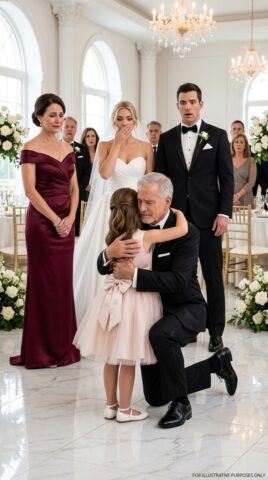
Grant lowered himself to one knee in the middle of her tiny Chicago living room, between a thrift-store coffee table and a radiator that clanked like a ghost.
“No ballroom,” he said. “No cameras. No strategy. No lie.”
Lena covered her mouth.
“I asked you once to pretend to be my wife,” Grant continued. “It was selfish, desperate, and ridiculous. But it led me to the only woman who has ever seen all of me and stayed long enough to argue about eggs.”
Tears filled her eyes.
“I love you, Lena Whitaker. Not because you saved my reputation. Not because America liked our story. Because you make ordinary life feel brave. Because you tell the truth when it costs you. Because home is wherever you are.”
He opened the box.
The ring was simple. Elegant. Not enormous. Perfect.
“Will you marry me for real?”
Lena wiped her face. “I have conditions.”
Grant laughed, shaky with emotion. “Of course you do.”
“No fake honeymoon stories.”
“Agreed.”
“No using the word strategy in wedding planning.”
“Agreed.”
“No five-fork dinners at the reception.”
“Painful, but agreed.”
“And when I make jokes during emotional moments, you let me.”
“Always.”
She knelt in front of him and kissed him.
“Yes,” she whispered. “For real.”
Their wedding happened the following spring in San Diego, because Lena decided the fake city deserved a real memory. The ceremony took place on a bluff above the Pacific, with fifty guests, wildflowers, wind, and no reporters.
Marissa cried. Nora managed the schedule with military precision. Avery gave a toast about courage. David Chen attended with his wife and joked that he expected exclusive rights to the anniversary article.
There was an American flag near the white chairs, moving gently in the ocean breeze. Not as decoration for power. As a reminder of the strange country where a broke woman could stand beneath one flag in Washington and tell the truth to people who expected her silence, then stand beneath another in California and marry the man who had learned to love her without pretending.
Grant’s vows were simple.
“Lena, you came into my life as a lie and became the truest thing in it. I promise not to hide behind control. I promise to listen when you say something hurts. I promise to burn fewer eggs and make more pasta. I promise to choose the real story, even when the fake one looks easier.”
Lena laughed through tears.
Her vows were less polished.
“Grant, the first time you spoke to me, you asked me to pretend to be your wife. My first thought was that you were insane. My second thought was that your suit was too expensive for someone making such bad decisions.”
The guests laughed.
“But somewhere between the scandal, the speeches, the burned food, and the fruit basket, I fell in love with the man behind the name. I promise to remind you that you are human. I promise to stand beside you, not behind you. I promise to make our life honest, loud, sometimes inconvenient, and always ours.”
The wind did attack her veil.
Everyone laughed when it smacked the officiant’s shoulder.
“See?” Lena whispered to Grant. “I told you this detail was realistic.”
He kissed her before she could say anything else.
Years later, people still asked Lena about the night at the Meridian gala.
They wanted the glamorous version. The billionaire. The whisper. The shocked elite. The scandal. The speech.
Lena usually smiled and gave them the truth.
“I was alone,” she would say. “And then someone asked me to pretend. But pretending only took us so far. The real story started when we stopped lying.”
Grant would always add, “And when I learned eggs require supervision.”
Their life was not perfect. No real life is.
They fought. They forgave. They built. They laughed. They donated millions to housing programs for women rebuilding after eviction and financial abuse. Lena became one of the most respected nonprofit voices in the country, not because she married Grant Ashford, but because she knew what it meant to need a second chance without shame attached.
Vivienne Cross eventually reappeared in California, softer around the edges, less powerful than before. Years later, she sent Lena a handwritten apology. Lena read it twice, then placed it in a drawer.
“Are you going to answer?” Grant asked.
“Maybe someday.”
“That sounds fair.”
“I am fair.”
“You are terrifyingly fair.”
“You love me.”
“I do.”
Colton Pierce tried to return to business, failed twice, and eventually became a consultant who gave speeches about ethics. Lena found this so ridiculous she nearly choked on coffee.
But mostly, the villains faded.
That was the thing no one told you about happy endings. They were not about enemies suffering forever. They were about enemies becoming less important than breakfast, work, family, and the person laughing across the kitchen.
One Sunday morning in their home outside San Diego, sunlight spilled over the counters while Grant stood at the stove with heroic concentration.
Their five-year-old daughter, Ellie, sat on a stool beside Lena, watching him.
“Daddy looks scared,” Ellie whispered.
“He’s making eggs,” Lena whispered back. “This is a historic battle.”
Grant turned. “I can hear you both.”
“Focus,” Lena said. “The eggs are watching.”
Ellie giggled.
Grant plated the eggs. They were slightly uneven, but not burned.
Lena tasted them and widened her eyes. “Grant Ashford, you did it.”
He bowed. “Thank you.”
Ellie clapped.
Grant looked at Lena over their daughter’s head, and in his eyes she saw the same man from the ballroom: powerful, controlled, impossible.
But she also saw the man from the kitchen, the hallway, the Chicago apartment, the San Diego bluff.
The real one.
Later that evening, after Ellie fell asleep, Lena and Grant stood on the balcony watching the Pacific turn gold under the sunset.
“Do you ever think about that first night?” Grant asked.
“All the time.”
“Do you regret saying yes?”
Lena leaned against him. “Not for a second.”
“I was selfish.”
“You were desperate.”
“I was arrogant.”
“You were wearing a very nice suit.”
He laughed.
She looked up at him. “You also said please.”
“That made the difference?”
“It helped.”
“And your response shocked the elite.”
“My response saved your life.”
“That too.”
He kissed her forehead.
Below them, the flag near their garden moved gently in the evening wind. Their daughter’s toys lay scattered across the patio. In the kitchen, a pan soaked in the sink because Grant still had not mastered cleanup.
It was imperfect.
It was honest.
It was theirs.
And Lena Whitaker Ashford, once alone at a Washington gala in a borrowed dress, knew with absolute certainty that the best thing she had ever done was refuse to be ashamed.
Because the night Grant whispered, “Pretend to be my wife,” she had not simply saved him from a scandal.
She had found the beginning of her real life.