My Cheating Husband Thought I Was Clueless—Until His Mistress’s Husband Paid Me $100,000 To Wait…
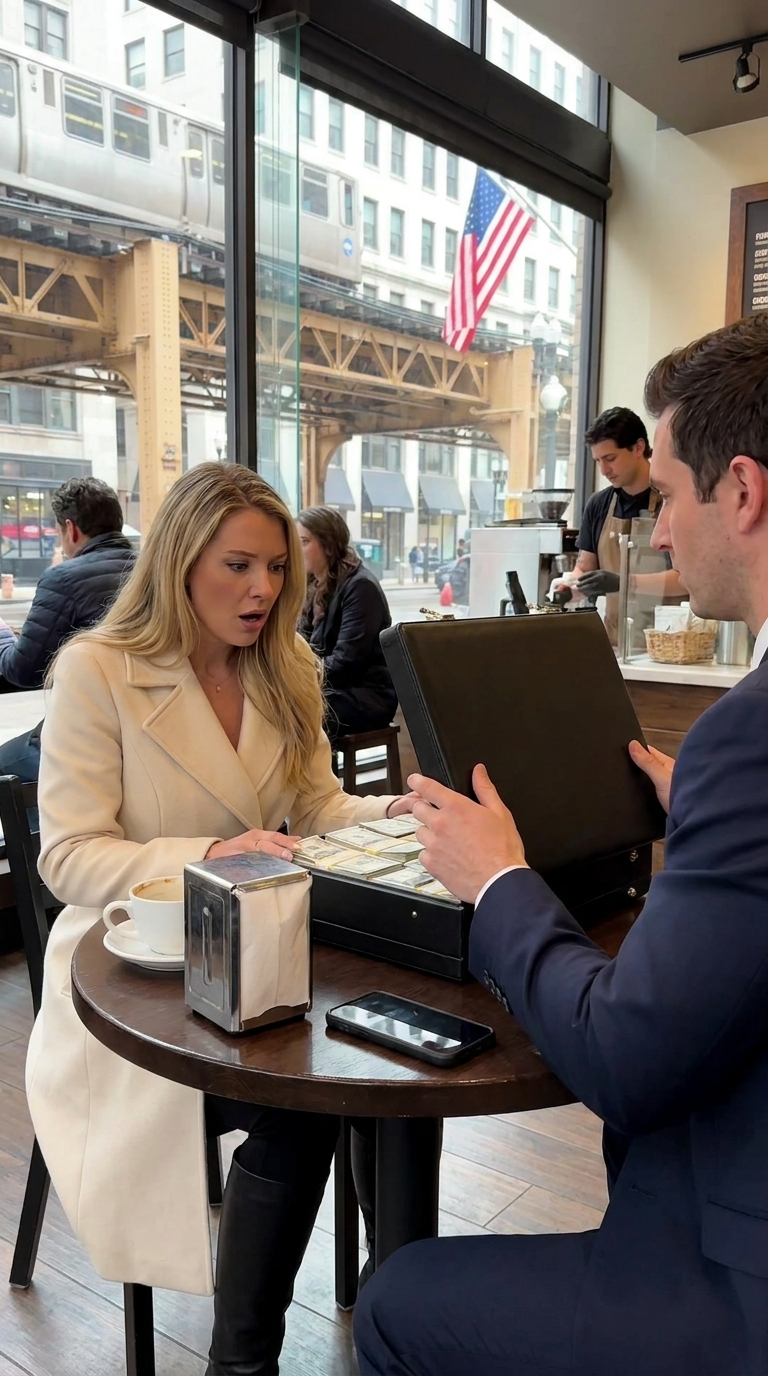
The stranger didn’t ask if I wanted revenge. He just opened a black leather briefcase in the middle of a Chicago coffee shop and showed me $100,000 in cash. Then he said the one sentence no betrayed wife expects to hear: “Do not divorce your cheating husband yet.”
PART 1 — THE PERFECT HUSBAND HAD A SECOND ADDRESS
“Take the hundred thousand dollars,” the stranger said, “and keep sleeping next to the man who’s lying to your face.”
I stared at him over my untouched Starbucks Americano, waiting for him to laugh.
He didn’t.
The briefcase sat between us on the small table by the window, fat with banded stacks of hundred-dollar bills. Real money. Not casino money. Not movie money. The kind of cash that makes honest people look around to see who’s watching.
Outside, Chicago moved like nothing had happened. Uber drivers honked at cyclists. A woman in a camel coat yelled into her AirPods. A businessman cut across the crosswalk holding a Sweetgreen bag and a phone charger like his life depended on both.
Inside, my marriage was being negotiated by a stranger with cold eyes and excellent cuff links.
“My husband is sleeping with your wife,” I said.
David Sterling nodded once.
“Correct.”
“And your solution is to pay me not to divorce him?”
“My solution,” he said, sliding the briefcase one inch closer, “is to make sure they don’t walk away from this with our money, our dignity, and their stupid little love story intact.”
I should have walked out.
Any normal woman would have stood up, told him to keep his cartel-looking briefcase, and gone straight to a divorce attorney.
But I wasn’t a normal woman anymore.
I was Anna Walker, thirty-five years old, freelance translator, resident of a quiet suburb outside Chicago, and wife of Michael Peterson, a project manager who had recently developed a suspicious interest in cologne, downtown gyms, and “late concrete pours.”
For seven years, I thought my marriage was boring in the best possible way.
Michael woke up at 6:45 every morning, used the same blue mug for coffee, drove the same silver SUV to work, and came home tired enough to complain about traffic but not tired enough to forget our anniversary.
He was not flashy.
He was not dramatic.
He was the kind of man who bought a snow blower after one bad winter and acted like he had secured our bloodline for generations.
I mistook predictable for loyal.
That was my first mistake.
The change started quietly.
Michael began coming home at 10 p.m., then midnight, then one-thirty in the morning with a neat little speech ready.
“Client meeting ran long.”
“Emergency site issue.”
“Boss is losing his mind.”
The man could lie while hanging up his coat.
He started taking long showers the second he walked in. He changed his phone wallpaper from our wedding picture to a black-and-white photo of some random mountain. He bought fitted shirts from Nordstrom and acted like middle-aged construction managers just wake up one day needing Italian leather shoes.
One Saturday, he told me he was joining a gym.
Michael, who once called Pilates “expensive stretching.”
“Good for you,” I said.
“Trying to get healthy,” he replied, flexing in the hallway mirror like he was auditioning for a protein powder commercial.
I smiled.
A wife can smell another woman before she has proof.
Not perfume. Not lipstick. Not some dramatic red flag taped to a hotel receipt.
It’s the shift.
The way a man stops seeing you but still expects dinner.
The way his phone becomes a newborn baby he carries into every room.
The way he smiles at a text, then looks up and gives you the dead corporate version of his face.
The proof came by accident.
I was having lunch downtown with my friend Sarah near Union Station. We had just ordered salads that cost twenty-two dollars each because Chicago restaurants have apparently declared war on lettuce.
Then I saw him.
Across the street, inside a trendy café, Michael sat at a corner table with a woman in a burgundy trench coat.
She had long dark hair, glossy like a shampoo commercial. She leaned forward when he spoke. He laughed.
Not the tired laugh he gave me when I made a joke at dinner.
A real laugh.
Then he reached across the table and took her hand.
My fork stopped halfway to my mouth.
Sarah followed my eyes, saw exactly what I saw, and whispered, “Oh, hell no.”
I wanted to storm across the street.
I wanted to throw his coffee in his lap and ask if his “job site” came with oat milk and adultery.
But my legs wouldn’t move.
Michael kissed the woman’s knuckles.
A small, casual kiss.
That hurt more than if he had grabbed her dramatically and knocked over the table. Casual meant practice. Casual meant comfort. Casual meant this was not the first time.
Sarah grabbed my wrist.
“Anna. Don’t do it here.”
“I should.”
“No,” she said. “You should be smarter than him.”
That sentence saved me.
I went home and did not scream.
Michael walked in at 1:12 a.m., smelling like expensive soap and another life.
“You’re awake?” he asked, loosening his tie.
“Busy night?” I said.
“Brutal.”
I almost laughed.
Brutal. Yes. Holding hands with a woman in a burgundy coat must be emotionally exhausting.
He kissed my forehead.
I let him.
That was the first performance.
The next morning, I started documenting everything.
Times he left. Times he came home. His excuses. His clothes. His new habits. I checked our Chase statements. Nothing suspicious. He was paying cash or using a card I didn’t know about.
I drove by his office one night when he claimed to be working late.
His parking spot was empty.
I called the gym, pretending I needed to confirm a billing issue.
He had checked in once.
The day he signed up.
Cute.
I thought about grabbing his phone while he slept, but Michael had fingerprint locks, face recognition, and the survival instincts of a raccoon near a trash can.
So I went to a divorce lawyer.
Richard Vance’s office sat on the thirtieth floor of a glass building in the Loop. Everything about the place said expensive: the receptionist’s posture, the silent coffee machine, the conference table polished enough to reflect my bad decisions.
Vance listened without interrupting.
Then he folded his hands and gave me the kind of look professionals use right before they ruin your afternoon.
“Mrs. Walker, I’m going to be blunt. Suspicion is not leverage.”
“I saw them holding hands.”
“That’s painful. It is not enough.”
“They’re having an affair.”
“Probably,” he said. “But court does not run on probably.”
He explained it in a calm voice that made me want to throw his Montblanc pen through the window.
If I filed with weak evidence, Michael could deny everything. If I accused him without proof, he could paint me as paranoid. If I wanted a stronger financial settlement, especially for marital funds spent on the affair, I needed records.
Photos. Hotel stays. Lease agreements. Credit card charges. Witnesses. A pattern.
“Do not confront him until you have the receipts,” Vance said.
Receipts.
The most American word for justice.
So I went home and became the perfect wife.
I made coffee.
I washed his shirts.
I smiled when he lied.
For four weeks, I lived inside a performance so clean it should have won an Emmy.
Then, on a Tuesday afternoon, the doorbell rang.
A man in a tailored navy suit stood on my porch.
“Anna Walker?” he asked through the camera.
“Yes.”
“My name is David Sterling. My wife’s name is Samantha.”
I didn’t answer.
He looked straight into the lens.
“And she’s having an affair with your husband.”
PART 2 — THE STRANGER BROUGHT RECEIPTS
He didn’t bring sympathy. He brought a manila envelope thick enough to destroy two marriages.
We met at a coffee shop downtown because apparently betrayal pairs well with espresso and exposed brick.
David didn’t waste time.
“My wife is Samantha Sterling,” he said. “Twenty-nine. Advertising agency. Dark hair. Burgundy trench coat.”
My fingers tightened around my cup.
He slid the envelope across the table.
Inside were photographs.
Michael and Samantha leaving a restaurant in the West Loop.
Michael and Samantha at Navy Pier.
Michael and Samantha walking into a Gold Coast hotel like they owned the place.
Michael and Samantha kissing in a parking garage.
Each photo had a date, time, and location printed in the corner.
David watched me flip through them.
“I hired a private investigator six months ago.”
“You knew that long?”
“I suspected that long,” he said. “I knew when the investigator sent me a picture of your husband carrying my wife’s overnight bag.”
I looked down at one photo.
Michael was smiling at Samantha in a way he hadn’t smiled at me in years.
Not sorry.
Not conflicted.
Happy.
That was the part nobody warns you about.
The cheating hurts.
The happiness offends.
David opened a spreadsheet on his phone. Thirty confirmed meetings. Five hotel stays. Two weekend trips. Multiple cash withdrawals. Restaurant names. Parking times. Surveillance notes.
It was not an affair.
It was a second life with better lighting.
“I can give your lawyer copies,” he said.
“Why?”
“Because we’re both being robbed.”
I looked at him.
He was controlled, polished, and clearly one bad sentence away from putting his fist through drywall.
“I was going to file,” he said. “Then my attorney told me something useful.”
“What?”
“If we strike too early, they get to call it a mistake.”
He tapped the envelope.
“I don’t want a mistake. I want a pattern.”
PART 3 — THE HUNDRED-THOUSAND-DOLLAR DEAL
Three days later, David opened the briefcase and asked me to stay married to a liar for ninety more days.
I stared at the cash until it stopped looking like money and started looking like a trap.
“No,” I said.
David didn’t blink.
“You haven’t heard the plan.”
“I heard enough. You want to buy my silence.”
“I want to buy time.”
“That’s an ugly sentence.”
“It’s an honest one.”
He leaned back in his chair.
“Anna, if you file tomorrow, Michael gets served. What’s the first thing he does?”
I said nothing.
“He calls Samantha,” David continued. “She panics. She deletes messages, changes passwords, wipes receipts, moves money, and suddenly my six months of work becomes half as useful.”
He was right.
I hated that.
“They’re connected,” he said. “So are we.”
That line landed hard.
Michael and Samantha had built a secret relationship.
David and I were building a legal weapon.
“What do you want from me?” I asked.
“Ninety days. No confrontation. No divorce filing. No dramatic suitcase-on-the-lawn moment. You act normal. I keep gathering evidence. Your lawyer prepares quietly. Mine does the same. Then we file at the exact same time.”
“The exact same time?”
“Same morning. Same hour. Two petitions. Two civil claims. No warning.”
He said it like he was describing a merger.
I almost admired the efficiency.
Almost.
“And the cash?”
“For what I’m asking you to endure.”
“I’m not a contractor.”
“No,” he said. “You’re a woman who has to cook breakfast for a man who’s using your joint assets to date my wife. That should come with hazard pay.”
I looked out the window.
A woman at the next table complained that her latte had the wrong milk.
I wanted her life.
“I can’t do ninety days,” I said.
“You can.”
“You don’t know that.”
“I know you didn’t scream when you saw them together. I know you hired a lawyer. I know you’ve been tracking his lies. That means you’re not impulsive. You’re angry, but you’re not stupid.”
It was the first compliment I had received in weeks that didn’t feel like an insult in a sweater.
David lowered his voice.
“Let them get arrogant. Arrogant people make expensive mistakes.”
I thought about Michael strolling through our front door, damp from fake gym sweat, kissing my cheek like I was furniture.
I thought about Samantha holding his hand in public, comfortable enough to act like I did not exist.
I thought about Vance telling me the law respected receipts, not pain.
“Three months,” I said.
David nodded.
“Three months.”
“If I do this, I do it for leverage. Not because you bought me.”
“Understood.”
“And if Michael finds out?”
“Then both our cases get harder.”
“Great. No pressure.”
His mouth twitched.
“Welcome to strategic misery.”
I took the briefcase home in an Uber.
The driver asked if I was traveling for work.
“Something like that,” I said.
At home, I shoved the money behind winter coats in the back of my closet. Michael never looked there. The man could find a hotel lobby blindfolded, but he could not locate his own gloves in December.
That night, he came home late.
“Sorry,” he said, dropping his keys into the bowl by the door. “Concrete pour ran forever.”
I looked at his polished shoes.
No dust. No mud. No concrete.
“That sounds awful,” I said.
He kissed my cheek.
“Thanks for understanding.”
I smiled.
The old Anna would have cracked.
The new Anna poured him reheated soup and asked if he wanted extra crackers.
The next morning, David texted me one line.
7:00 p.m. RPM Italian.
I replied:
Got it.
No names. No emotion. No details.
At 7:43, he sent a photo.
Michael and Samantha sat near the window with two glasses of wine. Michael’s hand rested on the back of her chair.
I zoomed in.
There it was.
His wedding ring.
Still on.
Because men like Michael don’t remove the ring. They enjoy the convenience of being married and the thrill of pretending they aren’t.
I put the phone face down and ate a frozen Trader Joe’s dinner alone.
The next week, Michael announced another Saturday gym session.
He left wearing athletic clothes that still had the store crease in them.
I texted David.
Target one left. 10:28.
David replied.
Target two left. 10:06.
Two hours later, David called.
“Can you talk?”
“I’m alone.”
“They just entered a residential building in the South Loop.”
I stood in Michael’s home office, staring at his desk.
“A hotel?”
“No,” David said. “Luxury apartment tower. Doorman. Private garage. The kind of place people rent when they want a second life with skyline views.”
My mouth went dry.
“Can you find out if Michael signed anything?”
I opened drawers.
Bank statements. Insurance papers. Old tax folders. A 401(k) packet he had never bothered to file properly because apparently adultery was easier than administration.
Then I found it.
A lease agreement tucked behind a stack of construction contracts.
Tenant: Michael Peterson.
One-bedroom apartment. South Loop. Twelve-month term.
Signed two months earlier.
Using funds from our joint account.
I took photos of every page.
Then I texted David.
Lease found. Sending now.
His reply came in seconds.
That’s the coffin nail.
That evening, Michael walked in wearing damp gym clothes.
He had sprayed himself with water.
Not sweat.
Water.
There are insults, and then there is a grown man misting himself like produce at Whole Foods.
“How was the workout?” I asked.
“Brutal,” he said. “My trainer is killing me.”
“Poor thing.”
He didn’t hear the blade under the words.
He sat at my kitchen island, eating the dinner I cooked, while the lease for his secret apartment sat photographed in my phone.
Two months passed.
David kept the investigator on key nights. My lawyer prepared filings. I documented bank movements. I stopped following Michael myself because Vance made it clear: clean evidence beats reckless evidence.
“Do not turn into a spy movie,” he said during one call. “Judges dislike drama. They like documents.”
So I gave him documents.
Receipts for furniture.
A West Elm charge.
A Crate & Barrel delivery.
A Best Buy purchase for a television we did not own.
Michael told me he was “saving more aggressively.”
He was.
For Samantha’s throw pillows.
Then came Miami.
Michael stood in our bedroom, folding polo shirts into a carry-on.
“My boss wants me to check out a development site in Florida,” he said. “Three days.”
“Miami?” I asked.
“Yeah. Brutal schedule.”
“Try to survive all that oceanfront suffering.”
He laughed because he thought I was joking.
The minute he left, I texted David.
Miami confirmed.
David replied:
Samantha just announced a girls’ trip to Miami. Same dates. This is the kill shot.
While Michael was gone, I slept better than I had in months.
David’s investigator captured them at a South Beach resort. Pool cabana. Dinner. Valet stand. Elevator. Ocean Drive. Same room charge linked to Michael’s hidden card and a transfer from our joint savings two days earlier.
When Michael came home, he handed me a box of airport chocolates.
“Meetings were brutal,” he said, dropping onto the couch.
I looked at his tan.
“I can tell.”
“You okay?” he asked.
“Perfect.”
For once, that was almost true.
We were close.
Then Michael got reckless.
One evening, while half-watching Netflix beside me, he cleared his throat.
“The commute has been killing me,” he said. “I might rent a small studio near the office for weeknights.”
I paused the show.
He looked nervous.
Not guilty.
Nervous that his plan might be inconvenient.
“A studio?” I said.
“Just during crunch weeks.”
“Sure,” I said. “You work so hard. Why not make cheating—I mean commuting—more comfortable?”
His head snapped toward me.
“What?”
I smiled.
“I said commuting.”
He stared for half a second too long.
Then he smiled back.
“Right.”
He was relieved.
Men like Michael survive on the assumption that women don’t notice tone.
A week later, he packed two suitcases.
Suits. Casual clothes. Toiletries. His expensive cologne.
It looked less like a work convenience and more like a man auditioning for a divorce petition.
I stood by the bedroom door.
“Need anything else?”
“No, babe. I’ll be back Friday.”
“Of course.”
He hugged me.
I let my hands rest lightly on his back.
Not affection.
Measurement.
I wanted to remember the exact size of the man I was about to cut out of my life.
That night, David called from his car outside the South Loop building.
“They walked in together,” he said. “Both carrying luggage.”
I sat in my dark kitchen with my laptop open and a glass of water untouched beside me.
“They’re living together?”
“Looks that way.”
“Good,” I said.
David was quiet.
Then he said, “You’ve gotten colder.”
“No,” I replied. “I’ve gotten accurate.”
PART 4 — THE DAY THE PAPERS HIT THE FLOOR
The process server handed Michael the divorce papers inside his secret apartment while his mistress was making coffee in the kitchen.
That detail came from David’s investigator.
I paid extra to hear it twice.
Michael was served at 9:42 on a Thursday morning.
Samantha was served at 9:47 at her advertising agency, in front of a creative director, two interns, and a conference room full of people pretending not to listen.
But the real strike happened three days earlier.
Monday morning, I sat in Richard Vance’s glass conference room while he stacked documents in front of me like bricks for a courthouse wall.
Petition for dissolution of marriage.
Claim for dissipation of marital assets.
Exhibit A through Exhibit Z.
Photos.
Lease.
Bank transfers.
Furniture receipts.
Miami records.
Investigator logs.
Apartment lobby footage.
“Anna,” Vance said, tapping the binder, “this is not a divorce filing. This is a guided missile.”
“Then launch it.”
He turned the laptop toward me and uploaded the final documents through the county court portal.
At exactly 10:00 a.m., he clicked submit.
A green confirmation bar appeared.
I texted David.
Filed.
Ten seconds later:
Filed.
That was it.
No fireworks. No music. No dramatic courthouse thunder.
Just two betrayed spouses using broadband and legal procedure to ruin a fantasy.
For three days, I waited.
Michael texted once.
Crazy week. Miss you.
I typed back:
Hang in there.
I laughed so sharply my own kitchen sounded unfamiliar.
Thursday afternoon, my phone rang.
Michael.
I let it ring until it stopped.
He called again.
I answered.
“Hello?”
“Anna.” His voice cracked on my name. “Where are you?”
“At home.”
“Don’t move.”
“Wasn’t planning to.”
He hung up.
Thirty-two minutes later, tires scraped the driveway. The front door flew open so hard it hit the wall.
Michael stood in the foyer, pale, sweating, holding a thick envelope with the county court seal on it.
For the first time in months, he looked at me like I was dangerous.
“What the hell is this?” he shouted.
I sat on the sofa with one leg crossed over the other.
“It’s a divorce petition, Michael. Reading is fundamental.”
He ripped pages from the envelope.
His eyes moved fast.
Dissipation of marital assets.
South Loop lease.
Samantha Sterling.
Miami.
West Elm.
Reimbursement demand.
Sixty percent property division.
His mouth opened.
Nothing came out.
That was satisfying.
Not joyful.
Satisfying.
Like hearing a lock click open after being trapped inside a room for months.
“How did you—”
“I’ve known for three months.”
He froze.
I stood up slowly.
“I know about Samantha. I know about the apartment. I know about Miami. I know about the furniture you bought with our money. I know about the fake gym sessions. I know your big construction project ended weeks before you used it as an alibi.”
He lowered himself into the armchair like his bones had been unplugged.
“Anna—”
“No. You had ninety days to talk. You used them to buy bath towels for another woman.”
His face twisted.
“It wasn’t like that.”
I laughed once.
“Fantastic. Tell that to the judge. Maybe bring the Crate & Barrel receipts for emotional support.”
He rubbed both hands over his face.
“I made a mistake.”
“No, Michael. You made a schedule. Mistakes don’t come with leases, furniture deliveries, and three-day Miami trips.”
His phone buzzed on the coffee table.
Samantha.
He grabbed it.
“Sam?”
I watched his face change as she spoke.
Panic recognized panic.
“She knows?” he said. “David knows? What did he file?”
I leaned against the doorway.
“Tell her I said hi.”
Michael looked at me like he was seeing a stranger.
Good.
I had been married to one for months.
That night, he slept on the couch.
Not because I asked.
Because he had nowhere else to go.
By Friday morning, the romance was already decomposing.
Michael’s lawyer called Vance before lunch, asking if we were “open to a reasonable settlement.”
Reasonable.
That word does a lot of heavy lifting when a man realizes his hidden apartment has become Exhibit F.
Vance called me.
“They’re offering a standard fifty-fifty split and twenty thousand reimbursement.”
I nearly dropped my coffee.
“Twenty thousand? He spent more than that pretending he was young in Miami.”
“My thoughts exactly,” Vance said.
“Tell them no.”
“How aggressively?”
“Tell them if they want to insult me, they can do it in open court where Samantha’s lobby kiss plays on a screen.”
Vance chuckled.
“I’ll phrase it professionally.”
David called that evening.
“She tried to blame Michael,” he said. “Apparently your husband manipulated her fragile soul into signing a lease and picking out an espresso machine.”
“That’s impressive. Did he also hypnotize her into buying linen sheets?”
“Apparently.”
“Michael says she pursued him.”
“Of course he does.”
There it was.
Their grand love story, collapsing under invoices.
Once money entered the room, romance left through the emergency exit.
Over the next month, Michael lived in my house like a punished ghost. He moved around quietly, reheated takeout, avoided eye contact, and slept under a throw blanket he used to complain was “too decorative.”
I did not comfort him.
I did not scream.
I treated him like an appliance scheduled for removal.
Samantha moved back in with her parents in Naperville. David told me her agency had put her on leave after gossip spread through the office. Apparently getting served during a brand strategy meeting is bad for brand strategy.
Mediation failed.
Michael still thought he could keep half the house.
That was adorable.
Court was colder than I expected.
No dramatic speeches. No screaming. No judge banging a gavel every three seconds.
Just polished wood, bad coffee, and grown adults learning that screenshots have consequences.
Michael sat across the aisle in a gray suit I had bought him for a wedding in Milwaukee.
He looked smaller.
Not sorry-small.
Caught-small.
Vance presented the timeline with surgical calm.
October: first confirmed hotel meeting.
November: recurring dinners and cash withdrawals.
January: South Loop lease signed.
February: furniture purchased from marital funds.
March: Miami trip.
April: cohabitation.
The judge watched without expression.
Michael’s attorney tried to challenge parts of the investigation.
Vance did not flinch.
“We are not asking the court to punish heartbreak,” he said. “We are asking the court to recognize documented financial misconduct.”
Clean.
Sharp.
No sobbing. No begging. No performance.
Receipts.
When the lobby footage played, Michael stared at the table.
On the screen, he kissed Samantha by the revolving door of the apartment building. Casual. Domestic. Practiced.
My attorney paused the video.
“Your Honor, this is not a brief lapse. This is a secondary household funded with marital money.”
The judge wrote something down.
Michael closed his eyes.
Too late, buddy.
A few weeks later, the decree arrived.
Vance called before I even opened the envelope.
“We won.”
I stood in my kitchen, barefoot, holding a mug of coffee that had gone cold.
“How much?”
“The house is yours. Sixty percent of retirement and liquid assets. Full reimbursement for the apartment-related expenditures, the Miami trip, and documented furniture purchases. Plus attorney’s fees.”
I set the mug down very carefully.
For months, I had held myself together with discipline and caffeine.
Now the war was over.
“Anna?” Vance asked.
“I’m here.”
“You okay?”
I looked around the kitchen.
The same island where I had served breakfast to a man funding a secret life.
The same sink where I had washed his coffee mug after he lied to me.
The same floor he crossed when he came home from another woman’s bed.
“Yes,” I said. “I’m okay.”
David texted an hour later.
We won too. Heavy damages. 60/40. She’s furious.
I replied:
Good.
He wrote back:
You survived.
I stared at the screen.
Then I typed:
So did you.
Michael packed the following Saturday.
Cardboard boxes. Trash bags. Two suitcases. The same pathetic cologne.
He stood by the front door with a box labeled OFFICE in his own handwriting.
“Anna,” he said.
I waited.
“I’m sorry.”
There are apologies that clean wounds.
There are apologies that are just a person begging not to be the villain in their own memory.
Michael’s was the second kind.
I opened the door.
“Drive safe.”
He looked like he wanted a bigger ending.
A hug. A fight. A final speech. Anything that made him important.
I gave him none of it.
The door closed behind him with a small click.
Seven years ended without a soundtrack.
I changed the locks that afternoon.
PART 5 — THE WOMAN HE UNDERESTIMATED KEPT THE HOUSE
By the time Michael lost his job, I had already repainted the living room.
Sage green.
New sectional.
New curtains.
No wedding photos.
No gray couch where he had slept after the papers came.
My house finally looked like mine.
The reimbursement cleared. The deed transferred. The retirement split processed. David’s hundred thousand still sat in a separate account, untouched for months, until I used part of it to expand my translation business and put the rest where no man’s bad decisions could reach it.
Michael resigned from his firm after details from the court fight reached the wrong partners.
Samantha was pushed out of her agency after the office gossip became louder than her client pitches.
They lost the apartment.
They lost the money.
They lost each other.
Their great romance apparently could survive secrecy, hotel rooms, and mojitos in Miami, but not financial discovery.
I did not celebrate.
I slept.
Real sleep.
The kind you get when nobody beside you is lying.
One evening, David and I met at a Starbucks downtown.
No briefcase this time.
No envelopes.
Just coffee.
“You look different,” he said.
“So do you.”
He smiled.
“Less homicidal?”
“More employable.”
He laughed, and for the first time, it didn’t sound like something dragged out of him.
We didn’t promise to stay in touch.
We didn’t turn our shared disaster into some cheesy second-chance romance.
He had been my ally in a war neither of us asked for.
That was enough.
When I walked back to my car, Chicago was bright, loud, and completely indifferent.
I liked that.
The city had not stopped for my betrayal.
So I stopped stopping for it.
That night, I stood in my kitchen, poured a glass of wine, and looked at the quiet rooms I had fought to keep.
Michael thought I was too soft to notice.
Too loyal to move.
Too broken to plan.
He confused patience with weakness.
That was his most expensive mistake.
I raised my glass to the empty house.
Not to revenge.
To ownership.
My name was Anna Walker.
Not Michael’s wife.
Not collateral damage.
Not the woman left behind.
I was the woman who waited, watched, documented, filed, won—and walked away with the keys.
And the next morning, I woke up alone in my own bed, in my own house, under my own name.