I Found My Chief Doctor Husband In His Assistant’s Arms—Then He Said He Had To “Play The Good Dad” At Our Daughter’s Party…
The worst sound in a marriage isn’t screaming.
It’s your husband laughing softly behind a half-open office door while your daughter’s birthday cake melts in your hand.
I went there to surprise him.
Instead, I heard seven words that turned six years of marriage into evidence.
And I recorded every second.
PART 1 — THE GOOD DAD PERFORMANCE
“I have to go play the good dad tonight,” my husband whispered to his assistant, “so don’t make this harder than it needs to be.”
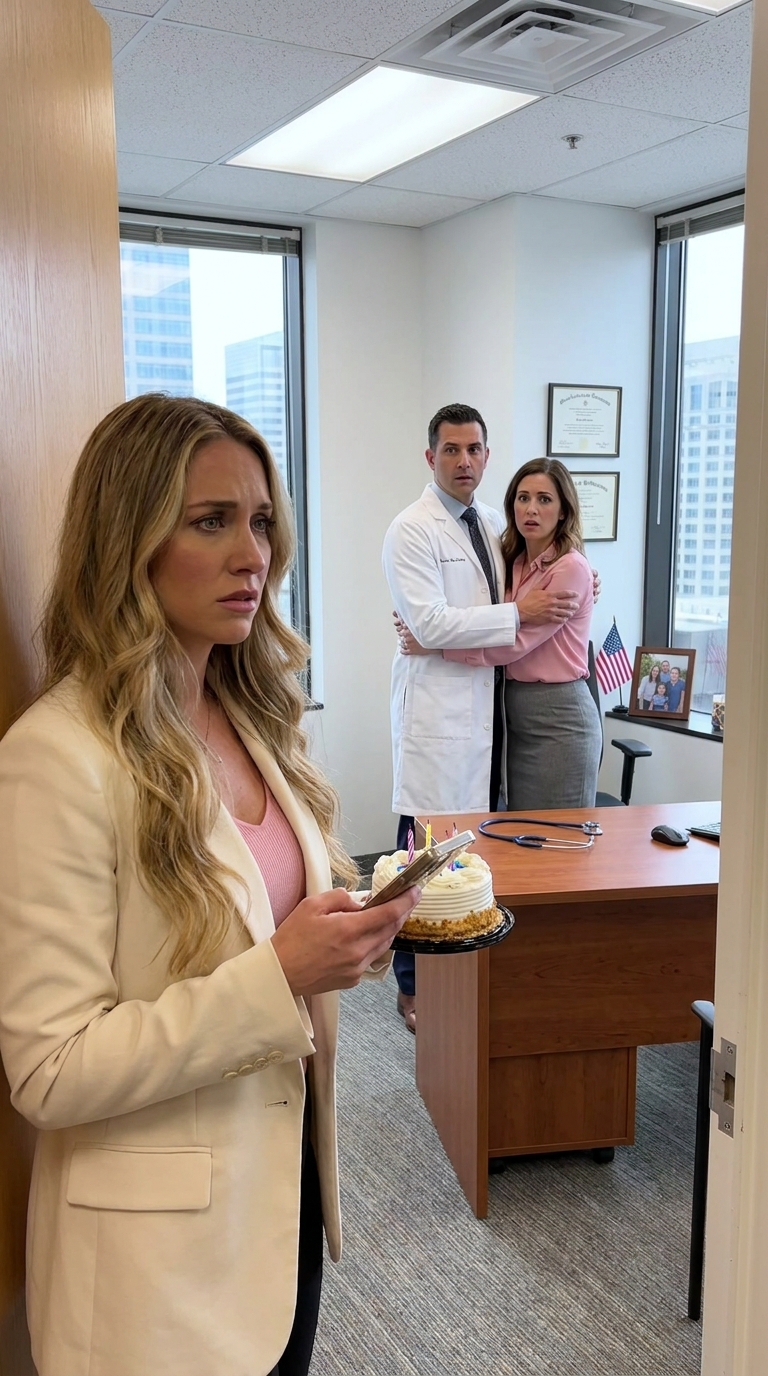
I stopped with my hand on the brass door handle.
The five-tier mermaid cake tilted against my wrist.
The gift bag in my other hand swung once, soft and stupid, like it didn’t know the man inside that office had just gutted my life with one sentence.
My name is Dr. Sarah Crawford.
I was thirty-two years old, married six years to Dr. David Osborne, Chief Medical Officer of Osborne Medical Group, Manhattan’s favorite golden-boy surgeon with a Navy suit, perfect teeth, and a LinkedIn profile that read like a TED Talk had a baby with a Rolex ad.
That afternoon, I had left my lab early.
I had picked up Lily’s birthday cake from a bakery in Midtown because my five-year-old had spent three weeks telling me the mermaid’s tail had to be “ocean blue, not regular blue, Mommy.”
I had a silver tie clip custom engraved for David in my purse.
D and S.
David and Sarah.
Six years of marriage.
One joke, apparently.
His office door was open just enough for me to see Madison Reed’s hand on his lapel.
Twenty-six years old.
Executive assistant.
Pilates body, glossy hair, baby voice, and the survival instincts of a raccoon in a gated community.
She said, “You always leave me alone when your family needs you.”
David chuckled.
Not his public laugh.
Not the one he used at hospital fundraisers when donors told boring golf stories.
This one was low. Private. Warm.
“Baby, tonight is Lily’s party. My father will be there. Sarah will be there. I have to play the good dad.”
My thumb moved before the rest of me did.
I opened Voice Memos on my iPhone, tapped record, and held it close to the crack in the door.
Madison sighed. “And tomorrow?”
“Tomorrow I cancel the symposium dinner and take you to that ridiculous Soho art show.”
“You hate modern art.”
“I hate being nagged more.”
She laughed.
He kissed her.
I didn’t kick the door open.
I didn’t throw the cake.
I didn’t give him the gift bag and say, “Happy anniversary, you walking malpractice suit.”
I stood there for fourteen seconds and collected data.
Scientists don’t scream at contaminated samples.
We label them.
I walked down the hall to a yellow medical waste bin, stepped on the pedal, and dropped the tie clip inside.
The silver hit plastic with a clean little clack.
That was the sound of my marriage losing sentimental value.
Then I texted David.
Traffic is brutal on the FDR. I’ll pick up Lily and head straight to the Hamptons. Meet us there when you’re done.
Sweet.
Helpful.
Wife-shaped.
He replied with a red heart.
I stared at it until the elevator doors closed.
Then I texted Andrew Vance, my college friend and New York’s most expensive divorce attorney.
Do you have time? Urgent.
Three seconds later:
For you? Always.
I drove to the Plaza Hotel instead of the Hamptons.
I booked a family suite.
I handed my Amex to the concierge and said, “Ocean theme. Balloons, blue streamers, mermaid plates. Whatever you can do in forty minutes.”
He glanced at the cake, then at my face.
Smart man.
He didn’t ask questions.
By six o’clock, Lily was sitting cross-legged on a hotel bed in a sparkly mermaid dress, frosting on her chin, yelling, “Mommy, her tail is perfect!”
I smiled.
“Of course it is.”
“Is Daddy coming?”
I picked a blue sprinkle off her cheek.
“Daddy got stuck at work.”
Lily nodded and went back to stabbing cake with a plastic fork.
At five, betrayal is just an adult being late.
At thirty-two, betrayal has invoices, hotel charges, deleted messages, and women named Madison who cry without smudging mascara.
When Lily fell asleep clutching her plush mermaid, I went into the bathroom, turned on the cold water, and played the recording.
David’s voice filled the marble room.
I have to play the good dad.
I sent it to Andrew.
Then I sent another message.
Audit everything. Personal accounts. Joint accounts. Corporate reimbursements. Also pull the patent agreement for Protovir One. I want every clause.
Andrew replied:
Do not confront him. Not yet.
I looked at my reflection.
My makeup was intact.
My lipstick hadn’t moved.
Good.
David loved a polished wife.
So I would give him one.
For the next three days, I performed better than he did.
I packed Lily’s lunch.
I made David’s pan-seared halibut.
I listened while he complained about board pressure and “how exhausting leadership is.”
He kissed my forehead every morning.
I wiped the spot with a cotton pad after he left.
On the third night, Andrew sent the first report.
Subject line:
Sit down.
I didn’t.
David had moved $250,000 through “research consulting expenses” and “travel reimbursements.”
A Tribeca condo had been purchased under Madison’s name.
The down payment came from David’s personal credit line.
The same David who told me last year Tribeca was “too noisy for investment.”
I closed my laptop.
David called from the bedroom, “Sarah? You still working?”
“Yes,” I said.
“Don’t stay up too late.”
“I won’t.”
He went back to bed.
I sat in the dark with both hands folded on the desk.
A cheating husband was ugly.
A cheating husband using corporate research money to fund his assistant was useful.
Two weeks later, Andrew met me in a private room at a Midtown club where the cocktails cost forty dollars and nobody looked impressed unless you owned a senator.
He slid a manila envelope across the table.
Inside were photos.
David and Madison on a hotel balcony in Bali.
David and Madison leaving the Tribeca building.
David and Madison at a private screening room, his hand low on her back.
Then the medical form.
Madison had listed David as her emergency contact after an OB-GYN visit.
Andrew said quietly, “There was a pregnancy. It didn’t continue.”
I stared at the form.
The date was three months ago.
That week, I had been working seventeen-hour days finalizing Protovir One’s Phase III data.
David had sent soup to my lab with a note.
Don’t burn yourself out, honey. Proud of you.
I laughed once.
Andrew didn’t.
“What do you want to do?” he asked.
“Not divorce,” I said.
He blinked. “That’s usually why people call me.”
“I want him to climb as high as possible.”
Andrew leaned back.
I tapped the envelope.
“Then I want him to jump.”
PART 2 — THE MISTRESS MADE A MISTAKE
Madison cornered me in the hospital parking garage like she was the wronged woman in a Lifetime movie.
She wore a beige trench coat, red lipstick, and fake misery.
“Dr. Crawford,” she said, voice shaking, “I never wanted to hurt you.”
I unlocked my SUV.
“That’s brave. Usually people start with hello.”
Her mouth twitched.
“I love David.”
“Congratulations. Does he validate parking?”
She stepped closer. “He’s miserable with you. You and his father put so much pressure on him. He needs someone who understands him.”
I looked at her shoes.
Red-bottom heels.
Corporate fraud looked cute this season.
“Madison, how old are you?”
“Twenty-six.”
“When I was twenty-six, I was running molecular screens sixteen hours a day and publishing in medical journals you can’t pronounce.”
Her face tightened.
I opened the driver’s door.
“And you’re standing in a parking garage begging a wife to donate her husband like he’s a used couch on Facebook Marketplace.”
“I didn’t come here to be insulted.”
“No,” I said. “You came here because you thought I’d cry.”
She stared at me.
I smiled politely.
“Garbage doesn’t become treasure because you clutch it hard enough. You just get your hands dirty.”
I got in and shut the door.
Through the tinted window, I watched her type furiously on her phone.
Perfect.
She would run to David.
David would feel guilty.
Guilty men buy things.
Guilty men move money.
Guilty men make mistakes.
That night, David came home with flowers, Ladurée macarons, and a Disney puzzle for Lily.
“Missed my girls,” he said.
I put the flowers in water.
Then I checked the bank alerts.
Madison had received a Cartier bracelet two hours after I left the garage.
I trimmed the flower stems, nicked my finger, and watched one drop of blood land on a white petal.
I threw the whole bouquet away.
PART 3 — THE TRAP WITH HIS SIGNATURE ON IT
“Sarah, you don’t have to sacrifice your patent rights for me,” David said, while reaching for the contract like a starving man reaching for a steak.
We were sitting near the window at a hospital café.
He had ordered black coffee.
I had ordered nothing.
The smell of burned espresso and disinfectant sat between us.
I looked tired on purpose.
No concealer under the eyes.
Hair pulled back.
Wedding ring on.
A woman close to breaking.
David liked women best when they were close to breaking.
“I’ve been thinking,” I said. “About us. About Lily. About your father.”
His shoulders relaxed a fraction.
He thought this was the speech.
The one where the wife says she knows marriage is hard and maybe she has been too distant and maybe they should take a trip to Napa and pretend a king-size hotel bed can fix moral decay.
“I don’t want Protovir One to become a weapon between us,” I said.
His eyes sharpened.
There he was.
Not the husband.
The executive.
Protovir One was Osborne Medical’s crown jewel.
A targeted anti-tumor therapy I had built from a molecular sketch in my Moleskine notebook into Phase III success.
David presented it as “our company’s innovation.”
Cute.
My fingerprints were on the lab notebooks.
His were on the champagne glasses.
“I’m willing to formally waive my right to revoke the exclusive license,” I said.
David inhaled.
Small.
Controlled.
But I saw it.
“You’d do that?”
“For the family.”
His face softened into the exact expression he used in fundraising videos.
“Sarah, I don’t deserve you.”
Finally, one accurate sentence.
“But I have one condition,” I said.
“Name it.”
“I want us to launch a medical charity. Safe Haven Foundation. Pediatric cancer support, emergency grants, family housing, the kind of work your father respects.”
He nodded quickly.
“Good PR,” he said, then corrected himself. “Good work. Meaningful work.”
“Two million to start. You personally guarantee it. I’ll oversee charitable programming. Your team handles governance.”
David ran the math behind his eyes.
Two million was nothing compared to keeping Protovir One.
A charity made him look generous.
His father would approve.
The board would applaud.
Madison would probably demand a matching necklace.
He reached across the table and took my hand.
“We’re family,” he said. “We fix things together.”
I let him hold my hand.
Then I watched him sign the first draft two days later without reading Appendix Three.
Page thirty-seven.
Font size nine.
Buried under compliance language was a clean little clause Andrew and I had built like a land mine.
If unauthorized transfers occurred within 180 days, all assets of the personal guarantor could be frozen pending judicial review.
David signed with a Montblanc pen.
He smiled up at me.
“Feel better?”
I slid the contract into my portfolio.
“Yes.”
And I meant it.
Safe Haven was established the next week.
David delegated the operations to his CFO.
Madison grew more expensive.
Chanel bag.
Cartier bracelet.
Private dinner.
Tribeca maintenance fees.
Then the first withdrawal hit.
$120,000.
Labeled equipment procurement.
Destination obscured.
Andrew traced it to a Delaware LLC.
The registered agent was Madison’s cousin.
I read the message in bed while David slept beside me.
His arm was draped over my waist.
I stared at the ceiling.
The trap snapped shut on day twenty-one.
He was faster than expected.
Greed has terrible impulse control.
A month before the gala, Andrew introduced me to Carter Sterling.
Founder of Sterling Capital.
Thirty-five.
Calm.
Dangerously precise.
His office sat on the sixty-seventh floor of One World Trade Center, all glass, steel, Hudson River, and money that didn’t need to introduce itself.
He had read my papers.
All of them.
“Protovir One is at least two years ahead of the market,” he said. “The fact that Osborne Medical controls it is unfortunate.”
“Unfortunate?” I asked.
“I was being polite.”
I almost smiled.
He offered me a partnership.
A new biotech platform.
Equal equity.
Independent executive authority.
No restrictive covenants.
No strings.
I looked at him for a long moment.
“Why help me?”
“Because brilliant people shouldn’t spend their lives making small men look tall.”
That landed harder than it should have.
I accepted one condition.
Confidentiality until the gala.
He nodded.
“Understood.”
When I stood to leave, he said, “The Osborne family is too small a room for you.”
I stepped into the elevator.
“It’s not ambition,” I said. “It’s restitution.”
The doors closed.
For the first time since the office door cracked open, I felt something practical and clean.
An exit.
Not rescue.
Not romance.
An exit.
There’s a difference.
Ten days before the gala, Osborne Medical mailed a gold invitation to our house.
30th Anniversary Gala and Breakthrough Drug Unveiling.
My name appeared as:
Mrs. Sarah Osborne, wife of Dr. David Osborne.
Not lead investigator.
Not inventor.
Not patent holder.
Wife.
I dropped the card on the coffee table.
Lily picked it up and spun it in the light.
“Mommy, is it a party?”
“Yes,” I said. “A very interesting one.”
“Can I come?”
“No, baby. Grandma’s house that night.”
“Will there be cake?”
“Probably.”
“Then save me some.”
I kissed her forehead.
“I’ll save you something better.”
Three days before the gala, David’s father had an angina attack.
Mount Sinai called me because William Osborne Sr. couldn’t reach his son.
I got to the hospital in fifteen minutes.
David arrived forty minutes later smelling like red wine and perfume.
His wedding ring was gone.
William looked at him from the bed.
“I called you eleven times.”
David adjusted his tie.
“I was in the OR.”
He was not in the OR.
He was in Tribeca.
I saw the bare finger.
Then I looked at my own ring.
White gold.
Cartier.
Classic.
Expensive.
Empty.
In the hospital hallway, I slid it off and put it in my coat pocket.
That was all.
No speech.
No trembling.
Just skin finally breathing.
That night, William grabbed my wrist before I left.
“Is something wrong between you and David?”
I crouched beside his bed.
“I can’t tell you everything yet.”
His eyes stayed on mine.
“But Lily will be safe,” I said. “I promise.”
He released my wrist.
“I believe you.”
Three words.
David had given me vows.
William gave me trust.
One weighed more.
The morning of the gala, I put on the black Tom Ford blazer dress David had once called “too intimidating.”
I did my makeup like armor.
Cool crimson lipstick.
Sharper brow.
No wedding ring.
I placed the ring beside our framed wedding photo and left it there like a discontinued product.
Then I texted Andrew.
I’m heading out.
He replied:
Flash drive will be at the AV booth forty minutes into the keynote. Assets ready.
I texted Carter.
Thank you for today. Regardless of outcome.
His reply came fast.
Execute it.
So I did.
PART 4 — THE GALA
“The primary inventor of Protovir One is here tonight,” the MC announced, “and it is not the man who just took credit for it.”
The Waldorf ballroom went silent so fast the champagne bubbles sounded rude.
Five minutes earlier, David had been glowing under the stage lights.
Navy bespoke suit.
Perfect posture.
White smile.
A room full of investors, surgeons, biotech CEOs, and board members waiting to worship him.
He spoke about “our breakthrough.”
“Our vision.”
“Our proprietary development.”
Our, our, our.
Men like David love collective nouns.
They spread blame.
They absorb credit.
I sat at table three, front row, listed under Dr. Sarah Crawford, independent scientific consultant, Sterling Medical Institute.
Not Mrs. Osborne.
Not David’s wife.
My own name.
The chair beside David at the head table had a white card that read Mrs. Sarah Osborne.
It stayed empty.
At thirty-five minutes, David reached the sentimental portion of his keynote.
“I want to thank my family,” he said, scanning the head table.
His eyes hit the empty chair.
Then he found me.
Black dress.
Red lipstick.
No ring.
His mouth missed a word.
Just one.
Most people didn’t catch it.
I did.
He rushed through the ending.
Applause rose.
I stood.
At the AV booth, Andrew’s guy handed me the flash drive.
Fifteen seconds later, the MC returned to the microphone with a new card.
“Ladies and gentlemen, please welcome Dr. Sarah Crawford, primary inventor and patent holder of Protovir One.”
Whispers hit the ballroom like dropped silverware.
David turned so sharply his champagne spilled over the tablecloth.
I walked onto the stage.
The lights were hot.
The microphone was cold.
My hands were steady.
“Good evening,” I said. “I apologize for interrupting the celebration. But some facts become harder to bury when they are placed on a screen large enough for everyone to read.”
Slide one appeared behind me.
My CV.
My publications.
The complete development timeline of Protovir One.
Every milestone.
Every lab record.
Every lead investigator entry.
My name.
“The molecular design of Protovir One began in March 2019,” I said. “In my lab. Under my direction. With my original formula.”
David moved toward the stage.
A Sterling security guard shifted one step into his path.
David stopped.
Smart enough not to wrestle a man shaped like a federal building.
Slide two.
The Sterling Medical Institute audit.
“The data was independently reviewed,” I said. “No manipulation. No misconduct. Fully reproducible.”
Several scientists at the front tables leaned forward.
They knew what that meant.
David had planned to attack my credibility.
Now that weapon was useless.
Slide three.
Audio file.
The waveform appeared.
David’s face changed.
Finally.
Not anger.
Fear.
I tapped play.
His voice filled the ballroom.
I have to go back and play the role of the good dad.
Someone gasped.
At the head table, William Osborne sat in his wheelchair.
He had discharged himself against medical advice to attend.
When he heard the recording, his shoulders dropped.
Not dramatic.
Not loud.
Worse.
Final.
I didn’t look at him for long.
If I did, I might stop.
And stopping would let David turn this into a “private marital issue.”
It was not private anymore.
Slide four.
Bank ledgers.
“This is the Safe Haven Foundation,” I said. “A charity personally guaranteed by Dr. David Osborne.”
Numbers appeared.
$120,000.
$180,000.
Additional transfers.
Shell company.
Delaware registration.
Madison Reed’s cousin.
The room changed temperature.
Investors stood.
Phones came out.
Board members looked like they were being audited by God.
“This is not an affair,” I said. “That was merely tacky. This is potential embezzlement, misallocation of charitable funds, and corporate exposure large enough to ruin every person in this room who pretends they didn’t see it.”
David snapped.
“Cut the screen!” he shouted.
His voice cracked.
Beautiful.
He lunged toward the stairs.
Two Sterling guards blocked him.
“Sarah!” he yelled. “Are you insane?”
I leaned into the mic.
“No. I’m properly documented.”
A few people turned their heads.
Someone at table two whispered, “Jesus.”
David tried again.
“Let’s talk. Not here.”
I looked down at him.
“Why not here?”
He froze.
“You accepted applause here,” I said. “You claimed my work here. You sold investors a future built on my patent here.”
I clicked the remote.
“So return it here.”
Slide five went black.
Then white text filled the screen.
All exclusive licensing rights to Protovir One are hereby revoked by the legal owner, Dr. Sarah Crawford, effective immediately. Osborne Medical Group is stripped of all rights to commercialize, develop, or profit from this intellectual property.
For three seconds, nobody moved.
Then the room detonated.
A venture capitalist at table two stood up.
“You can’t do this!”
I turned to him.
“Mr. Vance, your firm invested one hundred million dollars three years ago. Your own due diligence report identified the patent risk tied to the marital equity clause.”
His mouth opened.
Nothing useful came out.
“If your analysts skipped page twelve,” I said, “send them the invoice.”
The board chair was already on his phone.
The CFO looked like he might faint into the salad course.
Madison appeared near the ballroom entrance, wearing a silver dress and the Cartier bracelet bought with my patience.
She had come as someone’s “guest.”
Bad night to be visible.
When her cousin’s LLC appeared on the screen again, she stepped backward.
A photographer caught it.
Good.
David stopped fighting the guards.
His face had emptied.
No charm left.
No speech.
No husband.
Just a man watching every borrowed inch of status get repossessed.
I stepped away from the podium and walked past him.
He grabbed for my wrist.
A guard caught his arm first.
“Sarah,” David said.
Now his voice was small.
Almost human.
“We can fix this.”
I stopped.
For the first time all night, I looked directly at him.
“You said you had to play the good dad.”
His lips parted.
I smiled once.
“Curtain’s closed.”
Andrew stepped forward from the side aisle and handed him a folder.
“Dr. Osborne,” he said, “you’ve been served.”
Divorce petition.
Emergency custody filing.
Asset freeze request.
Foundation audit notification.
All in one elegant stack.
David looked at the papers.
Then at me.
“You planned this.”
“No,” I said. “You did. I just kept receipts.”
Behind him, William’s attorney leaned down to speak into the old man’s ear.
William nodded once.
By midnight, David’s access to the family trust would be suspended pending investigation.
By Monday, Osborne Medical stock would be halted.
By next week, Madison would discover that men who buy Cartier with stolen money rarely keep mistresses when prosecutors start calling.
I walked out through the side doors before dessert.
In the lobby, Carter Sterling stood near the marble column, hands in his pockets.
He didn’t congratulate me.
He didn’t touch me.
He simply said, “Clean execution.”
“Messy subject,” I said.
“That’s usually the case.”
Outside, the Manhattan night was sharp and bright.
My Uber Black pulled up.
I got in alone.
For the first time in six years, I did not text David where I was going.
PART 5 — AFTER
“Mommy,” Lily asked the next morning, “is Daddy still busy at work?”
I was sitting at my mother’s kitchen table in Westchester, drinking Starbucks from a paper cup while Andrew’s texts stacked up on my phone.
SEC inquiry.
Board emergency vote.
David suspended.
Madison terminated.
Personal assets frozen.
Trust access revoked.
Headlines pending.
I set the phone face down.
Lily was eating pancakes in pajamas with little whales on them.
I brushed syrup off her thumb.
“Daddy made some bad choices,” I said. “Adults are going to handle it.”
“Are you mad?”
I thought about the office door.
The cake.
The recording.
The empty chair labeled Mrs. Sarah Osborne.
Then I looked at my daughter.
“No,” I said. “I’m done.”
Two weeks later, I signed the final documents for my new company with Sterling Capital.
Crawford Therapeutics.
My name on the door.
My patent in my hands.
My daughter safe.
David called once from an unknown number.
I let it ring.
Then I blocked it.
That evening, Lily and I walked past a bakery window glowing warm against the New York sidewalk.
She pointed at a cupcake with blue frosting.
“Mermaid blue,” she said.
I bought two.
We ate them on a bench while taxis blurred past and the city kept moving like it always does after men mistake women’s silence for weakness.
Lily leaned against me.
“Mommy?”
“Yeah, baby?”
“Are we okay?”
I looked at the skyline.
Then at my bare left hand.
“Yes,” I said. “We are.”
And this time, nobody was acting.