She hid the envelope in a cookie tin behind old towels in her room and tried not to think about it.
Then came March 14.
At nine o’clock, Grace carried chamomile tea toward Arthur’s study. The hallway lights were low. Rain tapped against the tall windows. She was almost at the door when she heard voices inside.
Nathaniel.
Vivian.
“The new will becomes official tomorrow,” Nathaniel whispered. “If he files it, we lose everything. He’s giving a third to Ethan, a third to the foundation, and God help us, he left part of it to that housekeeper.”
Vivian’s voice was ice. “Then tomorrow can’t come.”
Grace stopped breathing.
Nathaniel said, “The tea?”
“Perfect,” Vivian replied. “Let the perfect son take the blame. Everyone already believes Ethan and his father fought about money.”
Grace’s hands began to shake.
“And the maid?” Nathaniel asked.
Vivian laughed softly. “Grace? She’s nobody. She could watch it happen and no one would believe her.”
The teacup slipped.
Porcelain shattered against marble.
Inside the study, silence snapped.
“Who’s there?” Nathaniel shouted.
Grace ran.
The next morning, Arthur Caldwell was dead.
By noon, Ethan was in handcuffs.
By sunset, Vivian was crying for the cameras.
And Grace, hidden behind a curtain while police sealed the study, understood the terrible truth.
They had built a perfect trap.
Part 2
The news called it the murder of the decade.
Every screen in America showed the same footage. Ethan Caldwell being pushed into a police car. Vivian sobbing on the courthouse steps. Nathaniel Pierce shaking his head with the sorrow of a loyal friend.
The prosecution’s theory was simple enough for everyone to hate.
Arthur Caldwell had planned to cut his reckless son from the fortune. Ethan found out. Ethan poisoned his father’s nightly tea. Ethan inherited everything under an older will that Nathaniel produced within hours of Arthur’s death.
Grace watched the coverage from the servants’ kitchen, both hands wrapped around a mug she could not drink from.
“He didn’t do it,” she whispered.
Hattie, standing at the stove, did not turn around.
“I know.”
Grace looked up.
The older woman’s face was hard.
“This house has smelled rotten for months,” Hattie said. “Question is, child, what are you going to do with what you know?”
That night, while the mansion slept, Grace slipped into Arthur’s study.
The police had taken photographs, samples, fingerprints. But they had not known Arthur the way Grace had. They did not know about the little tape recorder he kept behind the false back of the bottom drawer, the one he used for notes, memories, and, as he once said with a wink, insurance against wolves.
Grace found it.
Her fingers trembled as she pressed play.
First came static.
Then Nathaniel’s voice.
“The new will becomes official tomorrow.”
Vivian’s reply followed, cold and clear.
“Then tomorrow can’t come.”
Grace sank to the floor.
Arthur had known.
He had left the recorder running.
He had caught his own killers from beyond the grave.
The next morning, Nathaniel came to the mansion wearing a black suit and a dangerous smile.
He found Grace polishing the grand staircase.
“Miss Miller,” he said. “May I call you Grace?”
She kept her eyes down. “Yes, sir.”
He stepped closer. “You look tired. All this tragedy must be frightening for the staff.”
“It’s awful.”
“Awful things happen when people get involved in matters above them.”
Grace’s hand tightened around the cloth.
Nathaniel placed an envelope on the banister. It was thick with cash.
“This is fifty thousand dollars,” he said. “More than you’ll make in years. Take it. Go home. Take care of your mother. Forget this ugly business.”
Grace stared at the money.
For one weak second, she saw her mother’s medical bills paid. Her brother’s tuition covered. A life without fear.
Then she saw Ethan in handcuffs.
She pushed the envelope back.
“I don’t sell the truth.”
Nathaniel’s smile vanished.
“Careful,” he said quietly. “People who pretend to be brave often end up dead.”
That evening, Grace found her room torn apart.
Her mattress had been flipped. Drawers yanked open. Clothes scattered across the floor. Someone had searched every corner.
She threw herself toward the closet, pulling aside rags and old blankets until she found the cookie tin.
The recorder was still there.
So was Arthur’s yellow envelope.
But on her pillow lay a note made from magazine letters.
Quiet girls live longer.
Grace slid down the wall and cried with both hands over her mouth.
She wanted to run. She wanted to pack her bag, board a bus to Kentucky, and let the rich destroy one another. She was not a lawyer. She was not powerful. She was just Grace Miller, the maid who knew too much.
Then she opened Arthur’s envelope for the first time.
Inside were bank records, copies of wire transfers, a notarized statement accusing Nathaniel Pierce of stealing millions through offshore accounts, and a handwritten letter.
Grace,
If you are reading this, the wolves won. I am sorry for putting this burden in your hands, but you may be the only honest soul left in this house. Take these papers to justice. Save my son. He is innocent. Tell him his father loved him, even when pride made him say it badly.
Arthur Caldwell
Grace pressed the letter to her chest.
“I promise,” she whispered.
The next day, she went to see a journalist.
His name was Ben Alvarez, an investigative reporter for a small online paper that had questioned the case when no one else dared. His office was above a deli in Queens, and his desk looked like a storm had hit it.
“You’re telling me Vivian Whitmore and Nathaniel Pierce killed Arthur Caldwell?” he asked.
“Yes.”
“And you have proof?”
Grace swallowed. “Not with me. It’s hidden.”
Ben leaned back. “Grace, without seeing the evidence, I can’t publish this. Caldwell money could bury my paper by breakfast.”
“I understand.”
“But listen to me.” His face softened. “If what you’re saying is true, don’t go back to that house alone.”
She should have listened.
On the way back to the train, a black SUV pulled hard against the curb.
Two men got out.
One grabbed her arm.
“Miss Miller,” he said. “Mr. Pierce wants a conversation.”
Grace screamed.
The street was nearly empty. Rain misted the pavement. The man twisted her arm behind her back and shoved her toward the open door. She kicked, clawed, and swung her bag with everything she had. The bag struck the second man across the face. He cursed and stumbled.
Grace ran.
She ran through traffic, through an alley, past a delivery truck, over crates behind a restaurant. One man chased her, his footsteps pounding closer.
An old woman smoking behind a laundromat opened a side door.
“In here, baby,” she whispered.
Grace ducked inside.
The man ran past.
She hid between laundry carts for twenty minutes, shaking so violently her teeth clicked.
That night, she did not return to the Caldwell estate.
She went to Hattie’s apartment in Harlem.
Hattie opened the door and gasped. “Lord Jesus, what happened to you?”
“They tried to take me,” Grace said, collapsing into her arms. “They know.”
Hattie locked three deadbolts, pulled the curtains, and made sweet tea with trembling hands. Then she went to the pantry and pulled a taped package from inside a sack of flour.
“Your treasure,” Hattie said. “Safe as a baby in church.”
Grace took the recorder and envelope.
“Tomorrow is the verdict,” she said.
Hattie sat beside her. “You walk into that courtroom, they’ll tear you apart.”
“I know.”
“They’ll call you a liar.”
“I know.”
“They’ll say you wanted money.”
Grace looked down at Arthur’s letter.
“Then I’ll tell the truth anyway.”
Across the city, Ethan Caldwell spent what he believed might be his last night as a free man’s son in a cell that smelled of rust and bleach.
He had stopped expecting visitors.
His friends had vanished. His board had removed him. Vivian had wept on television and called him a stranger. Nathaniel had visited once, offering a power of attorney that would have stripped Ethan of everything if he signed it.
“You’ll rot in prison unless you cooperate,” Nathaniel had whispered.
Ethan had thrown the papers at him.
Now he sat on the edge of his bunk, staring at his hands.
His father was dead.
His name was ruined.
And the whole country wanted him punished.
Just before midnight, he remembered Grace.
Not because they had spoken much. They had not. But because on the day of his arrest, as the police dragged him out through his father’s marble foyer, every staff member had looked away.
Grace had not.
She had stood near the back stairs, white as paper, tears in her eyes. Not pity. Not fear.
Recognition.
As if she knew something no one else did.
Ethan had whispered, “Help me,” though he doubted she heard.
He closed his eyes in the dark cell.
“If anyone can hear me,” he prayed for the first time since childhood, “please don’t let my father’s name end in a lie.”
Morning came gray and cold.
By dawn, crowds filled the sidewalks outside the Manhattan courthouse. News vans lined the block. Commentators spoke in excited voices about justice, inheritance, poison, greed.
Inside, Vivian Whitmore adjusted her veil.
Nathaniel checked his watch.
The prosecutor smiled like a man already holding a trophy.
And Judge Whitaker began to read the verdict.
“After reviewing the evidence presented, this court finds the defendant, Ethan Caldwell—”
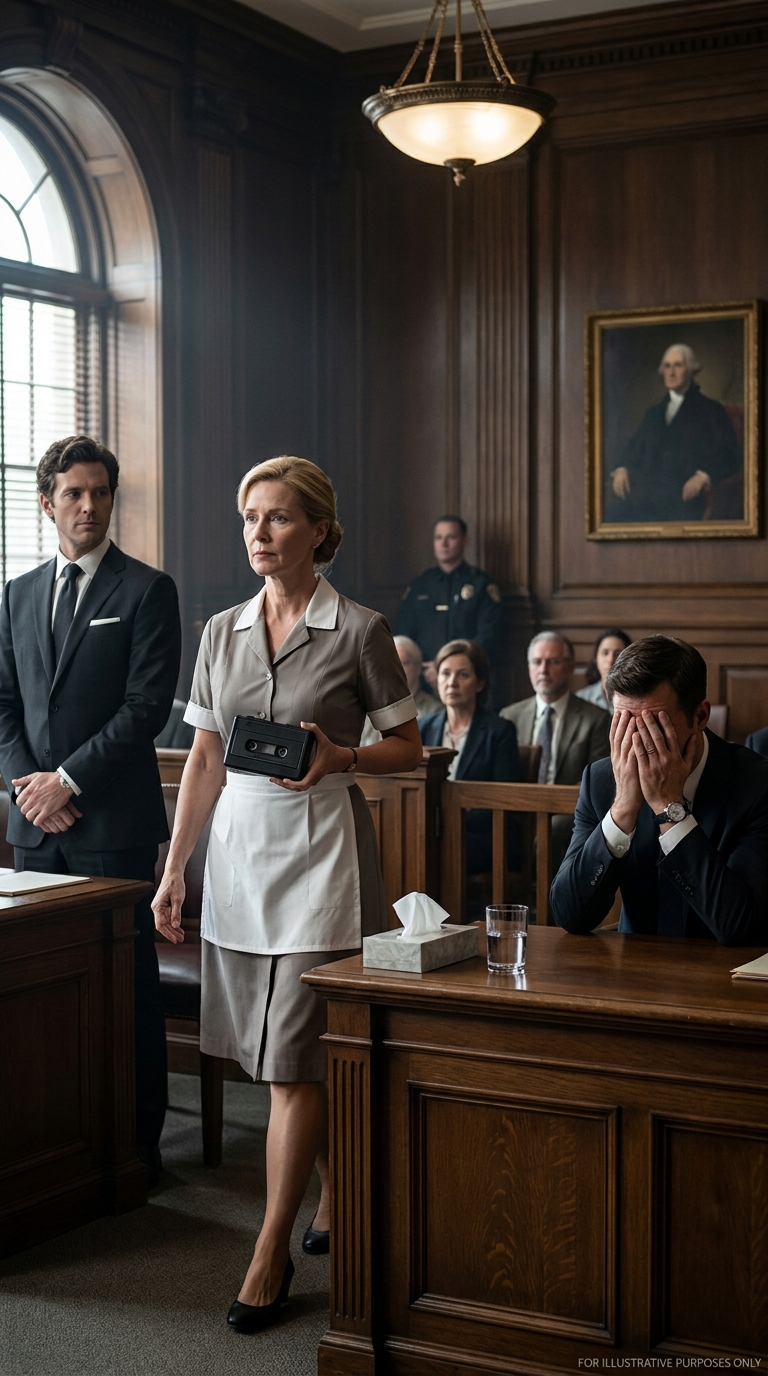
“I have proof, Your Honor!”
The doors burst open.
And Grace Miller stepped into history.
Part 3
Judge Whitaker ordered the bailiffs to release her arms.
“Approach carefully, Miss Miller,” he said.
Grace walked down the aisle.
Every step felt like crossing a battlefield.
Vivian rose, shaking with fury. “Your Honor, she is a servant. This is ridiculous.”
The judge’s eyes snapped toward her. “Sit down, Ms. Whitmore.”
Vivian sat.
Nathaniel remained standing. “Your Honor, this woman is making accusations of murder in open court. She should be removed and charged.”
“She will be heard,” Judge Whitaker said. “And if she is lying, she will face consequences. If she is not, God help everyone who tried to stop her.”
Grace placed the recorder and envelope on the bench.
The judge looked at her.
“You understand the seriousness of this?”
“Yes, Your Honor.”
“Then tell this court what you know.”
Grace took a breath.
“The night Arthur Caldwell died, I was bringing his tea to his study. I heard Ms. Whitmore and Mr. Pierce inside. They said Mr. Caldwell’s new will would become official the next day. They said if that happened, they would lose everything. Then Ms. Whitmore said tomorrow couldn’t come. They planned to blame Ethan because everyone knew he had argued with his father.”
Vivian gave a sharp laugh. “This is insane.”
Grace turned toward her.
“You also said I was nobody. You said even if I saw something, no one would believe a maid.”
The courtroom murmured.
The judge lifted the recorder.
“And this?”
“Mr. Caldwell kept it hidden in his desk. He left it running that night.”
Nathaniel’s face had gone gray.
Vivian whispered, “No. He didn’t record anything.”
The words slipped out before she could catch them.
A ripple of shock moved through the room.
Judge Whitaker stared at her.
“How would you know what Mr. Caldwell did or did not record that night, Ms. Whitmore?”
Vivian’s mouth opened.
No sound came.
Nathaniel closed his eyes.
Judge Whitaker pressed play.
At first, there was only static.
Then Nathaniel Pierce’s voice filled the courtroom.
“The new will becomes official tomorrow. If he files it, we lose everything.”
Vivian’s voice followed.
“Then tomorrow can’t come.”
A woman in the back row cried out.
On the tape, Nathaniel said, “And Ethan?”
Vivian answered, calm and cruel. “Let the perfect son take the blame. The public already wants to hate him.”
Ethan covered his mouth with his cuffed hands.
The tape continued.
Nathaniel: “The housekeeper might have heard something.”
Vivian: “Grace? She’s invisible. She’s nobody.”
The courtroom exploded.
Judge Whitaker pounded his gavel.
“Order!”
But people were standing now. Reporters shouted. Cameras flashed so quickly the room looked struck by lightning.
Hattie Mayfield rose from the back row, tears on her face.
“I worked in that house thirty years,” she shouted, pointing at Vivian. “That is her voice. I would know that snake anywhere.”
“Hattie,” Grace whispered, almost breaking.
The older woman nodded at her. You are not alone.
The judge took the yellow envelope next.
He read the bank records first. His face tightened with every page.
“These documents appear to show repeated transfers from Caldwell corporate accounts to offshore entities connected to Mr. Pierce,” he said. “Over six years.”
Nathaniel gripped the table.
The judge lifted Arthur’s letter.
His voice changed as he read.
“If you are reading this, Grace, the wolves won. Take these papers to justice. Save my son. He is innocent. Tell him his father loved him, even when pride made him say it badly.”
Ethan broke.
Not politely. Not quietly.
He bent forward and sobbed like a boy who had been holding grief behind his ribs until it split him open.
“My dad,” he whispered. “Oh God. Dad.”
For weeks, the country had watched a billionaire accused of murder. Now they watched a son finally learn that his father had loved him enough to fight from the grave.
Grace wiped her cheeks.
“Your Honor,” she said softly, “there’s one more document.”
The judge reached into the envelope and removed a notarized will.
He read it silently at first. Then he looked up, stunned.
“This is Arthur Caldwell’s true final will, signed three days before his death. It divides his estate into three portions. One portion to his son, Ethan Caldwell. One portion to the Caldwell Foundation for housing, medical care, and education. And one portion…”
The judge paused.
Grace felt the room tilt.
“One portion to Grace Miller,” he continued, “for being the only person in my final years who treated me as a man instead of a wallet.”
Grace stepped back.
“No,” she whispered. “No, I didn’t come here for money.”
Ethan looked at her through tears.
“I know,” he said.
That was what broke Vivian.
Her face twisted. The mask of the grieving fiancée fell away, leaving something raw and ugly beneath it.
“You miserable little nobody,” she screamed, lunging toward Grace. “That was ours. All of it was ours. He was going to ruin us. He had to die. Do you hear me? He had to die!”
The room went silent.
Vivian had confessed in front of the judge, the cameras, the reporters, and half the country watching live.
Nathaniel sank into his chair like a man whose bones had dissolved.
Judge Whitaker rose slowly.
“Bailiffs,” he said, voice shaking with anger, “arrest Vivian Whitmore and Nathaniel Pierce for the murder of Arthur Caldwell, conspiracy, fraud, witness intimidation, attempted kidnapping, and obstruction of justice.”
Vivian fought.
She clawed, screamed, cursed Grace, cursed Ethan, cursed the cameras. Nathaniel did not resist. He simply stood, lowered his head, and let the cuffs close around his wrists.
“This isn’t over,” Vivian shrieked as the bailiffs dragged her away. “I am Vivian Whitmore. You don’t know who I am.”
Judge Whitaker looked at her coldly.
“Now everyone does.”
When the doors shut behind her, the silence felt almost holy.
The judge turned to Ethan.
“Mr. Caldwell, in light of the evidence presented by Miss Miller, the recording, the documents, the authentic will, and the confession of the true perpetrator, this court finds no basis to continue the case against you.”
He lifted the gavel.
“Ethan Caldwell, you are innocent of all charges. You are free.”
The gavel fell.
The courtroom erupted.
The bailiffs removed Ethan’s handcuffs.
For a moment he stood there staring at his bare wrists, unable to understand freedom.
Then he crossed the courtroom toward Grace.
No one stopped him.
He reached her near the witness stand. Cameras caught every second, but neither of them noticed.
“I don’t know how to thank you,” he said, voice raw.
Grace shook her head. “Your father saved you. I only carried what he left.”
“You could have run.”
“I almost did.”
“But you didn’t.”
Grace looked at the doors where Vivian and Nathaniel had vanished.
“No one should die because powerful people think poor people don’t matter.”
Ethan bowed his head.
Then, gently, in front of the entire country, he took her hands and said, “You mattered more than all of us.”
The trial did not end that day. It became a national reckoning.
Nathaniel Pierce’s financial crimes led investigators through shell companies, bribed witnesses, falsified probate filings, and a fake older will meant to make Ethan look guilty. Vivian Whitmore eventually accepted a plea to avoid trial publicity she could no longer control, though her confession had already ruined her. Both were sentenced to decades in prison.
Ethan spent his first weeks of freedom in a fog.
He buried his father properly, this time without cameras pushing against the cemetery gates. Only a small group attended. Hattie stood beside Grace under a black umbrella. Ethan placed one white rose on Arthur’s casket and whispered, “I’m sorry I didn’t know.”
Grace heard him and stepped back to give him privacy.
But Ethan turned.
“Please stay,” he said.
So she did.
The true will was honored.
Ethan inherited enough to rebuild the company without Nathaniel’s corruption. The foundation received billions to fund medical clinics, affordable housing, scholarships, and emergency aid across the country.
And Grace Miller, who had arrived at the Caldwell estate with forty-seven dollars, became one of the wealthiest young women in America overnight.
She hated the headlines.
The Maid Who Inherited a Fortune.
The Housekeeper Who Brought Down High Society.
From Cleaning Floors to Caldwell Millions.
But she accepted the inheritance for one reason.
Arthur had trusted her.
The first thing she did was pay off her mother’s medical debt and move her into a safe, sunny home near Lexington.
The second thing she did was create the Miller House Fund through the Caldwell Foundation, offering legal support and emergency relocation money for domestic workers, caregivers, cleaners, drivers, and cooks who were threatened by wealthy employers.
The third thing she did was return to the Caldwell estate.
The staff gathered nervously in the grand hall.
Grace stood beside Ethan under the chandelier she had once polished on a ladder.
Ethan looked at every face. The maids. The gardeners. The drivers. The security guards. The kitchen staff.
“I owe my life to someone this house treated as invisible,” he said. “That ends today. Every employee here gets a raise, healthcare, paid leave, and respect. No one in this house will ever be treated like furniture again.”
Hattie sniffed loudly. “About time somebody in a suit made sense.”
People laughed through tears.
Grace laughed too.
For the first time, the mansion did not feel like a cage.
Months passed.
Ethan and Grace worked together on the foundation. At first, he found excuses to ask her opinion. A clinic location. A scholarship name. A speech draft. A photograph of Arthur from younger days.
Then he stopped pretending.
They drank coffee in the garden. They walked through the old library while rain tapped the glass. He told her about growing up with a father he loved but never understood. She told him about Kentucky, her mother’s stubbornness, her fear, her dreams of studying law one day.
“You should,” Ethan said.
“Should what?”
“Study law.”
Grace laughed. “I’m thirty. I barely finished community college.”
“And you walked into court and saved an innocent man with more courage than most attorneys have in their entire careers.”
She looked away, embarrassed.
He loved that about her.
Not because she had saved him, though she had.
Because she never seemed to understand how extraordinary she was.
One evening, near sunset, Ethan found Grace in the garden where Arthur used to sit. The roses were blooming. The mansion windows burned gold behind them.
“My father saw you clearly,” Ethan said.
Grace turned.
“What do you mean?”
“He spent his whole life surrounded by people who wanted something from him. But you brought him tea and listened. You gave him dignity when the rest of us gave him pressure.”
Grace’s eyes softened. “He was kind to me.”
“He was right about you.”
Ethan took her hands.
“I know the world will talk. They’ll say I’m grateful. They’ll say you inherited money. They’ll say a thousand ugly things because people hate what they can’t reduce to gossip.”
“Ethan…”
“I don’t care what they say.” His voice trembled. “When everyone abandoned me, you came. When the truth could have cost you your life, you spoke. You gave me my father back. You gave me myself back. Somewhere along the way, Grace, I stopped imagining a future that didn’t have you in it.”
Tears filled her eyes.
“I was your housekeeper.”
“No,” he said. “You were the bravest person in the room.”
She tried to speak, but the words broke.
Ethan smiled gently.
“I love you, Grace Miller. Not because you saved me. Because you taught me what kind of man I should have been all along.”
Grace looked at him for a long time.
Then she stepped into his arms.
They married the following spring.
Not in a cathedral. Not in a ballroom packed with billionaires. Grace refused anything that looked like a performance.
They married in Arthur’s garden, under white flowers and soft April sunlight, with Hattie crying in the front row and Grace’s mother holding a handkerchief in both hands. The staff were not serving that day. They were guests.
At the reception, Ethan raised a glass.
“To my father,” he said. “Who made mistakes. Who loved badly sometimes. But who knew truth when he saw it.”
Then he turned to Grace.
“And to my wife, who proved that the most powerful person in a room is not the one with the most money. It is the one brave enough to tell the truth.”
Grace did not become a society wife.
She became a lawyer.
Years later, people still told the story of the day she burst into court with an old recorder and stopped a verdict from destroying an innocent man. But Grace never liked when people called her fearless.
She knew the truth.
She had been terrified.
She had shaken. She had cried. She had almost run.
Courage, she learned, was not the absence of fear.
It was walking into the courtroom anyway.
And every year, on March 14, Ethan and Grace visited Arthur Caldwell’s grave.
They brought one cup of chamomile tea in a small thermos.
Grace would pour a little into the grass, smiling through tears.
Then Ethan would place his hand over hers.
“Thank you for saving me,” he would say.
And Grace would answer the same way every time.
“We saved each other.”