Part 1;
My name is Scott Walker. I’m twenty-eight years old, and I’ve been a firefighter at Station 7 for almost five years. I live alone in a small gray house at the end of Maple Lane, just outside Portland. It is nothing special, just one story, faded paint, a porch wide enough for one wooden chair, a coffee table that wobbles if I set my mug down too hard, and three pots of basil I keep forgetting to water, but it is mine. After my breakup two years ago, I decided I did not need much. My ex told me I was too safe, too predictable, too ordinary, so I built a life that matched those words more than I wanted to admit: quiet shifts, quiet mornings, quiet evenings, and a heart I tried very hard not to let get loud again.
Then Violet Bennett moved in next door. She was thirty-one, a pediatric nurse at the city hospital, and her cream-colored house with white trim looked warmer than mine from the first week she lived there. A low wooden fence separated our yards, and she lined her porch with lavender pots, the kind she actually remembered to water. A wind chime hung by her front door, making a soft, tired sound whenever the breeze moved through the street. We started as neighbors the way people do, with small practical things. She asked which bin was for recycling. I helped her change a porch light. She brought over cookies one Sunday because she said she had made too many, though I later learned she almost never made too many of anything by accident.
Little by little, the conversations got longer. I fixed her leaky backyard faucet on a Saturday afternoon when she was working a double shift, and some nights, when I came home still smelling like smoke, coffee, and the inside of an ambulance, I would find her sitting on her porch with a glass of iced tea, staring at nothing. I never pushed her to explain. I just leaned against my side of the fence and told her stupid stories from the station until she laughed. I liked her laugh. It was quiet, almost surprised, like she had forgotten it still worked.
That Friday afternoon, I was on my porch cleaning my helmet after a long shift when Violet crossed the lawn carrying a warm apple pie on a ceramic plate. She wore a light blue sweater, and her hair was pulled back like she had done it in a hurry. Her eyes looked tired in a way I had learned not to ignore. “Scott,” she said, stopping by the fence. “Are you free tonight?”
I wiped my hands on a rag. “Depends. If you don’t count microwave noodles and washing smoke out of my uniform, then yes.”
She smiled, but it did not reach her eyes. “Good. Come over for dinner.”
I paused, because Violet had invited me in before for coffee, soup when I had the flu, and once for leftover lasagna, but dinner sounded heavier. “Special occasion?”
“Not really,” she said, looking away. “I just cooked too much, and I could use the company.”
That last part was what got me. Violet did not ask for company often, so I nodded. “All right. What time?”
“Seven,” she said, then hesitated. “And wear something decent.”
I glanced down at my old T-shirt and faded jeans. “Decent by neighbor standards or hospital standards?”
She pressed her lips together. “Decent by meeting-parents standards.”
I should have asked more questions right then. I should have said, “Whose parents?” But I had gotten used to not pushing Violet when she looked like that, so I said yes. At seven, I showed up in a white button-down and dark pants, even shaved properly. I still thought it was just dinner, maybe her parents had dropped by unexpectedly and she did not want to sit through it alone. I could handle that. I was good at being the quiet guy in the room.
When Violet opened the door, the smell of roasted chicken, garlic butter, and something sweet hit me first. She was wearing a deep green dress that made her look softer than usual, and for one second I forgot how to say hello. “You came,” she said.
“Yeah. Should I have brought something?”
“You brought yourself. That’s enough.”
Then I heard voices from the dining room. More than one. A lot more than one. Violet reached for my hand, and I looked down at our fingers before looking back at her face. “Violet?”
She did not meet my eyes. “Please just follow my lead for a minute.”
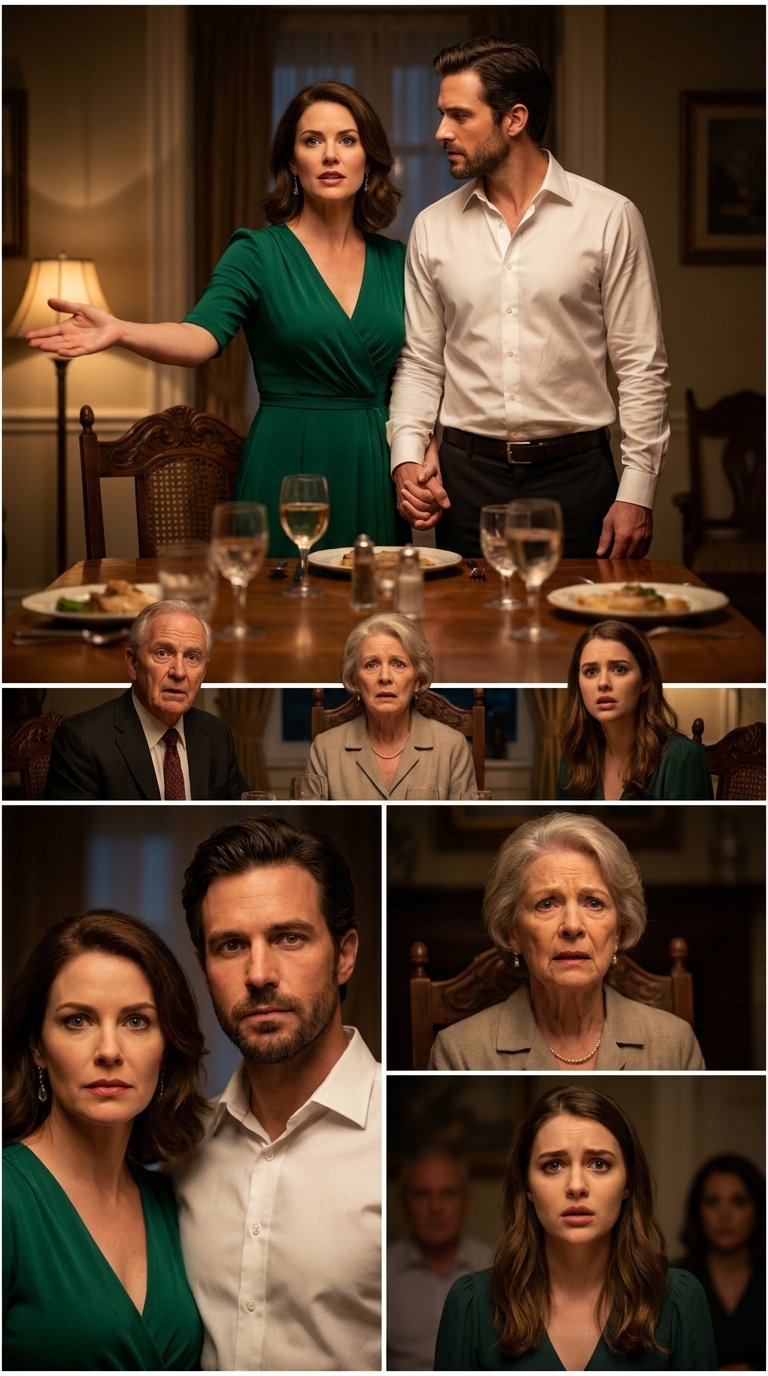
Before I could ask what was going on, she pulled me through the short hallway and into the dining room. Five people sat around the table. Her mother, Margaret, stood immediately, elegant and sharp-eyed. Her father, Robert, sat at the head of the table, watching me like I was a problem he had not decided how to solve yet. Her sister, Megan, smiled like she already knew something I did not. Her brother-in-law gave me a polite nod, and beside the sideboard, holding a glass of red wine, stood a tall man in an expensive shirt. He looked at Violet the way people look at something they used to own.
Violet’s fingers tightened around mine until it almost hurt. Her mother’s voice was warm but careful. “Violet, sweetheart, you’re home. And this is?”
Violet took a breath. I felt it more than heard it. Then she said, clear and steady, “Mom, Dad, this is Scott, my boyfriend.”
Part 2:
The room went completely silent. I stood there with Violet’s hand locked in mine, my mind trying to catch up to what had just happened. Ten minutes earlier, I had been the neighbor who fixed things and forgot to water basil. Now I was apparently the man Violet had been seeing, the man she had never mentioned, the man everyone at that table was suddenly judging.
Margaret’s eyebrows lifted. Robert set his knife down slowly. The man by the wine, whose name I would soon learn was Ryan, smirked like he had just been handed entertainment for the night. Violet kept holding my hand like it was the only solid thing in the room, and that was the part that stopped me from embarrassing her. I could have pulled away. I could have said there had been a misunderstanding. I could have walked back through the hallway, across the lawn, and into my quiet little house where nothing complicated ever happened.
Instead, I smiled at her mother and said, “I’m Scott Walker. It’s nice to finally meet you both.”
Margaret Bennett looked at me for another long second. “Boyfriend,” she repeated, as if the word tasted strange in her mouth.
Ryan took a slow sip of wine. “Interesting,” he said, his voice smooth and expensive. “Violet never mentioned she was seeing anyone.”
Violet’s fingers were cold around mine. “Ryan,” she said flatly, “not everything in my life needs to be announced to you.”
So that was Ryan. I had heard the name a few times before, always followed by Violet going quiet for the rest of the evening. I knew enough to understand he was not just some family friend. I also knew, from the way everyone watched her after she spoke, that the lie she had pulled me into was only the beginning.
Part 3:
Margaret’s polite smile returned, though it did not quite settle naturally on her face. “Well then,” she said, smoothing the front of her cream blouse as though the whole evening could still be arranged into something respectable. “I suppose dinner just got a lot more interesting.” Violet let out a breath so quiet I almost missed it, and we sat down beside each other at the table. Underneath it, her knee brushed mine, then pressed there as if she had started to pull away but could not make herself do it. I stayed still, because I understood something without being told: she did not need me to take over, but she needed to know I would not vanish.
The interrogation began immediately, wrapped in linen napkins, good silverware, and voices that sounded too calm for what they were asking. “So, Scott,” Margaret said, cutting into her chicken with almost surgical precision, “what do you do?” I took a sip of water, felt Violet glance at me, and answered evenly. “I’m a firefighter at Station 7. Mostly rescue and emergency response around this area.” A small silence settled over the table, not openly rude but heavy enough that I felt it. Ryan swirled his wine and said, “Ah. A firefighter,” in the exact tone someone might use for a hobby they considered mildly amusing.
Violet set her fork down a little too hard. “Scott is very good at what he does. If it weren’t for people like him, a lot of families wouldn’t get to go home at the end of the day.” I turned to look at her, surprised by the steadiness in her voice. She did not say it like a woman performing affection for her family. She said it like she meant it, and that made something in my chest tighten in a way I did not know what to do with. Robert leaned back in his chair, his eyes moving between us. “How long have you two been together?”
Violet hesitated, and before she could stumble, I answered. “Almost a year, if you count from when Violet moved in next door.” Megan perked up, her eyes bright. “Neighbors? Oh, that’s adorable. The classic next-door romance.” Violet’s cheeks went pink. I shrugged and let my voice go lighter, because if I could make one person at the table laugh, maybe Violet would breathe a little easier. “At first, I was just the guy who changed her light bulbs and checked her smoke detectors. Then she started paying me in apple pie. I have principles, but I’m not made of stone.”
Megan laughed, and even Robert’s mouth twitched. Violet kicked me lightly under the table, but when I glanced at her, the corner of her mouth had softened. For one moment, the room loosened. The scrape of forks resumed, the smell of garlic and roasted chicken filled the space between questions, and the storm around Violet seemed to draw back by an inch. But Ryan was not finished. He leaned forward slightly, smiling as if curiosity were a favor he was granting us. “So how did this little neighbor romance actually start? It seems sudden.”
Violet went still beside me. I set my glass down and looked at him. “Actually, it wasn’t sudden at all.” The whole table turned toward me, and in that second, I looked at Violet because I needed to know whether I was still lying or finally saying things I had been keeping to myself for months. Her eyes were guarded, but there was fear there too, and something softer beneath it. “It started with small things,” I said quietly. “A broken porch light. A cup of coffee left on my fence. One night, she left a slice of pie on my doorstep because she knew I had just come off a twenty-four-hour shift.”
I paused, but nobody interrupted. “After a while, I realized that every evening when I got home, the first thing I did wasn’t unlock my own door. It was check whether her porch light was on. I realized I missed the sound of her wind chimes. I missed the way she pretended she wasn’t tired when she clearly was. I even missed watching her talk to her lavender plants like they were difficult patients.” Megan covered her mouth with one hand, Margaret’s expression softened despite herself, and Ryan’s smile faded around the edges. Violet stared at me as if I had stepped out from behind a wall she had never known was there.
Then, without warning, she reached over and took my hand again, placing it on top of the table for everyone to see. “He left out the most important part,” she said. I looked at her. “What part?” Violet was not looking at her family anymore. She was looking straight at me, and her voice was soft enough that it almost made the room disappear. “The part where I liked him first.”
My heart stumbled. That sentence did not sound like acting. Or maybe Violet was a better actress than I had ever given her credit for, but as she continued, I stopped being able to tell where the lie ended and the truth began. “Because he’s kind without needing anyone to notice,” she said. “Because he helps people and then pretends it was nothing. Because when I have a bad day, he doesn’t ask a hundred questions or give me empty advice. He just stands on his side of the fence and tells me ridiculous stories from the station until I can breathe again.” The table was completely quiet, and I looked at her with my throat tight. I had come there to help her survive one dinner, but every word she said made me wonder if the person who had been fooled all along was not her parents. Maybe it was me.
After the main course, I volunteered to carry the plates into the kitchen, though the truth was that I just needed air. The kitchen was warm and bright, smelling of roasted garlic, lemon, and the sweet edge of dessert cooling somewhere nearby. I set the stack of dishes in the sink and braced both hands against the counter, trying to sort through everything that had happened in less than an hour. My life was simple by design. Fire had rules even when it looked wild; smoke moved in patterns; broken things could be lifted, repaired, or carried out. But Violet standing beside me in that green dress, calling me her boyfriend with Ryan watching, had no training manual.
A few seconds later, the door swung shut behind me. Violet stood there with her arms wrapped around herself, looking smaller than I had ever seen her. “I’m sorry,” she said quietly. I turned around, and she immediately looked down. “I’m really sorry, Scott. I didn’t plan to say you were my boyfriend. At least, not like that.” There was a tremor in her voice, and it made my anger harder to find. “So you were planning to say something?” I asked.
She closed her eyes. “I was going to tell them you were someone I was seeing. But when I walked in and saw Ryan sitting there, and my mother looking at me like I had failed at life again, I panicked. Your hand was right there, and I just…” She stopped, pressing her lips together. I should have been furious. I should have been mad that she had dragged me into a lie, brought me there without warning, and placed me between her family and her ex like I was a shield she could borrow. But all I felt was something heavier, something that hurt in a different way because I could see how long she had been carrying it.
“Ryan is the reason you needed me to come tonight,” I said. Violet nodded. “My mother still thinks he’s the right choice for me. Successful, good family, says all the right things. To them, Ryan is safe. They don’t know what it actually felt like to be with him.” I kept my voice low. “What did it feel like?” She looked at the floor, the overhead light catching the shine in her eyes. “Small,” she whispered. “Guilty. Like my feelings were always an inconvenience. He never hit me. He never yelled. He just made me believe that if I was sad, I was too sensitive. If I was tired, I wasn’t strong enough. If I wanted to be heard, I was asking for too much.”
Her voice cracked, and I took one careful step closer, stopping before I crowded her. “Violet.” She swallowed hard. “None of them know. Because in front of them, Ryan is perfect. And I’m just the thirty-one-year-old woman who is still single, still living alone, still not settled the way they want me to be.” I thought about all the evenings she sat on her porch with cold tea, eyes red but still smiling when she saw me. I thought about the way she laughed when I told her about the guy who tried to disable his smoke alarm with a butter knife because it kept going off while he was making toast. I thought about how many times she had said she was fine, and how badly I had wanted to believe her because believing her meant I did not have to admit I was already worried.
“The things you said out there,” I asked slowly. “How much of that was real?” Violet lifted her head. The question hung between us, heavy and honest. She could have said none of it. She could have told me it was all acting, all panic, all survival. She could have pulled us both safely back to the line between our houses, the one we had pretended was only made of wood and not fear. But she did not. “Some of it,” she whispered, then gave a small, painful laugh. “More than I want to admit.”
My chest tightened. “Since when?” Violet stared at me for a long moment. “Maybe since the night you fixed my backyard faucet and stayed for two hours drinking coffee with me in the rain. Or maybe the time I had a fever and you left soup on my doorstep with a note that said, ‘No need to open the door. I know you don’t want anyone seeing you look pathetic.’ Or maybe it was all the afternoons you stood on your side of the fence pretending you were just passing by.” I could not speak. The kitchen seemed too quiet around us, every sound from the dining room muffled by the door, every breath between us suddenly important.
“I tried not to like you,” she said. “Because you’re my neighbor. Because if this went wrong, I would still have to see your house every morning. Because I was scared of needing someone again and finding out I needed the wrong person. And tonight, I was selfish.” Her smile trembled. “I pulled you into my mess. I made you face my family. I used you to hide from Ryan.” “No,” I said, and she stopped. I looked at her for a long moment, at the woman who had made my quiet life feel less empty without ever asking permission. “You asked me to be your shield. But what I said out there wasn’t fake either.”
Violet’s eyes filled. “Scott.” I shook my head slightly, because if I stopped now, I knew I might hide again. “I don’t know when it started. Maybe it was when I realized I was fixing your fence more carefully than mine. Maybe it was when I started buying the coffee you like, even though you only came over sometimes. Maybe it was every time I heard your car pull into the driveway after a night shift and felt something loosen in my chest because I knew you were home safe.” Violet stood very still. I looked down at her hand. “I thought it was just being a good neighbor. And now I’m not sure I can keep lying to myself.”
The kitchen felt too warm, the air thick with everything we had spent a year not saying. Violet looked at my mouth quickly, but long enough for me to notice. I lifted my hand slowly, giving her every chance to pull away, and when she did not, my fingers brushed her cheek. Her skin was warm beneath my thumb, and her eyes closed for half a second as if the gentleness hurt more than the truth. I was about to say something responsible, maybe that we should slow down, maybe that this was the worst possible time, maybe that I had not come here to turn panic into a promise. But right then, the kitchen door swung open.
Megan stood there holding an empty wine glass, her eyes bright with curiosity. “Oh,” she said. “Sorry. I was just looking for the corkscrew, but it looks like you two are busy staring at each other like it’s a Hallmark movie for adults.” Violet yanked her hand back. “Megan.” Her sister shrugged, not even pretending to be sorry. “I’m rooting for you, by the way. Scott is definitely an upgrade from Ryan. Ryan has the energy of a man who wears loafers without socks.” I almost laughed, and Violet covered her face. Megan started backing out, but before the door closed, she added one more thing. “Oh, and Ryan just brought up Boston.”
Violet went pale, and just like that, I understood the night was not over yet.
When we walked back into the dining room, the air had changed. Ryan leaned back in his chair like he had just played a winning card, while Margaret watched Violet with that careful, worried expression mothers wear when they think their daughter is about to make another mistake. Robert sat quietly, but his eyes had lost some of their earlier sharpness, and Megan gave Violet a look that was both warning and encouragement. I did not ask what was coming. I only sat down beside Violet and placed my hand on the table close enough that if she needed it, she could reach for me. She did.
Ryan spoke first, his voice smooth and almost kind. “I was just surprised, that’s all. If you two are serious, I think Scott deserves to know that Violet was offered a position in Boston last year. A very good one. Higher salary, bigger hospital. She turned it down.” Margaret sighed as if the disappointment still stung fresh. “It was a rare opportunity. I still don’t understand why she let it go.” Robert added quietly, “We just want what’s best for you, Violet.” Violet’s hand trembled slightly in mine, but her face stayed composed.
Ryan continued, still smiling. “I always assumed she was afraid of change. She chose to stay here because everything was comfortable. Familiar job, familiar neighborhood, familiar neighbors.” He looked at me when he said the last word, as if I were part of the problem, a porch light she had mistaken for the sun. I met his eyes without blinking. The table waited, and for a moment, I thought Violet might retreat into the silence everyone seemed to expect from her. Instead, she took a slow breath.
“I’m not afraid of change,” she said. Ryan tilted his head. “Then why?” Margaret looked at her daughter, equal parts concerned and expectant. “Violet, Ryan is only trying to help. So are we.” Violet set her napkin down, and the small motion seemed to carry years of restraint. “No,” she said. “You all want a version of me that’s easier for you to manage.” The room went silent. Even the soft clink of silverware stopped. Violet’s voice was steady, but beneath it I could hear the ache of every sentence she had swallowed.
“Boston was a good job,” she said. “But I didn’t want it. I didn’t want to leave the hospital where I work now. I didn’t want to walk away from the kids I’ve been taking care of for three years. I didn’t want to move to a city just because it sounds impressive when Mom tells her friends.” Margaret looked stunned, and Violet turned toward Ryan. “And I didn’t reject Boston because I was scared of change. I rejected it because you were there. Because I knew if I moved, I would end up right back in your orbit, listening to you tell me what was good for me, who was good for me, and how I should live so I could look more successful.”
Ryan set his glass down carefully. “Violet, you’re being dramatic.” She looked straight at him. “That’s what you always say. When I tell the truth, you say I’m dramatic. When I’m hurting, you say I’m too sensitive. When I don’t want to follow your plan, you say I’m not mature enough.” Her voice cracked, but she did not stop, and I felt her fingers tighten around mine not as an act for the room but as a way to keep herself standing. “It took me a long time to understand that love shouldn’t make you feel like you have to apologize for who you are.”
Megan sat very still. Robert’s face had changed completely, and Margaret’s hand had risen to her mouth. I did not say a word because this was Violet’s fight, and she did not need me to rescue her from it. She only needed to know she was not standing alone. Violet looked around the table at the people who had mistaken her quietness for agreement. “I stayed here because I want this life. This house. This job. Quiet mornings. The low wooden fence between two yards. A man who doesn’t make me feel like I’m difficult to love.”
I turned to look at her. Violet was not looking at me, but her fingers were gripping mine tightly, and the meaning of those words moved through me so slowly and deeply that I could hardly breathe. Ryan stood up, the legs of his chair scraping against the floor. “I think I should go.” No one stopped him. Before he left the room, he looked at me one last time, his smile thin and cold. “Good luck. She’s more complicated than she looks.”
“I know,” I answered calmly. “That’s one of the things I like about her.”
Ryan paused for a second, then walked out. After the front door closed, the room felt heavy in a different way, as if everyone left behind had been forced to look at what they had helped protect. Margaret was the first to speak. “Violet, I didn’t know you felt that way.” Violet gave a small, tired smile. “Because every time I tried to tell you, everyone said Ryan was just being caring.” Robert let out a long breath. “I’m sorry,” he said. Just those two words, but Violet froze like she had never expected to hear them from him.
The rest of dinner was quieter. There were no more tests, no more sharp little questions tucked inside politeness, no more Ryan sitting by the sideboard like a shadow with a wine glass. Dessert was eaten too quickly, and apologies came in awkward pieces, late but not meaningless. Margaret kept looking at Violet as though she was seeing her adult daughter clearly for the first time, not as a problem to solve or a milestone that had failed to arrive on schedule, but as a woman who had been lonely in ways her family had not noticed. Robert asked me two practical questions about the station, then stopped himself, as if realizing the evening did not need another interrogation. Megan, true to form, refilled everyone’s water and whispered to me, “Still rooting for you,” when Violet was not looking.
When we finally stepped outside, it had started to rain. The air smelled clean and cool, and the pavement between the houses shone under the porch lights. Margaret hugged Violet longer than usual, and when she let go, she looked at me with red eyes. “Thank you for being there for her tonight.” Violet immediately said, “Mom, I don’t need anyone taking care of me like I’m a child.” Margaret nodded. “I know. But if someone makes your life a little easier to breathe in, I’ll learn to be grateful instead of controlling.” Violet did not answer, but I saw her eyes shine.
We walked down the path between our two houses. The rain was light, almost gentle, and her porch light was on. Mine was too. The wind chime by her door made that soft, tired sound I had come to know better than my own doorbell. Violet stopped halfway between the two porches, exactly where the low fence ended and the yards seemed to meet. “I’m sorry about tonight,” she said.
I turned to her. “You already apologized.”
“Not enough.”
“Then how long are you planning to keep apologizing?”
She looked up at me, her voice smaller. “Until you stop looking at me like everything has changed.”
I stepped closer. “But everything has changed.”
“For the worse?” she asked.
I looked at her house, then at mine. Two porches, one low fence, a year of things we had never said. I thought about all the mornings I had seen her watering lavender in her work scrubs, all the nights I had noticed her porch light before my own, all the ways she had made my careful life feel alive without ever asking me to call it anything. “No,” I said. “Just in a way that means I don’t know how to pretend tomorrow morning when I see you watering your flowers on the other side of the fence.”
Violet laughed softly, but her eyes were still wet. “You don’t have to pretend.” I reached out and touched her cheek, and this time there was no kitchen door, no family waiting, no Ryan watching from across the room. She leaned into my hand without hesitation, and I kissed her. It was not rushed. It was not desperate. It was slow, careful, and a little shaky, like two people who had stood on opposite sides of a fence for too long and finally found the gate.
When we pulled apart, Violet rested her forehead against my chest. “Tomorrow is going to feel really strange,” she whispered.
“Yeah,” I said. “We’re still neighbors.”
“Yeah. What if this breaks?”
I looked down at her, at the rain in her hair and the worry she was trying not to show. “Then we go slow. We don’t turn one chaotic night into a lifetime promise, but we also don’t pretend that kiss never happened.” Violet was quiet for a moment, then she nodded. “Tomorrow. A real date.” I smiled. “No parents, no Ryan, no interrogation dinner.” “No lying,” she said. “No lying,” I agreed.
She looked up at me. “So you’ll come over at seven?”
I laughed. “Are you going to introduce me as your almost husband this time?”
Violet smiled for real, the kind of smile that made her whole face look younger. “Depends on how you behave.”
The next morning, I saw Violet at the fence. She was wearing an oversized sweater, her hair loosely tied back, and she held a watering can like nothing had happened, except everything had. She looked like herself again, not the woman in the green dress who had walked into battle the night before, but the neighbor I had known for a year. Only now the space between us felt charged with all the words we had finally allowed to exist. I stood on my side with a cup of coffee, trying not to grin like a man who had slept badly and still woke up happy.
“Morning, neighbor,” she said.
“Morning, fake girlfriend.”
She raised an eyebrow. “Fake?”
I took a sip of coffee. “We’ll reassess after our actual date tonight.”
Violet laughed and tossed a dry leaf over the fence at me. It landed by my shoe, small and harmless, and I kept it there longer than I should have because it felt like proof that we had made it to morning. Our first real date was simple, because neither of us needed anything fancy after the emotional wreckage of that dinner. I took her to the weekend market by the river, where the air smelled like fresh bread, handmade coffee, cut flowers, and rain still drying on the pavement. An old man played violin slightly off-key near the honey stall, and Violet listened with the same tenderness she probably gave nervous children at the hospital.
She bought me a keychain shaped like a firefighter helmet. “You need reminding,” she said, pressing it into my palm, “that you don’t always have to run into burning buildings alone.” I did not know how to answer without making the moment too heavy, so I bought her a small lavender plant from a woman selling herbs in clay pots. Violet looked at it, amused. “I already have a whole garden of lavender.” “This one is from my side of the yard,” I said. She looked at me more carefully. “Why?” I shrugged, suddenly feeling more exposed than I had when Ryan tried to humiliate me. “So even when you don’t come over, I still have something of yours at my house.”
Violet did not speak for a long time. Then she kissed me right there in the middle of the market, in front of the honey stall and the off-key violin, with no audience that mattered and no reason except that she wanted to. There was no performance in it, no panic, no hand squeezed under a dining table for survival. It was just Violet, choosing me in the daylight. I remember the sweetness of honey in the air, the cool wind off the river, and the way her fingers curled into the front of my jacket like she was not afraid to be seen needing something.
After that, we took it slow, exactly like we had promised. We still lived in our separate houses, still saw each other across the fence every morning, and still kept the rhythm of our old lives because neither of us wanted love to feel like being swallowed. Violet still came over with soup after my long shifts, and I still found excuses to fix things at her place that did not really need fixing. The difference was that now, when she fell asleep on my couch after a double shift at the hospital, I did not sit there frozen, afraid of wanting too much. I could pull a blanket over her, kiss her forehead, and listen when she mumbled, “Stay a little longer.” And I stayed.
A month later, Violet invited me to dinner with her family again. This time she told them in advance. “No surprises,” she said. “No lying, no Ryan.” I wore the same white shirt from that first night, partly as a joke and partly because some stubborn corner of me wanted to reclaim it from the memory of being ambushed. Violet met me on her front porch, and the wind chime moved softly above us. “You know,” she said, taking my hand, “the first time I pulled you into that dinner, I only thought I needed someone to stand beside me.” She looked down at our fingers, then back up at me. “And now?” I asked. “Now I want you beside me.”
The second family dinner was completely different. Margaret did not interrogate me about five-year plans or whether firefighting had a stable enough future. Robert asked about my shifts at the station, then casually mentioned that his garage roof had a small leak and wondered if I could take a look sometime. Megan raised her glass and toasted, “To the couple who lied about their introduction but somehow ended up legitimate anyway.” Violet turned red. I laughed, because there was something almost healing about hearing the mess named out loud and realizing it no longer had teeth.
After dinner, Margaret pulled Violet into the kitchen for a private talk, and I ended up in the backyard with Robert, who handed me a rake without explaining much at first. “Is this a disguised interrogation?” I asked. He glanced at me. “You talk more than I expected.” “I talk when I’m nervous,” I said. He gave a small smile, and we raked leaves in silence for a while under the yellow porch light. Then he looked through the kitchen window, where Violet stood with her mother and sister, a dish towel in her hand, her head tilted back as she laughed.
“She looks lighter when she’s with you,” Robert said.
I followed his gaze. The warm kitchen light fell across Violet’s face, and for a moment I saw what he meant. She did not look like a woman bracing for the next correction. She looked like someone standing in a room where she was finally allowed to take up space. “She makes me feel that way too,” I said.
Robert nodded. “Then don’t lose it.”
“I won’t just try,” I answered. “I’ll learn. We’ve both been hurt before. Kind people don’t automatically know how to love right. We have to learn too.” He did not say anything else, but before we went back inside, he clapped a hand on my shoulder.
Winter came, then spring. Our two houses stayed side by side, but the fence between our yards slowly stopped feeling like a boundary and started feeling like the place where our lives met every morning. Violet planted more lavender on my side, claiming my basil needed better company. I repaired her front steps, even though she insisted they were fine, and she left a mug with her name on it in my kitchen, then pretended she had forgotten it there by accident. I kept a jacket at her house because she always forgot to wear enough layers when she came outside after dark. Some evenings we did not talk much at all; we just sat on our separate porches, hands touching across the fence, listening to wind chimes, distant traffic, and the quiet that no longer felt empty.
There were still hard days. Love did not turn Violet’s past into something painless, and it did not erase my old habit of retreating into silence when I was scared. Sometimes Ryan’s name came up in passing, or Margaret pushed too hard without meaning to, and Violet would go quiet in that old familiar way. Sometimes I came home from a bad call with my hands shaking under the kitchen faucet, and she would stand beside me without asking me to explain before I could speak. We learned each other slowly, not as a fairy tale and not as a rescue, but as two adults who understood that safety was not the same as boredom. Safety, in the right hands, could be a place where you finally stopped apologizing for being tired.
One year after the night Violet introduced me as her boyfriend before I had agreed to be one, she organized a small dinner in her backyard. There was no big family gathering, no ex standing by the sideboard, no polite interrogation under the sound of silverware. Just the two of us, two plates of pasta, a cheap bottle of wine, and string lights I had helped her hang along the fence. The evening smelled like lavender and tomato sauce, and the sky above Maple Lane had turned that soft blue-gray color that comes right before darkness. That was when I noticed the gate between our yards had been repainted a gentle blue. Hanging from it was a small wooden sign that read, “Path to Boyfriend’s House.”
I looked at her. “Real boyfriend or fake?”
Violet stood under the lights, her hair moving gently in the breeze. “Do you still need to evaluate?”
I stepped forward and pulled her into my arms. “Maybe I need more evidence.” She placed her hand on my chest, right over the part of me that had once worked so hard to stay quiet. “I love you, Scott,” she said. It was the first time she had said it. Not in panic, not in front of her family, not as a weapon against Ryan, but in her own backyard, under the lights, telling the man next door that she had chosen him.
I kissed her. “I love you too, Violet.”
She smiled against my mouth. “Good, because I already told my mother that next year you might not just be my boyfriend anymore.”
I froze. “Violet.”
She laughed, the real laugh, the one I had fallen for through a wooden fence a year earlier. It filled the yard, moved through the lavender, and settled somewhere deep inside the quiet life I had once mistaken for enough. For the first time since that chaotic dinner, I did not feel tricked. I did not feel safe in the old hollow way, either. I just felt like I had finally come home.