
PART 1: The Man Who Came To Fix The Fence
The first time I met Gary Whitaker, he was standing in my backyard with one boot pressed against a broken fence post and a tape measure hooked to his belt like he had been born holding it. He looked like the kind of man people trusted without thinking too hard about why. Broad shoulders, sun-browned hands, easy smile, a voice that made every problem sound smaller than it was.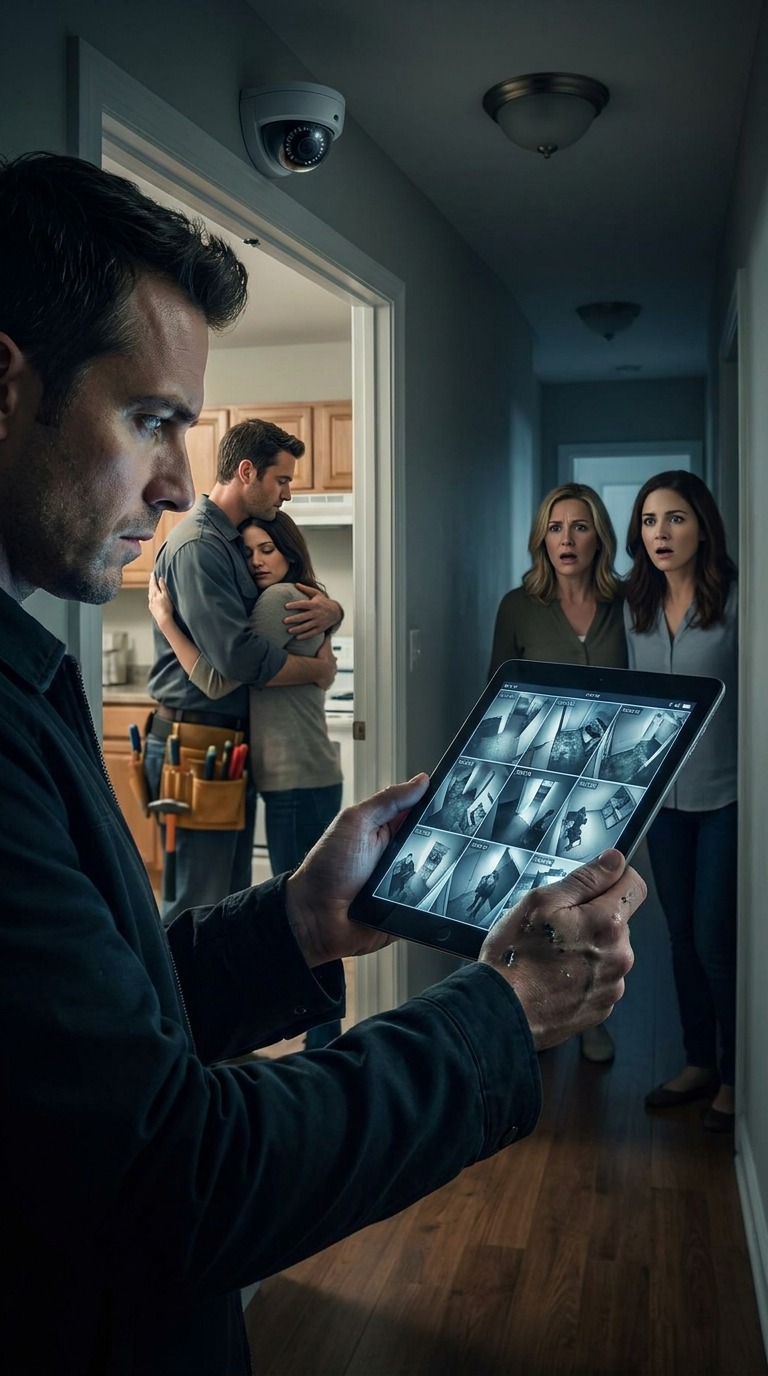
My wife, Jenny, stood beside him with her arms folded, watching him examine the leaning fence as if he were a surgeon assessing a patient.
“He says the whole left side is rotted,” she told me. “But he can reinforce it instead of replacing everything. That saves us money.”
Gary looked up and smiled. “No sense charging a man for a whole new fence if half the old one still has some life in it.”
That sentence sold me.
At the time, I was tired in the way men get tired when they do not know they are being slowly removed from their own home. I worked long hours as a project manager for a construction supply company. My days were made of schedules, invoices, phone calls, concrete estimates, late deliveries, and clients who always wanted something faster and cheaper.
So when Jenny found a handyman who was reliable, affordable, and apparently honest, I felt grateful.
“Hire him,” I said. “If he can fix the fence this week, that’s one less thing on my mind.”
Jenny looked pleased. Not just pleased with the practical victory, but lit from within, the way she used to look when we first bought the house and she spent weekends imagining where every lamp would go. I mistook that glow for pride in making our home better.
I did not yet understand that she had found more than a handyman.
Gary fixed the fence in two days.
Then came the kitchen drawer that never closed right. The basement shelves that sagged under old paint cans. The guest bathroom faucet that dripped at night. The back door that stuck whenever it rained. Every week, Jenny discovered another small wound in the house, and Gary arrived with his tools to heal it.
“He’s good,” she would say.
“He’s fast,” I would answer.
“He notices things.”
That was the first sentence I should have paid attention to.
At first, Gary came on Saturdays when I was home. He moved through the house with careful confidence, asking before placing his toolbox on the hardwood, wiping his boots on the mat even when it was dry outside. He called Jenny “ma’am” in a joking way that made her laugh, then called me “boss” even though I had never been his boss.
He remembered how I liked the garage organized. He remembered that Jenny hated the squeak in the laundry room door. He remembered which floorboards creaked in the hallway.
A man who remembers too much can feel useful before he feels dangerous.
One Saturday afternoon, I stood in the garage while he replaced a cracked window frame. Jenny came out with two cups of coffee and handed one to him before she handed one to me. It was such a small thing that my mind almost threw it away.
Almost.
“Careful,” she told Gary. “It’s hot.”
He looked at her over the rim of the cup. “You remembered no sugar.”
“I remember everything,” she said.
They both laughed.
I smiled because smiling is what husbands do when they do not want to look insecure in their own garage.
Jenny and I had been married for seven years. We were not unhappy, not in the dramatic way people imagine before everything burns down. There were no screaming fights, no broken plates, no nights where one of us slept in the car. We had simply become two people moving around each other with practiced politeness.
She worked part-time at a boutique design studio downtown and spent the rest of her time making our house look like something from a magazine. I paid most of the bills, handled the mortgage, planned our savings, and thought stability was proof of love.
Jenny wanted attention in the form of surprise. I gave it in the form of paid utilities and fixed insurance premiums.
That was not an excuse for what she did.
It was just the quiet crack she decided to widen.
As Gary became a regular presence, Jenny grew lighter around him. She wore jeans instead of sweatpants on days he was coming. She put on perfume before nine in the morning. She changed the kitchen curtains because, she said, the old ones made the room feel “dead.”
When I came home, she would be full of updates.
“Gary fixed the shelves in the basement.”
“Gary says the guest room has great potential.”
“Gary thinks the window trim is original and worth restoring.”
Gary says. Gary thinks. Gary noticed.
His name began to sit at our dinner table even when he wasn’t there.
One Thursday evening, I came home earlier than expected because a client canceled a late meeting. I remember the sky clearly. It was a pale gray, threatening rain but not delivering it. I pulled into the driveway and saw Gary’s white van parked near the curb.
Nothing unusual.
Still, my hand stayed on the steering wheel after I turned off the engine.
The house looked normal. The porch light had not come on yet. A package sat by the front door. Our maple tree shifted in the wind, scraping one branch against the gutter.
Then I heard laughter through the front window.
Jenny’s laugh.
Gary’s lower one following it.
I walked up the steps quietly. The front door was unlocked. When I stepped inside, I set my briefcase down without making a sound. Their voices came from the living room, low and easy, too intimate for a discussion about shelves.
I paused in the hallway.
“You’re terrible,” Jenny said, but she sounded delighted.
“I’m useful,” Gary replied. “There’s a difference.”
“You are impossible.”
“And yet you keep finding things for me to do.”
Something moved inside my chest.
I cleared my throat before entering the room.
Jenny jumped as if I had slapped the air. She was sitting on the couch, much closer to Gary than any conversation required. Gary was leaning back comfortably, one arm resting along the cushion behind her, a rag in his other hand like a prop in a play.
“Oh,” Jenny said. Her face flushed in patches. “Matthew. You’re home early.”
Gary stood first. Calm. Too calm. “Hey, boss. Just finishing up.”
“In the living room?” I asked.
He smiled and pointed toward the kitchen. “Shelves are done. Jenny was showing me some ideas for the guest room.”
Jenny nodded quickly. “Yes. The guest room. I told you I wanted to refresh it.”
I looked at the coffee table. Two mugs. A design magazine open between them. Jenny’s phone face down beside Gary’s knee.
Nothing was proof. Everything felt like evidence.
“Great,” I said. “Thanks for staying late.”
“No problem,” Gary said. “Anything for good clients.”
The word good landed strangely.
After he left, Jenny busied herself with the mugs, carrying them to the sink even though neither was empty. Her hands moved too quickly. She rinsed them, dried them, put them away, then looked at the counter as if searching for another task that would keep her from looking at me.
“You okay?” I asked.
“Of course.” She turned, smiling with effort. “Why wouldn’t I be?”
“You seemed startled.”
“You walked in quietly.”
“I live here.”
Her smile thinned.
For a moment, the old Jenny flickered in front of me, the woman who once danced barefoot in our kitchen while pasta boiled over, the woman who cried when we signed the closing papers because the house felt like a promise. Then the flicker vanished, and she became someone guarding a door I had not known existed.
“You’re being weird,” she said.
Maybe I was.
So I let the moment pass.
That is how betrayals grow. Not from one giant lie, but from a hundred small silences where you decide peace is easier than truth.
Two weeks later, Jenny announced we should remodel the guest room.
She did it over dinner, while I was cutting into a piece of chicken that had gone cold because I had answered three work emails at the table.
“We never use it,” I said.
“That’s the point,” she replied. “It’s wasted space.”
“It’s a guest room. It waits for guests.”
She smiled as if I had made a charming but foolish remark. “Matthew, it could be beautiful. New paint, new lighting, maybe built-in shelves. Gary says the bones are excellent.”
There it was again.
Gary says.
I set down my fork. “How much?”
“He thinks he can do it affordably.”
“How much, Jenny?”
Her eyes moved away. “We haven’t finalized everything.”
“We?”
She looked back at me. “Me and Gary. For the estimate.”
I wanted to object. I wanted to say I did not like how much time they were spending together. I wanted to ask why a handyman had become her design partner, why every repair required her presence, why she laughed at his jokes in a way she had stopped laughing at mine.
Instead, I rubbed my forehead and said, “Fine. Just keep it reasonable.”
She got up, walked behind my chair, and kissed the top of my head.
“Thank you,” she said softly.
For one second, I let myself believe I had been wrong.
Then the invoices began.
Paint more expensive than anything we had used in the rest of the house. Custom fixtures. Specialty wood. New hardware. Tools I did not remember authorizing. A deposit to Gary that seemed large for a simple room. Then another deposit. Then a third.
When I asked, Jenny had answers ready.
“Materials have gone up.”
“He found better lighting.”
“If we ever sell, it adds value.”
Gary had become the invisible authority behind every expense.
One afternoon at work, I opened our joint bank account while waiting for a supplier to call me back. I expected to see the usual pattern of bills, groceries, gas, maybe a few charges from Jenny’s studio suppliers.
Instead, the screen looked like a map of someone else’s life.
A jewelry store downtown.
A men’s clothing shop.
An electronics outlet.
A luxury boutique where Jenny had once said everything was overpriced.
I stared at the charges until the numbers blurred.
That evening, I asked her about them while she stood at the kitchen island slicing strawberries.
“What are these expenses?” I said, holding up my phone.
Her knife stopped.
“What expenses?”
“Jewelry. Electronics. Men’s clothing.”
She wiped her hands on a towel. “Oh. Gifts.”
“For who?”
“Friends. Family. Clients.”
“Since when do we buy clients watches and jackets?”
Her face changed so quickly I almost missed it. Fear, then calculation, then irritation.
“Why are you interrogating me?” she asked.
“I’m asking about money from our account.”
“I handle things too, Matthew. Not everything needs to go through you like I’m a child asking for allowance.”
That cut because she knew exactly where to place the knife. I had always been careful not to make her feel dependent, careful to call it our money even when most of it came from my paycheck. She weaponized that care in one sentence.
“I didn’t say that,” I said.
“You didn’t have to.”
She went back to slicing strawberries, but her hand trembled.
That night, I lay awake beside her while she slept facing away from me. Her phone was under her pillow. It had never been under her pillow before.
At 2:13 a.m., it buzzed once.
Jenny’s hand slid beneath the pillow, found it, and pulled it close.
She did not read the message.
She smiled.
That smile was the moment my doubt turned into dread.
The next day, I did something I had never imagined doing in my own marriage.
I went looking for the truth.
PART 2: The House Started Watching Back
I did not install cameras because I wanted to catch my wife. I installed them because I needed my own mind returned to me.
Suspicion is a cruel kind of prison. It makes every ordinary thing look guilty and every guilty thing look ordinary. Jenny humming in the laundry room became evidence. Jenny changing her blouse before Gary arrived became evidence. Gary’s van outside our house became a white rectangle of accusation.
I needed proof, even if proof destroyed me.
I bought small home security cameras designed for indoor monitoring. I did not put them in bathrooms. I did not put them where anyone undressed. I placed them in the living room, kitchen, hallway, and the guest room while it was under active renovation, the room Gary entered daily with tools and invoices and Jenny’s permission.
I told myself I was protecting the house.
The truth was harder.
I was protecting whatever was left of me from being lied to with a straight face.
That first night, after Jenny went to bed, I sat at the dining room table with my laptop open and a glass of water untouched beside it. The house was silent except for the hum of the refrigerator and the occasional settling creak in the walls. I watched the day’s footage with my heart beating in my throat.
Nothing.
Jenny made coffee. Gary measured the wall. They talked about paint colors. He carried lumber through the hall. She laughed at something he said, but laughter was not adultery. He touched her elbow when passing behind her, but kitchens were narrow. She handed him a towel. He thanked her.
By midnight, I felt ashamed.
I closed the laptop and looked toward the staircase. My wife was asleep upstairs, and I was downstairs playing detective in the house we had once filled with plans for children and holiday dinners. For a moment, guilt rose in me so sharply that I almost deleted everything.
Then her phone buzzed upstairs.
Once.
Then again.
The second night was worse because it gave me almost nothing, and nothing can be more maddening than proof.
Jenny spent most of the afternoon in the guest room while Gary worked. The audio caught fragments.
“You sure he won’t notice?”
“He notices numbers, not people.”
A pause. Gary laughed softly.
“That’s cold.”
“It’s true.”
I replayed that sentence five times.
He notices numbers, not people.
The words found every weak place in me. Was that how she saw me? A man with spreadsheets instead of feelings? A husband useful for payments and paperwork but too dull to desire?
I wanted to confront her then. I wanted to wake her, play the recording, demand she explain why my name had become a joke in my own house.
But the lawyer part of my mind, the part that handled contracts and difficult clients, whispered for patience.
If there was more, I needed all of it.
On the third day, Gary arrived at 10:04 a.m. Jenny opened the door before he knocked. She was wearing the blue sweater I bought her on our fifth anniversary, the one she said made her eyes look brighter.
They did not start in the guest room.
They stood in the kitchen, speaking quietly. Gary leaned against the counter like he belonged there. Jenny made coffee, but her movements were different from the polite hostess routine she performed when neighbors came over. She was nervous and excited, like a teenager expecting trouble.
“You transferred it?” Gary asked.
“Not all at once,” Jenny said. “I’m not stupid.”
“I didn’t say you were.”
“You implied it.”
“I implied your husband is careful.”
“He’s tired. There’s a difference.”
Gary looked toward the hallway. “And the room?”
“He approved it.”
“He approved the first estimate.”
Jenny smiled, and even through a screen, that smile hurt me. “Then you’ll just have to keep discovering problems.”
Gary reached for her hand.
She let him.
I sat frozen in the dark dining room, watching a recording of my wife calmly describing how to bleed money from our marriage.
The betrayal changed shape in that moment.
It was not only desire.
It was strategy.
Later that afternoon, the camera in the guest room caught them together. At first they were reviewing samples near the wall where new shelves were supposed to go. Then Gary said something too low for the microphone to catch, and Jenny stepped closer. His hand touched her waist. She did not move away.
They kissed.
Not a mistake. Not a moment. Not loneliness stumbling blindly into regret.
They kissed like people continuing something familiar.
I closed the laptop before the scene went further. My hands were cold, but my face burned. I stood so quickly the chair scraped against the floor, the sound ugly in the empty room.
For several minutes, I could not move.
The house around me seemed suddenly hostile. The table where we ate breakfast. The couch where we had watched movies. The hallway where I used to hang Jenny’s coat when she came home with cold hands. Every corner had become a witness.
Then I opened the laptop again.
Not because I wanted to watch.
Because I had heard something before I closed it.
I rewound the footage to the moment after the kiss. Their voices came through clearly.
Gary said, “When does he leave for Chicago?”
Jenny answered, “Monday morning. Three days.”
“And you’re sure?”
She laughed quietly. “Matthew sends me his whole schedule. He thinks it’s responsible.”
“What about the account?”
“I can move another five before then.”
“Five thousand?”
“Maybe seven.”
Gary whistled.
Jenny’s voice lowered. “After the divorce, I’ll have more. He won’t fight me. He hates scenes.”
My breath stopped.
After the divorce.
The affair had not been something she feared would end our marriage. It was something she was using to prepare for the ending.
Gary said, “You really think he’ll just hand over the house?”
“He won’t have a choice if we do this right.”
I replayed it once.
Only once.
Then I sent the video to a secure drive, copied the bank statements, saved screenshots of the invoices, and locked everything behind passwords Jenny would never guess because she had never cared about the parts of my life that did not flatter her.
The next morning, I sat at the kitchen table before sunrise.
Coffee cooled in front of me. My tie lay folded beside my plate because my hands had been too unsteady to knot it. Outside, a garbage truck groaned down the street, lifting bins with mechanical indifference.
Jenny came downstairs at 7:18.
She looked rested. Cheerful. Cruel in her normality.
“Morning,” she said, opening the cabinet for a mug.
“Sit down.”
She paused with her fingers on the cabinet handle. “What?”
“Sit down, Jenny.”
She turned slowly. Something in my voice reached whatever part of her still recognized danger. She sat across from me but kept one hand on the edge of the table, ready to rise.
I looked at her for a long moment.
This was the woman who had cried during our vows. The woman who once drove forty minutes in a snowstorm because I had the flu and wanted soup from a specific diner. The woman who used to press her cold feet against my legs in bed and laugh when I complained.
I had to remind myself she was also the woman who said I noticed numbers, not people.
“I know about you and Gary,” I said.
Her face emptied.
Not guilt first.
Calculation first.
That hurt more than the kiss.
“Matthew—”
“I saw the footage.”
Her lips parted. Her eyes flicked toward the hallway, then the ceiling, as if searching the house for the places where truth had hidden.
“You recorded me?”
“I recorded my house after thousands of dollars started disappearing and a man I hired kept showing up when I wasn’t home.”
“That’s illegal.”
“Interesting first concern.”
Color rose in her face. “You violated my privacy.”
“You violated our marriage.”
Silence fell hard between us.
Then she tried tears.
They came quickly, too quickly, filling her eyes before her voice even broke. “I didn’t mean for it to happen.”
I almost laughed, but there was no humor left in me.
“You planned transfers from our account.”
Her tears stopped.
I watched the performance fail in real time.
“That’s not what it sounded like,” she said.
“I have the recording.”
“You don’t understand the context.”
“Then give me the context.”
Her mouth opened.
Nothing came.
I leaned back, exhausted by the sight of her. “How long?”
She stared at the table.
“How long, Jenny?”
“A few months,” she whispered.
“A few months,” I repeated. “And the guest room?”
She flinched.
“Was any of that real? The remodel? The upgrades? The invoices?”
“It was going to improve the house.”
“It was going to fund him.”
Her eyes flashed. There she was. Not the crying wife. Not the frightened woman. The person underneath, angry that I had stopped being easy to manage.
“You were never here,” she said.
I nodded slowly. “There it is.”
“You worked late. You came home tired. You looked through me.”
“So you brought another man into our home?”
“I was lonely.”
“You were married.”
“I was invisible.”
“You were trusted.”
The words struck her. She looked away, jaw tight.
I stood because sitting across from her felt like sharing oxygen with a fire. “I’m speaking to a lawyer today. Do not move money. Do not delete messages. Do not let Gary back into this house.”
She looked up quickly. “You can’t ban him. He has tools here.”
“He can arrange pickup through my attorney.”
“Matthew, please.” Her voice softened again, but now I heard the machinery inside it. “Let’s not destroy everything in one morning.”
I looked around the kitchen. The strawberries from two nights before were still in a glass bowl in the refrigerator. The blue curtains Jenny had chosen moved slightly in the air from the vent. The mug she held had been a Christmas gift from my mother.
Everything ordinary remained in place.
Only the marriage had collapsed.
“You destroyed it slowly,” I said. “I’m just refusing to live inside the wreckage.”
I walked upstairs and packed a bag.
Jenny followed me to the bedroom door but did not come inside. Maybe she understood that crossing that threshold would require a kind of honesty she no longer possessed. She stood in the hallway, crying quietly while I folded shirts, gathered documents, removed my grandfather’s watch from the dresser.
When I opened the closet safe, her crying stopped.
“What are you doing?” she asked.
“Taking my personal records.”
“Why?”
I looked at her.
She understood before I answered.
Because I did not trust her anymore.
That was the first punishment she truly felt.
Not my anger. Not my words. Not even the divorce.
It was the moment she realized her face no longer opened doors in my life.
I left the house at 8:06 a.m. The sky was still gray. Gary’s van was not outside, but I could feel him everywhere, like smoke after a fire.
At the end of the driveway, my phone buzzed.
A message from an unknown number.
Think carefully before you make this ugly.
I stared at it.
Then a second message arrived.
You don’t know what Jenny told me about you.
The cliff I had been standing on widened beneath my feet.
Gary was not scared.
He was threatening me.
PART 3: The Handyman Had A Plan
I did not answer Gary’s message.
Men like him wanted heat. They wanted an angry reply, a threat, a typo-filled confession of rage they could later twist into fear. I had spent enough years managing subcontractors and angry clients to know when silence was more useful than volume.
I took a screenshot, saved it, and drove to my lawyer’s office.
Her name was Deborah Klein, and she looked like the kind of woman who had heard every version of betrayal and stopped being surprised by any of them. She had silver hair cut blunt at the chin, a navy suit, and eyes that sharpened when details mattered.
I sat across from her and told the story badly at first.
Betrayal does that. It takes a man who can lead meetings with twelve people arguing over numbers and reduces him to fragments.
Handyman. Wife. Money. Cameras. Guest room. Threats.
Deborah did not interrupt. She took notes on a yellow legal pad and waited until my voice steadied.
Then she said, “First, do not contact Gary directly again.”
“I wasn’t planning to.”
“Good. Second, we need to separate the emotional betrayal from the legal issues. Courts do not punish heartbreak the way people wish they did. But financial misuse, fraudulent invoices, threats, and dissipation of marital assets are different matters.”
I handed over printed bank statements, invoices, screenshots, and a flash drive with the recordings.
She did not smile, but something like approval moved across her face.
“You’re organized.”
“My wife said I notice numbers, not people.”
Deborah looked up. “Then let the numbers speak.”
That sentence became the first solid thing I held onto.
We went through everything slowly. The charges at jewelry stores. The deposits to Gary. The inflated materials. The repeated payments marked as “emergency repair” on days no repair had occurred. Deborah circled dates, drew lines between transactions, and asked questions that made the affair look less like romance and more like a scheme.
“Did Gary provide written estimates?”
“Sometimes.”
“Did Jenny sign them?”
“Yes.”
“Did you?”
“For the first one.”
“After that?”
“No.”
“Did any charges come from credit cards in your name?”
I hesitated.
Her eyes lifted. “Matthew?”
“There’s one card I didn’t recognize. It showed up as a payment from our joint account.”
She leaned back.
“Find out whose name is on it.”
By that afternoon, I knew.
The card was in Jenny’s name, but I was listed as an authorized user without my knowledge. The billing address was our house. The charges matched the boutiques, electronics, men’s clothing, and two hotel bars downtown.
When I sent Deborah the information, she replied with only six words.
This is no longer just infidelity.
That night, I did not go home. I rented a small apartment on the other side of town near the river. The building smelled like old wood and lemon cleaner. The unit had one bedroom, a narrow kitchen, and a living room with windows that looked over a parking lot.
It was not home.
But no one had lied to me there.
I slept on a rented mattress with no sheets the first night because I had forgotten to buy them. Around 3:00 a.m., I woke up reaching for Jenny out of habit. My hand touched cold empty space, and for a few seconds, grief rose so suddenly I could not breathe.
Anger is easier in daylight.
At night, betrayal becomes memory.
The next morning, Jenny called eleven times.
I did not answer.
Then she texted.
Please come home.
We can fix this.
Gary means nothing.
I was confused.
I still love you.
At noon, another message arrived.
If you loved me, you wouldn’t be punishing me like this.
There it was.
Even in apology, she wanted control.
I forwarded every message to Deborah.
On the third day, Jenny changed tactics. She sent a photo of our dining table set for dinner. Two plates. Candles. The lasagna recipe my mother taught her.
I stared at the image longer than I should have.
Then I noticed something in the background.
Gary’s tool belt on a chair.
My chest tightened, but not with surprise anymore. Surprise requires innocence. I had none left.
I saved the photo.
Deborah filed for divorce the following Monday.
The papers were served at our house at 10:30 a.m. I know because Jenny called me at 10:42, screaming so loudly I had to pull the phone away from my ear.
“You humiliated me!”
“No,” I said quietly. “You were served.”
“You sent a stranger to our door!”
“You brought one into our marriage.”
She went silent.
Then her voice changed, dropping into something cold. “You think you’re going to take everything?”
“I think I’m going to stop you from taking what isn’t yours.”
“This house is mine too.”
“Yes,” I said. “And the debt you created may be yours too.”
That frightened her. I heard it in the pause.
“What debt?”
“The card, Jenny.”
Her breathing changed.
I closed my eyes. “Did you think I wouldn’t find it?”
“You don’t know what you’re talking about.”
“Then explain it to the judge.”
She hung up.
Ten minutes later, Gary texted me again.
Big mistake.
This time, Deborah did not tell me to ignore it. She told me to file a police report for documentation.
So I did.
The officer at the desk was younger than I expected, with kind eyes and tired shoulders. He did not promise dramatic justice. He simply took the report, printed a copy, and told me to call if Gary escalated.
That copy became another piece of paper in a growing folder.
Evidence does not heal you.
But it gives your pain a spine.
A week later, Deborah’s investigator found the first surprise.
Gary Whitaker had not always been Gary Whitaker.
Three years earlier, he had operated under the business name Whitaker Home Solutions in another county. Before that, he had used G.W. Residential Repair. Both businesses had closed after complaints about unfinished work, inflated invoices, and disputes with homeowners.
No criminal conviction.
Just smoke.
Enough smoke to wonder where the fire had been hidden.
Deborah slid the report across her desk to me.
“Your wife found him online, correct?”
“Yes.”
“Did she say how?”
“An ad. Reviews.”
Deborah tapped the report. “Most of his positive reviews were posted within the same two-week period. Several use similar phrasing. We’re checking whether they’re real.”
I felt something heavy settle in my stomach. “You think he targeted her?”
“I think he recognized opportunity. Whether she was victim, accomplice, or both is what we need to determine.”
I wanted to say Jenny was not stupid enough to be used by Gary.
Then I remembered her smile in the kitchen.
Not all people who are used are innocent.
Sometimes greed simply meets better greed.
The temporary hearing took place three weeks later.
Jenny arrived wearing a cream coat I had bought her the winter before. Her hair was pinned softly, her face pale, her eyes red in a way that looked almost tasteful. She sat beside her attorney and never looked directly at me.
Gary was not there.
But his work was.
Deborah presented the spending records, the unauthorized card, the inflated invoices, the threatening messages, and the financial transfers. Jenny’s attorney argued that marital funds had been used for home improvements and personal purchases during a difficult period in the marriage.
Then Deborah played the audio.
Not the kiss.
Not anything intimate.
Only the kitchen conversation.
He notices numbers, not people.
After the divorce, I’ll have more.
He won’t fight me. He hates scenes.
I can move another five before then.
The courtroom changed temperature.
Jenny’s face collapsed, but she did not cry. She looked stunned that her private cruelty sounded so ugly when repeated under fluorescent lights.
The judge, a man with a calm face and no patience for theater, looked over his glasses.
“Mrs. Mercer, did you make those statements?”
Jenny’s attorney whispered to her.
Jenny swallowed. “I was emotional.”
“That was not my question.”
Her hands twisted in her lap.
“Yes,” she said.
The word was small.
But it opened the door.
The judge ordered temporary financial restraints. Neither of us could move significant funds without approval. Jenny was required to provide full records for the credit card and payments to Gary. Gary’s invoices were subpoenaed. The house could not be refinanced, sold, or encumbered.
For the first time since the truth surfaced, Jenny did not get to perform her way out.
When we left the courtroom, she waited near the hallway window.
“Matthew,” she said.
I stopped because part of me was still trained by marriage to respond when she used my name softly.
She stepped closer. “I know I hurt you.”
I looked at her hands. No wedding ring. She had removed it for court, maybe to look wounded instead of guilty.
“I made mistakes,” she continued. “But Gary manipulated me. He knew I was lonely. He pushed me. He made me feel seen.”
That word again.
Seen.
I wanted to tell her that I had seen her. I had seen her tired after work, seen her pretending not to worry about her mother’s health, seen her rearranging furniture at midnight because anxiety made her restless. I had seen so much that I had mistaken seeing for saving.
Instead, I said, “Did he force you to open the card?”
Her eyes filled.
“Did he force you to lie about the invoices?”
She looked down.
“Did he force you to laugh about how I wouldn’t fight?”
A tear slipped down her cheek.
“No,” she whispered.
I nodded. “Then stop handing him the parts of this that belong to you.”
She flinched like I had spoken louder than I did.
I walked away before pity could weaken me.
Outside the courthouse, the air smelled like rain on hot pavement. I stood under the stone steps and looked across the street at a café where Jenny and I used to have brunch after errands. For years, I had thought heartbreak would feel like a dramatic collapse.
It didn’t.
It felt like standing in a familiar city with every street name changed.
My phone buzzed.
A message from my neighbor, Mrs. Alvarez.
Matthew, I don’t want to get involved, but you need to know something. Gary was at your house last night. Jenny wasn’t alone.
Attached was a photo.
Gary’s van in my driveway.
And beside it, another car I recognized immediately.
My brother-in-law’s black SUV.
PART 4: The Family That Picked A Side Too Fast
Jenny’s brother, Paul, had never liked me.
He was the kind of man who called himself honest when he was only rude. At family dinners, he made jokes about my spreadsheets, my practical car, my habit of reading contracts before signing them. He thought caution was weakness because he had never had to pay the full price of his own confidence.
Paul sold commercial flooring and carried himself like a man one commission away from greatness. He wore expensive watches he could not afford and talked about “big moves” with the desperation of someone standing still.
When I saw his SUV in Mrs. Alvarez’s photo, something clicked into place that I did not want to understand.
I called Deborah.
She listened, then said, “Did Paul know Gary before your wife hired him?”
“I don’t know.”
“Find out.”
The answer came two days later through a detail so small it almost hid itself.
One of Gary’s old business complaints mentioned a supplier dispute with a flooring company. The contact listed on the complaint was Paul Reynolds.
Jenny’s brother had known Gary before Gary ever stepped into my backyard.
I sat in Deborah’s office, staring at the document.
“Paul recommended him,” I said.
“Possibly.”
“Jenny told me she found him online.”
“Maybe she did. Maybe Paul sent her the ad.”
Deborah turned another page. “There’s more.”
I already hated that phrase.
She showed me copies of payments from Gary’s account to a company registered under Paul’s name. Consulting fees. Referral fees. Material coordination. Vague language wearing a suit.
The amounts were not enormous, but they were steady.
Gary had been paying Paul.
Or Paul had been taking a cut.
The betrayal widened beyond my marriage and entered the family table where I had carved turkey, held babies, listened to Jenny’s mother tell stories about her childhood. I thought of all the times Paul had clapped Gary on the shoulder at the house when he stopped by unexpectedly.
“Good guy,” Paul had said once. “Hard worker. Men like that are rare now.”
I wondered how long he had been laughing at me.
That Sunday, Jenny’s mother called.
Her name was Elaine, and I had loved her like family because, for seven years, she had treated me like a son. She remembered my birthday. She sent soup when I was sick. She asked about my work and listened to the answer.
When I saw her name on my phone, I almost did not answer.
But I did.
“Matthew,” she said. Her voice trembled. “Can you come by? Please.”
I closed my eyes.
“Elaine, I don’t think that’s a good idea.”
“I’m not calling to defend her.”
That stopped me.
Her breath shook. “I need to show you something.”
I met her at a diner halfway between my apartment and her condo. It was nearly empty, the lunch rush over, sunlight lying flat across the vinyl booths. Elaine sat in the back with a manila envelope on the table and both hands wrapped around a cup of tea.
She looked older than she had a month ago.
“I’m ashamed,” she said when I sat down.
“You didn’t do this.”
“No. But I raised children who thought they could.”
I said nothing because there was nothing safe to say.
She pushed the envelope toward me. “Paul asked me for money last year. Said he had a business opportunity. I said no. Then Jenny asked. Said you were too controlling with finances and she needed something of her own.”
My stomach tightened.
“I gave her eight thousand dollars,” Elaine whispered. “She told me it was for design certification classes.”
I opened the envelope.
Inside were printed emails between Jenny and Paul. Not all of them, but enough.
Gary can get the work approved if Matthew signs off on the first part.
Don’t push too hard too fast. He checks accounts.
Mom might help if Jenny frames it right.
The guest room is the cleanest way. Materials are impossible for him to price exactly.
I read the lines twice, each time feeling less like a husband and more like the last person invited into the truth.
Elaine’s eyes shone with tears. “I found them on my old laptop. Jenny used my email once and must have stayed logged in. I didn’t know what they meant at the time.”
I placed the papers back in the envelope carefully.
“Why give them to me?”
“Because Jenny called me last night and said if I loved her, I would say you were financially abusive.”
The diner noise faded.
“She asked you to lie?”
Elaine nodded. Tears spilled down her face, but she wiped them quickly, angry at them. “My daughter broke her marriage. I will not let her break my character too.”
That sentence stayed with me.
Elaine agreed to provide a statement. Deborah called it significant. I called it devastating.
The next hearing was no longer just about an affair. It became about coordinated financial deception. Paul was pulled in through subpoenas. Gary was ordered to produce records. Jenny’s attorney looked increasingly less confident every time Deborah opened another folder.
And Jenny changed.
The soft victim mask disappeared.
She stopped texting apologies and started sending accusations.
You’re trying to ruin my family.
You always hated Paul.
You turned my mother against me.
You care more about winning than about what we had.
That last message came at midnight.
I stared at it in the dim light of my apartment.
What we had.
It is strange how people burn a house down and then accuse you of disrespecting the ashes.
One afternoon, I returned to the marital house with a court-approved arrangement to collect more belongings. Deborah had insisted on a neutral third party present, so Mrs. Alvarez stood on the porch pretending not to be watching while absolutely watching everything.
The house smelled different.
Jenny had changed the candles. The living room was messier than I had ever seen it. Paint samples lay scattered on the floor. Half-installed shelves leaned against the guest room wall. Gary’s tools were gone, but the marks remained—dust outlines, scratches, holes waiting to be filled.
I moved through the rooms like a visitor at a museum of my own mistakes.
In the bedroom, my side of the closet was empty except for one shoebox on the top shelf. I almost ignored it. Then I saw my name written on the lid in Jenny’s handwriting.
Inside were old cards.
Birthday cards. Anniversary notes. A photo from our honeymoon in Maine, Jenny laughing with her hair whipped across her face by ocean wind. Beneath them was a folded piece of paper I did not recognize.
It was not old.
It was a list.
House equity estimate.
Temporary support angle.
Claim emotional neglect.
Push for settlement before discovery.
If Matthew fights, threaten reputation.
At the bottom, in Paul’s handwriting, were three words.
Make him ashamed.
I sat on the edge of the bed with the paper in my hands.
For months, Jenny had not only betrayed me.
She had studied me.
She knew I hated public conflict. She knew I protected privacy. She knew I would rather lose money than be dragged through humiliation.
She had planned to use my dignity as a leash.
Mrs. Alvarez called from downstairs. “Matthew? You all right?”
I folded the paper and put it in my pocket.
“No,” I said quietly. “But I’m done being quiet.”
That evening, Deborah filed an amended motion.
The next morning, Paul called me for the first time since the divorce began.
“You pathetic little man,” he said when I answered.
I almost smiled.
People become honest when their plan stops working.
“Hello, Paul.”
“You’re going after my business now?”
“I’m going after the truth.”
“You’re going to regret this.”
“You should talk to a lawyer before you keep threatening me.”
He laughed, but it cracked at the edge. “Jenny was miserable with you. Everybody knew it. You think paperwork makes you a man?”
“No,” I said. “But it seems to frighten men pretending to be one.”
He hung up.
Two minutes later, Deborah received the recording.
By the end of that week, Paul’s attorney contacted Deborah asking whether we would consider settlement discussions.
That was how I knew they were scared.
Not sorry.
Scared.
There is a difference, and divorce teaches it brutally.
PART 5: The Room They Built Against Me
The deposition took place in a conference room with no windows.
That felt appropriate.
Jenny sat at one end of the long table beside her attorney. Paul sat separately with his own lawyer. Gary arrived last, wearing a clean button-down shirt and work boots polished so hard they looked unnatural. He nodded at no one and sat like a man who believed charm could survive fluorescent lighting.
It could not.
The court reporter swore everyone in. Deborah arranged her documents with surgical calm. I sat behind her, close enough to see Jenny’s hands tremble whenever Gary spoke.
That surprised me.
I had expected them to present a united front.
Instead, they avoided each other’s eyes.
Deborah began with Gary.
“Mr. Whitaker, when did you first meet Mrs. Mercer?”
“Through a job.”
“Who referred you?”
“Online inquiry.”
“Did Paul Reynolds refer you?”
Gary shifted. “He might’ve mentioned I did good work.”
“Did you pay him referral fees?”
His lawyer leaned in.
Gary’s jaw tightened. “For legitimate business consulting.”
Deborah slid a document forward. “Is this your signature authorizing twelve payments to Paul Reynolds over five months?”
Gary looked at the paper.
“Yes.”
“Were those payments connected to work performed at the Mercer residence?”
“I don’t recall.”
Deborah’s voice stayed even. “You don’t recall paying the brother of your client’s wife while receiving repeated deposits from that client’s joint marital account?”
Gary’s smile vanished.
Jenny looked down.
Paul muttered something his attorney quickly silenced.
For two hours, Deborah walked Gary through invoices. Materials billed but never delivered. Labor hours that overlapped with other jobs. Emergency charges on days he had not been at the house. Receipts from stores that did not sell the items listed on his invoice.
The room became smaller with every question.
Then Deborah asked about the men’s clothing purchases.
Gary denied receiving anything.
Deborah opened another folder.
“Is this you wearing the jacket purchased on March 14th from Ellery & Co.?”
A photo slid across the table. Gary in Jenny’s Instagram story background, half visible at an outdoor bar, wearing the jacket.
Jenny closed her eyes.
Gary said, “Could be similar.”
Deborah placed the receipt beside the photo. “Same brand. Same size. Same day your phone records place you near that store with Mrs. Mercer.”
Gary’s attorney requested a break.
No one moved for several seconds.
During the break, Jenny approached me in the hallway. Her face was pale, stripped of the careful softness she had worn in court. For the first time, she looked less like an enemy and more like someone waking up in a room she had helped lock.
“Matthew,” she said.
I turned.
“I didn’t know about all the invoices.”
I let the sentence sit between us.
She wrapped her arms around herself. “Not all of them.”
“That’s your defense now?”
“I know how it sounds.”
“How does it sound?”
Her eyes filled. “Like I’m trying to save myself.”
“Are you?”
She looked through the glass wall of the conference room at Gary, who was speaking sharply to his lawyer.
“I thought he loved me,” she whispered.
The old version of me would have softened. He would have seen her pain and mistaken it for innocence. He would have stepped closer, lowered his voice, maybe even touched her shoulder because the habit of comforting her was written into his body.
But that man had paid for a guest room that became a trap.
“Maybe he did,” I said. “In the way men like him love unlocked doors.”
She flinched.
“Did you love me?” she asked.
That question came so unexpectedly I almost answered from memory.
Then I saw the trap inside it. If I said yes, she would ask how I could do this to her. If I said no, she would rewrite our marriage as cold from the beginning.
So I told the truth she could not use.
“I loved the woman I thought you were.”
Her mouth trembled.
The court reporter called us back in.
Jenny’s deposition came after lunch.
She admitted the affair. She admitted using marital funds for purchases connected to Gary. She denied planning to defraud me. She claimed Paul pressured her. She claimed Gary manipulated her emotionally. She claimed loneliness made her vulnerable.
Deborah did not attack the loneliness.
She attacked the timeline.
“When did you first become romantically involved with Mr. Whitaker?”
Jenny swallowed. “Late February.”
Deborah placed an email on the table. “Then why did you write to your brother on January 18th, ‘Gary thinks Matthew will approve the first estimate if I keep it under four thousand’?”
Jenny stared at the email.
“I don’t remember.”
“Did you write it?”
“I don’t remember.”
Deborah placed another document down. “Did you write, ‘Once the guest room starts, it will be easier to justify extras’?”
Jenny’s breathing turned shallow.
“I was talking about design choices.”
“Were you also talking about design choices when you wrote, ‘Matthew hates scenes, so if he catches anything, cry first’?”
The room went silent.
Even Gary looked at her.
I felt the sentence enter me like cold water.
Cry first.
Not I hope he doesn’t find out.
Not I feel guilty.
Cry first.
A tactic. A rehearsed response. A weapon shaped like grief.
Jenny’s attorney objected to tone, but the damage was done.
Jenny sat very still.
For a moment, I saw the exact second she understood that she had not merely lost my trust. She had lost the story of herself as a good person who made a mistake.
That loss terrified her more than losing me.
The deposition ended late. Outside, the sky had gone dark, and rain streaked the parking lot in silver lines. I stood under the overhang while Deborah packed her briefcase.
“You did well today,” she said.
“I didn’t do much.”
“You didn’t react. That matters.”
I looked through the rain at Jenny standing near Paul’s SUV. Gary was nowhere near her now. Paul was yelling, one finger pointed close to her face. She did not yell back. She looked small under the parking lot lights, but I reminded myself that small was not the same as harmless.
“What happens next?” I asked.
Deborah followed my gaze. “They settle, or this gets uglier.”
“Can it get uglier?”
She gave me a look that answered before she spoke.
“Always.”
Three nights later, the uglier arrived.
I was leaving work when my phone rang from an unknown number. I almost ignored it, but something made me answer.
A woman’s voice said, “Is this Matthew Mercer?”
“Yes.”
“My name is Dana Whitaker. I’m Gary’s ex-wife.”
I stopped walking.
Across the parking lot, the security lights flickered on.
“I heard what he did,” she said. “And if you’re willing to listen, I can tell you how he does it.”
PART 6: The Other Woman Who Survived Him
Dana Whitaker met me and Deborah at a library conference room two days later.
She was not what I expected. I had imagined someone bitter, dramatic, eager for revenge. Instead, Dana arrived in a gray coat, carrying a folder and a cup of tea, with the composed exhaustion of a woman who had spent years learning how not to shake.
She had been married to Gary for nine years.
“He’s not charming at home,” she said. “Charm is work clothes for him. He puts it on when there’s something to get.”
Deborah asked if we could record the conversation. Dana agreed.
Gary, she explained, had a pattern. He found households where one person felt ignored or underestimated. Sometimes it was a lonely wife. Sometimes an elderly widower. Sometimes a couple with enough money to remodel but not enough time to supervise. He became useful first. Then indispensable. Then intimate in whatever way the situation allowed.
“He listens like a priest,” Dana said. “Then he spends like a thief.”
She opened her folder.
Inside were copies of complaints, old invoices, text messages, and photos of unfinished projects. None of them alone had been enough to ruin him. Together, they formed a portrait.
A porch paid for and abandoned.
A kitchen remodel that doubled in cost after “hidden damage” appeared.
A widow who bought Gary a truck because he said his old one was unsafe.
A woman who left her husband and later discovered Gary had been seeing someone else the entire time.
Jenny was not his first.
She was just the one who had helped him aim at me.
Dana looked at me across the table. Her expression softened, but not with pity. With recognition.
“You’re probably wondering how much was him and how much was her.”
I said nothing.
She nodded. “That question will eat you if you let it.”
Deborah leaned back, letting the silence work.
Dana continued. “Gary manipulates. But he can’t create what isn’t there. He needs greed, loneliness, resentment, vanity—something already cracked. He finds the crack and calls it a door.”
I looked down at my hands.
Jenny had been cracked.
But she had opened the door.
Dana agreed to provide an affidavit regarding Gary’s pattern, though Deborah warned me it might not all be admissible. Still, it mattered. It pushed Gary’s attorney toward panic. It pushed Paul toward self-protection. It pushed Jenny toward desperation.
And desperation makes people careless.
The next week, Jenny came to my apartment.
I do not know how she found the address. Maybe Paul. Maybe old account records. Maybe she followed me. I only know that when I opened the door after a soft knock, she stood in the hallway wearing a raincoat, her hair damp, mascara smudged beneath one eye.
For one dangerous second, she looked like my wife again.
Not the woman in court. Not the woman in the footage. My wife.
“Please,” she said. “I didn’t know where else to go.”
I kept the chain lock on.
“What happened?”
She looked over her shoulder as if someone might appear. “Gary is threatening me.”
The hallway smelled of wet wool and old carpet. Somewhere downstairs, a dog barked twice.
“What kind of threat?”
“He said if I turn on him, he’ll release messages. Photos. He said he’ll make sure everyone knows I chased him.”
“Did you?”
Her face twisted. “Why are you asking me that?”
“Because truth matters now.”
She gripped the strap of her purse. “I was stupid. I was angry at you. Paul said you’d never let me have anything of my own. Gary said I deserved to feel wanted. It all happened so fast.”
“No,” I said. “It happened in emails, invoices, transfers, lies, and planning. That’s not fast. That’s a calendar.”
She began to cry, but this time the tears did not look performed. They looked inconvenient. She wiped them angrily.
“I know you hate me.”
“I don’t hate you.”
That seemed to hurt her more.
“I need help,” she whispered.
“Call your lawyer.”
“I can’t trust him. Paul picked him.”
That was new.
I studied her through the gap in the door. “Paul picked your attorney?”
She looked down.
“Jenny.”
“Yes.”
The hallway seemed to tilt.
“Why would you let Paul pick your divorce attorney?”
“Because he said he knew someone who could protect me.”
“Protect you or protect him?”
Her silence answered.
For the first time, I saw the hierarchy of the scheme clearly. Gary wanted money. Paul wanted a cut and perhaps leverage. Jenny wanted attention, control, and a softer exit from a marriage she no longer valued. But when the plan failed, the men began protecting themselves, and Jenny became useful only if she kept lying.
She had helped build the trap.
Now she was inside it.
I did not open the door.
But I did something the old me needed to do in order to become the new me cleanly.
I gave her one piece of mercy without giving her access.
“Tell your lawyer everything. If you can’t trust him, get a new one. Tell Deborah’s office if Gary threatens you directly. But do not come here again.”
She looked up. “That’s it?”
“That’s more than you gave me.”
Her lips parted, but no words came out.
Then she nodded once and walked away.
I closed the door and leaned against it until her footsteps disappeared down the stairs.
The next morning, Jenny changed attorneys.
Three days later, through her new counsel, she offered cooperation.
Deborah called me into her office to discuss it. “She’s willing to provide records implicating Paul and Gary in exchange for a settlement that avoids trial.”
I sat with that.
Part of me wanted trial. Not for justice, if I’m honest. For exposure. I wanted every word read aloud. Every lie held under light. Every person who thought I would fold forced to watch me stand.
Deborah seemed to know.
“Matthew,” she said, “there is winning, and there is staying tied to people who hurt you so you can keep proving they hurt you.”
I looked at the folder on her desk.
“What does the settlement include?”
She listed it cleanly. Reimbursement for misused funds from Jenny’s share. Responsibility for the unauthorized credit card debt assigned to Jenny. Sale of the house with credits to me for documented losses. No spousal support. Mutual non-disparagement, except truthful cooperation in legal proceedings involving Gary or Paul. Gary’s fraudulent invoices referred to civil action. Paul’s referral payments disclosed.
“And the affair?” I asked.
Deborah’s face softened slightly. “The affair got you here. The financial proof protects you here.”
That night, I drove past the house.
I had not meant to stop.
But I did.
The porch light was on. The maple tree moved in the wind. Through the front window, I could see the living room lamp glowing beside the couch where Jenny and Gary had laughed the day I came home early.
The house looked innocent.
That almost broke me.
A house does not betray you. People do. But people leave their ghosts in drywall, in staircases, in coffee cups, in rooms painted the wrong color.
The guest room window was dark.
I wondered what would happen to it after the sale. Some other couple might use it for a nursery. A home office. A place for visiting parents. They would never know that for a while, that room held the exact point where one life ended and another began.
My phone buzzed.
A message from Jenny.
I told them everything.
Then another.
I’m sorry I waited until I was scared to become honest.
I read the sentence twice.
For the first time, an apology from her sounded true.
It also came too late to matter.
The next morning, Gary disappeared.
PART 7: When The Charming Man Ran Out Of Doors
Gary did not vanish dramatically.
He did not flee the state in the middle of the night with cash under his mattress like a criminal in a movie. He simply stopped answering calls. His van disappeared from his rented driveway. His business website went offline. His social media accounts turned private, then blank.
For three days, his lawyer claimed he was “unavailable due to personal matters.”
On the fourth day, Dana Whitaker called Deborah.
Gary had done this before.
“He’ll look for the next soft place to land,” she said.
But this time, the ground beneath him had changed.
Deborah filed the civil claim with enough documentation to make hiding expensive. Two homeowners from Dana’s folder came forward after hearing Gary’s name through local contractor circles. Mrs. Alvarez, who knew every neighbor within three streets and half the truth before anyone admitted it, made sure people understood that Gary Whitaker was not a misunderstood handyman caught in romance.
He was a man who had used work boots as a costume.
His business dried up first.
Then Paul’s flooring company began receiving calls from clients who had seen his name tied to Gary’s referral payments. Paul tried to explain. Then he tried to threaten. Then he tried silence.
Silence did not suit him.
At a family mediation session related to Jenny’s settlement, Paul exploded.
“This is all because she couldn’t keep her mouth shut,” he snapped, pointing at Jenny.
Jenny sat across the table, thinner than before, her face bare of makeup, her hands folded tightly.
Elaine was there as a witness. She looked at her son with a grief sharper than anger.
“No,” Elaine said quietly. “This is because none of you could.”
Paul turned on her. “Mom, stay out of it.”
Elaine lifted her chin. “You brought me into it when you asked your sister to use me.”
The room went still.
Paul looked away first.
There are moments when families do not break loudly. They break in a shift of eyes, in one person finally refusing to keep the lie warm.
Jenny signed the settlement two weeks later.
We met in Deborah’s office, not because we had to, but because some documents required final signatures in sequence. Jenny arrived early. I arrived on time.
She wore a simple black dress and no jewelry. Her hair was pulled back. She looked less beautiful than she used to, and more real. That did not make me want her back. It only made me mourn the fact that reality had arrived after destruction instead of before it.
We signed page after page.
House sale agreement.
Debt allocation.
Asset division.
Acknowledgment of reimbursement.
No spousal support.
When it was done, Deborah left the room to make copies.
Jenny and I sat alone at opposite sides of the table.
For seven years, silence between us had meant comfort, fatigue, resentment, routine, peace, distance, and sometimes love.
Now it meant ending.
“I don’t expect forgiveness,” she said.
I looked at the pen in my hand. “Good.”
She nodded as if she deserved that.
“I did love you,” she said.
I almost told her not to.
But she continued.
“I loved you in the beginning. I think I hated how safe you made things because safety started feeling like proof I had disappeared. That’s not your fault. I should have said something before I turned it into permission to betray you.”
Her voice did not shake. That made it easier to hear.
“Gary made me feel reckless,” she said. “Paul made me feel justified. But I chose every step.”
I looked at her then.
That was the first fully honest sentence she had given me.
“What will you do now?” I asked.
She gave a small, broken smile. “Pay debts. Find work. Lose people. Deserve it.”
I did not comfort her.
But I did not enjoy her ruin either.
That surprised me.
For months, I had imagined revenge as a clean fire that would warm me after everything went cold. But sitting across from Jenny, watching consequence settle on her shoulders, I understood that revenge is only satisfying from far away. Up close, it looks like wreckage spread across too many lives.
Deborah returned with copies.
Jenny gathered hers and stood.
At the door, she turned back. “Matthew?”
I waited.
“Thank you for not using the worst footage.”
I knew what she meant.
I had never shown anything intimate. Not to family. Not to court beyond what was legally relevant. Not to anyone. I had used words, records, money, threats, documents, the parts of truth that mattered without turning pain into spectacle.
For a moment, she seemed to understand the difference between being exposed and being destroyed.
“You did enough to yourself,” I said.
She accepted that with a nod and left.
The house sold in early autumn.
A young couple bought it. The wife was pregnant, the husband nervous in a sweet way that made him measure doorframes twice and ask about the age of the furnace. At closing, they talked about turning the guest room into a nursery.
I signed the papers with a strange calm.
That room would become something innocent after all.
After the sale, I drove to the house one last time. The new owners had not moved in yet, and with permission from the realtor, I walked through alone.
Empty rooms echo differently when they no longer belong to you.
The living room looked larger without furniture. The kitchen counters were bare. The bedroom smelled faintly of cleaning solution and open windows. In the guest room, sunlight fell across the floor in a clean rectangle.
The shelves Gary had started were gone. The wall had been repaired. Fresh primer covered every bad decision.
I stood there for a long time.
Then I noticed something near the baseboard.
A small pencil mark, half hidden where the old trim met the wall. I knelt and saw my own handwriting from years ago, when Jenny and I first painted the room and measured where a bookshelf might go someday.
M + J. First house. Don’t forget how lucky we are.
I touched the wall once.
Then I stood and walked out.
Not because it didn’t hurt.
Because it did.
And pain deserved an exit too.
PART 8: The Life After The Lie
For a while, my new apartment remained temporary in every visible way.
One chair. One table. A mattress on a frame I assembled badly and fixed later. Dishes bought in a set of four because buying eight felt like admitting I expected guests. A coffee maker that sputtered like an old lawn mower.
But slowly, almost without permission, life entered.
I bought curtains.
Then bookshelves.
Then a decent lamp for the living room because the overhead light made every evening feel like an interrogation.
On Sundays, I walked by the river. At first, I did it because staying still made me think too much. Later, I did it because the air near the water made my chest feel less crowded. I learned which café opened earliest and which bench caught sunlight after rain.
People told me I looked better.
I did not feel better all at once.
Healing is not a door you walk through. It is a room you build while still sleeping in the ruins.
Deborah called in November to tell me Gary had resurfaced two counties away under a slightly altered business name. This time, however, the civil filings followed him. So did the complaints. So did Dana’s affidavit. So did the search results that appeared whenever someone looked him up.
“He can still work,” Deborah said. “But he won’t find it as easy to hide.”
That was enough.
Paul’s business suffered more publicly. A local contractor association suspended him pending review. Several clients canceled bids. Elaine stopped speaking to him for months, not out of cruelty, but because she said forgiveness without accountability was just another form of lying.
Jenny found full-time work at a small design office.
I knew this because Elaine wrote me once.
She did not write often. She respected the boundary divorce had drawn. But around Christmas, she sent a card to my office because she did not know whether my apartment address should be used.
Inside, she wrote:
I will always be sorry for what my family did to you. You were my son in all the ways that mattered, and I failed to see what was happening under my own roof. I hope the next chapter of your life is quieter, kinder, and yours.
I kept the card.
Not because I wanted to stay tied to Jenny’s family.
Because not every piece of the past deserved to be burned.
In January, nearly a year after Gary first fixed the fence, I saw Jenny again.
It happened at a grocery store on a bitter Saturday morning. I was standing near the apples, trying to decide whether I was the kind of man who bought organic fruit now, when I heard someone say my name.
I turned.
Jenny stood at the end of the aisle holding a small basket. She looked startled, like she had spoken before deciding whether she should. Her coat was plain. Her hair was shorter. There were shadows under her eyes, but she seemed steady.
“Hi,” she said.
“Hi.”
For a moment, we were two strangers carrying groceries in the same weather.
Then she said, “I heard you moved near the river.”
“I did.”
“That sounds peaceful.”
“Sometimes.”
She nodded.
I saw her look at my left hand. No ring, of course. Then she looked away quickly, ashamed of the habit.
“I won’t keep you,” she said.
I surprised myself by asking, “Are you all right?”
Her eyes lifted.
Not hopeful. Not manipulative. Just human.
“I’m getting there,” she said. “Gary tried to contact me last month.”
My body tensed.
“What did he want?”
“Money. Sympathy. A door back in.” Her mouth tightened. “I didn’t answer.”
“Good.”
She smiled faintly. “You taught me documentation. I sent it to my lawyer.”
Despite everything, I almost laughed.
“That’s something.”
“It is.” She adjusted her grip on the basket. “For what it’s worth, I’m sorry every day. Not in a way that asks anything from you. Just… every day.”
I accepted the words with a nod.
There was nothing left to punish.
There was nothing left to restore.
We had become what some broken marriages become when the fire finally goes out: two people standing in the ash, careful not to step on what still might be hot.
“I hope you keep getting there,” I said.
She blinked hard.
“Thank you.”
Then she walked away.
I watched her turn the corner near the bakery and disappear behind a display of bread. My hands were steady. My chest hurt, but it did not split open. That felt like progress.
In spring, I accepted a promotion I would have turned down before because it required less travel but more leadership. Jenny had once said I hid inside work. Maybe she was partly right. So I learned to work differently. I went home on time. I answered fewer emails after dinner. I let quiet be quiet instead of proof that something was missing.
One Friday evening, my colleague Nora invited a group of us to a small backyard barbecue.
I almost said no.
Then I said yes.
Nora was not dramatic. She did not sweep into my life like salvation wearing a red dress. She was a civil engineer with a dry sense of humor, a laugh she tried to hide, and the habit of listening fully before she answered. We talked that night about bridge inspections, bad coffee, and why people buy patio furniture that cannot survive rain.
Nothing happened.
That was why it mattered.
Later, over months, we became friends. Then something gentler than urgency began to grow. She knew I was divorced, but she did not ask for details like gossip. When I told her, eventually, she listened without turning my pain into entertainment.
“That must have made your own home feel unsafe,” she said.
No one had said it that plainly before.
“Yes,” I answered.
She nodded. “Then we go slow.”
We.
The word did not frighten me as much as I expected.
A year and a half after the divorce, I bought a small house near the river.
Not big. Not impressive. Not the kind of house Jenny would have filled with expensive fixtures and mood boards. It had old floors, a stubborn back door, and a fence that leaned slightly after storms.
The first time the fence needed repair, I fixed it myself.
Badly at first.
Then better.
Nora came over one Saturday and found me in the backyard with dirt on my jeans and three boards cut wrong.
“You know,” she said, leaning against the porch railing, “there are professionals for this.”
I looked at the crooked fence panel.
“I’ve had complicated experiences with professionals.”
She smiled, but not too much.
Then she picked up a level and walked over. “Move aside.”
We worked until sunset. The fence did not come out perfect. One post leaned just enough that I noticed and Nora pretended not to. But it stood.
That night, after she left, I sat on the back steps with a beer in my hand and looked at the repaired fence.
For the first time in a long time, fixing something did not feel like denial.
It felt like proof.
Proof that not every broken thing becomes a trap.
Proof that a home can survive what happened in another home.
Proof that trust, once shattered, does not return as innocence. It returns as choice.
A few weeks later, a letter arrived from Deborah’s office with final updates. Gary had settled several civil claims. Paul had filed for bankruptcy restructuring after losing contracts. Jenny had completed the debt repayment schedule earlier than required.
There was no dramatic final punishment.
No prison bars. No screaming public scene. No lightning strike of justice.
Just consequences.
Real consequences are often quieter than people want them to be. They arrive as signed agreements, closed businesses, lost trust, smaller apartments, family dinners with empty chairs, and mornings where people wake up beside the life they chose.
I folded the letter and placed it in a file box.
Then I closed the lid.
That evening, Nora came over for dinner. I cooked pasta. The sauce was slightly too salty. She ate it anyway and told me honestly that it was “almost good,” which made me laugh harder than it should have.
After dinner, we sat on the porch while the sky turned violet.
She looked at the fence. “Still standing.”
“So am I,” I said.
I did not mean to say it aloud.
Nora turned toward me, her face soft in the porch light.
“Yes,” she said. “You are.”
The words settled without drama.
No swelling music. No perfect ending. No promise that nothing would ever hurt again.
Just a porch. A repaired fence. A woman who did not rush me. A life that belonged to me.
And somewhere behind me, far away now, there was another house with a guest room full of new light, maybe painted pale yellow for a baby, maybe holding a crib, maybe echoing with a future untouched by what had happened there before.
I used to think betrayal took everything.
It didn’t.
It took the lie.
The truth took longer, cost more, and hurt worse than I thought I could survive.
But in the end, the truth gave me back the one thing Jenny, Gary, and Paul had all counted on me surrendering.
My own name.
My own voice.
My own life.
And this time, when something in my house needed fixing, I did not call a stranger to do it.