
That was the first ordinary thought my mind gave me while my mother stood on a ballroom stage and sold my life to a room full of strangers. Cold steel. Tight ratchet. Three sharp clicks around the wrists that had signed supply audits, carried wounded men, and wired money home every month because my father could no longer protect himself.
My mother, Christine Franco, lifted her champagne glass like she was making a toast at a wedding instead of burying her daughter in public. Cameras flashed against the diamonds at her throat. Beside the bar, my sister Victoria watched with the expression she used when a card went through at a boutique. Relief. Hunger. Victory.
“I reported her,” my mother said into the microphone. “For America, I could not shield a traitor, even if she is my own blood.”
The applause came fast. It rolled over me from every table, from defense executives, donors, political wives, and people who had never worn a uniform but loved judging one from a safe distance. I felt the FBI agent’s hand on my chain. I heard someone whisper, “That’s the daughter.” I smelled champagne, perfume, polished wood, and fear wearing expensive clothing.
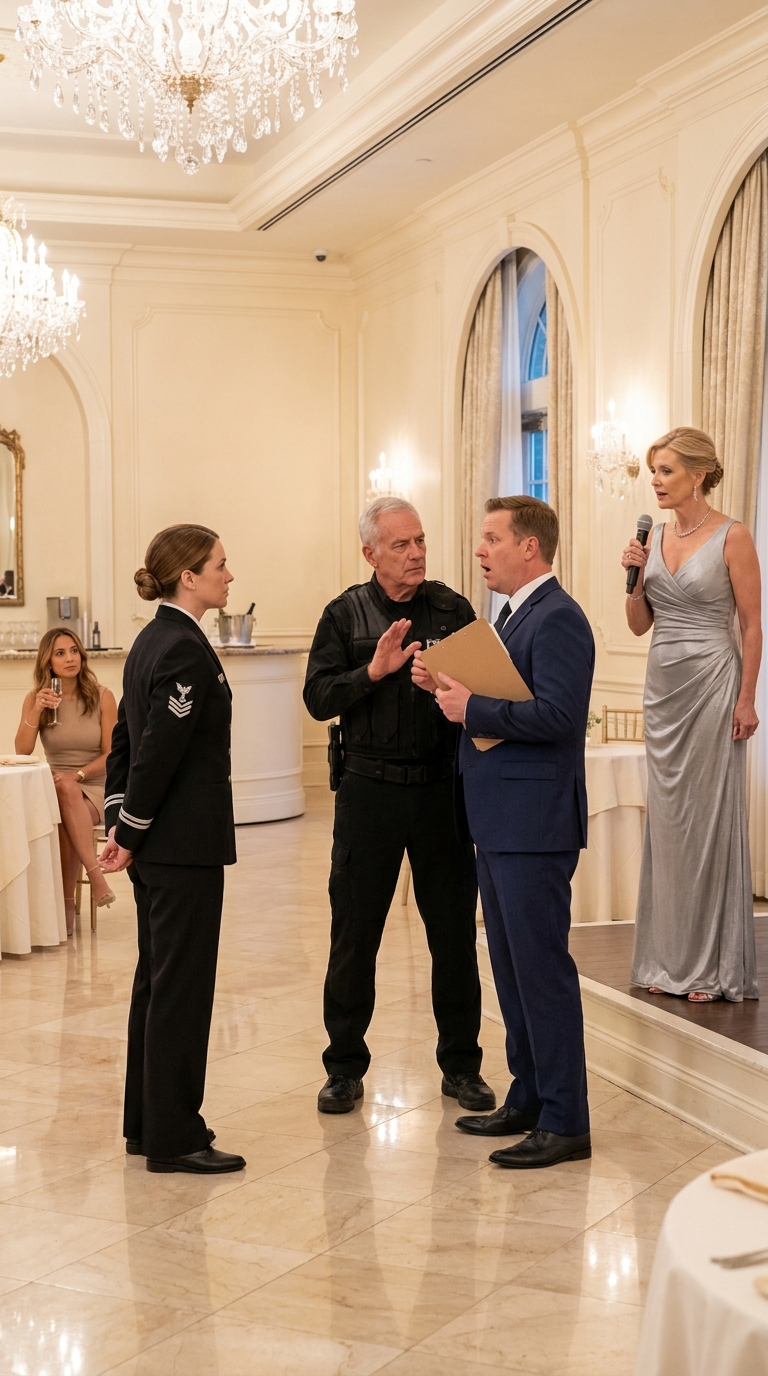
My mother expected that. She had raised herself on scenes. Tears would have completed the picture she sold Atlantic Forge: the disgraced Navy commander breaking under the weight of her own treason while her patriotic mother stood bravely above her. She had not understood the difference between silence and surrender.
For two years, my silence had kept my father alive.
After his stroke, Dad’s world shrank to a wheelchair, a second-floor bedroom, and whatever mercy my mother felt like renting out by the hour. She had made herself his legal medical guardian while he was still unable to speak. She controlled his doctors, his medicine, his therapy, and the threat she used whenever I pushed back.
“Stop sending money,” she once told me, pointing a manicured finger toward his room, “and I will sign him into the worst public hospice I can find.”
So I paid. My Navy salary, my investments, every spare dollar I could move without breaking myself. I drove an old sedan with a cracked windshield while my mother carried bags worth more than a sailor’s housing allowance. Dad sat in stained pajamas, his medication low, his eyes terrified whenever her heels clicked down the hall. Victoria called me cheap while spending from cards opened in my name. They did not see a daughter. They saw a tap they could turn whenever greed ran dry.
Atlantic Forge saw the same weakness and dressed it in a suit.
They were a defense logistics contractor I had blocked for months. Their equipment had failed inspections. Their paperwork lied. Their lobbyists smiled too much. I had recommended debarment after two supply failures injured soldiers overseas. That made me inconvenient. In their world, inconvenient people were either purchased or ruined.
My mother chose purchased.
The first article hit the military feeds before sunrise on a gray Pentagon morning. It called me a dirty defense broker and listed details that made my stomach go still: leave dates, route codes, habits, even the coffee shop where I sat facing the door. A hostile company could have bought rumors. They could not have guessed the rhythm of my life inside the Franco house.
The part that hurt was not the article. Lies have a shape, and I had spent my career reading shapes. The hurt came from recognizing the fingerprints inside it. My mother knew the coffee shop. Victoria knew which mornings I drove back before physical training. They knew Dad’s condition would keep me obedient, because every threat against him had worked so far. Atlantic Forge had not found a weak point in my clearance. They had found the weak point in my heart.
I called my mother.
She answered laughing.
“If you had approved that contract,” she said, “this family would have been taken care of. Now get ready for prison, daughter.”
Victoria laughed in the background. A cork popped. That was the sound of my family celebrating the sale of my freedom.
I wanted to drive to Greenwich and drag the truth into the light by its throat. Instead, I sat still. Training has a mercy inside it: it gives pain somewhere useful to go. Anger becomes sequence. Betrayal becomes map. Fear becomes perimeter.
I requested leave through command channels and let my enemies believe I was collapsing. While my mother spoke to brokers and Victoria moved money through shell companies, I preserved what had already been captured through lawful household network records, bank alerts, and secure military reporting channels. Emails. routing trails. bribe negotiations. A private investigator’s invoice for tracking my movements near base. My mother had not just lied to reporters. She had helped a defense contractor build a false intelligence case against an active-duty officer.
Then came the affidavit.
NCIS investigators placed it on a metal table in a room that smelled like stale coffee. Four pages. My mother’s signature at the bottom. She claimed I had confessed over dinner to selling logistics data. She included terminology she could not have known without coaching. She listed dates when I was not even in Connecticut. Every lie was written with the confidence of a woman who believed motherhood made perjury sound holy.
One investigator mentioned my father’s care like it was leverage. I looked at him until he stopped speaking.
“I reserve my right to remain silent until command clears me,” I said.
Six hours later, I walked out with a secure message waiting on my burner phone.
They are locking onto the wrong target. Let them gloat. I owe you a life, commander.
Admiral Ethan Graves.
Three years earlier, in a compound overseas, an RPG had hit his convoy just after dawn. I had run into smoke, dragged him from burning metal, and pressed my hands into the wound in his leg until the medics reached us. Before I returned to the line, I slipped a blood-slick challenge coin into his hand. I never reported the action. I never asked for anything.
But debts have memories.
Atlantic Forge and my mother wanted theater, so command gave them a stage. They named the event the Gala of Truth, printed my mother’s face on ivory invitations, and planned to have federal agents arrest me in front of every camera they could invite. She was supposed to receive a civilian medal for exposing me. The medal came from a Forge subsidiary. Even her courage had an invoice.
I arrived in dress blues at 8:15.
The ballroom turned quiet the way rooms do when people are eager to witness cruelty but not honest enough to call it that. My mother saw me and glowed. Victoria raised her glass. A woman near the stage whispered “traitor daughter” loudly enough for me to hear.
The agents cuffed me on schedule.
Then the doors broke open.
Twelve NCIS tactical operators entered in formation. Chairs scraped. Glass shattered. A congressman stumbled backward into a table. The elite room that had applauded my humiliation became a containment zone in under ten seconds. Admiral Graves walked at the front, broader than I remembered, his face carved from command.
The FBI agent tried to stop him.
Graves pushed a sealed Pentagon folder into his chest.
The agent read three lines. His face emptied. The cuffs fell from my wrists and rang against the marble.
“Operation Evergreen is authorized by the Pentagon,” Graves said. “Commander Franco was designated as an intelligence decoy to dismantle Atlantic Forge’s corruption network.”
My mother’s champagne glass slipped from her hand and shattered on the stage.
The exits sealed.
Victoria screamed when military police reached the bar and zip-tied the Atlantic Forge executives. One broker hit the polished wood hard enough to split his lip. A television camera kept recording. That mattered. My mother had wanted the world to watch my disgrace. Now the world was watching hers arrive with receipts.
I walked up the steps slowly. Broken glass cracked under my shoes. My mother backed away until the podium stopped her.
The large screen behind her changed from the gala logo to evidence. Wire transfers. Dates. Account names. Victoria’s Delaware shell companies. Payments routed through offshore intermediaries. The numbers matched my classified leave windows down to the hour. Then the first recording played.
My mother’s voice filled the ballroom, sharp and satisfied.
She haggled over my clearance like she was selling jewelry. She laughed when the broker worried I might cooperate. “She’s a soldier,” my mother said on the recording. “She’ll follow orders and shut up. That’s all they know how to do.”
The silence after that line was heavier than the applause had been.
People physically moved away from her. A retired general near the front took off his glasses and pressed his fingers to his eyes. Victoria folded in on herself. My mother looked at the sealed doors, then at me, then at the cameras. For the first time in my life, she had no audience willing to rescue her.
I took the microphone.
“You sold me out for a handbag and a round of applause.”
Her mouth trembled. No words came.
“In uniform, we call that treason,” I said. “At home, I call it pathetic.”
I set the microphone down and turned away.
That should have been the end of her power over me, but there was one more door I had to open.
That same night, I went back to the Greenwich estate with a military medical extraction team. The house was dark. Without my mother’s noise in it, the place felt less like a mansion than a mausoleum with better curtains. We found Dad in the upstairs room, curled into himself at the sound of boots. For a second he thought she had sent someone to punish him.
Then he saw me.
His good hand reached out, shaking so hard the wheelchair rattled. I knelt and took it. His fingers were cold. His eyes were wet. The room smelled of old food, disinfectant, and neglect. Empty pill bottles sat on the nightstand. A tray of dried mashed potatoes had hardened beside the bed.
“Let’s go, Dad,” I told him. “Her guardianship is revoked.”
He made a sound that broke me more than any accusation had. It was not quite a word, but I understood it. Relief has its own language.
We carried him out wrapped in a warm blanket. He held my hand all the way to the ambulance. When the doors closed, I looked at the estate once. Every window was black. The house had spent years pretending to be grand, but without fear inside it, it looked hollow.
I did not look back after that.
One month later, my mother was denied bail in federal court. The judge cited her deliberate cruelty toward a dependent spouse and a decorated officer. Atlantic Forge’s accounts were frozen. Executives who once bought politicians dinner were begging lawyers for phone calls. Victoria lost the shell money, the cards, the house, and the soft life she thought my destruction would fund. The government seized the estate.
Dad moved into a sunlit room at Walter Reed. His medication was corrected. His therapy restarted. A nurse told me he had smiled at breakfast for the first time in two years. When I visited, he squeezed my hand and pushed out something close to “thank you.” I had faced gunfire with less courage than it took to sit beside him and let myself cry.
Recovery did not make him the man he had been before the stroke, and I stopped demanding that from the universe. Some victories are smaller and more sacred than full restoration. A steady hand on a spoon. A laugh that returns as a rough sound. A man who no longer flinches when footsteps come down the hall. Those were the medals I wanted most, and none of them belonged in a display case.
There was no dramatic forgiveness scene. I did not visit my mother. I did not answer Victoria’s calls. Blood is not a command chain. It does not outrank truth. It does not excuse cruelty. It does not require you to keep funding the people who would sell your soul and call it family.
Weeks later, I stood at Arlington in uniform, surrounded by white headstones and clean wind. My secure phone buzzed with orders from Graves. EUCOM needed me back in theater. I read the message twice, then typed my answer.
Orders received.
A young Marine walking the path recognized my rank and saluted. I returned it. For one quiet second, I understood something my mother never could. Family is not always the people who share your name. Sometimes it is the person who keeps watch at your door, the medic who runs toward smoke, the old man in a hospital bed squeezing your hand, or the uniformed stranger who knows what the salute costs.
My mother had tried to turn my silence into a confession.
She never understood it was discipline.
And discipline is what carried me out alive.