“You clean houses for rich people, Kate,” he said. “I’m sure you get plenty of cash tips. Pay for your sister. Consider it your wedding gift.”
My mother nodded.
“You don’t have a husband, children, or a mortgage. Be useful for once.”
I looked at them for a long second.
Then I reached into my blazer and removed a slim card case.
I placed my titanium black American Express Centurion card on the bill.
The sound it made against the table was small, heavy, and final.
Evelyn’s eyes snapped to the card.
Victor’s face changed.
My parents, who understood nothing except logos and appearances, saw only a black piece of metal.
My mother sniffed.
“I hope that prepaid cleaning-supply card has enough on it.”
The waiter picked it up, felt the weight, and nearly bowed.
“Of course, ma’am.”
I stood.
“The bill is handled,” I said. “Congratulations, Madison. I am certain your wedding will be unforgettable.”
Victor rose quickly.
“Kate, wait. How do you have—”
But I was already leaving.
Outside, the cold Chicago night wrapped around me like clean linen. I handed my valet ticket to the attendant and breathed for the first time in two hours.
The glass doors burst open behind me.
Madison stormed onto the sidewalk.
“You think you’re so clever,” she hissed. “Mom and Dad may not know what that card was, but I do. It’s probably some company expense card your rich clients gave you to buy bleach in bulk.”
I looked at my sister, at her expensive shawl, her trembling rage, her desperate need to make me small.
“Was there something you needed, Madison?”
“Yes,” she snapped. “Since you decided to make a scene tonight, you can make it up to me. Hawthorne Hall requires a deep clean three days before the wedding. You and your little cleaning crew are going to do it for free.”
I said nothing.
“The ballroom, the bridal suite, the terraces. All of it,” she continued. “Consider it your sisterly duty. And come through the service entrance. I don’t want Victor’s family seeing my sister dragging trash bags around.”
The valet pulled up in my black Porsche Panamera.
Madison stared at it.
I opened the door and glanced back.
“I’ll personally make sure Hawthorne Hall is exactly what you deserve,” I said.
Then I drove away, leaving her shivering on the curb, still believing she had just ordered around a maid.
Part 2
The next morning, sunlight poured through the forty-first-floor windows of my office overlooking the Chicago River.
On my desk sat the final acquisition packet for Hawthorne Hall. I signed the last operational transfer form with a platinum fountain pen while my chief counsel, Preston Blake, stood across from me with a tablet in his hand.
“Your sister’s wedding file is already a disaster,” he said. “Unpaid vendor deposits. Questionable financing. Inflated guest count. Multiple bounced checks from your parents.”
“That tracks.”
“There’s more.”
He turned the tablet toward me.
A loan application.
My name.
My Social Security number.
My forged signature.
Eighty thousand dollars.
For one moment, the room went soundless.
I stared at the document, and fifteen years vanished. I was nineteen again, standing in a campus financial office while a tired administrator told me my tuition payment had failed. I was carrying textbooks I could not afford and pretending I had somewhere to sleep that night.
Preston’s voice softened.
“Kate.”
“They did it again,” I said.
My parents had used my identity to finance Madison’s wedding. Flowers, designer dress deposits, catering advances, luxury rentals. They had stolen from me once to decorate Madison’s life. Now they had tried to do it again.
Only this time, I was not a broke nineteen-year-old girl.
“Do we have proof?”
“Bank footage. IP logs. Device location. Handwriting analysis. Vendor invoices. The lender has already flagged inconsistencies, but nobody moved because the payments cleared from temporary funds.”
“Can it hold up?”
Preston gave a humorless smile.
“It could survive a hurricane.”
I looked out at the city.
My parents had spent fifteen years telling the world I was too stupid and too poor to fight back. They had mistaken silence for weakness. They had mistaken patience for surrender.
“No police yet,” I said.
Preston frowned. “Kate, identity theft and loan fraud are criminal.”
“I know.”
“Then why wait?”
“Because if they’re arrested quietly at home, they’ll call it a misunderstanding. They’ll tell everyone it was paperwork. They’ll become victims before lunch.”
His eyes narrowed with understanding.
“You want witnesses.”
“I want the same audience they committed the crime to impress.”
By noon, Evelyn and Victor were in the private library of my penthouse.
Victor stood by the window, white-knuckled, reading the files for the third time.
“I almost married her,” he said.
Evelyn sat perfectly still, but her eyes were cold enough to frost glass.
“Madison told us her family had old money,” she said. “She said her father had investment holdings, that her mother sat on charity boards, that you were unstable and jealous.”
Victor looked ashamed.
“She told me you resented her because she succeeded.”
“I know.”
He turned to me.
“Why didn’t you expose them years ago?”
That question had followed me for most of my adult life.
“Because survival came first,” I said. “Then building. Then protecting what I built. Revenge is expensive when you are poor. Justice gets cheaper when you own the room.”
Victor closed the file.
“What do you want from me?”
“The truth. Spoken clearly. At the right time.”
He nodded once.
“You’ll have it.”
The wedding was five days away.
In those five days, Madison called me fourteen times. My mother called twenty-two. My father sent one text that said, Don’t embarrass us.
The night before the wedding, my mother appeared at my penthouse uninvited.
She had never visited me before. In fifteen years, she had never asked where I lived. She must have bullied the address out of Madison, who had probably followed me after a vendor meeting.
Donna Whitaker stepped out of the elevator into my foyer wearing pearls, a camel coat, and a look of disgust that faltered the moment she saw the view.
My penthouse stretched across half the floor, all glass, limestone, walnut, and quiet money. Real money does not shout. It absorbs sound.
Her eyes moved over the art, the staircase, the river beyond the windows.
“Whose apartment is this?” she demanded.
“Mine.”
“Don’t be ridiculous.”
I smiled slightly. “Would you like coffee?”
She ignored the question and threw a plastic garment bag onto my marble island.
Inside was a gray polyester housekeeping uniform and a white apron.
“I want you in this the second you arrive at Hawthorne Hall tomorrow,” she said. “You will enter through the loading dock. You will not speak to Victor’s relatives. You will not linger near the ballroom. You will clean what you’re told to clean and stay invisible.”
I touched the stiff fabric.
“You brought me a costume.”
“It’s not a costume. It’s your uniform.”
I looked at my mother and felt, unexpectedly, nothing.
Not pain. Not rage. Not hope.
Just distance.
“You came all the way here to hand-deliver this?”
“I came here to make sure you don’t ruin the most important day of Madison’s life.”
“By existing?”
“By forgetting your place.”
There it was.
The sentence beneath every insult.
I folded the garment bag carefully and slid it back toward her.
“No.”
Her mouth opened.
“What did you say?”
“I said no.”
Her face twisted.
“You selfish little—”
“Tomorrow,” I said, cutting through her voice, “I will come to Hawthorne Hall through the front entrance. I will wear what I choose. I will speak to whomever I choose. And you will not touch me.”
For a second, fear flashed in her eyes.
Then pride crushed it.
“You are nothing,” she whispered. “You have always been nothing.”
I walked to the elevator and pressed the button.
“Then you have nothing to worry about.”
The doors opened.
My mother stood there, shaking with fury.
“This family made you,” she spat.
“No,” I said. “This family taught me what needed to be removed.”
On the morning of the wedding, Hawthorne Hall looked like a painting rich people bought to prove they had taste.
The limestone mansion rose behind iron gates and a long drive lined with old oaks. White tents dotted the gardens. Florists carried orchids through side doors. Caterers moved like a small army. Security stood at every entrance, all employed by me.
I arrived two hours before the ceremony in a midnight-blue tailored suit, diamond cufflinks, and heels sharp enough to make a point.
My head of security, Mason Hayes, met me at the entrance.
“Good morning, Ms. Whitaker.”
“Morning, Mason. Any issues?”
“Only the bride’s father yelling at a valet because the Bentley he rented was parked twelve feet from the door instead of six.”
“Let him enjoy his authority while it lasts.”
Mason almost smiled.
Inside, my parents were already performing.
My father strutted around the foyer in a rented tuxedo, barking orders at staff who knew exactly who owned the building. My mother floated between guests, kissing cheeks and pretending she had personally discovered the estate.
Madison was upstairs in the bridal suite, surrounded by makeup artists, champagne, and debt.
Evelyn arrived with Victor’s family at eleven.
They were everything my parents wanted to imitate and could not. Judges, surgeons, professors, executives. Calm people with expensive clothes and quiet voices. People who did not need to announce their importance because rooms adjusted around them.
My mother rushed toward Evelyn.
“Welcome to our little celebration,” she sang. “We fell in love with this place instantly.”
Evelyn’s eyes moved to me at the bottom of the staircase.
“Clearly,” she said.
Victor entered moments later.
He looked handsome in black tie, but not happy. His face was composed in the way lawyers compose themselves before delivering bad news.
He crossed the foyer and stopped in front of me.
“Are you ready?” he asked quietly.
“No,” I said. “But I’m done waiting.”
The ceremony happened under a canopy of white roses in the garden.
Madison walked down the aisle like a queen approaching subjects. My parents cried loudly. Victor said his vows in a steady voice, but I noticed the careful wording. He promised honesty, dignity, and truth. He did not promise forever.
Madison heard only what she wanted.
By the reception, three hundred guests filled the ballroom. Crystal chandeliers burned above silk tablecloths. Champagne glowed gold in narrow flutes. A string quartet played near the balcony.
Madison found me during cocktail hour.
Her eyes dragged over my suit.
“What are you wearing?” she hissed.
“Clothes.”
“You were supposed to be in uniform.”
“I decided against it.”
Her smile sharpened for the guests nearby.
“You really cannot stand that today is about me, can you?”
“Madison, today is entirely about you.”
She heard the words as surrender.
I meant them as warning.
My mother appeared at Madison’s side, saw me standing near Evelyn, and nearly lost control of her face.
“Kate,” she whispered, gripping my arm hard enough to bruise. “Kitchen. Now.”
Evelyn’s voice rang out before I could answer.
“Katherine, darling, there you are.”
My mother froze.
Evelyn crossed the ballroom with open warmth, took my mother’s hand off my arm, and embraced me in front of half the guest list.
“You look stunning,” Evelyn said. “I was just telling Judge Marlow that your insight on historic property compliance may save our bank months of review.”
The guests nearby turned.
My mother’s mouth opened and closed.
Madison’s cheeks went red beneath layers of bridal makeup.
“What is she talking about?” Madison snapped.
Evelyn smiled.
“Your sister is quite knowledgeable.”
“She cleans houses.”
Victor, standing behind his mother, looked at Madison with something final in his eyes.
“Yes,” he said quietly. “That is what you keep saying.”
The dinner began.
My parents tried to recover with speeches about love, sacrifice, and family values. My father referred to Hawthorne Hall as “a place we selected because only the best would do.” My mother cried into a lace handkerchief and told Victor’s family that Madison had always been “humble.”
Evelyn did not blink.
Victor barely touched his food.
Then Madison took the microphone.
Part 3
Madison stood in the center of my ballroom in a Paris couture gown bought with a stolen identity, smiling like the world owed her applause.
“I want to thank everyone for being here,” she said. “Family means everything to me. Honesty, loyalty, and knowing where you come from.”
Victor’s jaw tightened.
I set down my champagne.
Madison turned toward me.
“And I want to give a special thank-you to my older sister, Kate.”
Every eye followed her gaze.
My mother looked pleased. My father smirked.
Madison’s voice became sugar over poison.
“Kate has always taken a different path. A much simpler path. But we love her for it. She works very hard with her hands so people like us can enjoy beautiful spaces like this. Thank you, Kate, for helping make sure Hawthorne Hall was clean enough for my special day.”
A sound moved through the ballroom..
Not laughter.
Disgust.
Old money forgives many sins, but not vulgar cruelty in public.
Madison did not notice. She was too drunk on the sight of me seated while she stood above me with a microphone.
Then Victor rose.
He walked toward her with measured steps.
Madison beamed and held out the microphone, expecting him to praise her.
Victor took it.
Then he stepped away from her.
The room changed.
Madison’s smile faltered.
Victor looked over the crowd. Then at my parents. Then at me.
I nodded once.
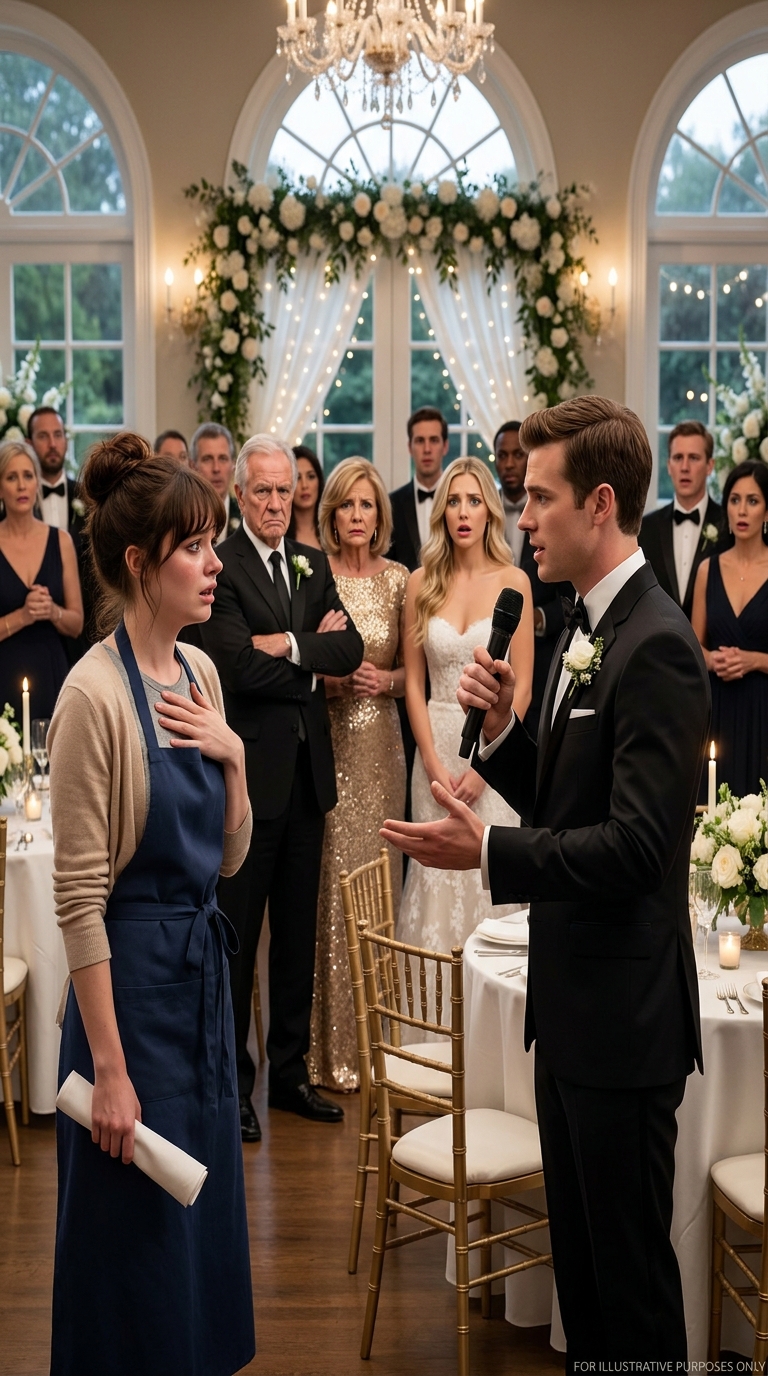
“Madison is right about one thing,” he said. “Family should be built on honesty.”
The microphone carried his voice to every corner.
“Transparency is the foundation of any marriage. Without it, there is no partnership. Only fraud.”
Madison laughed nervously.
“Baby, what are you doing?”
Victor did not look at her.
“Over the past week, I became concerned by several inconsistencies in statements made by Madison and her parents. I reviewed financial documents, vendor payments, credit applications, and communications related to this wedding.”
My father shot to his feet.
“What the hell is this?”
Victor turned his head slowly.
“The truth, Richard. Sit down if you have enough dignity left to hear it.”
My father sat.
Victor faced the room again.
“This wedding was not paid for by family wealth. It was not paid for by successful business income. It was not paid for by honest savings.”
Madison’s face drained.
“Victor,” she whispered. “Please.”
“It was funded in part by an eighty-thousand-dollar fraudulent loan taken out using the stolen identity of Katherine Whitaker.”
Gasps exploded across the ballroom.
My mother clutched her pearls.
My father stood again, knocking his chair backward.
“That is a lie!”
Victor’s voice hardened.
“I have bank footage, IP records, loan documents, handwriting analysis, and vendor invoices. Two days ago, Donna and Richard Whitaker used their older daughter’s personal information to secure financing for this event.”
He pointed at the flowers.
“The orchids.”
At the tables.
“The linens.”
At Madison.
“The dress.”
Then at my parents.
“All of it touched by fraud.”
My mother began crying, but there were no tears at first. Only noise.
“We were going to pay it back,” she shrieked. “It was just temporary. Family helps family.”
I stood.
The room turned toward me.
“For fifteen years,” I said, “my parents told people I dropped out because I lacked discipline. The truth is that when I was nineteen, they forged access to the education fund my grandmother left me. They emptied it to pay Madison’s debts. I lost my housing, my tuition, and my place in school.”
Madison shook her head violently.
“No. No, you’re twisting everything.”
I looked at her.
“You were driving the Mercedes they bought with my future.”
Her lips parted.
She remembered.
That was enough.
My father lunged forward.
“You jealous, lying little maid.”
Mason Hayes moved from the wall.
My father pointed at him.
“Security! Remove her. I am the host of this event.”
Mason walked past him.
He stopped in front of me, squared his shoulders, and bowed his head.
“Orders, Ms. Whitaker?”
My father stumbled back.
The ballroom went silent again.
I reached into my jacket and removed a folded legal document.
“This is the recorded deed and acquisition certificate for Hawthorne Hall,” I said. “Luminary Estate Group purchased this property thirty days ago.”
I looked at my father.
“I do not clean this estate, Richard. I own it.”
My mother made a small choking sound.
I continued.
“I am the founder and chief executive officer of Luminary Estate Group. The company your family mocked at dinner last week is the company that manages Evelyn Hale’s bank portfolio. It owns the ballroom you are standing in, the bridal suite Madison dressed in, the gardens where she walked, and the security team you just tried to command.”
My father’s face went gray.
Madison sank into a chair as if her bones had disappeared.
“You let me humiliate you,” she whispered.
“No,” I said. “I let you introduce yourself.”
Outside, sirens began to rise.
Red and blue lights flashed against the tall windows.
My mother turned toward the sound.
“No,” she said. “No, no, no.”
The ballroom doors opened.
Uniformed officers entered with a detective in a dark suit. Guests stepped aside without being asked.
The detective stopped before my parents.
“Donna Whitaker. Richard Whitaker. You are under arrest on suspicion of identity theft, loan fraud, and financial forgery.”
My mother screamed.
“We are respectable people.”
The detective did not react.
My father looked at me, all the fake grandeur gone.
“Katie,” he said, using the childhood name he only remembered when he wanted something. “You would do this to your own parents?”
I walked closer.
“You did this to your own daughter.”
For the first time in my life, he had no answer.
The officers cuffed them in front of the people they had spent decades trying to impress. My mother sobbed so hard her mascara ran in black lines. My father lowered his head as if he could hide inside his rented tuxedo.
Madison crawled toward Victor, grabbing at his pant leg.
“Please,” she cried. “You’re a lawyer. Fix this. I love you.”
Victor looked down at her.
“No, Madison. You love what my name could buy you.”
She shook her head, sobbing.
“I can change.”
“You had every chance to tell the truth. Instead, you let your family mock the woman you helped rob.”
He removed his wedding band.
The room seemed to hold its breath.
“This marriage will be annulled. My attorneys will contact you Monday regarding the funds you moved from our joint account.”
Madison collapsed against the floor, surrounded by silk, orchids, and consequences.
Evelyn stood and came to my side.
“You handled that with more grace than they deserved,” she said.
“I did not feel graceful.”
“Good,” she replied. “Grace should never be confused with permission.”
The police led my parents out through the front doors of Hawthorne Hall.
Not the service entrance.
The front.
Guests watched in silence. Some recorded. Some whispered. Some simply stared, witnessing the death of a lie that had fed itself for too long.
When the doors closed, the ballroom felt strangely clean.
Victor approached me.
“I’m sorry,” he said. “For believing her.”
“You believed what she showed you.”
“I should have looked harder.”
“Yes,” I said. “You should have.”
He accepted that without defense, which made me respect him more.
“What happens now?” he asked.
I glanced around the ruined wedding reception.
“Now the vendors get paid honestly. The guests are free to leave. Your family keeps its dignity. My parents get lawyers. Madison gets reality.”
“And you?”
I looked up at the chandeliers, at the restored ceiling, at the old estate my company had saved from bankruptcy and neglect.
“I go home.”
Six months later, my parents pleaded guilty to reduced charges after the evidence made denial impossible. They lost the house they had mortgaged three times to maintain a lifestyle they never owned. Their country club membership vanished. Their friends stopped returning calls. The people they had worshiped finally saw them clearly.
Madison’s boutique closed before Thanksgiving.
Victor annulled the marriage quietly and rebuilt his life with less shame than he expected. Eventually, his firm became one of Luminary’s outside legal partners. He never flirted, never crossed a line, never asked for more than professional trust. That, too, made me respect him.
Evelyn became something I had not known I needed.
An ally.
Not a mother. I had stopped auditioning for that role in anyone’s life.
But a witness. A woman who understood power, precision, and the cost of surviving rooms designed to make you smaller.
One evening in December, she and Victor came to my office after Luminary closed the largest acquisition in our company’s history. We opened champagne while snow fell over Chicago.
“To clean foundations,” Evelyn said, raising her glass.
Victor smiled. “And to seeing rot before it spreads.”
I looked out over the city.
For years, my family said I only cleaned houses.
They were right in one way.
I built an empire by walking into neglected places, finding the hidden damage, and refusing to decorate over decay. I cleaned buildings. I cleaned contracts. I cleaned balance sheets. And finally, I cleaned my life.
I removed the people who treated me like a servant while stealing from my hands.
I swept out the lies.
I locked the doors behind the cruelty.
I stood in my own office, above a city I had earned piece by piece, and felt something deeper than triumph.
Peace.
I had started with a mop and a bucket.
I ended with the deed to the room where they tried to bury me.