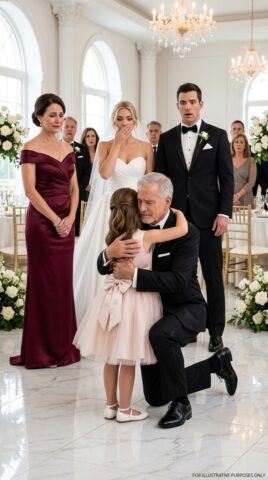
Do I know you?” she asked.
He stepped closer to the counter. “Five years ago. Miller’s Diner. The alley behind the kitchen.”
The ribbon slipped from Evelyn’s hand.
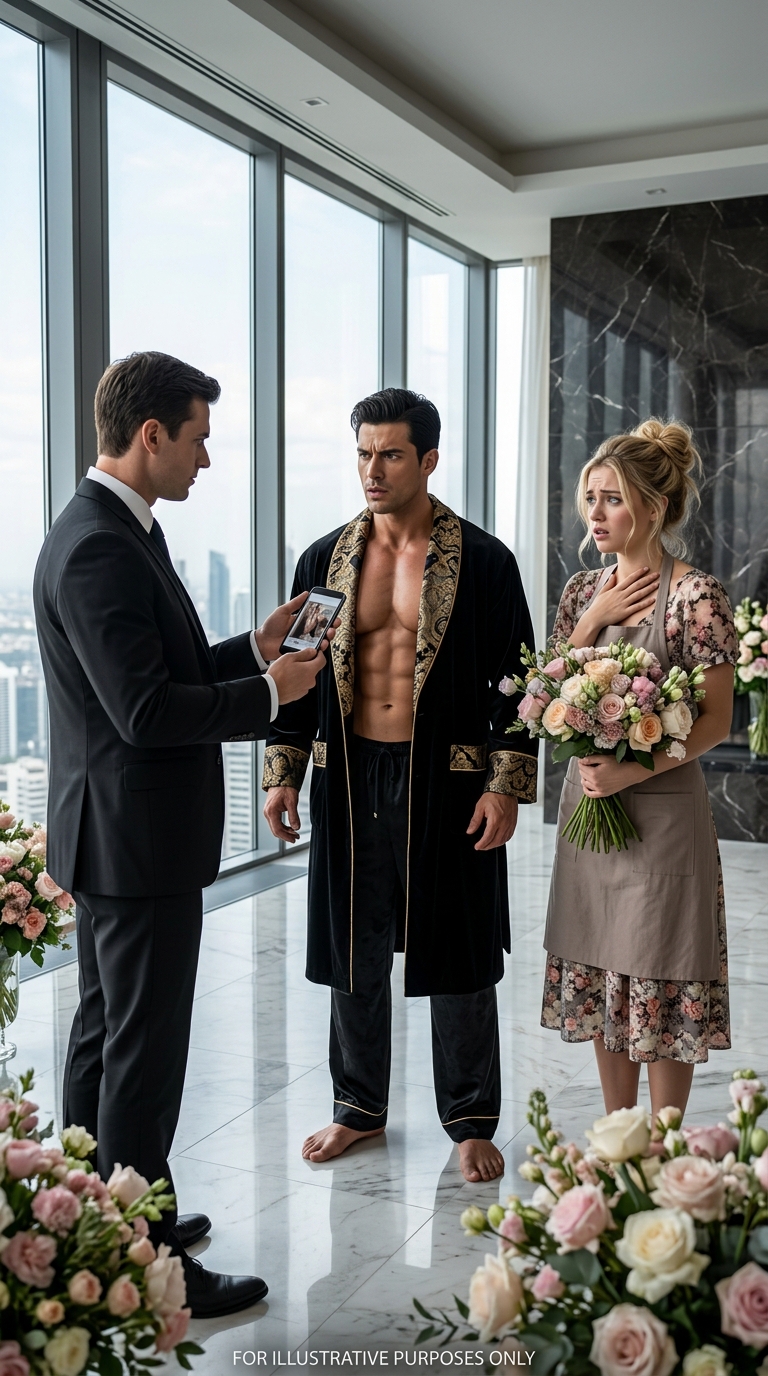
For one breath, she was back in the blizzard. Blood on snow. A man too heavy for her terrified body to move, yet somehow she moved him. A coat soaked red. Voices outside. Her hands clamped over a stranger’s mouth while she silently begged God not to let him die in her arms.
“You,” she whispered. “You were the man in the pantry.”
“My name is Roman DeLuca.”
Evelyn took one step back.
She knew that name. Everyone in Chicago knew that name, even if they pretended not to. Roman DeLuca was the kind of man whose restaurants never got inspected, whose trucks never got stopped, whose enemies moved to Florida or disappeared from the lakefront entirely. He was not just rich. He was feared.
Her throat tightened. “I saved Roman DeLuca?”
“You saved a dying man,” he said. “The rest came later.”
“Why are you here?”
His expression changed. Whatever tenderness recognition had brought to his face hardened into something grim.
“Because my underboss tried to trick me into killing you.”
Evelyn stared at him. For a second, the words were too absurd to enter her body. Then the bell above the door chimed again.
Three men walked in.
They did not look at the flowers. They did not look at the prices. They looked at Roman, then at Evelyn, and the shop seemed to lose all oxygen.
The tallest man smiled. “Morning, boss.”
Roman did not turn around. “Merrick.”
“Silas figured you might get sentimental.” The man pulled a pistol from inside his jacket. “He told us to finish pruning the problem.”
Evelyn’s hand closed around the nearest thing on the counter: a pair of long steel pruning shears.
The man laughed. “Look at that. Big girl thinks she’s dangerous.”
Something in Roman’s eyes went black.
But Evelyn moved first.
She grabbed the bucket of lilies and hurled the entire thing across the counter. Forty pounds of water, stems, and ceramic slammed into Merrick’s chest. He stumbled backward, gun jerking toward the ceiling as it fired. The shot shattered a hanging planter. Soil rained over everyone.
Roman seized the moment. He drove his shoulder into the second man, slamming him into a display of glass vases. Evelyn ducked as the third man aimed at Roman’s back. She did not think. She swung the pruning shears with both hands, not at flesh but at the man’s wrist. The steel cracked hard against bone. He shouted, dropped the gun, and Roman finished the fight with terrifying efficiency.
Outside, tires screamed. Wade Callahan burst through the broken doorway with his weapon drawn, eyes scanning for threats.
The whole thing lasted less than twenty seconds.
Evelyn stood amid broken lilies and shattered glass, breathing hard, her hands trembling around the pruning shears.
Roman turned to her, and for the first time since he walked in, he looked shaken.
“You saved me again,” he said.
Evelyn barked out a laugh that sounded too close to a sob. “Don’t make it a habit.”
Police sirens wailed somewhere north of the block.
Roman’s gaze sharpened. “We have to go.”
“No.”
“Evelyn—”
“No.” She pointed the shears at him. “A man with a gun just tried to murder me in my own shop because of you, and I am not climbing into a car with you because you said so.”
Wade glanced nervously toward the street. “Boss, we have maybe two minutes.”
Roman did not look away from Evelyn. “Silas has police on payroll. If they find you standing over three armed men connected to my organization, you will be arrested, isolated, and killed before midnight. I am not asking you to trust my soul. I am asking you to trust my fear.”
That reached her.
Not his power. Not his command. His fear.
Evelyn lowered the shears slightly. “Where?”
“A safe apartment on the river.”
“And after that?”
“After that, I prove you were framed.”
Her eyes burned. “You had better.”
Roman gave one sharp nod. “I will.”
Evelyn grabbed her purse, her coat, and the old metal cash box she kept beneath the counter. Roman noticed the box but asked no questions. Smart man.
They left through the back just as the first police cars turned onto Wabash.
The safe apartment did not look safe to Evelyn. It looked expensive enough to be guilty.
It sat high above the Chicago River in a building with private elevators, silent hallways, and windows that turned the city into a glittering map of people who had no idea how close violence lived beneath their feet. Roman’s men swept the rooms first. Wade stayed by the door. Roman led Evelyn into a living room all gray stone, black leather, and cold modern art.
Evelyn hated it immediately.
“Do you decorate,” she asked, “or do you just intimidate furniture until it gives up?”
Wade made a sound that might have been a cough.
Roman looked at the room as if seeing it for the first time. “I have never thought about it.”
“That’s obvious.”
For one strange second, Roman smiled.
Then the weight of everything returned. Evelyn set the cash box on the dining table.
Roman nodded toward it. “You brought money?”
“No.” She opened the box. Inside were old receipts, a dried rose wrapped in tissue, a yellowed photo of her mother in front of Miller’s Diner, and a small plastic evidence bag containing a silver cufflink shaped like a hawk.
Roman went still.
Evelyn noticed. “You recognize it.”
“Where did you get that?”
“The night I saved you, one of the men came back.” Her voice softened, but her eyes did not. “Not all the way inside. Just near the dumpster. I was hiding behind the pantry door with you bleeding on my shoes. He was talking on the phone. He said, ‘Kane said leave him in the snow.’ Then he laughed and said, ‘By morning, the old man will have no heir.’ After they left, I found that cufflink in the slush.”
Roman’s face drained of color beneath his tan.
Evelyn continued. “I didn’t know what it meant. I didn’t know who you were until later. When I saw your face in the news months after the diner closed, I understood enough to be scared. So I kept it.”
“Why didn’t you go to the police?”
“I grew up on the South Side, Roman. I knew which cops came into the diner and ate free because men like yours paid their tabs. I was a waitress with no money, no family power, and a dead mother’s medical debt. Who was going to protect me from a name like Kane?”
Roman sank slowly into a chair.
Silas Kane had not simply framed an innocent florist. He had targeted the only living civilian witness to the night he tried to murder Roman and seize the DeLuca family before Roman could inherit it. For five years, Roman had blamed a rival crew. He had gone to war over it. Men had died. Territory had changed hands. Silas had stood beside him through every funeral, every retaliation, every negotiation, pretending loyalty while building his future on Roman’s blood.
The betrayal was not a crack in the foundation.
It was the foundation.
Evelyn watched the realization hit him and felt no satisfaction. He looked suddenly younger, not softer, but wounded in a place power could not armor.
“He was there,” Roman said.
“I think so.”
“No,” Roman whispered. “He was there.”
Evelyn closed the cash box. “Then he didn’t choose me because I looked easy to erase. He chose me because he finally realized I was the woman from the diner.”
Roman looked up. “How would he realize that?”
“Two weeks ago, a man came into my shop asking questions about funeral wreaths. He had pale eyes, slick hair, expensive shoes, and a hawk cufflink on his sleeve. I remembered the cufflink because of that one.” She nodded toward the evidence bag. “He said he liked supporting local businesses. He asked if I had always been a florist. I told him I used to work at Miller’s before it closed.”
Roman’s hands curled into fists.
Evelyn’s voice lowered. “He smiled like I had just handed him a knife.”
Silence spread through the apartment, dense and dangerous.
Roman stood. “I am going to end him.”
“No,” Evelyn said.
He turned. “No?”
“No.” She stepped closer, surprising herself with how little fear she felt now that anger had burned through it. “I know what men like you mean when you say end. I saved your life once. I did not save it so you could use me as a reason to spill more blood.”
“Evelyn, Silas will not stop.”
“Then stop him in a way that ends more than one man.” She tapped the evidence bag. “You said he has police. You said he framed me with fake FBI photos. You said he is skimming shipments and setting you up. That means there are records, payments, messages, dirty cops, maybe federal crimes. Use those.”
Roman gave a humorless laugh. “You want me to call the FBI?”
“I want you to decide whether you’re a king protecting a throne or a man who remembers what it felt like to be helpless in the snow.”
The words landed harder than any bullet.
Roman looked at her for a long time. “You have no idea what you’re asking.”
“Yes, I do.” Evelyn’s voice trembled, but it did not break. “I’m asking you to be brave in a way your world will mock. Anybody can pull a trigger. Try telling the truth when lying has made you rich.”
Wade, still near the door, lowered his gaze as if he had accidentally witnessed something private.
Roman walked to the window. Below, Chicago glittered, indifferent and beautiful. For years, he had told himself control was survival. Mercy was a debt he owed one woman, not a language he could afford to speak. But Evelyn had not saved him because he deserved it. She saved him because she refused to let the worst thing in front of her be the final thing.
He turned back.
“There is one federal agent I trust,” he said. “Not because he is clean. Because he hates me too much to be bought by me.”
Evelyn nodded. “Call him.”.
The trap they built was not clean, because nothing involving Roman DeLuca could ever be clean. But it was careful.
Roman’s attorney contacted Special Agent Marcus Bell, a stubborn federal investigator who had spent eight years trying to build a case against the DeLuca organization and failing because witnesses vanished, evidence burned, and half the city looked away when money entered a room. Bell did not believe Roman at first. He cursed for almost two minutes, accused him of baiting a federal officer into an ambush, and promised to enjoy watching him die in prison.
Then Evelyn got on the phone.
She told him about Miller’s Diner. She told him about the cufflink. She told him about the fake informant file, the attack on her shop, and the dirty officers Roman could name. When she finished, Agent Bell was quiet.
Finally, he said, “Ms. Hart, are you safe?”
Evelyn looked at Roman. “I’m alive.”
“That is not the same thing.”
“No,” she said. “It isn’t.”
Bell agreed to meet under controlled conditions with a small team from outside Chicago, no local police. Roman agreed to provide financial ledgers, names, recordings, and shipment routes. Evelyn agreed to act as bait only after Roman nearly shouted the word no and she reminded him that it was her life Silas had tried to take.
“I will not hide in a marble apartment while men decide my fate,” she told him.
“You could be killed.”
“I could have been killed watering lilies this morning.”
“That is not an argument.”
“It is the only one we have.”
In the end, they compromised. Evelyn would be present, but protected. Roman would leak word that the florist had remembered the old cufflink and planned to trade it for federal protection at the abandoned Union Cold Storage building near the river. Silas, desperate to destroy the link between himself and the attempted murder five years ago, would come personally. Men like Silas did not trust others with the truth when the truth had his name on it.
By midnight, rain turned the streets silver.
Union Cold Storage had been empty for a decade, its brick walls tagged with graffiti, its loading docks rusted, its freezer rooms gutted and echoing. Roman stood in the center of the main floor beneath broken skylights while Wade and a handful of loyal men waited in the shadows. Federal agents hid beyond the perimeter in dark vans, recording everything through microphones Roman wore beneath his shirt.
Evelyn sat in a locked security office above the floor with Agent Bell beside her, watching through a dusty interior window. She hated being separated from the action, but Bell had made one thing clear: “You already survived being brave once today. Do not confuse courage with standing where bullets fly.”
She accepted that because it sounded like something her mother would have said.
At 12:17 a.m., Silas Kane arrived with six men and the frantic confidence of someone whose life depended on appearing calm. He wore a dark overcoat, black gloves, and the same hawk cufflinks Evelyn remembered.
Roman stood alone in the light.
Silas laughed when he saw him. “You always did have a flair for theater.”
“You always did mistake patience for blindness,” Roman replied.
Silas’s gaze moved toward the office window. Evelyn knew he could not see her clearly through the grime, but she felt the moment he sensed her. His mouth tightened.
“Where is the florist?”
“Alive.”
“For now.”
Roman’s expression did not change. “You framed her.”
“I protected us.”
“You tried to have me killed five years ago.”
Silas smiled then, and it was the ugliest thing Evelyn had ever seen. “You were never supposed to live.”
Agent Bell leaned closer to the recording equipment.
Roman took one slow step forward. “Say it again.”
Silas spread his arms. “Fine. Yes. I ordered the ambush. Your father was dying, and you were too sentimental to run the family properly. You wanted rules. No kids. No civilians. No product near schools. Noble little Roman, trying to put manners on wolves.” His voice sharpened with contempt. “I gave this city what it understands.”
“And the war that followed?”
“Useful.” Silas shrugged. “A few dead rivals, a few grieving widows, and you looking everywhere except beside you. Honestly, Roman, it was almost disappointing how easy it was.”
Evelyn felt sick.
Roman did not move, but something in his face broke quietly. Not weakness. Grief. For the dead. For the years stolen by a lie. For the man he might have become if betrayal had not hardened every remaining part of him.
Silas looked toward the office again. “And then your fat little waitress turned florist remembered too much. I should have killed her at Miller’s.”
Roman’s control snapped.
He crossed the floor fast enough that Silas’s men raised their weapons. Before anyone fired, floodlights burst on from every side. Federal agents poured through the loading doors shouting commands. Wade and Roman’s loyal men dropped their weapons and stepped back exactly as arranged. Silas’s crew panicked, trapped between the guns of the FBI and the collapse of their own plan.
Silas grabbed for his pistol.
Evelyn did not think. She shoved open the office door and shouted, “Roman!”
Roman heard her and shifted half a step. The shot meant for his heart tore through his sleeve instead. Agent Bell fired once. Silas dropped his weapon and hit the concrete, screaming, alive but finished.
Within seconds, agents swarmed him.
Roman looked up at Evelyn, rain dripping through the broken skylight onto his face. She stared back, shaking with terror and fury.
“You said I would be protected,” she yelled down.
“I said you would be alive,” he called back, pressing a hand to his bleeding arm. “I am doing my best.”
Despite everything, despite the blood and sirens and federal agents shouting across the warehouse, Evelyn laughed. It came out breathless and half-broken, but it was real.
Roman smiled at her like the sound had saved him a third time.
The arrests began before dawn.
Silas Kane’s confession tore through Chicago’s underworld and its police department like fire through dry paper. Federal agents seized ledgers Roman surrendered voluntarily. Dirty officers were suspended before lunch. Two shipping companies, three shell charities, and a private security firm were frozen by court order. Men who had strutted through restaurants as if they owned the city suddenly discovered that loyalty vanished quickly when plea deals appeared.
Roman DeLuca was arrested too.
He had expected it. Evelyn had expected it. That did not make the sight easier.
They stood outside the federal building two days after the warehouse sting, the sky washed clean after rain. Roman wore a simple black suit, his injured arm bandaged beneath the sleeve. Evelyn wore a navy dress and her mother’s old locket. Reporters shouted from behind barricades, hungry for the image of the crime lord and the florist who had somehow become the center of his downfall.
Roman turned to her before the agents led him inside.
“You should hate me,” he said.
Evelyn folded her arms. “I’m considering it.”
His mouth curved faintly. “Only considering?”
“You ruined my shop, got me shot at, dragged me into a federal investigation, and made me wear a bulletproof vest under a perfectly good dress.”
“The vest was necessary.”
“The dress was expensive.”
“I will replace both.”
“You will not buy your way out of this conversation, Roman.”
His smile faded. “No. I won’t.”
For the first time since she had learned his name, he looked fully human. Not powerless, exactly, but unarmed in the only way that mattered.
“I cannot undo what I have done,” he said. “I cannot make myself innocent because you were kind to me. But I can stop running the machine. I can give Bell everything. I can make sure Silas and the men like him never use my name again. And if there is anything left that can be used for good, it is yours to direct.”
Evelyn searched his face. “Do not do this for me.”
“I am doing it because of you. There is a difference.”
She looked toward the federal doors. “What happens now?”
“I plead. I testify. I lose the throne.” His eyes held hers. “Maybe I earn back the name.”
“And us?”
The question surprised them both.
Roman’s voice softened. “I have no right to ask for us.”
“No,” Evelyn said. “You don’t.”
He nodded, accepting the blow.
Then she stepped closer and straightened his tie, because it was crooked and because her hands needed something to do besides tremble.
“But when this is over,” she said, “if you still know how to walk into a flower shop without bringing armed men with you, we can have coffee.”
Roman’s breath caught.
“Coffee,” he repeated.
“Public place. Daylight. No crime.”
“That sounds terrifying.”
“It should.”
Agent Bell approached. “It’s time.”
Roman did not kiss her. He did not make a grand promise. He simply touched the back of her hand with his fingertips, gentle as petals, then walked into the federal building to tell the truth that would cost him his empire.
Six months later, Mercy & Thorn reopened.
The new front windows were thicker. The security system was better. The floor tiles had been replaced, though Evelyn insisted on keeping one cracked ceramic lily from the day her old life ended. She placed it on a shelf behind the counter as a reminder that broken things could still hold shape.
The money for the repairs came from a victim restitution fund created from seized DeLuca assets. Evelyn did not take a dollar directly from Roman. She let the court distribute it properly, publicly, with names attached to every family harmed by Silas’s operations and Roman’s silence. It mattered to her that help did not arrive like a secret payoff. It mattered that the money learned to stand in daylight.
Reporters came for a while. They called her the florist who toppled a syndicate. She hated that. She had not toppled anything alone. She had carried one man through snow, kept one cufflink in a cash box, and refused to let mercy be twisted into weakness. That was not a headline. That was a life.
On the first morning of reopening, Evelyn arranged hellebores in the front window.
Winter roses.
Strong, stubborn things.
The bell above the door chimed at nine sharp.
Evelyn looked up.
Roman stood there in a charcoal coat, thinner than before, his face tired but clear. His case was not over, not completely. He had months of testimony ahead, years of consequences behind him, and a future no longer protected by fear. But he was free that morning under conditions strict enough to make even Agent Bell smile.
No bodyguards entered with him.
No guns.
No shadows.
Just Roman, holding two coffees from the diner down the block and looking more nervous than he ever had with a pistol aimed at him.
Evelyn raised an eyebrow. “You’re early.”
“I was afraid if I waited outside too long, it would become suspicious.”
“It is suspicious. You brought coffee to a florist at opening time like a man trying not to look dramatic.”
“I am trying very hard.”
She took one cup and read the label. Cream, no sugar. He had remembered.
For a moment, neither of them spoke. The shop smelled of earth and roses. Morning light poured across the new floor. Outside, Chicago moved on, loud and wounded and alive.
Roman looked at the hellebores in the window. “They bloomed in the cold.”
Evelyn smiled. “I told you they would.”
He turned back to her. “So did you.”
Years ago, that kind of compliment would have made her look away, embarrassed by the attention, suspicious of the tenderness. Now Evelyn let herself be seen. She stood in her flower shop with her curves, her scars, her strong hands, and her complicated heart, and she did not shrink.
“No,” she said softly. “We did.”
Roman’s eyes warmed.
The city outside had not become innocent overnight. No city ever did. But one violent man had told the truth. One ordinary woman had refused to be erased. One act of mercy had crossed five years of blood and lies to demand repayment, not in revenge, but in change.
And in the front window of Mercy & Thorn, the winter roses opened anyway.