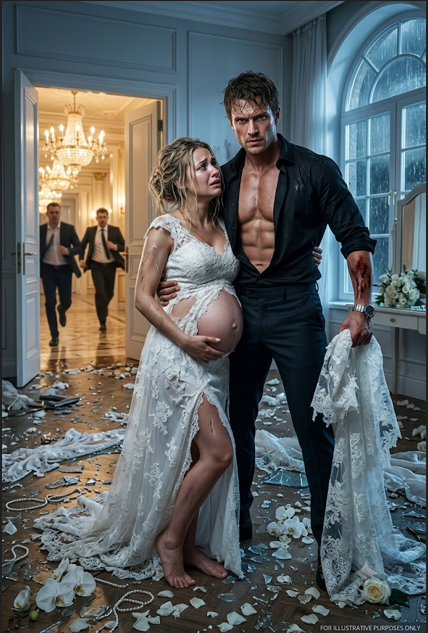
Nicholas crossed the room and knelt in the broken glass without looking down. “Did he know?”
“He came in twenty minutes ago. He saw it before I could hide it.”
Nicholas reached toward her. When his fingers brushed her arm, she flinched. The movement was small but instinctive, and it emptied the last restraint from his face. He gently took her wrist and turned it toward the light. The bruises were fresh. Four dark marks and a thumb. A man’s grip.
“Clayton did this.”
“Nicholas, please listen to me.”
“Did Clayton Voss put his hands on you?”
Her tears spilled before her answer did. “Yes.”
The single word changed the temperature of the room. Vincent, standing just inside the doorway, lowered his chin. Nicholas did not raise his voice. That would have been easier to bear. Instead, he became very still.
“Tell me why he is still breathing.”
Amelia grabbed his lapels with desperate strength. “Because if you hurt him, my father goes to federal prison.”
Nicholas looked at her hands clutched in his suit, at the engagement ring Clayton had placed on her finger, at the bruises around her wrist. He forced himself to remain kneeling. “Start at the beginning.”
“There isn’t time.”
“Make time.”
She drew a breath that shook so badly he could feel it through her hands. “My father’s accounting firm handled oversight reports for the municipal pension fund. Four million dollars disappeared last year through a shell company. Dad found irregularities and was preparing to go to the state comptroller, but his partner, Evan DeLuca, vanished. Clayton’s office opened an investigation. Suddenly Dad’s signature was on transfer approvals he swears he never signed.”
Nicholas’s eyes sharpened. “Voss found the paper trail.”
“Clayton said he could bury the charges if I married him. He said my father was old, tired, and would die in prison before his appeal reached court. He needed a wife for his attorney general campaign. A surgeon from a respected family. Someone clean enough to make him look decent.” Amelia laughed once, brokenly. “He said I was useful because people already knew I had left you. Marrying him would look like a redemption story.”
Nicholas’s gaze flicked to Vincent. Vincent stepped back into the hall, already pulling out his phone.
Amelia noticed. “No. Don’t. Clayton has detectives downstairs. He has warrants ready. He said if I embarrassed him today, he’d have Dad arrested before the reception.”
“Your father isn’t at home,” Nicholas said.
She stared at him. “What?”
“I had him moved before I came upstairs.”
“Nicholas.”
“I told you I would always watch over you.”
“That was not permission to abduct my father.”
“He came willingly after my people showed him the fake warrant Voss prepared. He’s in a safe house outside Beacon with a retired federal marshal and a bottle of Scotch he has apparently decided is beneath him.”
For the first time since Nicholas entered the room, something like air reached Amelia’s lungs. It did not become relief yet. Fear had owned her for too long to surrender quickly.
“You knew?” she whispered.
“I knew Voss had leverage. I didn’t know it was you.”
“Why were you looking into him?”
Nicholas’s mouth tightened. “Because a clean man doesn’t invite me to watch him marry the woman I love unless he thinks he has a knife at my throat.”
The word love landed between them with almost unbearable weight. Amelia shut her eyes. Nicholas had never said it easily when they were together. He had shown it with bulletproof glass, private doctors, midnight coffee, and men stationed two blocks from her hospital who never let her see them. But words had frightened him more than enemies. Now he gave the word away when everything was already ruined.
“He said the baby would be his,” Amelia whispered. “He told me I would walk down the aisle, smile for the cameras, and announce a honeymoon pregnancy in two months. He said if I ever told anyone the truth, he would destroy Dad and reopen every investigation into you until our child was born behind prison glass.”
Nicholas lowered his head for one second. When he looked up, his eyes held no rage that Amelia could see, only decision.
“You are not walking down that aisle.”
“Nicholas, he has the whole estate locked down.”
“So do I.”
“Please don’t make this a war.”
“It became a war when he touched you.” His voice softened before she could recoil. “But I hear you. No bodies. No blood. Not today.”
That was when the first false twist arrived.
A knock came at the open door, polite and horrifyingly calm. Clayton Voss appeared in the doorway wearing a white tuxedo jacket, his blond hair perfectly styled, his public smile restored so completely that Amelia wondered if she had imagined the man who had shaken her hard enough to bruise. Behind him stood two plainclothes detectives and a bridesmaid whose face had been drained of color.
“There you are,” Clayton said, as if speaking to a child who had wandered too far at a department store. His eyes moved from Amelia to Nicholas kneeling before her, and the smile thinned. “This is awkward.”
Nicholas rose. “That depends on how attached you are to walking.”
Clayton gave a soft laugh for the benefit of the detectives. “Threatening the district attorney at his own wedding. That’s bold, even for you.”
Amelia tried to stand. Nicholas helped her without taking his eyes off Clayton. His suit jacket came off in one smooth movement and settled around her shoulders, covering the torn gown and bruises. Clayton’s eyes noticed the gesture. Hatred flashed before he smothered it.
“Amelia,” Clayton said, his voice sharpening, “come here.”
She did not move.
The detectives noticed. One shifted uncomfortably. Clayton saw that too and adjusted his tone back to velvet. “Sweetheart, everyone is waiting. You’re emotional. That’s understandable. Weddings are overwhelming. Mr. Rourke has no place here.”
“He has more place here than you do,” Amelia said.
Her voice trembled, but it held.
Clayton’s smile died.
“There it is,” he said quietly. “The bad judgment I warned your father about.”
Nicholas stepped forward. Clayton lifted one hand. “Careful. There are cameras in this wing. Audio too. If you assault me, every news station in America will have footage before the cake is cut.”
Nicholas smiled then, and it was not pleasant. “You put cameras in the bridal suite?”
Clayton’s eyes flickered.
The second false twist landed harder because Amelia felt it before she understood it. Clayton had recorded everything. Not just this moment. Perhaps the argument. Perhaps the pregnancy test. Perhaps her crying. He had wanted proof, leverage layered over leverage, enough to edit any story he needed.
Nicholas turned slightly. “Vincent.”
From the hall, Vincent answered, “Already found the feed. It runs through a private server in the catering office.”
Clayton’s jaw tightened. “That equipment belongs to my campaign.”
“Not anymore,” Vincent said.
The detectives looked at each other. One of them, a heavyset man with tired eyes, lowered his hand from his radio. Clayton saw his authority slipping and changed tactics.
“Amelia,” he said, cold enough now that no one could mistake it for concern, “your father signed those transfers. I have certified copies. I have witness statements. I have enough to put him away for twenty years. Whatever Rourke promised you, he cannot save Arthur from documents that already exist.”
Nicholas took one step closer. “Documents can be forged.”
“Try selling that to a jury after I tell them the city’s most notorious crime family manufactured a defense.”
“Who said anything about a defense?”
Clayton blinked.
Nicholas reached into his jacket. Both detectives tensed. He withdrew a slim black phone and turned the screen toward Clayton. The display showed a live video call. Arthur Hart sat in a modest room with wood-paneled walls, wearing a cardigan over his dress shirt. His silver hair was uncombed, his expression exhausted but very much alive. Beside him sat a woman in a navy suit Amelia recognized from old newspaper interviews: Marjorie Bell, former chief of the Public Corruption Unit for the Southern District of New York.
Amelia gasped. “Dad?”
Arthur leaned toward the camera. “I’m all right, Millie.”
Clayton’s face changed in a way no campaign consultant could have trained out of him. For one second, he looked like a cornered animal.
Marjorie Bell spoke next. “Mr. Voss, I should inform you that Mr. Hart has been cooperating with federal authorities for the past six weeks.”
Amelia went still. Nicholas looked at her, and she saw then that even he had not known everything.
“What?” she whispered.
Arthur’s eyes filled with pain. “I tried to tell you, but Clayton had my phone watched. Evan DeLuca didn’t just disappear. He came to me afraid. He said the district attorney’s office was using pension contracts to funnel money through Aegis North Holdings. Before Evan could testify, he vanished. I signed nothing, sweetheart. I kept copies of everything.”
Clayton lunged forward. “Shut that off.”
Nicholas did not move. “You’re not giving orders in this room anymore.”
Marjorie Bell continued, calm and merciless. “We have the original transfer metadata, emails from your campaign server, and a recorded conversation in which you instructed Mr. DeLuca to forge Arthur Hart’s authorization. What we did not have until today was evidence that you used the pending investigation to coerce a witness’s daughter into marriage.”
Clayton’s gaze snapped to Amelia. In that instant, the mask fell entirely.
“You stupid woman,” he hissed. “Do you know what you’ve done?”
Nicholas was on him before the detectives could react. He did not punch him. He did not draw a weapon. He caught Clayton by the front of his white tuxedo and slammed him against the wall with enough force to rattle the mirror. The detectives reached for their holsters, but Vincent and two of Nicholas’s men appeared in the doorway, hands visible, bodies calm. The message was clear. No one needed to escalate, but everyone could.
Nicholas leaned close to Clayton. “She did what you thought she couldn’t. She survived you.”
Clayton’s breath shook. “You think you win because you have some files? I am the district attorney. I decide who gets charged.”
A new voice answered from the hallway. “Not today.”
Special Agent Rebecca Sloan entered wearing a raincoat over a plain black suit, a federal badge in her hand and no patience in her face. Behind her came four agents and two state investigators. The bridesmaid who had been standing frozen at the doorway began to sob from relief.
Clayton stared at the badge as if it were an insult.
Agent Sloan looked at Nicholas first. “Mr. Rourke, step away.”
For one breath, the hallway held its future in silence. Nicholas could have refused. Everyone knew it. Clayton knew it most of all. The old Nicholas Rourke would have dragged the man somewhere dark and handled justice with the brutal certainty of the docks. But Amelia’s hand found his arm. Her fingers rested there, light and shaking.
“Nicholas,” she said softly.
He released Clayton and stepped back.
That small surrender changed everything.
Agent Sloan turned to Clayton. “District Attorney Clayton Voss, you are under arrest for extortion, witness tampering, wire fraud, obstruction of justice, and conspiracy to commit public corruption.”
The words traveled down the corridor like a crack through ice. One detective cursed under his breath. The other raised his hands and stepped away from Clayton as though corruption might stain by proximity. Clayton looked past the agents, down the hallway toward the ballroom where two hundred guests waited for a wedding that had never been real.
“You can’t do this here,” he said.
Agent Sloan’s mouth tightened. “You chose the venue.”
Clayton’s arrest did not become a bloodbath. That was what saved the story from becoming another legend whispered in the wrong bars. There were no gunshots, no bodies under tarps, no screaming guests pushed aside by men with black gloves. There was only the click of handcuffs closing over a white tuxedo, the stunned silence of power watching one of its own taken away, and Amelia Hart standing barefoot in a ruined gown with Nicholas Rourke’s jacket around her shoulders.
The ballroom doors opened just as the agents led Clayton through.
At first, the guests thought it was part of the ceremony. Cameras turned. The string quartet faltered into a wrong note. Then the room saw the handcuffs. They saw Clayton’s face. They saw Amelia behind him, pale and shaking, and Nicholas beside her like a shadow that had chosen to stand in the light.
A senator whispered, “Dear God.”
Clayton’s campaign manager dropped his phone.
Nicholas did not look at the guests. Amelia did. She had spent three months being told her father’s freedom depended on her silence. She had been fitted into a dress chosen for television, coached to smile, instructed on where to place her hand over Clayton’s arm. Shame had been Clayton’s strongest weapon, because shame made victims lower their heads.
Amelia lifted hers.
“My father is innocent,” she said, and though her voice was not loud, the microphones waiting for wedding vows caught it. “Clayton Voss framed him, blackmailed me, and tried to force me into this marriage. There will be no wedding today.”
A murmur surged through the room. Reporters disguised as society guests began reaching for phones. Clayton turned, fury twisting his face, but Agent Sloan pushed him forward.
Nicholas looked down at Amelia. “You don’t owe them anything else.”
“I know.” She drew one breath, then another. “That was for me.”
He nodded once.
Outside, rain came down hard enough to blur the estate lights. Vincent brought the SUV to the east entrance, and Nicholas guided Amelia through a side hall to avoid the crush of guests. She moved slowly, one hand on his arm, the other on her stomach. The adrenaline that had kept her upright began to drain with every step, leaving exhaustion so deep that her knees trembled.
In the vehicle, the heat was already on. Nicholas helped her out of the ruined gown as carefully as a man could manage without looking where he had no right to look. He wrapped her in a soft gray sweater from the emergency bag he kept in every car, then covered her legs with a blanket. She laughed weakly when he handed her a bottle of water instead of the whiskey he poured for himself.
“You remembered,” she said.
“You hate sparkling water unless you’re nauseous.”
“I meant the emergency clothes.”
“I remember everything you leave behind.”
The sentence hurt them both. For a while, neither spoke. Rain hammered the roof. The SUV rolled down the long drive past white roses bending under the storm. Behind them, Bellemont House dissolved into flashing blue lights and scandal.
Amelia rested her head against the seat and closed her eyes. “I thought you would kill him.”
“So did I.”
“Why didn’t you?”
Nicholas looked at the glass in his hand but did not drink. “Because you asked me not to.”
“That never stopped you before.”
“No.” His voice grew rough. “But before, I thought protecting someone meant removing the threat by whatever means worked. Tonight I saw your face when I moved toward him. You weren’t afraid of him then. You were afraid of what I might become in front of you.”
Amelia opened her eyes.
Nicholas set the glass aside. “I can’t promise I’ll become a good man because I held back once in a hallway.”
“I’m not asking for a fairy tale.”
“You deserve one.”
“I’m a trauma surgeon in New York. I gave up fairy tales sometime during residency.” She touched the bruise on her wrist and winced. “I want the truth.”
He looked at her then, fully. “The truth is that I love you. I loved you badly before. I loved you with guards you didn’t ask for, secrets you couldn’t consent to, and decisions I made because I thought fear made me wiser. When you left, I told myself I had protected you by letting you go. But I didn’t protect you from Clayton. I didn’t protect you from being alone.”
“You couldn’t have known.”
“I should have asked.”
Amelia’s eyes filled. “I wouldn’t have answered.”
“Then I should have kept asking in ways that didn’t make you feel owned.”
That word opened a door between them. Owned. Clayton had used it. Nicholas had once lived too close to it without understanding the difference between protection and possession. Amelia looked down at her stomach, where their child existed as a fact too profound to fit inside the chaos of one day.
“She’s yours,” she said.
Nicholas went still. “She?”
“I don’t know. It’s just what I’ve been thinking.” A tear slipped down her cheek. “I was afraid to imagine too clearly.”
Nicholas’s hand hovered above the blanket. He did not touch her stomach until she took his wrist and guided him there. His palm settled over the small curve, careful, almost reverent. The man who had made judges sweat and rival bosses disappear looked undone by the possibility of a heartbeat too small to hear.
“I missed eighteen weeks,” he said.
“You didn’t know.”
“I missed them because I built a life where you were safer keeping secrets from me.”
The honesty mattered more than an apology would have. Amelia covered his hand with hers. “Then build a different life.”
His eyes lifted.
“For her,” Amelia said. “For me. For yourself, if you can stand it.”
The SUV turned onto the highway, heading south toward the city at first, then east. Nicholas had already arranged for Arthur to be moved to a secure house near the water, but the old plan no longer fit. Plans made by fear rarely survived contact with truth.
“We’ll go to the Hamptons tonight,” he said. “Your father is there. Agent Sloan will send a doctor to examine your wrist and document the bruises. Tomorrow, Marjorie Bell will file a statement clearing Arthur publicly. You can decide what you want to say after that.”
“And you?”
He understood the question beneath the question. Amelia was not asking where he would sleep. She was asking what kind of father their child would have. What kind of man would stand beside her after the scandal faded and the tabloids found a new carcass.
Nicholas leaned back, looking suddenly older than his forty years. “There are parts of my business I can unwind. Shipping, warehouses, unions, legitimate contracts. There are parts that will fight back if I cut them loose too quickly. I won’t lie and say I can walk away by sunrise. Men like me don’t get clean because we want a nursery.”
Amelia listened without flinching.
“But I can start,” he continued. “I can give federal prosecutors what they need on Voss’s network. Not my people. Not all at once. But the judges, cops, and contractors who used the same routes he did. I can move my companies into daylight piece by piece. I can make sure our child inherits my name without inheriting my sins.”
“That sounds dangerous.”
“It is.”
“So was staying the same.”
A faint, humorless smile touched his mouth. “You always did have a surgeon’s talent for cutting straight to the damage.”
“You always did confuse pain with proof something mattered.”
For the first time that day, Nicholas almost laughed. The sound did not quite become joy, but it was alive.
By the time they reached the estate near Southampton, the storm had softened into cold mist. The house was not the fortress Amelia expected. It had gates, cameras, and men posted discreetly along the drive, but beyond them stood a weathered cedar-shingled home facing the Atlantic, its windows glowing warm against the darkness. It looked less like a crime lord’s refuge than a place someone might heal if they were brave enough to stop running.
Arthur Hart met them in the foyer.
He crossed the room faster than a seventy-year-old accountant should have been able to manage and folded Amelia into his arms. She broke then, not dramatically, not the way people broke in films, but with the exhausted collapse of someone who had been holding up a ceiling alone. Arthur held her and said, “I’m sorry,” over and over until she finally whispered, “You’re here,” as if that was the only apology she needed.
Nicholas stood back. He had never known what to do with family tenderness except guard the door while it happened.
Arthur looked over Amelia’s shoulder at him. The old man’s eyes were red, but steady. “Mr. Rourke.”
“Nicholas.”
“You saved my daughter.”
“I should have done it sooner.”
Arthur studied him for a long moment. “Yes.”
Amelia stiffened. Nicholas accepted the blow with a nod because it was deserved.
Arthur continued, “But you came today. And you let the law take Clayton when you could have made him vanish. I don’t know if that makes you good, but it makes today different than it might have been.”
“It has to be different,” Nicholas said.
Arthur’s gaze dropped briefly to Amelia’s stomach. His face changed. “Millie?”
She nodded, tears returning in a gentler form. “Eighteen weeks.”
Arthur pressed a hand over his mouth. “Oh, sweetheart.”
Nicholas expected accusation. He would have accepted it. Instead, Arthur touched Amelia’s hair and said, “Then we have more to protect than our reputations.”
Those words became the first brick in a new foundation.
The next two weeks were not romantic in the way scandal sheets would later try to make them. There were lawyers, doctors, federal interviews, and nightmares. Amelia’s bruises turned yellow at the edges. She woke some nights with her hand pressed to her stomach, convinced she was back in the bridal suite and Clayton was outside the door. Nicholas learned not to touch her awake from fear. He learned to sit beside the bed and speak softly until the room returned to her.
Clayton Voss’s fall consumed the city. The first headlines called it a wedding-day arrest. The second wave called it a corruption scandal. By the third, reporters had found the pensioners whose money had been stolen, retired teachers and transit workers and sanitation employees whose futures had been treated as campaign fuel. Amelia watched one interview with a widow from Queens who said she had delayed surgery because her pension adjustment never arrived. Amelia turned off the television and cried for a woman she had never met.
Nicholas saw it. That night, he called Vincent into the study.
“I want a restitution fund,” he said.
Vincent blinked. “For the pension case?”
“For every retiree touched by Aegis North. Quietly at first. Through Marjorie Bell, if she’ll structure it.”
“That’s millions.”
“It’s money stolen through routes we should have seen.”
“We did see some of it.”
“Too late.”
Vincent watched him with the careful stillness of a man seeing the ground move beneath an empire. “This about the baby?”
Nicholas looked toward the closed study door. Beyond it, Amelia slept under doctor’s orders with one hand curled beneath her cheek. “This is about the baby asking one day what I did when I learned the world was already broken.”
Vincent nodded slowly. “Then we start with the fund.”
“No.” Nicholas opened a drawer and removed three ledgers bound in black leather. They were older than Voss, older than the pension theft. Routes, names, payments, judges, union fixers, police captains. A map of rot. “We start with this.”
Vincent’s face went hard. “Those ledgers hold up half the city.”
“Then half the city has been leaning on the wrong thing.”
“You hand those over, some of our friends become enemies.”
Nicholas closed the drawer again. “They were never friends.”
The true climax of Nicholas Rourke’s life did not happen in a hallway with his hand around Clayton Voss’s throat. It happened in a quiet study at 2:13 a.m., when he chose to become less untouchable so his child might become more free. It was not clean. It was not immediate. It was not the kind of redemption that erased blood. But it was a beginning, and beginnings mattered because every terrible dynasty in America had once depended on someone claiming change was impossible.
Three months later, Amelia stood in a federal courthouse in lower Manhattan and testified in a closed preliminary hearing. She wore a navy dress, flat shoes, and no jewelry except her mother’s small gold cross. Nicholas sat behind her, not close enough to crowd her, not far enough to leave her alone. When Clayton’s attorney suggested she had invented coercion because she was still involved with a known criminal, Amelia looked at the man with the calm fury of every woman who had ever been told her fear was inconvenient.
“I did not invent the bruises,” she said. “I did not forge the recordings. I did not steal city pension funds, and I did not force Clayton Voss to threaten my father. The fact that another man has done wrong in his life does not make Clayton innocent of what he did to me.”
The courtroom went silent.
Nicholas looked down, hiding the fierce pride in his face.
Outside, the press shouted questions. “Dr. Hart, are you and Nicholas Rourke together?” “Mr. Rourke, are you cooperating with federal authorities?” “Is it true the Rourke companies are restructuring?” “Did Clayton Voss know about the pregnancy?”
Amelia stopped at the courthouse steps. Nicholas leaned close. “You don’t have to answer.”
“I know.”
She faced the cameras. Her stomach was visible now beneath her coat, undeniable and no longer hidden. “I will not discuss my child for headlines,” she said. “I will say this. I was coerced, my father was framed, and a powerful man thought public admiration would protect him from private cruelty. It did not. If anyone watching this is being threatened into silence, tell one person who can help you. Shame belongs to the person using fear, not the person surviving it.”
The clip traveled farther than any wedding video Clayton had planned. It reached hospitals, law offices, police departments, and homes where people watched with the sound low because someone dangerous was in the next room. Amelia received letters by the hundreds. Some she could not read without stopping. Some she brought to Nicholas because he needed to understand that protection was not only force; sometimes it was building a world where people believed the first cry for help.
Winter came early that year. By Christmas, Clayton Voss had been indicted on twelve federal counts. Arthur Hart’s name was cleared. Evan DeLuca, found alive in Arizona under federal protection, testified that Voss had threatened his family. Three corrupt detectives resigned before they could be fired. A judge Nicholas had once paid through intermediaries took an abrupt medical leave, then found himself named in an investigation that did not care about his blood pressure.
The Rourke organization did not become pure. Nicholas never insulted Amelia by pretending it did. But docks once used for quiet shipments became audited logistics centers. Men who had depended on fear found their services no longer required. Some left angry. Some tried to test the new order and discovered Nicholas was still dangerous, only more disciplined. He did not become gentle. He became accountable, which was harder.
On a cold January morning, Amelia found him in the nursery assembling a crib with the grim concentration of a man defusing a bomb. The instructions lay open on the floor. Two screws had rolled beneath the rocking chair. Nicholas, wearing rolled-up sleeves and a scowl worth millions, held one wooden rail in place with his knee.
“You know,” Amelia said from the doorway, “we could hire someone.”
“We are not outsourcing her first bed.”
“You run shipping companies.”
“I don’t see how that qualifies me to understand Swedish furniture.”
“It’s from Ohio.”
“That explains the aggression.”
Amelia laughed, one hand on the curve of her stomach. The sound filled the room in a way no security system could have managed. Nicholas looked up, and something in his face softened so completely that she had to look away for a second.
“What?” he asked.
“I used to think safety meant a clean house, clean hands, clean reputation. Then Clayton happened, and I thought maybe safety was just power standing between me and the worst thing in the room.” She walked to him and touched the half-built crib. “Now I think safety is this. Someone trying to build something correctly even when he could pay the world to do it for him.”
Nicholas set the rail down. “That may be the most generous description of incompetence anyone has ever given me.”
“I’m serious.”
“So am I.” He stood carefully, wiping his hands on a cloth. “I don’t know how to be her father yet.”
“No one does before the baby comes.”
“My father taught me fear before he taught me my own address.”
“You’re not your father.”
“I hear his voice sometimes.”
“Then answer with yours.”
Nicholas absorbed that. Amelia had a way of making mercy sound like an order.
He took a folded paper from his pocket and handed it to her. “I signed the final transfer this morning. The restitution fund is fully financed. The first payments go out next week.”
Amelia read the document. Her eyes blurred. “This is more than what was stolen.”
“Interest,” he said.
“This says the fund is named after your mother.”
“She spent twenty-six years married to a man who treated kindness like a defect. She hid cash in flour tins for women in our neighborhood who needed bus fare out. I thought it was weakness when I was young.” He looked around the nursery, at the pale walls, the empty crib, the small stack of folded blankets. “I understand it differently now.”
Amelia rose on her toes and kissed him. It was not desperate like Chicago, not frantic like the escape from Bellemont, not haunted by all the things they were afraid to say. It was quiet. It was chosen.
Their daughter was born during a February snowstorm while the city outside turned soft and white. Amelia labored for eighteen hours with the same stubborn focus she brought to surgery. Nicholas stayed beside her through every minute, letting her crush his hand until Vincent, waiting outside with Arthur, later noted that the boss appeared to have lost feeling in two fingers and considered it an honor.
When the baby finally cried, Nicholas did not speak. He looked at the tiny red-faced child placed on Amelia’s chest and wept with the silent shock of a man who had expected love to arrive as a command and instead found it helpless, furious, alive, and smaller than his forearm.
“What’s her name?” the nurse asked.
Amelia looked at Nicholas.
He touched the baby’s dark hair with one careful finger. “Grace,” he said, voice breaking. “If your mother agrees.”
Amelia smiled through exhaustion. “Grace Maren Rourke.”
Arthur, allowed in a few minutes later, cried openly. Vincent stood in the doorway pretending he was not. The retired federal marshal who had somehow become part of the family sent flowers. Marjorie Bell sent a handwritten note that said only, Raise her honest. Agent Sloan sent nothing, but the next week a final batch of documents arrived through proper channels that made Nicholas’s lawyers very busy and very nervous, which he took as her version of congratulations.
Months later, when spring returned to the Hudson Valley, Amelia and Nicholas married without cameras in the garden behind the Southampton house. There were no white roses imported by the thousands, no senators pretending virtue, no campaign manager counting angles. Arthur walked Amelia across wet grass. Vincent held Grace and looked more terrified of dropping her than he had ever looked facing armed men. The officiant was a retired judge with a clean record and a fondness for brief ceremonies.
Nicholas wore a dark suit. Amelia wore a simple cream dress and carried no bouquet because Grace had fallen asleep clutching her finger and she refused to move.
When it was time for vows, Nicholas did not promise to burn the world. He had said things like that before, and though part of him still meant them, he understood now that fire was not the same as shelter.
“I once thought love meant standing between you and every danger,” he said. “Then I learned love also means listening when you tell me I have become one. I cannot give you a spotless past. I cannot pretend there is no darkness in me. But I can give you truth, choice, and every day of work it takes to build a life our daughter does not have to escape. I choose you without owning you. I protect you without caging you. I love you without making fear the price.”
Amelia’s eyes shone. When she spoke, her voice carried over the garden with the steady strength he had loved from the beginning.
“I once thought leaving was the only way to survive you. Then I learned survival is not the same as living, and goodness is not proven by the color of a man’s suit or the applause he receives in public. You frightened me because your world was dangerous. You changed me because, when it mattered most, you chose not to let that danger decide for you. I choose the man who came through the locked door, but I also choose the man who stopped at my voice. I choose the father who is learning. I choose the future we build honestly, even when honesty costs us.”
Grace woke halfway through the kiss and began to cry, which everyone agreed was the most appropriate possible objection.
The newspapers eventually moved on. Clayton Voss pleaded guilty after two co-conspirators turned state’s evidence. He did not disappear into a harbor. He disappeared into a federal prison system that did not care how well he once photographed. Arthur returned to accounting part-time, mostly to annoy younger auditors by being right. Amelia went back to surgery after maternity leave, not because she had to prove strength, but because healing had always been her calling. Nicholas kept dismantling what needed dismantling and legitimizing what could be saved, one hard confession and one harder signature at a time.
He remained feared. Some doors still opened because men remembered old stories. But at home, Grace learned him differently. She learned his hands as the ones that warmed bottles, fastened tiny shoes, and held picture books upside down until she shrieked with laughter. She learned her mother’s voice as the one that filled rooms with truth. She learned her grandfather’s pockets always contained peppermints. She learned Uncle Vincent could be defeated by a toddler with a ribbon.
Years later, when Grace was old enough to ask why there were no pictures from the day her parents were supposed to marry other people, Amelia told her the gentlest version first. She said there had been a man who wanted to use fear to build a beautiful lie, and there had been a locked room, and there had been a choice.
“What choice?” Grace asked.
Nicholas, standing in the doorway with gray beginning at his temples, answered before Amelia could.
“To open the door,” he said. “And then to become the kind of man who deserved to be on the other side of it.”
Amelia looked at him then with the same fierce tenderness that had once saved him from himself. Grace did not understand all of it yet. One day she would. One day she would learn that her life had begun in scandal but not shame, danger but not defeat. She would learn that love was not proven by possession, and protection without respect was only another cage. She would learn that even men born into darkness could choose, again and again, to carry someone toward the light.
And Nicholas Rourke, who had once gone to a wedding to say a final silent goodbye, spent the rest of his life grateful that Amelia had been brave enough to cry behind a locked door, and that he had been just human enough to hear her.