“Why this facility?” he asked carefully. “There are cheaper ones farther south.”
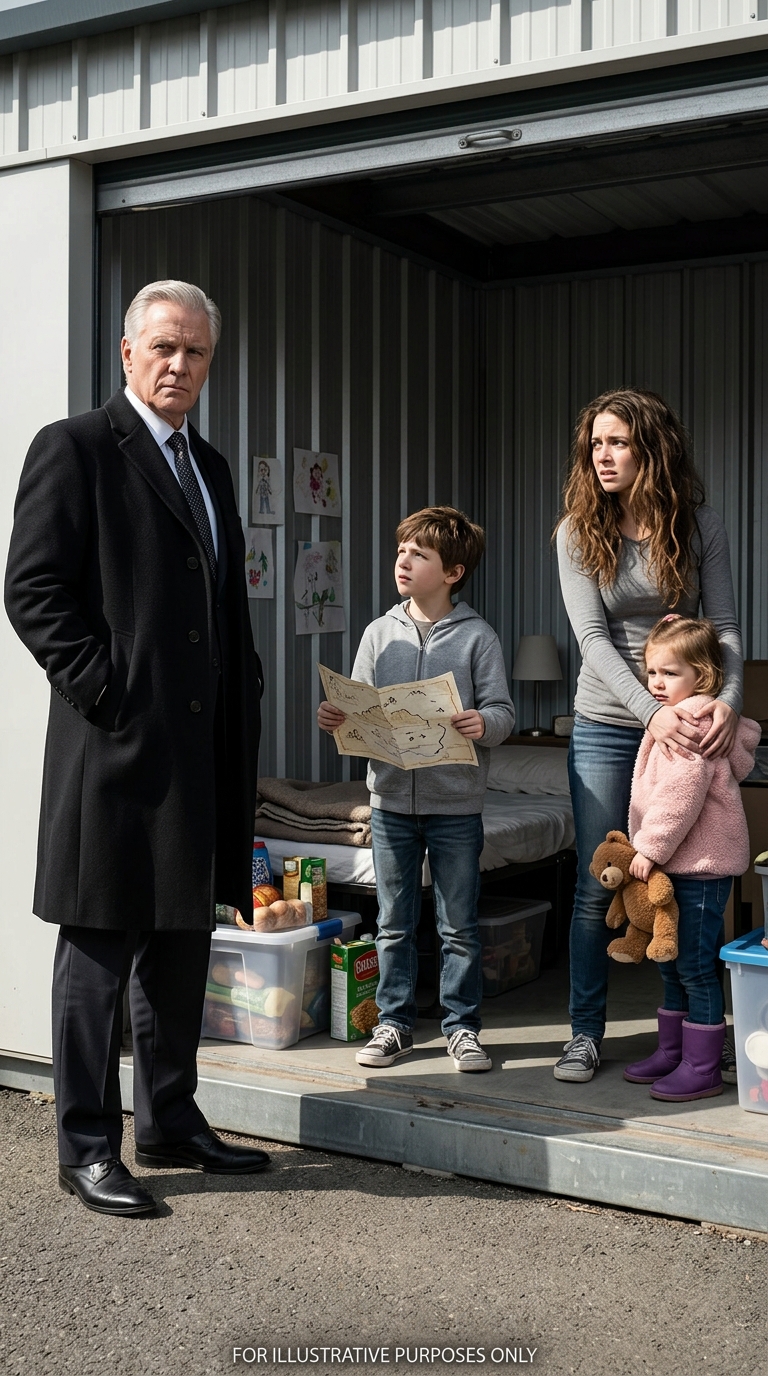
Marissa gave him the first look that held something other than suspicion. It was almost respect, though not quite. He had found the right question.
“I looked at fourteen.”
Grant turned his head. “Fourteen storage facilities?”
“Between one-fifty and two hundred a month. Six were too far from Jefferson. Three were on routes I wouldn’t walk alone at night. Two didn’t have a public bathroom close enough for Ellie. That left three. This one was four blocks from the school and one-point-three miles from the warehouse.”
“Jefferson mattered that much?”
“My son couldn’t read.”
She said it bluntly, because softening it would have made it harder. Mason had changed schools four times in two years. Every new school started the evaluation process from the beginning. Every teacher promised to look into it. Every move erased the promise. By the time he entered Jefferson, he was in fifth grade reading at a second-grade level. Jefferson had an after-school literacy program funded through a federal grant. Three afternoons a week, Miss Waverly sat with him until the letters stopped swimming. In seven months, Mason had climbed nearly two reading levels.
Marissa’s voice remained steady, but her fingers dug into the denim at her knees. “I didn’t choose a storage unit, Mr. Calder. I chose the distance between my son and the only classroom that was teaching him to read.”
Grant looked away.
The sentence did not simply move him. It entered a locked room inside him and turned on the light.
He did not tell Marissa yet. Some memories cannot be offered too quickly without turning someone else’s pain into your confession. But as he sat beside her on the concrete step, he was no longer fully in the present. He was seven years old again, lying across the back seat of a brown Ford Pinto behind Mount Olive Baptist Church on Scott Street while his mother, Lorraine Calder, pressed his school shirt on the hood of the car with a travel iron plugged into an outdoor church outlet.
His mother had lost their apartment in 1981 after the diner cut her shifts. She had packed his clothes, his homework, a dented tin box, and two blankets into the Pinto. They lived in that car for eighty-three days. She chose the church parking lot because it was two blocks from his elementary school. Every morning, she woke him before dawn, walked him to the gas station bathroom to wash, ironed his shirt, and sent him into class looking like he belonged there. No one knew. That had been by design.
He had spent forty years turning that memory into a success story. He had told himself hardship made him disciplined. He had told himself his mother’s struggle explained his ambition. He had never asked what kind of man he had become once the ambition worked.
Now, in one of his own facilities, another mother had made the same calculation. Different decade. Different child. Same map.
Earl took Grant to Unit 14A later that morning. It belonged to Ruth Mae Banks, seventy-one, retired cafeteria worker, widow, cancer survivor, and the only tenant who had known Marissa’s secret from the first month.
Ruth Mae sat outside her unit in a folding chair, wearing a pressed yellow blouse and white sneakers so clean they looked ceremonial. Behind her, Grant saw a cot, a hot plate, a kettle, two grocery bags, and a small framed photograph of a man in a mechanic’s uniform. The extension cord running under the door violated at least four company policies.
Grant looked at Earl.
Earl shrugged slightly. “I was going to get to that.”
Ruth Mae snorted. “No, you were not.”
Grant almost smiled, but the moment did not allow it.
She told him she had heard Ellie crying through the wall one night. Not loud crying, but the quiet kind children do when they are trying to be brave and failing. Ruth Mae had knocked twice on the metal. After a long silence, two knocks came back. That was the beginning. Two knocks between two women living in storage units for different reasons, agreeing without words that the wall between them was also a promise.
“She used my hot plate,” Ruth Mae said. “I watched the little girl when the boy had tutoring and Marissa’s shift ran late. Sometimes I gave them soup. Sometimes she refused it until I told her I made too much and would throw it out, which was a lie, and she knew it was a lie, but we both respected the performance.”
Grant asked, “Why didn’t you report it?”
Ruth Mae looked at him as if he had asked why she breathed air. “A mother does not choose where she lives. She chooses where her children can still become something. I wasn’t going to take that choice from her.”
The sentence struck Grant hard enough that he felt it physically.
Ruth Mae was not finished. “And before you look at me like I’m only some rule breaker, you should ask why an old woman with a paid-off house ended up sleeping beside boxes in one of your metal closets.”
Grant did not look away. “Why?”
“My husband died in 2015. Cancer came for me the next year. The treatment worked. The bills did not. I sold the house to pay what insurance wouldn’t cover, then rent went up faster than Social Security. One diagnosis can turn a homeowner into a tenant. One rent increase can turn a tenant into a woman with a hot plate in Unit 14A.”
She said this without self-pity, which made it harder to hear. Anger would have given Grant something to resist. Plain truth did not.
That afternoon, Grant rode back across Houston in the Escalade, but he did not open his iPad. The quarterly report sat beside him with Facility 47 still marked for sale. The land value had risen. The occupancy rate was weak. Maintenance costs were up. Selling was the clean decision. It was the decision his board would understand, the decision his operations team expected, the decision the spreadsheet had already made.
Then he thought of Mason’s map.
He thought of Marissa counting fourteen dollars in a cookie tin, though he had not seen her do it. He simply knew she did. His mother had counted money the same way each morning from a dented tin box in the glove compartment of the Pinto. He remembered the pressure of the clasp. He remembered her hands. He remembered that she had never cried in front of him, and for the first time he understood that not crying had been labor.
A sentence he had spoken that morning returned to him with new cruelty.
Every unit that isn’t generating revenue is costing me money.
He had said it in this very car. He had said it as if it were wisdom.
Now he heard what it meant when the unit contained a mother, two children, a library book, a bleach bottle, and a map from US to SCHOOL.
Grant picked up his phone and made five calls.
The first was to his vice president of operations. “Remove Facility 47 from the disposition list.”
His VP paused. “Grant, the numbers support sale.”
“I know what the numbers support. Remove it.”
“We already have buyer interest.”
“Then disappoint them.”
The second call was to his general counsel. He wanted emergency options that did not begin with eviction and did not involve police unless there was an immediate safety threat. His counsel started explaining liability. Grant cut him off.
“I know the liability of letting people live in units. I’m asking about the liability of pretending they don’t exist until they die.”
There was silence on the line. Then the attorney said he would research housing partnerships by the end of the day.
“By three,” Grant said.
The third call went to a domestic violence legal aid director he had met at a fundraiser and forgotten until now. The fourth went to Jefferson Elementary, where he asked the principal what it would cost to expand the literacy program from three afternoons to five. The fifth call went to the corporate philanthropy director, a woman who had spent three years trying to convince him that “community investment” was not a decorative line in an annual report.
“This is not a press release,” Grant told her. “No photos. No naming rights. Find me a structure that pays for the program without turning those children into a story we use.”
She asked what changed.
Grant looked out at the freeway. “I opened the wrong door.”
Two days later, he sat with Marissa on the same back step and told her what he had found. Rapid rehousing might be possible. Legal aid could help enforce and revise her protective order. Jefferson would keep Mason in the literacy program even if her address changed. Ruth Mae qualified for a senior housing placement with medical debt counseling. Earl would not be fired.
Marissa listened without moving.
When he finished, she asked the only question that mattered. “What do you get?”
Grant had expected suspicion. He respected it. People who have survived offers learn that help often comes with hooks hidden in the ribbon.
He did not say redemption. That would have been too clean. He did not say forgiveness, because she did not owe him any. He did not say nothing, because that would have been dishonest.
“I get to stop being the man my mother would have been afraid of.”
Marissa looked at him then. Really looked.
Grant continued, not because he wanted sympathy, but because she deserved the truth behind the offer. “When I was seven, my mother and I lived in a car behind a church for almost three months. She picked that parking lot because it was close to my school. She ironed my shirt on the hood before sunrise so nobody would know. I built this company telling myself I understood hard choices. Yesterday I realized I had built a business that could punish the same choice my mother made.”
Marissa’s expression changed slightly. Not trust. Trust would take longer than one honest story. But her face softened around the edges of caution.
“I’m still going to verify everything myself,” she said.
“You should.”
“I’m not moving my children into anything I haven’t seen.”
“I wouldn’t ask you to.”
“And I don’t want my picture anywhere. Not on your website. Not in a brochure. Not at some rich-people lunch where everybody claps because you discovered poor people have children.”
Grant lowered his head. “Agreed.”
Marissa studied him. “You say that like you mean it.”
“I do.”
“People mean things in the moment.”
He accepted that too. “Then don’t believe the moment. Believe what happens next.”
It took three weeks. Marissa made every call herself. She confirmed the housing program, spoke with the legal aid attorney, visited the apartment, checked the locks, timed the bus route, walked the path to Jefferson with Mason and Ellie, and stood in the kitchen for ten full minutes before saying yes. Grant did not rush her. For once in his life, he understood that speed was a privilege. People with money called urgency efficiency. People without money called it danger.
On the morning Marissa moved out of Unit 14B, she packed seven months of life into three plastic bins. Mason school. Ellie school. Marissa work. The air mattress deflated with a tired sigh. The cooler was emptied and wiped. The adhesive lights left faint marks on the wall. The library book had already been returned on time.
Marissa opened the cookie tin and counted fourteen dollars. She had protected that amount through hunger, bus delays, school fees, and warehouse shift changes. It had remained untouched because touching it would mean the wall had fallen.
Mason watched her close the tin. “Are we taking it?”
“Yes,” she said. “Some things come with us.”
Ellie held Tuesday the rabbit and looked at the emptying unit with confusion. “Is the room sad?”
Marissa swallowed. “No, baby. The room did its job.”
Before leaving, Marissa sprayed the floor one last time with diluted bleach and mopped the concrete. Mason did not ask why. He understood. Clean was not about impressing the owner. Clean was proof that they had lived there without surrendering themselves to what the place wanted to make of them.
At the threshold, Mason removed the old map from his backpack. He placed it on the concrete ledge beside the door track. Then he pulled out a new map, folded into quarters.
Marissa saw the word at the top and went still.
This one did not begin with US.
It began with HOME.
The route was longer now, from the Gulfton apartment to Jefferson Elementary, with different dots: bus stop, park bench, library, Mrs. Ruth’s building, school. The handwriting was still uneven, but the word HOME was dark, pressed into the paper with certainty.
Mason looked embarrassed. “It’s not perfect yet.”
Marissa brushed a hand over his hair. “It doesn’t have to be.”
Grant came to the facility that afternoon after they were gone. Earl rolled up the door. Unit 14B was empty except for the faint smell of bleach and the adhesive marks on the wall where the lights had been.
“She mopped it before she left,” Earl said.
Grant nodded. He understood.
Then Earl pointed to the ledge. “The boy left something.”
Grant unfolded the map. The old route from US to SCHOOL lay in his jacket pocket, where he had carried it since the day he found it. Now he held the new one, from HOME to SCHOOL. Two maps. Same child. Same destination. Different starting point.
Grant stood in the empty unit for a long time.
Finally, Earl said, “You going to fire me?”
Grant looked at him. “No.”
“I broke policy.”
“You kept children alive until someone with more power finally paid attention.”
Earl’s face tightened. “That’s one way to put it.”
“It’s the correct way.”
“No,” Earl said quietly. “The correct way is that I did what I could and not enough. I should’ve known who to call. I should’ve had something better than looking away.”
Grant folded the new map with care. “Then we’ll build something better.”
Six months later, Calder Secure Storage had a new policy that made several executives uncomfortable and several attorneys nervous. When managers suspected someone was living in a unit, they were not to begin with enforcement. They were to contact a housing navigator funded through regional nonprofit partnerships. The goal was not to ignore danger or pretend storage units were homes. The goal was to create an exit that did not punish people for needing one.
Grant paid for the program, but he did not name it after himself. In Houston, Dallas, and Phoenix, housing navigators began visiting facilities quietly, offering information without police lights, without threats, without making frightened parents choose between exposure and another night outside.
Jefferson Elementary’s literacy program expanded to five afternoons a week through a private education fund named for Lorraine Calder. Grant never announced the name. He did not need applause for remembering his mother. He needed policy that would outlive his guilt.
Ruth Mae moved into a senior apartment three blocks from Marissa’s new place. It had a stove, but she kept her hot plate in the closet because, as she told Ellie, “You don’t throw away a thing that helped you survive. You let it rest.”
Marissa started a certified nursing assistant program at Houston Community College. She still worked full time, now on a day shift at a medical supply warehouse in Stafford. Day shift changed more than her schedule. It changed the shape of her fear. She came home while the sun was still up. She cooked dinner in a kitchen with a window. She locked a bathroom door and stood on the other side of it sometimes, doing nothing, simply appreciating the small mercy of a lock that belonged to her.
Mason kept reading. At first, he read quietly, lips moving without sound. Then one afternoon, Miss Waverly called Marissa and said, “He volunteered today.”
Marissa gripped the phone. “Volunteered for what?”
“To read out loud.”
Marissa turned toward the apartment window. Outside, traffic moved through the Houston heat. Inside, Ellie was coloring at the table, and the flashlight from Unit 14B sat on the bookshelf, retired but not hidden.
“Did he finish the page?” Marissa asked.
“He finished two,” Miss Waverly said.
Marissa said thank you, ended the call, and stood very still. She did not cry. Her hand went to the counter, fingers holding the edge the way Lorraine Calder’s hands had once held a steering wheel, the way women hold themselves together when the thing they prayed for arrives too gently to trust.
Grant visited only when invited. The first time he came to the apartment, he brought school supplies in a paper bag: notebooks, pencils, markers, two books from a list the librarian had recommended. Nothing expensive. He had learned that useful was kinder than impressive.
Ellie ran to the window when he arrived. “Mr. Grant, this room has a window.”
He looked at Marissa, who looked away quickly.
“Yes,” he said to Ellie. “It does.”
Mason stood in the hallway with his backpack still on, though school had ended an hour earlier. He watched Grant with the wary face of a boy who had learned that adults could remove places as easily as they promised them.
“Are you going to take this away too?” Mason asked.
The room went quiet.
Grant crouched, not too close, not touching him. “No.”
“People say that.”
“I know.”
“Then how do I know?”
Grant thought of contracts, deeds, accounts, all the papers adults used to make promises official. None of those would mean much to a ten-year-old who had lived behind a rollup door.
“You don’t know from me saying it,” Grant said. “You know from every month you wake up here and it’s still yours. I’m not asking you to believe the sentence. I’m asking you to watch what happens.”
Mason considered that. It was an answer built like his maps: not emotional, not magical, just a route that could be tested.
Then he took the small flashlight from his backpack. For seven months, it had been their morning sun, their reading lamp, their emergency signal. He placed it on the middle shelf of the empty bookcase.
Ellie gasped. “You’re putting it there?”
“I don’t need it in my bag anymore,” Mason said.
“Can I use it?”
“You can have it,” he told her. “But only if you put it back. It’s important.”
Grant saw Marissa’s face then. She was not crying, but the effort of not crying moved through the room like weather.
Nearly a year after he opened Unit 14B, Grant spoke at a housing conference downtown. He had refused three invitations before accepting the fourth, not because he had suddenly become comfortable with public confession, but because Ruth Mae told him, “A man with a microphone ought to say something useful into it.”
So he stood at a podium in a hotel ballroom and faced city planners, nonprofit directors, corporate landlords, and policy people who used soft terms for hard things.
“I used to believe an empty unit was wasted space,” he said. “Then I found out one of my units was not empty. It held a mother, two children, a neighbor who knocked on the wall, and a ten-year-old boy’s map to school. I was wrong about what I owned. I owned buildings. I did not own the stories inside them. But I was responsible for what my company did when those stories became visible.”
He paused, seeing not the ballroom but the clean concrete floor, the bleach bottle, the word US written in a child’s hand.
“An elderly woman named Ruth Mae Banks told me something I have not stopped hearing. She said a mother does not choose where she lives. She chooses where her children can still become something. That sentence changed our policy. It should have changed it sooner.”
There was applause when he finished, but Grant did not trust applause. Applause was easy. Systems were harder. He stepped off the stage and checked his phone. A message from Marissa waited there, brief and practical as always.
Mason read at assembly today. Full page. No stopping.
Below it was a photo, not of Mason’s face, because Marissa still protected her children from becoming someone else’s proof. The photo showed only a sheet of notebook paper on a kitchen table. Across the top, in Mason’s handwriting, was a new map. This one ran from my room to the library. No gas station bathroom. No emergency awning. No hiding places. Just a bedroom, a hallway, a kitchen, a front door, a sidewalk, and a public library three blocks away.
Grant sat in the back of the ballroom and looked at the photo for a long time.
The old maps did not disappear. Mason kept them in a folder. Marissa kept the cookie tin in the top cabinet with fourteen dollars still inside. Ruth Mae kept her hot plate. Grant kept a copy of the first map in his desk, not framed, not displayed, simply folded where he could find it when numbers began turning human beings invisible again.
Some people are not waiting to be rescued. They are waiting for a door to stop being locked. Marissa had walked through that door on her own feet, carrying her children, her tin box, her labels, her caution, and the dignity she had scrubbed into concrete every morning before sunrise.
And Grant Calder, who had built an empire out of rooms people used to store what no longer fit in their lives, finally understood that sometimes what no longer fits is not furniture, or boxes, or old clothes.
Sometimes it is a country’s conscience.
Sometimes it is a child’s future.
Sometimes it is a mother with fourteen dollars, a bleach bottle, and a map from US to SCHOOL, waiting for someone powerful enough to open the door and human enough not to slam it shut again.