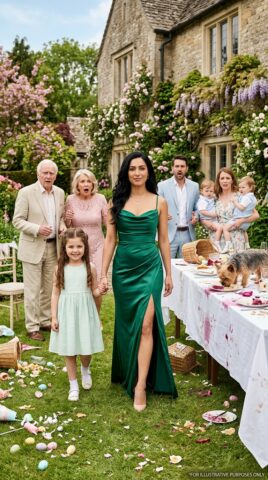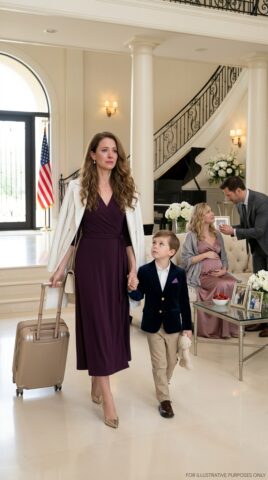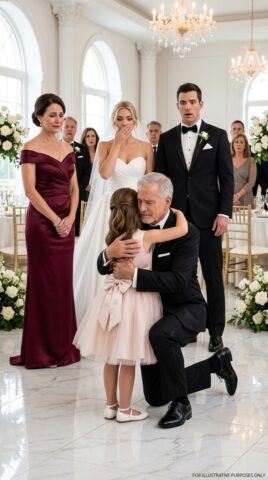
“Who are those children?”
“My God, look at the boys.”
“That little girl looks exactly like Grant.”
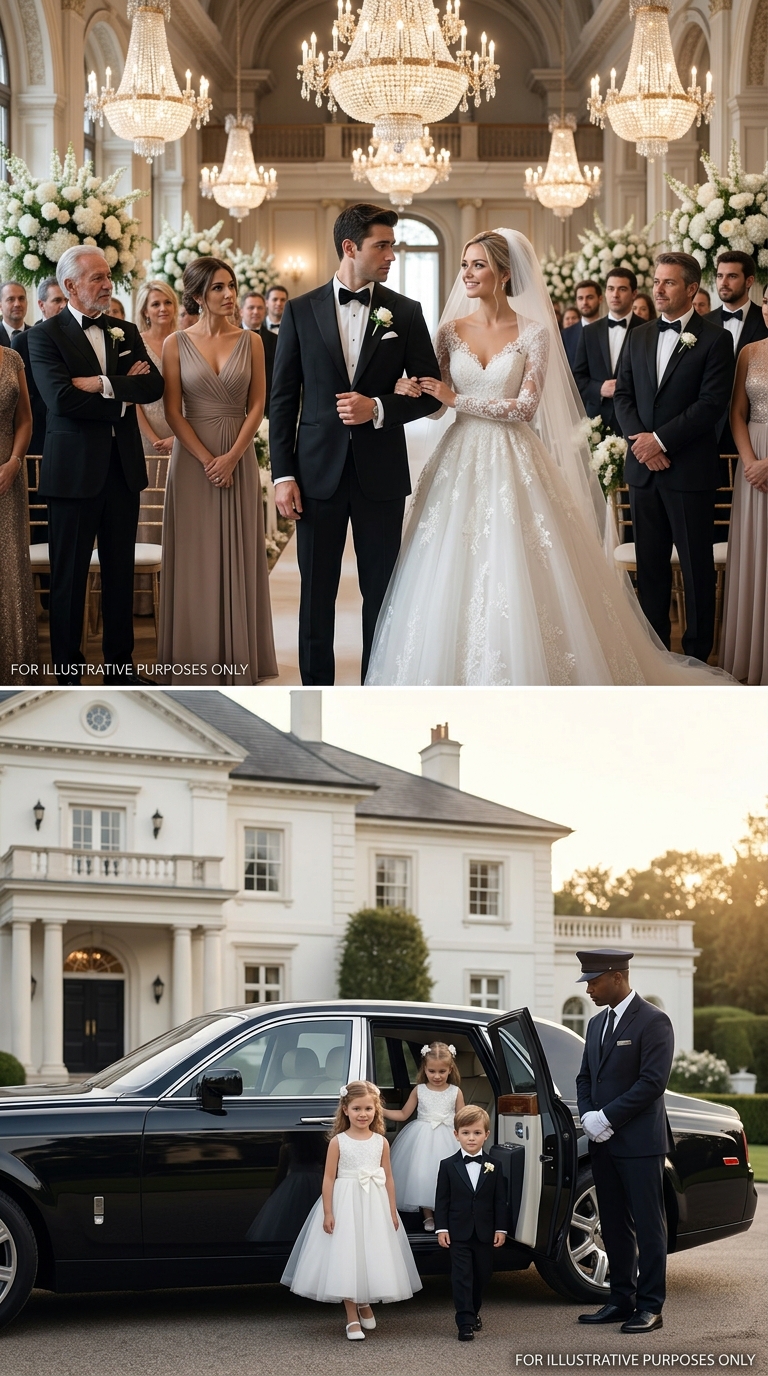
Claire did not slow down. She held Sophie’s hand and kept the boys close as they walked across the lawn toward the sunken garden, where white roses climbed trellises and a string quartet played something delicate enough to be drowned by scandal. At the entrance stood Margaret Whitmore in silver silk, speaking to an Episcopal bishop with the gracious posture of a woman who believed heaven had assigned her preferred seating.
“Margaret,” Claire said.
Margaret turned with a smile already prepared. “Claire, how brave of you to—”
The smile collapsed.
It was subtle at first, just a tightening around the eyes. Then Margaret looked down. Her gaze moved from Leo to Ben to Sophie, and the blood drained from her face so completely that the bishop reached out as if to catch her. Beside her, Charles Whitmore, Grant’s father, dropped his champagne flute. It shattered on the limestone path with a crack that made half the garden turn.
Claire allowed herself one pleasant smile. “You asked me to come. You said it would mean so much to the family.”
Margaret’s mouth opened. No sound came out. She stared at the children as if they had climbed out of a sealed grave.
Sophie, who had been coached to be polite, lifted one hand. “Hello.”
The innocence of it was devastating.
Margaret stepped closer, lowering her voice to a hiss. “Who are they?”
Claire tilted her head. “You care a great deal about lineage, Margaret. I’m surprised you have to ask.”
“Do not play games with me.”
“I learned from the best.”
Margaret’s eyes flashed. “You bring children to my son’s wedding? To what end? Money? Attention? Revenge?”
Claire leaned closer, close enough that Margaret could smell the peppermint on her breath. “You invited the woman you called barren to watch your son marry someone useful. I brought the grandchildren you erased before you knew they existed.”
Charles made a sound, low and wounded. Margaret grabbed Claire’s arm, nails biting through satin. “That is impossible.”
Claire looked down at Margaret’s hand until the older woman released her. “They were conceived before the divorce was final. Legally, biologically, and inconveniently, they are Whitmores.”
“Security,” Margaret snapped, though fear had weakened the command. “Have her removed.”
“I wouldn’t recommend that,” said a dry voice behind them.
Elliot Crane, the Whitmore family attorney, approached with the measured pace of a man who had spent fifty years watching rich people panic. He was thin, ancient, and famously unamused by emotion. His eyes, however, were fixed on the children with unmistakable interest.
“Elliot,” Margaret said. “This is a private matter.”
“On the contrary,” he replied. “If these children are Grant’s, this is a trust matter. And given the terms of the Whitmore Foundation and Family Holdings Agreement, any biological child of Grant’s becomes an immediate primary beneficiary. Until verified, removing them from the premises could be interpreted as obstructing the rights of potential heirs.”
Margaret stared at him. “This is a wedding.”
“Yes,” Elliot said. “An increasingly expensive one.”
Claire almost laughed. Instead she looked past Margaret toward the altar, where Grant stood with his best man, unaware that his life had already split in half. He wore a navy morning suit and a pale tie. He looked handsome, polished, and restless. Older, too. There were shadows under his eyes she did not remember.
“Shall we sit?” Claire asked sweetly. “I would hate to interrupt Savannah’s entrance.”
Margaret looked like she might strike her. But Elliot Crane was watching, the bishop was watching, and so were two hundred guests now pretending not to record with their phones. Claire walked past her and took three seats in the third row on the groom’s side, placing Sophie on her lap because the chairs were too delicate and the moment too dangerous.
The quartet resumed, though with less confidence. Guests stood. At the top of the stone staircase, Savannah Pierce appeared in a gown of white silk and hand-appliquéd lace that probably cost more than Claire’s car. She was beautiful in a sharp, fragile way, smiling for the cameras and the bloodlines. Then she saw that no one was looking at her.
Her smile tightened.
She descended slowly, scanning the crowd for the source of insult. When she spotted Claire, confusion crossed her face. When she saw the children, that confusion curdled into alarm. Savannah’s heel caught on the last step. Her maid of honor grabbed her elbow before she could fall, but the stumble sent a gasp through the garden. Claire gave her a small nod, almost apologetic. Savannah did not nod back.
At the altar, Grant took Savannah’s hands. “You look beautiful,” he whispered, still trying to live in the wedding he had expected.
Savannah leaned toward him without moving her smile. “Turn around.”
“What?”
“Turn around, Grant.”
He frowned, annoyed by her tone, then looked over his shoulder. First he saw his mother, pale and rigid in the front row. Then his eyes drifted back and found Claire.
The world seemed to stop moving.
Claire held his gaze. Five years folded between them: rain, silence, signatures, midnight feedings, unpaid bills, first steps, fevers, birthdays, all the years he had missed because he had not asked the right question when it mattered.
Grant mouthed her name.
Then Sophie, tired of being still, rose on Claire’s lap and pointed down the aisle. “Mommy,” she said in a clear, bell-like voice that carried perfectly through the sunken garden, “is that the man from the picture? Is that Daddy?”
The quartet stopped so abruptly one violin gave a wounded squeal. The bishop closed his book. Somewhere, a woman whispered, “Oh my Lord.”
Grant staggered. He gripped the altar rail with one hand and stared at Sophie, then at Leo, then at Ben. His face changed as recognition struck not as a thought but as a physical blow. He saw his own childhood in their faces. He saw the Whitmore line Margaret had claimed Claire could never give him. He saw, perhaps, the shape of everything he had lost by being obedient.
“Grant,” Savannah said sharply. “Do not move.”
He moved anyway.
He came down the aisle like a man walking underwater, each step uncertain, the guests parting before him. Claire stayed seated. Her instinct was to stand between him and the children, but she forced herself still. Let him come low. Let him meet them where they were.
He stopped at the end of the row. His voice barely worked. “Claire.”
“Grant.”
“Are they—”
“They’re four and a half,” she said. “You can count.”
He did. She watched him do it. His hand rose to his mouth. “You knew?”
“I found out after I left.”
“Why didn’t you tell me?”
The question came out wounded, almost accusing, and it nearly broke her composure. “Because the last time I saw you, your mother called me defective and handed me divorce papers while you looked into a fireplace. I was pregnant, alone, and terrified. I made the choice that kept them safe.”
Grant flinched as though slapped. Leo studied him with open suspicion.
“Are you our dad?” Ben asked.
Grant dropped to his knees in the grass, heedless of his suit. Tears filled his eyes before he could hide them. “I think,” he said, voice cracking, “I think I might be.”
“You don’t know?” Leo asked, unimpressed.
A broken laugh escaped Grant. “No. I mean, yes. I mean—” He looked at Claire, shattered. “I need to know.”
Margaret appeared behind him like a silver blade. “Get up. Now. You are making a spectacle.”
Grant looked up at his mother. “Look at them.”
“I am looking,” Margaret snapped. “I am looking at a scheme.”
Claire stood, lifting Sophie to her hip. “Careful, Margaret. You taught this crowd to worship bloodlines. Don’t insult yours in public.”
Savannah threw her bouquet. It landed at Grant’s feet like a dead bird. “Is anyone planning to marry me today, or are we all gathering around the ex-wife’s surprise litter?”
The word litter cut through the garden.
Grant stood slowly. For the first time that afternoon, his expression hardened. “Don’t talk about them that way.”
Savannah blinked, stunned that his anger had turned toward her. “You are at the altar with me.”
“And there are three children in the third row who might be mine.”
“Might be?” Margaret seized the opening. “Exactly. We know nothing. Claire has had five years to invent this.”
Elliot Crane cleared his throat. “Then perhaps we should determine the facts before vows are exchanged.”
Savannah’s father, Warren Pierce, rose from the front row, face red with contained fury. “Grant, my daughter is not standing here while your family runs a circus. Either marry her now, or the capital agreement dies before cocktail hour.”
There it was. The wedding’s true spine. Not love, not romance, but money dressed in white.
Grant looked at Savannah, at Warren, at Margaret, and finally at the children. When he spoke, his voice shook but did not bend. “No vows. Not yet.”
Margaret grabbed his sleeve. “Grant, think.”
“I am thinking,” he said. “For the first time in years.” He turned to Elliot. “Get Dr. Mercer here. Get the legal team. We’ll do a paternity test today.”
“Grant!” Savannah cried.
He did not look away from Claire. “Will you allow it?”
Claire could have refused. She could have let them stew in uncertainty for months. But she had not come to create fog. She had come to end it.
“Yes,” she said. “On one condition.”
Margaret laughed bitterly. “You are in no position to make conditions.”
“Actually,” Elliot said, “as the mother and legal guardian of potential Whitmore heirs, she is in an excellent position.”
Grant nodded. “Name it.”
Claire looked at Margaret, and every whispering guest seemed to hold a breath with her. “If the test proves they are Grant’s, Margaret resigns from the board of Whitmore Industries and from every family trust position. Permanently.”
Margaret went still. “You little fool.”
Grant turned to his mother. “Agree.”
“Absolutely not.”
“Then I’ll postpone the wedding indefinitely and request an emergency audit of the family trust.”
Margaret’s eyes flickered. It was brief, but Claire saw it. Elliot saw it too. Something moved under the surface of that polished face, something larger than rage.
Warren Pierce muttered a curse. Savannah looked between them all, calculating and terrified.
Margaret lifted her chin. “Fine. Test them. When this collapses, I expect an apology in writing.”
Claire smiled. “You always did love paperwork.”
The library of Whitmore House had witnessed mergers, betrayals, settlements, and at least three generations of men mistaking inheritance for character. It smelled of leather, smoke, lemon oil, and old decisions. Five years earlier, Claire had signed away her marriage on the mahogany desk beneath a portrait of Grant’s grandfather. Now her children sat on a velvet sofa beneath the same portrait, eating shortbread cookies delivered by a trembling maid while the room’s adults behaved worse than toddlers.
Dr. Mercer arrived with a portable rapid DNA unit and the expression of a man who was paid too well to ask questions. The guests had been guided toward the reception tent with vague assurances of a brief delay, but no amount of champagne could stop the rumor from spreading. Phones buzzed. News alerts began forming in social circles before any reporter had facts. The wedding of the year had become a hostage negotiation with floral arrangements.
Margaret paced near the windows. Warren Pierce took calls in a corner, speaking in the low, lethal tone of a man threatening bankers. Savannah sat stiffly in her wedding gown, veil pushed back, eyes dry and bright. Grant stood near the children but did not touch them without Claire’s permission. That, at least, she noticed. His hunger to reach for them was visible, but so was restraint.
“Mommy,” Sophie whispered when Dr. Mercer prepared the swabs, “is it a shot?”
“No, baby. Just a soft cotton swab in your cheek. Like brushing your mouth with a tiny cloud.”
Ben opened his mouth immediately. “I like clouds.”
Leo crossed his arms. “I’ll go first.”
Grant knelt. “You don’t have to be brave for everyone.”
Leo looked at him. “I’m the oldest.”
“By four minutes,” Ben objected.
“Still oldest.”
Something like a smile broke through Grant’s grief. “I’m an oldest, too.”
Leo considered this as Dr. Mercer swabbed his cheek. “Did you boss people?”
“I did,” Grant admitted. “Too much.”
“Mom says bossy people need chores.”
“She’s right.”
Claire looked away because tenderness, when unexpected, can be more dangerous than cruelty.
The swabs were taken from Leo, Ben, Sophie, and Grant. Dr. Mercer inserted the samples into the machine on the desk. “The preliminary result should appear within the hour. Formal certified results will follow, but the rapid test is highly reliable for immediate family determination.”
“An hour,” Savannah said. “I’m supposed to stand here in a wedding dress for an hour while your ex-wife auditions her children for a trust fund?”
Claire’s patience thinned. “They are not auditioning. They are eating cookies.”
Savannah turned on her. “You knew exactly what you were doing.”
“Yes,” Claire said. “I accepted an invitation.”
“You wanted to ruin me.”
“I didn’t know you well enough to want anything for you.”
That landed. Savannah’s cheeks flushed.
Grant stepped forward. “Enough.”
“No,” Savannah said, rising. “Not enough. You let her walk in here with three children and blow up our wedding, and you’re looking at them like you’ve already decided.”
Grant’s jaw tightened. “Look at them, Savannah.”
“I am. That’s the problem.”
Warren ended his call and stormed toward them. “This marriage was supposed to stabilize the manufacturing partnership. My capital. Your factories. Shared board influence. Now I hear there’s a dormant heir clause that could freeze your voting control?”
Elliot Crane, who had been examining a leather-bound file with the gloomy pleasure of a coroner, lifted his eyes. “If the children are Grant’s, the Whitmore Children’s Protective Trust activates immediately. Grant’s voting shares transfer to stewardship status until the youngest child turns twenty-five. Significant mergers, acquisitions, asset sales, and debt restructuring would require trust board approval.”
Savannah stared at Grant. “You never told me that.”
“I didn’t know,” Grant said.
Margaret stopped pacing. “Because it was irrelevant. There were no children.”
Claire heard it then. Not disappointment. Fear.
Elliot closed the file. “Irrelevance has a way of becoming expensive.”
Warren’s expression darkened. “So Grant can’t close the deal without approval.”
“Not if paternity is confirmed,” Elliot replied.
Savannah looked at Grant, and for the first time all day, Claire saw the bride clearly. The woman was not heartbroken. She was assessing damage. Grant was no longer a groom. He was a compromised asset in a navy suit.
“You would lose control,” Savannah whispered.
“I would gain children,” Grant said, as if correcting her arithmetic.
Savannah’s mouth twisted. “That is the most sentimental, useless thing you’ve ever said.”
Before he could answer, the DNA machine beeped.
Every adult in the room froze. Even the children, sensing the shift, stopped chewing. Dr. Mercer leaned over the screen. He adjusted his glasses, read, then read again.
“Well?” Margaret demanded.
Dr. Mercer turned. “The preliminary probability of paternity is 99.9998 percent. Grant Whitmore is the biological father of all three children.”
No one spoke. The sentence seemed to echo against every portrait in the room, waking the dead Whitmores from their gilt frames. Grant closed his eyes. His shoulders folded inward as if relief and guilt had struck at once. Then he sank to his knees, not dramatically but because his legs no longer trusted him.
Sophie slid off the sofa and walked to him. “Are you crying again?”
Grant laughed through tears. “Yes.”
“Are you sad?”
He looked at Claire before answering. “A little. But mostly I’m sorry.”
Sophie considered that. Then she patted his shoulder with sticky fingers. “Mommy says sorry only counts if you fix stuff.”
Claire pressed her lips together. Grant looked at her, the words cutting him cleanly because they were true.
Savannah removed her engagement ring with slow, precise movements. She placed it on the desk beside the DNA machine. “Daddy,” she said to Warren, “we’re leaving.”
Grant rose. “Savannah, wait.”
She laughed, brittle and cold. “For what? To become stepmother to three secret children while your ex-wife sits on a trust board and your mother claws at her own lawyer? No, Grant. I was promised a partnership, not a public relations disaster.”
Warren pointed at Grant. “The bridge financing is canceled. The equipment deal is canceled. If any joint documents have been filed, my attorneys will unwind them by morning. Consider this your material adverse change.”
Margaret lunged toward him. “You cannot walk away.”
Warren smiled without warmth. “Watch me.”
Savannah paused at the door and looked back at Claire. For one second, the anger between them cleared enough for something almost human. “You should have warned me,” she said.
Claire met her gaze. “Someone should have warned both of us.”
Savannah’s expression flickered. Then she turned and left, her white train dragging across the library floor like the last scrap of a ruined flag. Warren followed. The door slammed behind them.
Margaret did not collapse. Women like Margaret Whitmore did not collapse when rage could hold them upright. She turned on Claire with eyes full of poison. “You have destroyed this family.”
Claire stood. “No. I revealed it.”
“The Pierce deal was the only thing keeping us liquid,” Margaret snapped.
Grant turned slowly. “Keeping us liquid?”
The silence that followed was too sharp.
Margaret’s face changed. “I mean strategic growth requires—”
“Mother.”
Elliot Crane removed his glasses. “Grant, I had intended to address this privately after the ceremony, but the trust activation now requires immediate transparency. There are irregularities in several family holding accounts.”
Margaret’s hand went to her pearls. “Elliot.”
He ignored her. “The annual audit had been delayed twice. The Pierce capital infusion would have disguised certain deficits long enough for restructuring. Without it, and with the children’s trust activated, we are required to conduct a forensic audit.”
Claire felt the room tilt. Grant stared at his mother as if seeing not a monster but the architect’s drawings.
“How much?” he asked.
Margaret looked away.
Elliot answered. “Preliminarily? At least thirty-eight million dollars unaccounted for across ten years.”
Grant whispered, “No.”
“Yes,” Elliot said quietly. “And perhaps more.”
Claire understood then. Margaret had not hated her merely because she was middle-class, or because pregnancy had not happened fast enough, or because she lacked the right family name. Margaret had needed Grant to marry money. Claire had been an obstacle to a financial rescue disguised as legacy. The infertility accusation had been convenient. The divorce had been a business decision. Savannah had not been chosen as a bride. She had been chosen as a patch over a crime.
Grant looked physically ill. “You stole from the family trust?”
“I protected this family!” Margaret cried. “Your father was weak. The board was complacent. Markets changed. I made decisions.”
“You stole from your grandchildren before you knew they existed,” Claire said.
Margaret’s head snapped toward her. “Do not you dare speak to me about grandchildren.”
“They are your grandchildren,” Grant said, voice low. “And you tried to have security remove them.”
Margaret looked at him then, really looked, and Claire saw the moment she understood she had lost not just control, not just a merger, but her son. Her expression hardened to survive it.
“You are not strong enough to run this family without me.”
Grant’s answer was quiet. “Maybe I don’t want to run a family that way.”
Claire gathered the children’s jackets. The air had grown unbearable, thick with greed, grief, and old smoke. Grant turned to her quickly, panic returning.
“Claire, please don’t leave. Not yet. We have to talk. I need to—God, I need to know them.”
“You will,” she said. “But not here.”
“They’re my children.”
“Yes. And I am their mother. You are a stranger who shares their blood.”
The words hurt him. She did not soften them.
“If you want to be their father, you come to Chicago. You visit. You learn their teachers’ names, their allergies, how Ben sleeps with one sock on and one sock off, how Leo pretends not to be scared of thunderstorms, how Sophie only eats grilled cheese cut diagonally. You do not walk out of a ruined wedding and claim instant fatherhood like a company asset.”
Grant swallowed. “I deserve that.”
“You deserve worse. But they deserve better.”
She placed a business card on the desk beside the discarded engagement ring and the DNA machine. Claire Donovan Events & Florals. Her name, her work, her life. “Call when you are finished being Margaret’s son and ready to begin being their dad.”
Then she walked out.
The reception tent had become a museum of discomfort. Guests hovered near untouched lobster rolls and champagne towers, pretending not to stare as Claire passed with three tired children. Outside, the sky had cleared. At the SUV, Ben looked up and asked, “Was that the wedding?”
Claire buckled him in. “That was the wedding.”
“It was weird,” Leo said.
“Very weird,” Claire agreed.
Sophie yawned. “Can we get fries?”
Claire laughed then, so suddenly and deeply that tears came with it. Five years of fear left her body in one breath. “Yes,” she said. “We are getting fries.”
Three days later, the scandal had become national news. “Secret Triplets Stop Billion-Dollar Wedding” ran beneath a blurry photo of Claire in emerald satin walking across the Whitmore lawn like vengeance with good posture. Commentators speculated. Society blogs foamed. Business networks discussed the frozen Pierce deal. Someone leaked that Margaret Whitmore had resigned from the board “for personal reasons,” which fooled no one. Claire turned off the television after ten minutes because the children were building a blanket fort and did not need strangers narrating their origin story.
When the buzzer rang, she was folding tiny socks at the kitchen table. On the monitor, Grant stood outside in jeans, a gray sweater, and no visible armor. No driver. No assistant. No suit. He held three gift bags and a bouquet of lilies. Not roses. Lilies. The flowers he had brought her after their first real fight in college, when they were young enough to believe apology could fix anything.
She buzzed him in.
When she opened the door, he looked around her duplex without judgment. That mattered more than she wanted it to.
“Hi,” he said.
“Hi.”
“I flew commercial.”
“Congratulations on discovering airports.”
A tired smile crossed his face. “Middle seat. Near the bathroom.”
“That sounds educational.”
“It was humbling.” He held out the lilies. “I remembered.”
She took them, hating that her heart noticed. “The kids are at preschool.”
“I know. I wanted to talk to you first.”
They sat at her kitchen table with coffee between them. Grant wrapped both hands around his mug as if warmth could steady him. He looked less like a billionaire’s son than a man who had slept poorly and learned too much.
“Elliot finished the preliminary audit,” he said. “You saved me.”
Claire frowned. “From what?”
“Prison, probably. Public disgrace, definitely. If I had married Savannah and closed the Pierce deal, the funds would have been blended into accounts my mother had already compromised. I would have signed documents certifying numbers I didn’t know were false.” He looked up, eyes hollow. “She had been embezzling for years. Bad real estate, political donations, offshore accounts, private losses she hid under company transfers. The Pierce money was supposed to fill the hole before the audit. The wedding was her cover.”
Claire sat back slowly. “She accused me of destroying the family.”
“She was doing that long before you arrived.”
The quiet between them held more than anger. It held the absurdity of all they had lost because one woman had mistaken image for survival.
Grant pulled an envelope from his bag and placed it on the table. “This is not a payoff. It’s a trust document. Leo, Ben, and Sophie are recognized as my legal heirs. There’s child support, backdated. Health care. Education funds. Housing support if you’ll accept it. Elliot drafted it so I can’t control it or use it to pressure you.”
Claire did not touch the envelope. “I made it work without you.”
“I know. That is why I’m asking, not telling.” His voice broke slightly. “It’s theirs, Claire. And some of it should have been yours years ago.”
She looked at the envelope and thought of nights counting grocery money, of pretending she was not hungry because the children wanted seconds, of choosing which bill could wait without disaster. Pride had kept her upright, but pride did not pay tuition. Pride did not buy a backyard.
“For them,” she said at last.
Relief moved across his face. “For them.”
“And you don’t get to arrive with presents every visit like Santa Claus in a guilt crisis.”
He glanced at the gift bags.
She raised an eyebrow.
“One Lego set each,” he confessed. “And books.”
“Grant.”
“I panicked.”
Despite herself, she smiled. “We’ll discuss boundaries.”
“I’ve started therapy,” he said quickly, as if afraid she might miss the important part. “Twice a week. I stepped down as CEO, temporarily at least. I’ll remain chair while the board stabilizes, but I’m moving to Chicago. Not next door,” he added when her eyes narrowed. “Nearby. Appropriate nearby. I want supervised visits at first, whatever you think is best. I want to learn.”
Claire studied him. Five years ago, Grant had let silence choose for him. Now he was speaking plainly, offering documents, surrendering control. It did not erase the past. It did not make him safe. But it made him different enough for a beginning.
The preschool bus arrived twenty minutes later. The front door burst open with the force of three small lives returning at full speed.
“Mommy!” Sophie shouted, then stopped when she saw Grant.
Leo stepped in front of his siblings. “You’re the crying man.”
Grant got down on one knee on the linoleum. “I am. My name is Grant. I cried because I found out I had three children and I had missed a lot. I’m hoping, if your mom says it’s okay, I can start showing up now.”
Ben eyed the gift bags. “Are those for us?”
“Ben,” Claire warned.
Grant smiled. “They are, but your mom says I can’t buy your affection.”
“What’s affection?” Sophie asked.
“Love with manners,” Claire said.
Leo looked Grant over. “Do you know how to build forts?”
“I can learn.”
“Do you know dinosaurs?”
“Some.”
Ben narrowed his eyes. “Do you know Spinosaurus?”
Grant hesitated.
Ben sighed heavily. “We have work to do.”
And just like that, fatherhood began not with a dramatic embrace but with a five-year-old dragging a humbled man to the living room to educate him on prehistoric predators.
Six months later, Claire stood in the kitchen of a brick brownstone in Lincoln Park, watching morning sunlight spill across hardwood floors she still sometimes could not believe were hers. She had refused a mansion, refused a driver, refused anything that smelled like being purchased. But she had accepted a home with a small backyard, good schools nearby, and enough bedrooms that no child had to share unless they wanted to. The trust paid for it. Her pride survived because the deed listed protections she had insisted on, and because every room rang with laughter instead of obligation.
Outside, Leo ran across the yard holding a worm in triumph. Ben shouted advice from the sandbox. Sophie sat on the patio step putting pink clips in Grant’s hair while he reviewed a quarterly report on his tablet and pretended this was a normal executive practice.
“Dad, look!” Leo cried. “He’s huge.”
Grant set down the tablet with grave respect. “That is a remarkable worm.”
“We should name him Captain Dirt,” Ben said.
“Mr. Wiggles,” Sophie argued.
Grant looked between them. “Captain Dirt Wiggles.”
All three children cheered.
Claire leaned against the doorframe, coffee in hand, and let herself watch. It had not been easy. Grant had missed cues, overbought toys, cried once in the grocery store because Sophie called him Dad without thinking, and nearly ruined a bedtime routine by introducing a flashlight puppet show at 8:57 p.m. They had argued about boundaries, discipline, money, holidays, Margaret, the press, and whether Grant’s guilt gave him the right to be too available. It did not. He learned anyway. He showed up to preschool pickup. He memorized snack preferences. He changed his phone’s emergency bypass to ring for Claire even during board meetings. He became, through effort rather than blood, a father.
He looked up and caught her staring. A pink barrette dangled over one eye.
“You’re enjoying this,” he said.
“I’m documenting it mentally for blackmail.”
“I have a board call in forty minutes.”
“Then I suggest you remove the glitter stickers from your sleeve.”
He looked down and sighed. “Leadership is sacrifice.”
Her phone rang. Elliot Crane’s name appeared on the screen. Claire stepped inside to answer. When she returned, Grant saw her face and stood.
“What happened?”
“Margaret wants a visit.”
Grant’s expression closed. Margaret had pleaded guilty to fraud, embezzlement, and falsifying trust documents. Because the money had been recovered through asset seizures and because she had cooperated late but usefully, she was serving her sentence at a minimum-security federal facility in Connecticut. Grant had not visited. Neither had Claire. The children knew only that their father’s mother had made choices that hurt people and was not part of their life.
“We don’t have to go,” Grant said immediately. “You don’t owe her closure.”
“I know.” Claire watched Sophie clip another barrette into the dog’s collar. “But I think I want to look at her once without being afraid.”
The visiting room was gray, plain, and brutally fluorescent. No silver silk. No pearls. No servants moving silently with trays. Margaret Whitmore entered in beige prison clothing, smaller than Claire remembered and yet somehow still trying to carry herself like a chairwoman. She sat behind plexiglass. For a moment she looked only at Grant, then at Claire, then down at her own hands.
“You look well,” Margaret said.
“I am well,” Claire replied.
“And the children?”
“They’re happy. Loved. Protected.”
Margaret’s mouth tightened. “Do they know about me?”
“They know enough for now.”
“I am their grandmother.”
“No,” Claire said evenly. “You are a woman who tried to erase them before learning their names. Maybe when they are older, they can decide what word fits you.”
Margaret flinched. The mask cracked, and underneath it Claire saw something like regret. But regret in Margaret had always been too proud to kneel.
“I did what I did for the family,” Margaret said.
Grant’s voice was calm. “You did it for the portrait of the family. Not the family itself.”
“I built that company.”
“You stole from it.”
“I protected the legacy.”
Grant took a photo from his jacket pocket and pressed it to the glass. It showed Leo, Ben, and Sophie in the backyard, all three covered in mud, laughing. “This is the legacy.”
Margaret stared at the photo. Her eyes shone, but no tear fell. “You’ll fail,” she whispered. “You’re soft now. You let feelings lead you. The board will eat you alive.”
Grant smiled, and Claire heard freedom in it. “Profits are up fourteen percent since we restructured. Claire’s sustainability vendor plan cut waste by a third. Employee retention is the highest it’s been in a decade. It turns out fear was an expensive management strategy.”
Margaret looked at Claire. “So now you advise him?”
“Only when he asks nicely.”
The old Margaret would have attacked. This Margaret only sat back, diminished by the fact that cruelty no longer produced obedience.
Grant stood. “Goodbye, Mother.”
“Grant,” she said, and for the first time her voice held panic instead of command.
He paused, but he did not turn back.
Claire did. Not because Margaret deserved it, but because the woman behind the glass had once haunted her dreams, and Claire wanted to remember her accurately: not as a queen, not as a monster too powerful to defeat, but as a lonely woman who had traded love for control and ended with neither.
“I hope someday you understand what you threw away,” Claire said.
Then she followed Grant into the autumn light.
They did not speak until they reached the car. Grant sat behind the wheel, hands resting loosely at ten and two, staring through the windshield at the prison walls.
“You okay?” Claire asked.
He exhaled. “I think so.” Then he turned to her, and the space between them shifted into something older than co-parenting and newer than forgiveness. “Claire, I know I said I wouldn’t ask for anything beyond being their father.”
“You did.”
“And I meant it. I still mean it. But I miss you. Not the idea of you. Not the wife I failed. You. The woman who used to drag me to roadside diners at midnight because she said pancakes tasted better under bad fluorescent lighting. The woman who built a life when I didn’t deserve to be part of it. The woman who walked into my wedding with three children and more courage than everyone in that mansion combined.”
Her throat tightened. “Grant.”
“I’m not asking you to forget. I’m not asking you to pretend the past was smaller than it was.” He reached into his pocket, and her heart jumped before she could stop it. He did not pull out a ring. Instead, he unfolded a worn paper napkin from a diner in Evanston, faded nearly blank with age. On it, in Claire’s old handwriting, were the words they had written during their first year together: Build something honest.
“I kept it,” he said. “All these years. I didn’t live by it, but I kept it. I’d like to try now. Dinner. One night. No board talk. No lawyers. No guilt speeches unless absolutely necessary.”
Despite everything, Claire laughed.
He smiled cautiously. “Is that a yes laugh or a you’re pathetic laugh?”
“It can be both.”
“I’ll take both.”
She looked out at the road ahead, bright with fall leaves. Forgiveness, she had learned, was not a door thrown open. It was a lock turned slowly from the inside. It did not mean the wound had never existed. It meant the wound no longer got to be the only truth.
“One dinner,” she said.
Grant’s smile broke wide and young. “One dinner.”
“And if you mention quarterly projections, I’m leaving before dessert.”
“Understood.”
Months later, when people still occasionally asked Claire whether she had gone to the wedding for revenge, she never gave them the answer they wanted. Revenge sounded too simple, too glamorous, too small. She had gone because Margaret Whitmore had mistaken silence for weakness. She had gone because her children deserved to enter the world of their father’s family standing upright, not hidden like a scandal. She had gone because truth, when carried long enough, becomes too heavy not to set down.
The emerald dress remained in the back of her closet, cleaned and wrapped, no longer armor but evidence. Sometimes Sophie asked if she could wear it when she grew up. Claire always said yes, though she hoped her daughter would never need a dress like that to survive a room.
On the first anniversary of the ruined wedding, Claire found herself in the backyard at dusk while Grant helped the children chase fireflies. He had one child on his shoulders, one clinging to his leg, and one issuing orders with a plastic jar. He looked ridiculous and happy. The Whitmore name no longer sounded like a threat in her house. It sounded like children laughing through an open door.
Margaret had invited Claire to witness her replacement. Instead, she had introduced the truth. Savannah had walked away from a bad bargain. Grant had lost an empire built on fear and found a family built on effort. And Claire, who had once driven away from Newport believing she had been discarded, finally understood the twist life had hidden from her in the rain.
She had not left the Whitmores empty-handed.
She had left with everything that mattered.