PART 3
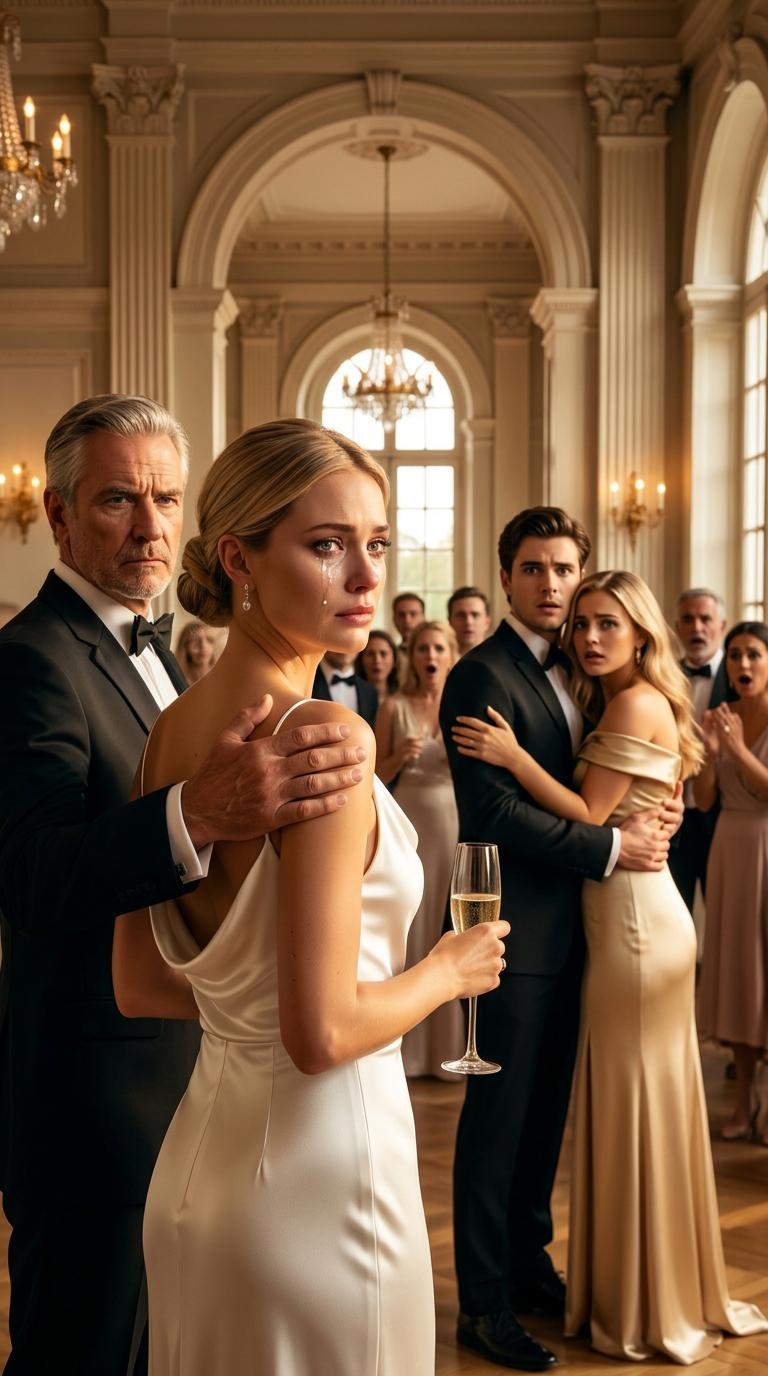
I walked out into the night, shivering in a cheap trench coat I’d grabbed from the coat check, draped over my silk dress. An icy drizzle had started. A cab dropped me at the luxury high-rise apartment my father had gifted us for the wedding.
I scanned my keycard.
The keypad glowed angry red. Invalid.
I swiped it again.
Red.
My cell phone buzzed. The caller ID flashed my father’s name.
I answered.
“Where exactly are you?” Carlton demanded.
“Standing outside a home I’m apparently locked out of,” I replied.
“That real estate is no longer yours,” he stated flatly. “And effective immediately, you are terminated from Sinclair Foods.”
The air punched out of my lungs.
“You’re firing your own daughter?”
“You are being dismissed for gross misconduct that jeopardizes the brand. Your corporate credit cards and linked accounts are already shut down. Do not try to move any funds.”
“Dad, listen to me—”
“Do not ever dial this number again.”
The line clicked dead.
I sank down onto the hallway carpet, surrounded by yards of white silk, and started scrolling through my contacts.
My father’s oldest golfing buddy disconnected the moment I said my name.
My late mother’s supposedly loyal best friend blocked my number when I begged for a couch to sleep on.
Within sixty minutes, I learned the terrifying reality of crossing a man with limitless influence. People don’t actually have to dislike you. They just have to be terrified of the man who wants you destroyed.
I had no money. I had nowhere to go.
Then, a forbidden address surfaced in my memory.
A weathered brick cottage on the rural outskirts of the city. Aunt Beatrice’s property.
Carlton’s estranged older sister. The woman he frequently referred to as a toxic liability.
By the time I staggered onto her wooden porch, my expensive gown was dragging in the mud. Mascara tracked dark lines down my cheeks. My heels had blistered my feet raw.
Beatrice threw the door open before I could even raise my fist a second time.
She was tall, impeccably postured, and possessed the same sharp, calculating eyes as my father—but tempered with actual humanity.
She looked at my ruined dress. She looked at the rain.
“Get inside before you freeze to death,” she ordered.
She didn’t demand an explanation right away. She wrapped me in thick towels, handed me an oversized flannel robe, and pressed a steaming mug of chamomile tea into my shivering hands.
Only after I stopped shaking did she pull out a kitchen chair.
“So,” Beatrice murmured. “Carlton finally cut you loose.”
I spilled everything.
The microphone. The dance. The confrontation about the debt. The firing. The locked doors.
When my rambling finally stopped, Beatrice’s expression darkened.
“You honestly believe this whole circus was about Donovan Pierce?” she asked.
I blinked at her. “Wasn’t it?”
“Oh, sweetheart. No. Donovan was just the shiny lure. Mia was the cancer.”
My brain struggled to process the words.
“Your little sister has been playing billionaire heiress for years,” Beatrice explained, her voice hard. “Chartered flights, designer wardrobes, reckless gambling. She took money from the kind of people who don’t send collection letters. By the time Carlton realized what was happening, she was twenty-five million in the hole.”
“Mia did that?” I breathed.
“Yes.” Beatrice tapped her fingers against the table. “And Carlton refuses to let his golden child go to prison or get her knees broken. So, he drafted a narrative. He found Donovan—hungry, charming, and drowning in his own smaller debts. Carlton paid off Mia’s mess, absorbed Donovan, and used you to legally bind him to the company.”
“But why use me?”
“Because you follow orders,” Beatrice said gently. “Because you wouldn’t dig into the accounting. He knew that if he branded it as a family duty, you would quietly take the hit.”
I stared into my cold tea.
Beatrice pushed back her chair, walked to a wooden hutch, and retrieved a small, tarnished brass key. She slid it across the table.
“Your mother wasn’t as blind as you thought,” Beatrice said softly. “Margaret knew exactly what kind of monster she married. Years before her heart gave out, she quietly purchased a tiny studio downtown. She used a shell trust Carlton never tracked. I’ve been paying the property taxes ever since she passed, hoping you might need a place to land one day.”
The following morning, dressed in Beatrice’s oversized sweater and faded jeans, I rode a public transit bus into the city.
The building was a decaying five-story walkup. Unit 24’s deadbolt protested loudly when I turned the key.
I stepped into a time capsule.
It was cramped. A fold-out couch. A writing desk overlooking an alley. A tiny stove hidden by a fabric curtain. A heavy gray wool coat hung near the entrance. A layer of dust coated the surfaces, but the air still held the faint, undeniable scent of lavender. My mother’s perfume.
Margaret Sinclair supposedly died from a sudden, massive coronary a decade ago. I had never questioned it. When you are drowning in grief, you don’t look for conspiracy theories.
But standing in her hidden sanctuary, the silence felt expectant. Like a held breath.
I started tearing the place apart. Drawers. Coat pockets. Bookshelves.
Nothing.
I slumped against the desk, my eyes drifting to a faded calendar pinned to the wall. The last circled date was the exact day she died.
I peeled the calendar back. Taped directly to the plaster was a microscopic metal key.
It unlocked the bottom drawer of the desk.
I pulled out a worn, dark green accounting ledger.
The first page was covered in my mother’s elegant script: Discrepancy Manifests, Processing Plant Two.
I sat on the dusty floor and read for an hour, my stomach twisting into tighter and tighter knots.
My father hadn’t just been cooking the books. He had been flagging massive shipments of food as contaminated or spoiled. Some of it was quietly fenced to black-market distributors for untraceable cash. The rest was aggressively donated to public schools, homeless shelters, and charity drives at wildly inflated values to wipe out his tax liabilities.
But the final pages made me physically nauseous.
Inventories explicitly marked as biologically unsafe.
Rancid.
Failed safety seals. Dangerous sodium spikes.
He donated them anyway.
Carlton Sinclair had built his saintly public image by feeding toxic waste to the most vulnerable people in the state.
And as the VP of Quality Control, my signature was on dozens of the authorization forms.
I hadn’t known. But ignorance was no longer an acceptable defense.
I shoved the ledger into a tote bag and tracked down Walter Henson. The warehouse manager had known my mother for decades. He openly despised my father. If anyone would corroborate the documents, it was him.
I intercepted him near the bus terminal after his shift.
Walter looked like he hadn’t slept in a week. His eyes darted nervously around the street.
“I found my mother’s private records,” I told him, reaching for my bag. “I have the proof of what he’s been distributing.”
Walter took three rapid steps backward.
“Don’t show me that.”
“Walter, please—”
“I can’t help you.”
“People got sick from those shipments.”
“My wife’s medical bills are burying us,” Walter interrupted, his voice trembling. “Your dad pulled me into his office at dawn. He gave me your old title. My salary is tripled. Both my grandkids’ college tuitions are paid in full as of this morning.”
I stared at the man who had taught me how to ride a bike.
“I am so sorry, Audrey.”
He turned and practically sprinted away.
When I dragged myself back to Beatrice’s kitchen, I felt entirely defeated.
She poured me a glass of water and listened.
“That is classic Carlton,” she noted grimly. “He doesn’t just crush his enemies. He purchases the loyalty of your allies. Walter didn’t betray you. He’s just another captive.”
“So what’s the next move?” I asked, exhausted.
“When they barricade the door,” Beatrice said, her eyes flashing, “we break a window.”
The window’s name was Gavin Cole.
Five years ago, Gavin was the most feared investigative journalist in the Midwest. He started poking around my father’s institutional catering contracts. Months later, anonymous sources accused Gavin of accepting bribes to print libel. His paper terminated him. He was completely blacklisted.
Beatrice tracked him down to a depressing basement office in a dying strip mall.
The air in “Creative Spark Media” was thick with the smell of stale coffee and crushed dreams. Gavin sat slumped behind glowing monitors. He looked exhausted, aggressively unshaven, and completely checked out.
“I’m Audrey Sinclair,” I announced.
He let out a sharp, cynical bark of laughter. “My deepest sympathies.”
“I know exactly how my father ruined your life.”
His smirk vanished.
I slammed the green ledger onto his messy keyboard. “And I have the paper trail proving he’s done much worse.”
Gavin opened the book with extreme skepticism. Initially, he scoffed at the columns of numbers. “A billionaire dodging taxes. Stop the presses.”
“Look at the dates,” I urged. “Cross-reference the final Friday of every month.”
He paused, his eyes scanning the ink.
Slowly, the relentless reporter he used to be dragged himself back to the surface.
He yanked open a filing cabinet and pulled out stacks of his old research files. He laid my father’s glowing PR clippings next to the ledger entries.
Sinclair Foods Hosts Veteran Banquet. Local Orphanage Receives Massive Holiday Surplus.
The exact serial numbers marked as toxic in my mother’s ledger matched the pallets of food photographed behind my father’s grinning face.
Gavin fell back into his rolling chair, the color draining from his face.
“This goes way beyond financial fraud,” he whispered. “This is sociopathic.”
Before we could strategize, Gavin’s cell phone buzzed with an urgent news alert from a local society blog.
The headline framed Donovan and Mia as star-crossed lovers who finally escaped an unhinged, possessive bride.
The article spun a masterful web of lies. It claimed Donovan and I had privately agreed to an annulment weeks ago, but that I had suffered a psychotic break at the reception out of pure jealousy. It labeled my comments about the debt as paranoid delusions. “Close friends” were quoted calling me deeply unstable.
My father hadn’t just fired me. He was actively erasing my credibility.
Included in the article was a high-resolution photo of Donovan and Mia posing in the corporate lobby.
Mia was wearing a stunning gold dress.
And resting against her collarbone was my mother’s signature sapphire necklace.
I knew that piece intimately. Three massive midnight-blue stones haloed by diamonds.
I bolted out the door and ran all the way back to Beatrice’s house.
I shoved the digital photo in her face. She gasped, her hand flying to her mouth.
“That necklace vanished the exact afternoon your mother died,” Beatrice whispered.
“Which was the exact same day Donovan was hired at the plant,” I realized, the horror creeping up my spine.
“And the day he now claims he instantly fell for Mia.”
I broke into the studio apartment again that evening. I wasn’t looking for financial records anymore. I was hunting for a ghost.
I tore the place apart a second time. I checked the floorboards. I ripped the backing off the artwork.
Nothing.
Defeated, I grabbed the heavy gray wool coat hanging by the door to use as a blanket. As the fabric bunched in my hands, I felt something rigid stitched deep inside the left lining.
I grabbed a serrated kitchen knife and slashed the seam open.
A small, black leather journal dropped onto the floor.
My mother’s final weeks were trapped inside its pages.
August 15. Carlton exploded over Mia’s debts again. He isn’t upset that she’s a criminal. He’s just furious that she’s sloppy.
September 5. We hosted the new logistics guy, Donovan Pierce. He couldn’t take his eyes off Mia. Carlton kept over-praising Audrey. I can see the architecture of his trap. He is going to sacrifice one girl to salvage the other.
September 22. I listened to Mia pitch an idea to Carlton. She suggested donating the contaminated inventory instead of paying disposal fees. She said it was great PR. My own flesh and blood laughed about poisoning people for a tax break.
October 10. Carlton cornered me. He swore he would have me legally committed if I blew the whistle.
October 13. I caught Mia wearing my sapphire necklace. I tried to take it back. She smirked and told me Donovan likes girls with expensive taste, and she needed it more than me.
I turned to the final entry.
October 15. I gave Mia an ultimatum. I told her I was walking into the FBI field office in the morning if she didn’t come clean. She didn’t blink. She just said she’d come over after her shift to talk. I don’t know why, but I am terrified.
Tucked into a small pocket on the back cover was a crumpled pharmacy receipt. It was dated forty-eight hours before her death. A hurried note was scrawled across the bottom.
Mia insisted on picking up my heart pills today. She said she wanted to be helpful. I am so afraid.
I sat alone in the dark, the truth crushing my chest like a physical weight.
It wasn’t a sudden coronary event.
Mia had swapped the medication. Or withheld it. And my father had undoubtedly given her the green light.
My mother was murdered because she was going to burn down the empire.
When I shoved the diary onto Gavin’s desk the next morning, he read the entries in complete silence. When he finally looked up, every trace of his cynical burnout was gone.
“This is explosive,” Gavin said. “This changes the entire board.”
“We need a live confession,” I told him fiercely. “On camera. In front of witnesses. Somewhere Carlton can’t throw money at the problem to make the evidence vanish.”
Gavin raised an eyebrow. “Psychopaths don’t just willingly confess.”
“They do when you back them into a corner and shatter their ego.”
The perfect stage was already set.
My father was scheduled to headline the annual Founders Gala at the Imperial Hotel that weekend. He was accepting a lifetime achievement award for his “unwavering civic integrity.” Rumor had it he was also planning to officially name Donovan as the next CEO.
It was supposed to be his ultimate victory lap.
We turned it into a slaughterhouse.
First, I ambushed Walter.
I caught him walking through the park near his neighborhood.
“I didn’t come here to ruin you,” I promised him.
He looked like he was going to be sick.
“I found my mother’s hidden diary,” I said softly. “I know exactly what happened the night she died.”
I walked away without another word. I knew exactly what he would do.
Less than an hour later, Donovan Pierce showed up on Beatrice’s front porch. He was clutching a leather briefcase.
He unlatched it on her kitchen table, revealing stacks of banded bills.
“One hundred grand,” Donovan said, his voice tight with panic. “Take it. Relocate. Change your name. Just disappear.”
“In exchange for what?” I asked flatly.
“The journal.” His hands were physically trembling.
I stared at the cash, then looked up into his terrified eyes.
“Get out of this house.”
“Audrey, you are playing a very dangerous game.”
“Tell my father and my sister to dress nice. I’ll see them at the gala.”
For the first time since I met him, the slick, confident Donovan Pierce looked like a man staring down the barrel of a gun.
The Imperial Hotel ballroom was a monument to excess.
Towering marble columns. Waterfalls of champagne. Guests draped in diamonds and custom tailoring. Every corrupt judge, bought politician, and greedy investor in Carlton’s pocket was there to kiss his ring.
I walked through the brass doors wearing a simple, sleek black dress. Aunt Beatrice was right beside me.
No white silk. No diamonds. No obedience.
A security guard stepped into our path.
Beatrice leveled a glare at him that could have melted steel.
“She is my plus-one,” Beatrice stated with lethal calm. “If Carlton wishes to throw his own flesh and blood out of a public charity event, he can march his cowardice down here and do it himself.”
The guard swallowed hard and stepped aside.
Gavin was already inside, flanking a highly respected, out-of-state journalist named Harlan Price. They both had their cameras rolling. Digital copies of the ledger and the diary had already been sent to federal prosecutors Gavin still maintained relationships with.
Up on the brightly lit stage, my father was smiling warmly next to the mayor.
Donovan hovered dutifully in the background, practicing his best humble-successor face.
Mia stood front and center in a shimmering gold gown.
The sapphires rested heavily against her skin.
The mayor finished his fawning introduction. My father accepted a heavy glass trophy. Thunderous applause filled the room.
Carlton leaned into the microphone.
“Family,” he lied smoothly, “has always been my true north.”
I started walking.
Right down the center aisle.
The whispers ignited instantly.
Look at her. That’s the crazy sister.
My father spotted me. Pure, unfiltered rage contorted his features for a microsecond before the PR mask snapped back into place.
Mia, however, lacked his sociopathic discipline.
She abandoned her mark, practically sprinting down the stage stairs to intercept me in the middle of the floor.
“What the hell is wrong with you?” she hissed, her face flushed red. “This is our night! Donovan is mine. The inheritance is mine. You lost. Get out.”
I didn’t blink. I just stared directly at her throat.
“Did you earn the necklace, too?” I asked, keeping my voice dangerously level. “Or did you just strip it out of her jewelry box after you poisoned her?”
All the blood drained from Mia’s face.
She went completely hollow.
The murmurs from the surrounding tables died out. The silence spread backward like a shockwave until the entire ballroom was dead quiet.
Mia spun around to look at our father.
“Daddy,” she whimpered, sounding like a terrified little girl. “Tell them she’s insane. Tell them she’s lying.”
Carlton stood frozen behind the podium.
He looked at his favorite daughter.
He looked at me.
He looked at the hundreds of influential faces staring back at him.
I watched the exact moment he made his calculation. Truth was irrelevant. Loyalty was dead. Survival was everything.
He leaned back into the microphone.
“Security,” Carlton announced, his voice dripping with faux-sorrow. “Please escort Mia out of the building. My daughter is clearly unwell.”
Mia’s jaw dropped.
“Unwell?” she repeated, stunned.
“Mia, stand down,” Carlton ordered sharply.
“You did this,” she breathed, stumbling backward.
The security guards hesitated, unsure of who to grab.
“You orchestrated this!” Mia screamed, her voice cracking. “You said she was a threat to the stock price!”
My father abandoned the podium and marched down the steps.
“Keep your mouth shut,” he warned her quietly.
But the dam had broken. The golden child was realizing she was just as expendable as the discarded bride. Carlton’s reputation was the only child he truly loved.
Mia turned and bolted out into the sprawling marble lobby.
Carlton chased after her.
Donovan scrambled behind them.
I followed closely, with Gavin and Harlan tracking every second through their lenses.
The wealthy guests spilled out of the ballroom, forming a massive, silent audience in the lobby.
Mia was backed against a marble pillar, hyperventilating. Her perfect makeup was destroyed. The sapphires trembled violently with every ragged breath.
“Shut down this theatrical nonsense right now,” Carlton commanded.
I calmly unclasped my black clutch. I pulled out the leather diary and the crumpled pharmacy receipt.
Mia stared at the evidence.
Donovan stared at it.
My father stared at it.
“You don’t have proof of anything,” Mia cried, though she sounded entirely unconvinced.
“I don’t need it,” I told her. “Your face just gave the entire room the confirmation they needed.”
Donovan broke first.
Self-preservation overrode everything else. He threw his hands up, backing away from the Sinclair family.
“I didn’t touch her medication!” Donovan shouted to the crowd. “I didn’t know about the murder! Carlton told me it was just some creative accounting to cover Mia’s gambling debts! They manipulated me!”
Carlton glared at him with absolute disgust. “You pathetic, weak little rat.”
Then, Carlton made his fatal error.
He lunged for the diary in my hand.
He didn’t try to comfort his crying daughter. He tried to destroy the evidence.
Mia violently shoved him backward.
Carlton stumbled hard against the pillar, genuinely shocked that his prized possession had physically retaliated.
Mia pointed a shaking finger at his chest. Her screams echoed off the vaulted ceilings.
“He made me do it!” she shrieked. “He told me Mom was weak! He said her heart was a ticking time bomb anyway, and she was going to drag all of us down!”
The gathered crowd gasped in unison.
My father’s face turned the color of wet concrete.
“Mia, close your mouth!”
“No!” she wailed. “You don’t get to throw me to the wolves! Not after I killed her for you!”
She ripped at the necklace, clawing at her own skin.
“You swore you’d protect me! You told me exactly which pills to swap out! You said she’d just fall asleep and the autopsy would call it natural causes! I went to the pharmacy because you gave me the order!”
The lobby was so terrifyingly quiet I could hear the rain hitting the glass doors outside.
Gavin lowered his phone. He had everything.
The heavy glass doors slid open.
Uniformed police officers flooded the lobby, flanked by federal agents wearing dark windbreakers. Gavin hadn’t waited for the meltdown. The moment he had the physical proof, he had tipped off the FBI.
A grim-faced detective walked directly up to Carlton.
“Carlton Sinclair, you are under arrest for conspiracy to commit murder, corporate fraud, and obstruction of justice.”
A second officer approached Mia, pulling her hands behind her back.
“Mia Sinclair, you are under arrest for the murder of Margaret Sinclair.”
Donovan tried to slowly inch toward the exit, but an agent grabbed him by the shoulder.
“Donovan Pierce. You’re coming too.”
The sharp, metallic click of the handcuffs locking around my father’s wrists was surprisingly quiet.
But the sound shattered a twenty-year nightmare.
Mia sobbed uncontrollably, begging for a lawyer. Donovan openly wept, swearing he would testify against them.
My father remained perfectly silent. He locked eyes with me as they dragged him out the doors.
For the first time in my entire existence, I didn’t look away. I stared right back.
By sunrise, the truth owned the news cycle.
It wasn’t the sanitized PR spin my father had purchased.
It was the raw, ugly reality. The humiliated bride. The twenty-five-million-dollar secret. The poisoned food donations. The hidden diary. The public confession under the crystal chandeliers.
Gavin Cole’s name was plastered on the front page of every major outlet in the country.
Six months later, the dust had finally settled.
I stood on the steel catwalk overlooking the main production floor of the factory.
The federal trial was brief and brutal. Carlton and Mia were handed massive prison sentences without the possibility of early parole. Donovan sang like a canary to avoid jail time, but he was stripped of every corporate license he held and vanished into obscurity, entirely disgraced.
The company had teetered on the brink of total liquidation.
But the bankruptcy courts needed a clean proxy to restructure the assets and pay out the massive victim restitution funds.
They handed the keys to me.
The first thing I did was rip the Sinclair name off the side of the building.
The new marquee read: Margaret Harvest Foods.
My very first executive action was signing a massive contract to provide fresh, heavily regulated, locally sourced meals to the exact same shelters my father had used as a toxic dumping ground. The philanthropic foundation I launched in my mother’s honor funded independent safety audits across the state.
Aunt Beatrice moved into an office down the hall as my senior advisor.
Walter had walked into my office a week into my tenure, carrying a typed resignation letter and weeping openly.
I fed the letter into the shredder.
“You made a bad call because you were terrified,” I told him. “So, stay here and help me run a company where nobody ever has to be afraid again.”
As I stood on the catwalk, the warning buzzer signaled the start of the morning shift.
Down on the floor, dozens of workers in white coats looked up at me. And then, they started clapping.
It wasn’t the polite, terrified applause of a country club under my father’s thumb.
It was the sound of people realizing the poison had finally been drained from the soil.
Beatrice stepped up next to me, leaning her elbows on the railing.
“Margaret would be incredibly proud of you,” she said warmly.
For just a fleeting second, the sharp scent of machinery was replaced by the soft smell of lavender.
I thought back to the girl in the white silk dress, standing abandoned while high society applauded her destruction. I genuinely thought my life had ended in that ballroom.
I was wrong.