“Why?”

“One said Mrs. Kane made her nervous. One said she could not understand her. One cried for two days and refused to return.”
I should have walked away.
Instead, I thought about Caleb’s asthma medication, school fees, rent, and the hole in his winter boots.
“I can start Monday,” I said.
On my first morning, the housekeeper led me to a bedroom at the end of the east wing. Margaret Kane sat near the window in a pale blue robe, silver hair brushed over one shoulder, a cross resting at her throat. At first glance, she looked fragile.
Then she raised her eyes to mine.
She was not fragile.
She was trapped.
There is a difference. Fragility has no strength left. Trapped strength is still strength, only locked behind something cruel.
I placed the communication board beside her hand and introduced myself slowly.
“My name is Claire.”
Margaret stared at me for a long moment. Then she tapped the board twice.
The housekeeper said, “That means thank you.”
But Margaret’s eyes remained on me, measuring whether I would accept someone else’s translation as enough. I did not. I tapped twice back, then signed my name the best way I knew.
Her eyes changed. Only a little. But I saw it.
That was the first day she understood I had not come only to feed and dress her. I had come to listen.
Within weeks, I learned her language. Two taps meant yes. One tap meant no. Her fingers touching the cross at her throat meant someone was lying. A closed fist meant pain. Her eyes moving to the door meant she wanted the room empty. A palm flat against her blanket meant tired. A long blink meant memory. A tremble in the left hand meant anger she was trying to control.
Dominic visited every morning.
That surprised me. Men like him were not supposed to kneel.
But he did.
He knocked once, waited for his mother’s eyes to find him, then walked in without guards and kissed her forehead.
“Morning, Ma,” he would say.
Margaret would touch his sleeve. Sometimes she tapped twice. Sometimes she pointed at me, and I would translate.
At first, I feared him. Everyone did. His silence had weight. His kindness did not feel safe because power followed him into every room like a shadow.
But with Margaret, he was patient.
“Tell me exactly,” he would say.
So I did.
“She wants you to eat breakfast.”
“She says you look tired.”
“She says you promised to visit yesterday and did not come.”
The first time I told Dominic Kane that his mother was angry with him, the guard outside the door stopped breathing.
Dominic looked at Margaret, lowered his head, and said, “You’re right, Ma. I should have come.”
That was when I realized Margaret still ruled one part of that house. Not because she could speak. Not because people understood her. But because Dominic loved her enough to become a son before he remembered he was feared.
And that was exactly why Vanessa Rhodes hated me.
Vanessa arrived in white the first time I saw her. Not a wedding dress, but close enough to make every woman on staff understand her ambition. She was beautiful in the expensive way, the kind of beauty that seemed professionally maintained: blond hair, pale skin, soft mouth, careful posture, diamonds that whispered money instead of shouting it.
She kissed Margaret’s cheek in front of Dominic.
“Mrs. Kane, you look lovely today,” she said, her voice warm as honey.
Dominic looked relieved. I understood why. He wanted peace. He wanted his mother to accept the woman he planned to marry.
But Margaret’s fingers tightened on the arm of her chair the moment Vanessa touched her.
Vanessa saw it.
I saw Vanessa see it.
From that day forward, her smile for me changed.
In front of Dominic, she brought flowers and asked about Margaret’s meals. She called her “Mama Margaret” in a tender voice that made older relatives sigh. But when Dominic left, the tenderness disappeared.
Vanessa moved Margaret’s board just beyond reach. She stood too close to the chair. She spoke slowly, not because Margaret could hear her, but because Vanessa enjoyed insulting a woman who could not answer aloud.
“He will marry me,” she whispered one afternoon while adjusting her lipstick in Margaret’s mirror. “You can stare all you want.”
Margaret reached for the board.
I stepped forward to help.
Vanessa turned. “Leave it. She’s tired.”
“She wants the board.”
“She wants attention.”
I placed the board beside Margaret anyway.
Vanessa smiled at me with no warmth at all.
“You are very loyal for someone who is paid by the hour.”
That was the beginning.
The engagement dinner was set for Friday, October 18. It was not just a family dinner. It was a public blessing, a symbolic joining of the Kane and Rhodes families. Vanessa’s father, Charles Rhodes, was a respected real estate developer with judges, senators, and police commanders in his phone. Dominic’s people called the match smart. The newspapers would call it elegant. The church would call it respectable.
Margaret would be asked to bless the marriage.
Dominic had made that rule years before. No woman would become his wife unless his mother approved.
Some people thought it was tradition.
I thought it was guilt.
Dominic had never forgiven himself for not being at the estate the night Margaret was attacked. He had given her doctors, guards, specialists, a private suite, and every comfort money could buy. But he could not give back what had been taken. So he gave her power in the one place he could.
Vanessa understood that Margaret’s no could destroy everything.
So she began testing the walls around it.
“Does she understand everything?” Vanessa asked me one afternoon.
“Yes.”
“Can Dominic read her signs without you?”
“Some.”
“If she were tired, could she mistake no for yes?”
I folded a blanket and did not answer.
Vanessa watched my hands. “You have a son, don’t you?”
My body went cold.
“Caleb,” she said thoughtfully. “Nine years old. Brown curls. Asthma.”
I turned to her. “Do not say my son’s name.”
Her smile widened. “Then don’t make me.”
The next morning, the black SUV appeared outside Caleb’s school.
For three days, I lived in two places at once. My body worked in Margaret Kane’s bedroom, poured tea, changed blankets, translated taps. My mind stood outside school gates listening for the bell, searching every child’s face for the one I loved.
Margaret knew something was wrong.
She watched my shaking hands. She watched me avoid Dominic’s eyes. On Wednesday, when I spilled tea into the saucer, she tapped once.
No.
“I’m fine,” I whispered.
She touched her cross.
Someone is lying.
“Please,” I said. “Not now.”
Her eyes burned, not with anger at me, but anger for me. She took the pen and wrote one crooked word.
Caleb.
My breath stopped.
“How do you know?”
She only looked at me.
Silent people see everything.
On Thursday afternoon, after Dominic left for a meeting at the docks, Vanessa returned with the phone call that changed all our lives.
After she discovered the call had stayed connected, she left the room with her threat still hanging in the air. For several minutes, I could not move. Margaret tapped rapidly on the arm of her chair until I took the board down from the shelf and placed it in her lap.
Her hands shook so badly the first letters broke apart.
I held the board steady.
She wrote: Dominic heard?
“I think so.”
She closed her eyes.
Hope frightened her more than fear. I understood that. Hope is dangerous when you have survived too long without it.
Downstairs, the mansion was strangely quiet. No shouting. No running feet. No slammed doors. That silence scared me more than noise would have. If Dominic had heard Vanessa threaten his mother and my child, why had the house not exploded with his anger?
An hour passed.
Then my phone rang.
Caleb’s school.
My knees nearly gave out as I answered.
“Ms. Bennett?” the secretary said. “Your son is safe. Mr. Kane is here.”
“What?”
“He’s in the principal’s office with Caleb. He said you would want to know personally.”
“Put my son on.”
A moment later, Caleb’s voice came through. “Mom?”
I closed my eyes. “Baby, are you okay?”
“Yeah. A tall man in a black coat bought me a turkey sandwich. He said you were busy and that I shouldn’t talk to anybody near the gate.”
Tears blurred the room. “Stay with the principal. Don’t leave unless I call you again.”
“Mom, are you crying?”
“No,” I lied. “I love you.”
“I love you too.”
When the call ended, Margaret was watching me.
“Dominic is with Caleb,” I whispered.
Her hand pressed over her heart.
Dominic did not return until after dark. By then, Caleb had been moved to a guarded apartment owned by the Kane family, with Mrs. Rosa Alvarez, a retired nurse who had cared for Margaret years before. Dominic had done it without asking me, without announcing it, without giving Vanessa time to move first.
That was when I understood why men feared him.
His anger was not loud.
It was precise.
At nine that night, a guard came to Margaret’s door.
“Mr. Kane wants Ms. Bennett in the library.”
The library smelled of old leather, cigar smoke, and decisions that could not be undone. Dominic stood by the window, jacket off, sleeves rolled to his forearms. On the desk lay his phone, a small recorder, and a photograph of Caleb outside his school.
My stomach twisted.
“My son—”
“Is safe,” Dominic said. His voice was calm, which made it more dangerous. “No one will touch him.”
“Did you hear everything?”
He turned then.
His face was not the face of a man betrayed by a fiancée.
It was the face of a son who had just realized his mother had been suffering in the next room while he walked past the door every day.
“I heard enough,” he said.
Shame rose hot in my throat. “I should have told you.”
“Yes.”
The word hurt because it was true.
Then his jaw tightened. “But she knew where your child was.”
“I was afraid.”
“You had reason.”
Silence stretched between us.
I expected him to ask about Vanessa first. Instead, he asked, “How long has my mother been afraid of her?”
My eyes filled. “Since the first day.”
He looked away as if I had struck him.
“Tell me everything.”
So I did.
Truth buried under fear does not come out clean. It comes in pieces, with pauses, with shame attached to things that were never your fault. I told him about Vanessa moving the board, about the cruel whispers, about the questions, about the black SUV, about Margaret trying to warn him.
Dominic listened without interrupting.
Only once did he move. When I told him Vanessa had called his mother a useless silent problem, his hand closed around the edge of the desk so hard his knuckles whitened.
“Why didn’t my mother write it to me?”
“She tried. Vanessa made sure someone interrupted whenever you were near. The housekeeper helped. Sometimes one of Vanessa’s assistants.”
Dominic’s eyes darkened. “I know.”
“You know?”
“The housekeeper admitted it an hour ago.”
I did not ask how.
He turned the photograph of Caleb facedown, as if he understood it hurt me to see it.
“The SUV outside your son’s school belonged to a man who works for Vanessa’s cousin. He has been removed from that responsibility.”
I swallowed. “Removed?”
“He will not go near your son again.”
In Dominic Kane’s world, some answers were safer unspoken.
“What do you want from me?” I asked.
“The truth,” he said. “Tomorrow night. In front of everyone.”
Fear returned so quickly I almost stepped back. “You want me to expose her at the dinner?”
“I want my mother to speak. Through you, through the board, through whatever she chooses. But only if she wants to.”
That last sentence changed something in me.
Vanessa wanted to use Margaret’s silence.
Dominic wanted permission from it.
There was a difference.
“She will want to,” I said.
“Then we let Vanessa believe she still controls you.”
“That’s dangerous.”
“I know.”
“For my son.”
“Your son is under my protection now,” Dominic said. “Not as a favor. As a debt.”
“A debt?”
“You protected my mother when I failed to see she needed protection.”
I did not know how to answer.
He walked to the door, then stopped.
“Claire.”
I looked up.
“The next time you are afraid for your son, you come to me. You do not carry that alone in my house.”
I wanted to believe him. But trust is not a door that opens because a powerful man says the lock is gone. Trust takes time. I nodded because it was all I could manage.
That night, I slept on the narrow sofa in Margaret’s room. She woke twice. The first time, she wrote: Caleb safe?
“Yes.”
The second time, she wrote: Dominic angry.
“Yes,” I said, “but not at you.”
Margaret stared at the ceiling. Then she wrote: My son blind.
I almost smiled, but the sadness in her eyes stopped me.
“He wanted to trust the woman he planned to marry.”
Margaret tapped once.
No.
Then she touched her cross.
Someone is lying.
I nodded. “Yes. Vanessa was lying.”
Margaret tightened her fingers around the pen and wrote two words.
Before too.
A chill moved through me.
“What do you mean?”
She closed her eyes.
For weeks, I had wondered whether Margaret’s fear of Vanessa came only from the present. Now I understood there was something older beneath it. Something Vanessa’s perfume and diamonds had awakened.
Before I could ask more, Margaret pushed the board away and tapped once.
No.
Not tonight.
Friday, October 18, arrived cold and bright.
The mansion woke before sunrise. Florists carried white roses through the side entrance. Caterers rolled silver carts across the kitchen floor. Guards checked guest lists twice. Vanessa moved through the chaos in an ivory dress, calm again, beautiful enough to make a person doubt what she had said with her own mouth.
When she entered Margaret’s room, I was brushing the old woman’s hair.
Vanessa looked at me through the mirror.
“How is Caleb?”
My hand froze.
Margaret’s eyes sharpened.
“Safe,” I said.
Vanessa’s smile flickered. “For now.”
“Safe,” I repeated.
This time, there was something in my voice she had never heard before.
She studied me. Vanessa was clever enough to sense a change, but proud enough to believe fear would return when she needed it.
She placed a hand on Margaret’s shoulder.
“Tonight will be beautiful,” she said. “All you have to do is sit there and let Claire speak for you.”
Margaret lifted one hand and tapped once on the arm of the chair.
No.
Vanessa’s eyes flashed.
I set the brush down. “Mrs. Kane needs rest before dinner.”
“Do not forget your place,” Vanessa said.
I met her gaze in the mirror. “I know my place.”
For the first time, uncertainty crossed her face. Only for a second. But I had spent years reading silent signs. One second was enough.
At noon, Dominic came to his mother’s room alone.
He looked as if he had not slept.
Margaret watched him approach. He knelt in front of her chair, took her trembling hand, and pressed it to his forehead.
“Ma,” he said quietly. “I’m sorry.”
The room held its breath.
“I should have seen it. I should have listened better. Tonight, no one speaks for you unless you want them to. Not Claire. Not me. No one.”
He looked at me. “May I?”
I handed him the board.
He placed it gently in Margaret’s lap.
Her hand shook as she wrote: Not Claire fault.
Dominic read the words, and something in his face broke.
“I know,” he whispered.
Margaret wrote again: Boy safe.
“Yes,” he said. “Caleb is safe.”
She closed her eyes in relief.
Then she wrote one final word.
Vanessa.
Dominic’s face hardened.
“Tonight,” he said.
Margaret tapped twice.
Yes.
The dining hall looked like a chapel built for ambition. Candles burned in tall crystal holders. Long tables gleamed under white linen. Gold-edged plates reflected chandeliers. Men in dark suits stood near the walls, pretending to be guests when everyone knew they were guards. Women in silk dresses whispered behind champagne glasses.
The Kane family had come to witness the blessing.
So had the Rhodes family, smiling too widely, looking too often at the ceiling, the paintings, the marble, already measuring what they hoped would soon belong to Vanessa.
Margaret entered in her blue dress with her silver cross at her throat and the communication board resting in her lap. I walked beside her chair.
Dominic wore a black suit and no smile.
Vanessa entered last, dressed in ivory, radiant enough to remind every woman in the room that beauty could be a weapon if the hand holding it had no conscience. She crossed to Dominic and touched his arm.
“Everything is perfect,” she whispered.
Dominic looked at her hand, then at her face.
“Almost.”
She did not understand the warning.
Dinner began. People talked. Glasses lifted. Vanessa laughed at the right moments and lowered her eyes modestly when older women praised her. Twice, she looked at me, reminding me without words what she believed she still held over me.
I looked back only once.
Near the end of dinner, Dominic stood.
The room went silent.
“My family knows why we are here,” he said. His voice was calm, but it carried through the hall like a blade wrapped in velvet. “Before I marry, my mother gives her blessing. Without it, there is no marriage.”
Vanessa smiled, though her fingers tightened around her glass.
Dominic stepped down from the head of the table and stood before Margaret.
“Ma,” he said. “Do you bless my marriage to Vanessa Rhodes?”
Every eye turned toward Margaret.
I placed the board on her lap and put the pen in her hand.
Her fingers shook.
For one terrible second, I feared she would not be able to write.
Vanessa saw it too and moved quickly.
“She’s tired,” Vanessa said with a gentle laugh. “This is too much for her. Claire can tell us what she means, can’t you, Claire?”
Every face turned to me.
My mouth went dry.
I had imagined this moment all day, but imagination is easier than standing in a room full of powerful people while the woman who threatened your child waits for you to choose fear.
Vanessa’s voice softened. “Claire knows Mrs. Kane better than anyone. Tell them.”
I looked at Margaret. Her eyes were tired, steady, and trusting.
Then I looked at Dominic.
He gave no command. No pressure. Only the smallest nod, as if the choice was mine.
I took one breath.
“Mrs. Kane will speak for herself.”
A murmur moved through the room.
Vanessa’s smile vanished. “Don’t be dramatic. She can barely hold the pen.”
“Then we will wait,” Dominic said.
Two words.
The room went still again.
Margaret pressed the pen to the board. Slowly, painfully, she wrote the first word.
No.
Someone gasped.
Vanessa stepped forward. “She’s confused.”
Margaret kept writing.
No blessing. Vanessa hurt me. Claire protected me.
The room erupted. Chairs scraped. Voices rose. Vanessa went pale, then red.
“This is a lie,” she snapped. “That caregiver wrote it. She has been turning your mother against me for months.”
Dominic did not look at me.
He looked only at Vanessa.
“Is that what you want to say?”
Vanessa turned to him with tears already shining. Perfect tears. Beautiful tears.
“Dominic, please. Your mother is not well. Claire controls everything. She hates me because she knows if you marry me, she loses her little power in this house.”
I saw the whole plan then.
She had prepared that speech long before that night. If Margaret refused, blame me. If I translated, call me manipulative. If Dominic doubted, hide behind his mother’s disability.
But Vanessa had forgotten one thing.
The phone.
Dominic lifted his hand.
A guard placed a small speaker on the table.
Vanessa’s eyes widened.
“Dominic,” she whispered.
He pressed play.
Her own voice filled the room.
“Tomorrow night, when Dominic asks for his mother’s blessing, you will tell him she gives it. You are her voice. If you say she accepts me, Dominic will believe you.”
The room froze.
My own trembling voice followed: “Mrs. Kane will refuse.”
Then Vanessa again, colder than the silver knives beside the plates.
“Then you will translate differently. And if you do not, your son will never come home from school.”
A woman cried out.
One of Vanessa’s brothers stood, but a Kane guard moved behind him before he took one step.
The recording continued until Vanessa’s final words filled the hall.
“You are a caregiver. I am Dominic Kane’s fiancée. She cannot speak.”
Dominic stopped the recording.
Silence followed.
Not ordinary silence.
The kind that changes the shape of a room.
Vanessa looked around and understood that beauty could not save her from her own voice.
Still, she tried.
“I was angry,” she said. “I didn’t mean it.”
“You threatened a child,” Dominic said.
“She provoked me.”
“You abused my mother.”
“No.” Vanessa shook her head quickly. “No, Dominic. I only wanted her to accept me. I love you.”
Margaret tapped once, sharp and clear.
No.
The sound cut through the room harder than any shout.
Dominic looked at his mother, then back at Vanessa.
“My mother heard lies in you before I did.”
Vanessa’s tears changed then. They were no longer beautiful. They were desperate.
“Everything I did, I did because I was afraid of losing you.”
Dominic stepped closer.
“You never had me.”
She flinched as if he had slapped her.
Then Margaret struck the board twice to get my attention. Her hand moved toward the pen again.
“Ma,” Dominic said softly, “you don’t have to.”
Margaret stared at him with the calm authority of a woman who had survived violence, silence, pity, and lies.
She wrote slowly.
Rhodes knew before.
The hall went quiet in a different way.
Vanessa’s father, Charles Rhodes, stopped moving.
Dominic’s eyes narrowed. “What does that mean?”
Margaret’s hand trembled, but she continued.
Night of attack. Rhodes voice. Chapel.
Charles Rhodes stood so quickly his chair fell backward.
“This is outrageous.”
Dominic turned toward him.
The older man’s face had gone gray under his careful tan.
Margaret touched her cross.
Someone is lying.
Dominic looked at Vanessa. “Did you know?”
Vanessa’s lips parted. For once, she had no prepared tears.
Charles pointed at Margaret. “That woman has been unstable for years.”
Dominic’s voice dropped. “Choose your next sentence carefully.”
Charles swallowed.
Margaret wrote again.
He said: quiet her.
The words seemed too small for the damage they caused.
A memory moved through the room like smoke: the unsolved attack, Margaret’s stolen voice, Dominic’s years of guilt, the Rhodes family’s sudden rise in city contracts soon after. No one needed the whole story to understand its shape.
Vanessa whispered, “Daddy?”
That single word betrayed her more than denial could have.
Dominic removed the engagement ring from Vanessa’s finger himself. He did it slowly, not cruelly, but with a finality that made every person present understand there would be no forgiveness bought with tears.
“Take them out,” he said.
Vanessa screamed then, not words at first, only rage. Her family shouted. Kane men closed ranks. Charles Rhodes tried to speak to two lawyers at once, but no one listened. Vanessa pointed at me as guards pulled her backward.
“You ruined everything!”
I stood beside Margaret’s chair, my knees shaking, one hand on the back of it.
“No,” I said, louder than I expected. “You did.”
Her eyes burned into mine until the doors closed behind her.
The room remained in chaos for several minutes. Guests whispered. Dominic’s uncle demanded explanations. Someone said the police should be called. Someone else said police had eaten at Charles Rhodes’s table for years.
Dominic ignored them all.
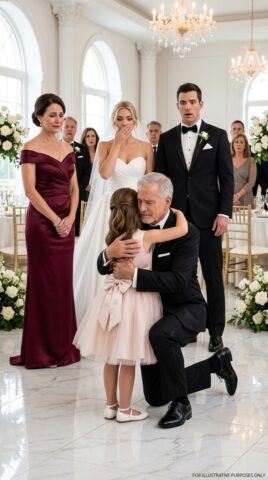
He knelt in front of his mother in the middle of the dining hall, before family, allies, enemies, servants, and guards. He took her trembling hands in his.
“Ma,” he said, and his voice broke. “Forgive me.”
Margaret looked at him for a long time. Then she lifted one hand and touched his cheek.
Dominic closed his eyes like a child receiving mercy he did not deserve.
Margaret tapped twice against his face.
Yes.
Forgiveness, in her language, was not dramatic. It was two taps from a hand that had suffered too much and still chose love.
I looked away because some moments are too private even when they happen in a crowded room.
Later that night, after the guests were gone and the mansion had become quiet again, I found Dominic outside Margaret’s room. His tie was loosened, his jacket gone, his eyes fixed on the closed door.
“She’s asleep,” I said.
He nodded. “Rosa says Caleb ate too much cake and asked if all dangerous houses have better food than ours.”
For the first time that night, I almost laughed.
Then Dominic’s expression changed.
“I owe your son an apology too.”
“He doesn’t know enough to need one.”
“Children always know more than adults think.”
That was true.
I leaned against the wall because my legs were finally feeling the weight of the day.
“You were brave tonight,” Dominic said.
I shook my head. “No. I was afraid the whole time.”
“Bravery is not the absence of fear.”
“That sounds like something powerful men say after ordinary women take the risk.”
For one second, I thought I had gone too far.
Then he lowered his eyes.
“You’re right.”
His answer surprised me. Men like Dominic Kane were not supposed to admit when a caregiver was right. But that was the strange thing about him. Power had made him feared, but grief had left cracks in him, and through those cracks his mother could still reach the boy he had once been.
“What happens to Vanessa?” I asked.
“She will leave Boston before sunrise.”
“That’s all?”
“No,” he said. “But it is all you need to carry.”
I accepted that, not because I trusted violence, but because I had learned some burdens are not meant to be placed on a child’s breakfast table.
The next morning, Caleb woke in a guest room larger than our apartment. He sat cross-legged on the bed, eating toast with jam from a silver tray and looking suspiciously at the butter.
“Mom,” he said, “are we rich now?”
I laughed for the first time in days. A real laugh. It startled me.
“No, sweetheart.”
“Then why is the butter in a little bowl?”
“Because rich people are afraid of normal plates.”
He giggled, and the sound loosened something inside my chest.
Then his face grew serious.
“Did the bad lady go away?”
“Yes.”
“Because of the tall man?”
“Because of the truth.”
He thought about that. “Can truth make bad people go away?”
“Sometimes,” I said. “But it usually needs brave people to say it.”
“Were you brave?”
I looked at my son, the child I had chosen over every easier life.
“I tried to be.”
He leaned against me.
“I think you were.”
That was enough.
In the days that followed, the mansion changed in ways outsiders would never notice. Margaret’s communication board was never moved out of reach again. A second board was placed in every room she used. Dominic hired a specialist not to replace me, but to teach the entire staff basic signs, so his mother would never again depend on only one person to be understood.
The housekeeper who helped Vanessa was dismissed quietly. Two guards were replaced. Vanessa’s flowers were removed from the garden. Her engagement portrait vanished from the grand hall before breakfast.
Charles Rhodes’s name disappeared from contracts faster than paint drying in sunlight. Men who had smiled at his table suddenly claimed they had never trusted him. That is how powerful people survive scandal. They rewrite their memories before anyone can question them.
But inside the mansion, no one forgot.
Margaret did not forget.
I did not forget.
Dominic did not forget.
Sometimes I caught him standing in his mother’s doorway, watching her write, watching her choose, watching her refuse small things simply because she could. There was pain in his eyes on those days. But there was also gratitude. He had almost married a woman who saw his mother’s silence as weakness. Instead, he learned that silence could hold truth sharper than any scream.
I planned to leave.
That may sound strange after everything, but fear does not disappear simply because one enemy is gone. The mansion had nearly cost me my son. It had dragged Caleb into a world I had spent nine years trying to avoid. I told myself the wise thing was to take my final pay, thank Margaret, and find work somewhere ordinary, somewhere without gates and guards and women who used children as threats.
I told Margaret first.
“Caleb needs peace,” I said. “And I think I do too.”
She listened, board on her lap, eyes calm. Then she wrote: You leave because afraid?
I smiled sadly. “Yes.”
She wrote again.
Good mothers afraid.
Then, after a pause, she added: But do not let fear choose whole life.
I had no answer.
That afternoon, Dominic asked to speak with me in the garden.
It was the first time I had been there without pushing Margaret’s chair. The roses were trimmed too neatly, the paths swept too clean, but outside the walls the air felt easier.
“My mother says you want to leave,” Dominic said.
“Your mother reads too much.”
“She reads correctly.”
I looked toward the house. “This place is not safe for Caleb.”
“It is safer now.”
“Because you say so?”
He did not answer quickly. I respected that.
“Because it should have been safe before,” he said, “and I failed.”
“I’m not asking for guilt.”
“I know.”
“And I won’t stay because you feel responsible.”
“Good.”
His answer made me look at him.
“Stay only if the work matters to you,” he said. “Stay only if my mother matters to you. Stay only if you believe your son can be safe here. If not, I will arrange work for you elsewhere under another name if necessary. Your pay will continue until you are settled.”
I stared at him. “Why?”
“Because my mother is alive in ways I did not see because of you.”
“She was always alive.”
“Yes,” he said softly. “That is the part I will regret.”
The honesty in his voice unsettled me more than command would have. I was used to men who tried to buy decisions. Dominic, for once, was trying not to.
“And if I stay?”
“Then you stay as Margaret Kane’s personal advocate, not as a servant anyone can order around. No one enters her room without her permission. No one moves her board. No one speaks over her. You answer to her first, then to me.”
“And Caleb?”
“A car takes him to school. A guard watches from a distance so he does not feel watched. His asthma medication is covered. His life remains his life.”
I looked at him sharply. “I will not have my son raised like a Kane.”
Something almost warm touched his eyes.
“That may be the wisest thing anyone has said in this house.”
I looked away because I did not want to smile.
“I need time.”
“Take it.”
I stayed.
Not because Dominic asked. Not because the mansion suddenly became safe. I stayed because Margaret took my hand that evening and tapped twice, then placed her palm over mine.
Yes. Stay.
And because Caleb, after discovering the cook would make chocolate pancakes if he said please, declared that the mansion was scary but interesting, which was the most honest description anyone had ever given of the place.
Months passed before people stopped whispering Vanessa’s name. Winter came softly. Boston turned gray and cold. The mansion, strangely, became warmer.
Margaret spent more time in the sitting room. Caleb did his homework near her window while she corrected his spelling with slow taps and stern eyes. Dominic came home earlier than he used to. At first, I thought it was for his mother. Then one evening, I found him in the doorway watching Caleb explain a school drawing to Margaret, and his eyes moved to me with something quiet and honest.
Not hunger.
Not possession.
Not the look Vanessa had wanted from him.
Something gentler.
And because it was gentle, it frightened me more.
I had spent my life refusing love that demanded a sacrifice from me. I did not know what to do with love that simply stood at the door and waited for permission.
One evening near the end of winter, Margaret asked to have dinner in the same hall where Vanessa had been exposed.
I thought it was a terrible idea.
Dominic thought so too.
Margaret was stubborn in a way that made both of us obey.
“Small dinner,” Dominic said.
Margaret tapped twice.
“Yes.”
“No guests,” I added.
She tapped twice again.
“No speeches,” Caleb said seriously.
Margaret looked at him and tapped once.
No.
Caleb groaned. “Grandma Margaret speeches are boring.”
She lifted one eyebrow, and he immediately sat straighter.
Somehow, even without a voice, Margaret Kane could command a room better than anyone I had ever known.
The dinner was held on a Friday evening. Not for an engagement. Not for business. Not for power. It was for the family that had formed after the lie had died. There were no false allies, no Rhodes relatives measuring marble columns, no woman in white pretending to love what she only wanted to own.
Only Dominic, Margaret, Caleb, Rosa, the cook who had become Caleb’s secret ally, two old Kane cousins who genuinely loved Margaret, and me.
The hall looked different without fear in it. The candles still burned. The chandeliers still shone. The plates were still gold-edged. But the room no longer felt like a stage for someone else’s ambition. It felt, for the first time, like a home trying to remember how to be warm.
Margaret wore blue again.
When I fastened the silver cross at her neck, she looked at me through the mirror and tapped twice.
Beautiful.
I smiled. “You are.”
She tapped once.
No.
Then she pointed at me.
I looked down quickly because praise had always made me uncomfortable. Poor women are used to being useful, not beautiful.
Margaret knew that.
She knew too much.
During dinner, Caleb talked more than anyone. He told Dominic the cook put too much butter in the potatoes, then asked for more. He told Margaret his teacher said his handwriting was improving, which made Margaret tap twice like a queen granting approval. Dominic watched him with quiet amusement, and sometimes his eyes met mine across the table.
Each time, I looked away first.
Near the end of dinner, Margaret placed her palm flat on the table.
The room went silent immediately.
Dominic leaned forward. “Ma?”
She pointed to her board.
I placed it in front of her, but she pushed the pen toward Dominic first. He frowned, not understanding.
She tapped twice, then pointed to the empty chair beside him, then to me.
My heart began to beat harder.
“Margaret,” I said softly.
She ignored me.
She took the pen and began to write. Her hand was steadier than it had been on the night Vanessa fell.
Slowly, letter by letter, she wrote a sentence that made the room stop breathing.
I want my son to marry Claire if Claire chooses him freely.
For a moment, I heard nothing. Not the candles. Not the silverware. Not Caleb’s little gasp beside me.
My face went hot.
“Margaret,” I whispered. “Please.”
Dominic did not move. His eyes stayed on the board, then lifted to his mother.
“Ma.”
Margaret looked at him with the calm authority of a woman who had survived lies, violence, silence, and still knew exactly what truth looked like.
She wrote again.
Not servant. Not debt. Family.
Dominic’s throat moved.
He looked at me then, and there was no command in his eyes, no expectation, no arrogance. Only shock, tenderness, and something he had been too careful to name.
“Claire,” he said quietly, “you do not have to answer anything tonight.”
That should have made the moment easier.
It made it harder, because it proved he understood what I feared most.
I had spent years being chosen only when I was useful. Useful to Aaron until Caleb made life complicated. Useful to employers until my body tired. Useful to the Kane mansion because I could translate a woman no one else understood.
But Dominic was not asking me to be useful.
He was giving me room to be free.
Margaret pushed the board toward me. There was another line written beneath the first.
My son needs a woman who tells him the truth. Claire needs a man who will never ask her to abandon her child.
Caleb looked at me with wide eyes.
“Mom,” he whispered, “is she asking if Mr. Kane can be my dad?”
The room softened and broke at the same time.
I covered my mouth, but a laugh and a sob came together.
Dominic looked at Caleb, and for the first time since I had known him, the feared Dominic Kane looked afraid of a nine-year-old boy’s answer.
“Only if your mother wanted that,” Dominic said. “And only if you did too.”
Caleb studied him seriously.
“Would I have to wear black?”
Dominic blinked.
Rosa turned her laugh into a cough.
“No,” Dominic said.
“Could Mom still tell you when you’re wrong?”
“She already does.”
“Would Grandma Margaret live with us?”
Margaret tapped twice so hard the board jumped.
Yes.
Caleb nodded as if concluding a business negotiation.
“Then I think maybe it’s okay.”
Everyone laughed softly then, even Dominic.
But I could not laugh for long. My eyes were full.
I looked at Margaret. “You are asking too much.”
She tapped once.
No.
Then she wrote: I give blessing before asking. Your choice. Always your choice.
Dominic stood slowly and came around the table, but he did not come too close. He stopped a few steps away, as if distance itself were a form of respect.
“Claire,” he said, his voice lower than I had ever heard it, “my mother is bold.”
A small laugh escaped me through tears. “Your mother is dangerous.”
Margaret tapped twice.
Yes.
Dominic smiled faintly, then grew serious.
“I will not pretend I deserve you because my mother says so. I will not pretend my world is simple. It is not. I have enemies. I have sins. I have a name people fear. But I also have a mother who taught me too late that love without listening is just another kind of pride. You taught me that too.”
I could not look away now.
“I do not want you as a caregiver,” he continued. “I do not want you because you saved my family. I do not want you because I owe you. I want you because when you entered this house, you saw the person everyone else missed. You saw my mother. You saw me, even when I did not deserve it. And if one day, not tonight unless you wish it, but one day, you can see a life beside me, I would spend the rest of mine proving that neither you nor Caleb will ever have to stand alone again.”
No one spoke.
Even Caleb was quiet.
I looked at the man Boston feared, standing before me like a man asking for mercy. Then I looked at Margaret, who had once been trapped inside silence and had somehow used that silence to lead us all toward truth. Then I looked at Caleb, my promise, my heart, the child I had chosen before every easier life.
“I spent years refusing any love that asked me to give up my son,” I said.
Dominic’s eyes did not leave mine. “I would never ask that.”
“And I will not become part of this house’s charity.”
“Never.”
“If I say yes one day, it will not be because Margaret blessed it, or because you protected Caleb, or because I feel grateful.”
“Then say yes only if it is because you want me.”
My hands trembled.
Margaret watched me with wet eyes.
Caleb slipped his small hand into mine.
I took a breath.
“Then not one day,” I said softly. “Tonight.”
Dominic’s face changed, not with triumph, but with disbelief so tender it hurt to see.
“Claire.”
“Yes,” I whispered. “But slowly. With truth. With Caleb. With your mother. With no secrets moved out of reach.”
Margaret tapped twice again and again until everyone laughed through tears.
Dominic came closer then, slowly enough that I could have stepped back.
I did not.
He took my hand, not like a boss taking what he wanted, but like a man receiving something he had no right to demand. He pressed his lips to my fingers, and the whole room seemed to exhale.
Caleb made a face. “Do I have to watch this?”
Rosa laughed openly this time.
Margaret tapped once at Caleb.
No.
Then she pointed to his cake.
He understood at once and happily returned to dessert.
Months later, when Dominic placed a ring on my finger in the garden behind the mansion, Margaret sat in the front row wearing blue, with Caleb beside her holding the communication board like it was a royal document. There were no crowds of false allies, no families hungry for power, no woman in white pretending to love what she only wanted to own.
There was only sunlight, roses, a few trusted people, and Caleb whispering too loudly, “Mom, don’t cry. Your face will look funny in pictures.”
I cried anyway.
Dominic laughed under his breath and wiped one tear from my cheek with a tenderness that made Margaret tap twice in approval.
When the minister asked for blessings, Margaret lifted her board. Dominic and I turned toward her. Her hand moved slowly, but every letter came clear.
Family is who protects your voice when the world refuses to hear you.
Dominic bowed his head.
I held Caleb’s hand.
Margaret tapped twice.
Yes.
That was how our story truly ended.
Not with Vanessa’s downfall. Not with the anger of a feared man. Not with the open phone call that let justice hear what cruelty sounded like when it thought no one important was listening.
It ended with a woman who could not speak blessing a family that had finally learned to listen.
People later said Vanessa Rhodes was destroyed because she forgot to hang up the phone. But that was not the whole truth. Vanessa was destroyed because she believed silence meant weakness. She believed a caregiver could be frightened into lying. She believed a mother without a voice could be ignored. She believed a child could be used as a weapon and no one would make her answer for it.
She was wrong about all of us.
Margaret could not speak, but she said no.
I was afraid, but I told the truth.
Dominic was powerful, but he learned to listen.
Caleb was only a child, but he reminded us why courage mattered.
And Vanessa, who wanted a throne beside a man the city feared, lost everything because one phone call stayed open long enough for the truth to hear her clearly.
My name is Claire Kane now.
I was once only the quiet caregiver in Dominic Kane’s mansion, the woman who carried tea, folded blankets, and translated silent signs.
But I learned that even the quietest voice can shake an empire when someone finally refuses to ignore it.
And sometimes the woman hired to protect another woman’s voice finds her own waiting in the silence.