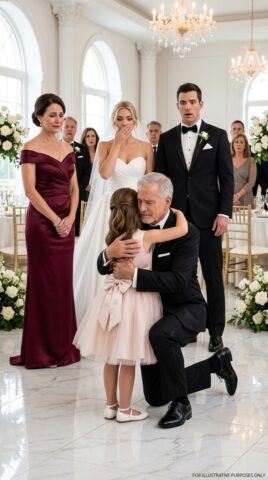
All three of them looked up.
At the top of the sweeping staircase stood Margot Morel, Adrian’s mother, one hand gripping the banister, the other pressed to her chest. She had not been seen downstairs in weeks. Celeste had told everyone the grief had made her too fragile to leave her room.
Now she was standing there in a silk robe, pale with fury.
Celeste’s face emptied.
“Margot, you shouldn’t be out of bed—”
“Oh, be quiet,” Margot said, and her voice cracked like a whip through the foyer.

She descended slowly, one step at a time, never taking her eyes off Celeste.
Adrian stood frozen beneath her.
“Mother,” he said, but even he did not know which part of the moment he was reacting to first.
Margot reached the last stair and looked straight at Lucie.
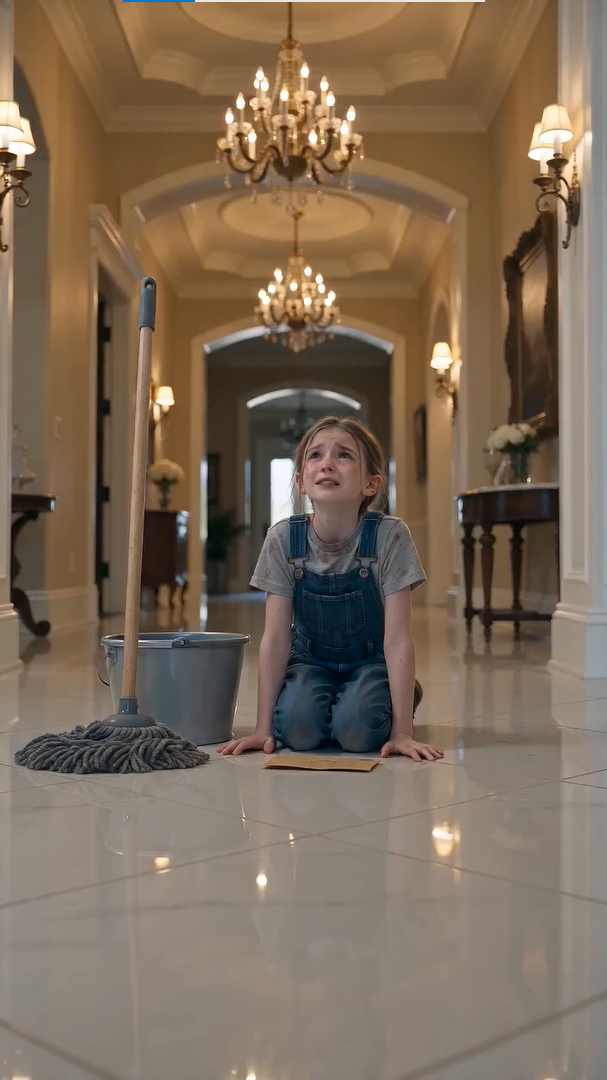
The child stood beside the mop bucket, frightened but still upright, her small wrist bare now where the bracelet had been opened.
Margot’s mouth trembled.
Then she whispered, “She has Elena’s eyes.”
Adrian felt the name like a blade.
Elena.
A woman from his father’s old estate office. Kind, quiet, long gone by the time Adrian returned from years abroad. Celeste had once dismissed her as nothing important. A passing scandal. A servant girl who disappeared after asking for money.
Now Adrian understood why the subject had always died so quickly in his house.
He turned to Lucie. “Elena was your mother?”
Lucie nodded.
“She died when I came out,” she said, using the language of a child who had never been taught gentler words for cruel things. “Grandpa said she loved you before she got sick.”
Adrian shut his eyes.
For one horrible second he saw the entire missing life at once — the years, the lies, the child hidden in the shadow of his own name.
Margot stepped closer to Lucie, then glared at Celeste with naked hatred.
“You told me the baby didn’t survive the winter,” she said. “You brought me a death certificate.”
Celeste lifted her chin, but her hands had started to shake.
“I did what was necessary.”
Adrian looked at her slowly.
“For what?”
Now she snapped.
“For this house!” she said, gesturing wildly around the foyer. “For your name, your inheritance, your future! Do you think your father wanted some illegitimate village child taking everything?”
Margot’s slap landed so hard it echoed off the marble.
Celeste staggered sideways.
Lucie flinched.
Adrian did not.
He only stared.
Because the slap had not shocked him nearly as much as Celeste’s answer.
She had not denied it.
She had just justified it.
Margot turned to Adrian, breathing hard.
“Your father changed the will six months before he died,” she said. “He told me he would tell you himself. He said if anything happened, the proof was inside the bracelet and inside the blue file in his study safe.”
Celeste moved at that.
Too fast.
Toward the dining room.
Toward the back corridor.
Toward escape.
Adrian caught her wrist before she made it three steps.
She gasped.
His voice, when it came, was terrifyingly calm.
“Where is the file?”
Celeste looked at him with the final desperation of a person whose mask had no skin left to cling to.
“You don’t understand what you’re doing,” she said. “If this comes out, your father’s name is dragged through mud, the papers tear this family apart, everyone asks who the mother was, where the child came from—”
“My daughter,” Adrian said, “was already on her knees scrubbing my floor.”
That ended the argument.
Lucie had not cried again yet.
That somehow made everything worse.
She was standing very still, clutching the wet wooden mop as if she still wasn’t sure whether she was allowed to let it go.
Adrian released Celeste’s wrist and crossed the foyer to Lucie.
He knelt in front of her.
Really looked at her.
There was fear in her face, yes. But also something more dangerous in children than fear: caution learned too early.
“Did she hurt you?” he asked softly.
Lucie’s lower lip trembled.
“Only when I called you Daddy.”
Adrian broke.
Not loudly.
Not dramatically.
Just in the eyes first, then the mouth, then the way his shoulders lowered as if the full weight of his own blindness had finally found him.
He reached out slowly.
“Lucie,” he said, voice shaking, “you never have to clean this floor again.”
For a second she didn’t move.
Then, with the smallest possible motion, she let go of the mop.
It hit the tile with a soft clatter.
And threw herself into his arms.
He caught her like a man trying to hold the last surviving piece of his own soul.
Behind them, Margot pressed one hand to her mouth and cried silently.
In the distance, somewhere deeper in the house, staff had begun to gather — drawn by the shattering glass, the raised voices, the impossible reversal of power.
Celeste stood alone now in the middle of the foyer she had ruled so carefully, looking suddenly smaller than the child she had tried to bury inside it.
Adrian rose with Lucie in his arms.
He did not look at Celeste for a long time.
When he finally did, there was nothing left in his face that belonged to marriage.
“Call my lawyer,” he said to the nearest servant.
No one hesitated.
Celeste’s voice cracked. “Adrian, please—”
He turned away from her before she finished.
Margot stepped beside him and rested one trembling hand on Lucie’s hair.
Then she looked at Celeste and said, with cold satisfaction:
“The heir is home.”
And for the first time since walking through that door, Lucie stopped trembling.
But she did not let go of Adrian.
Her small arms stayed locked around his neck as if she was afraid that if she loosened them, the house would change its mind and throw her back onto the floor.
Adrian felt it.
Every tiny shake in her body.
Every careful breath.
Every bruise fear had left where no one could see.
He turned toward the staircase.
“Mother,” he said softly. “She needs a room.”
Margot wiped her face quickly.
“No,” she whispered.
Adrian froze.
Lucie’s fingers tightened in his collar.
Margot saw the fear cross the child’s face and immediately stepped closer.
“No, sweetheart. Not a room.”
Her voice broke.
“She needs the nursery.”
Celeste made a small sound.
Margot turned on her.
“The nursery your lies kept empty.”
The words landed like another slap.
The old nursery had been closed for years. Adrian had never asked why his mother kept the door locked. He thought it was grief over children never born in the family after him. He thought it was another strange habit of a woman who had spent too much of her life inside a large silent house.
Now he understood.
It had not been empty because no child belonged there.
It had been empty because the child had been hidden downstairs with a mop in her hand.
Adrian looked down at Lucie.
“Would you like that?” he asked gently.
She blinked.
“The nursery?”
“Yes.”
She looked at the marble floor. At the servants gathered in silence. At Celeste standing pale and furious behind them.
Then she whispered, “Will I have to leave it if I make noise?”
Adrian closed his eyes.
Margot’s hand flew to her chest.
“No,” Adrian said, his voice breaking. “You can make all the noise you want.”
Lucie looked at him, unsure.
“All?”
He nodded through tears.
“All.”
She thought about that like it was a dangerous promise.
Then she rested her head against his shoulder.
“Okay.”
Adrian carried her up the stairs himself.
Margot followed slowly, one hand on the banister, the other never leaving Lucie’s back whenever she was close enough to touch her.
The staff watched from below.
Some cried.
Some looked ashamed.
Some stared at Celeste with hatred that had been silent for too long.
Celeste did not follow.
For the first time in that house, nobody waited for her permission.
At the top of the stairs, Margot stopped before a white door at the end of the hall.
Her hand shook as she removed a key from the pocket of her robe.
“I kept it ready,” she whispered.
Adrian looked at her.
“For who?”
Margot’s eyes filled.
“For the baby I was told died.”
She unlocked the door.
The room opened with a soft creak.
Inside, dust floated in the golden afternoon light.
A small bed stood against the wall.
A wooden cradle sat near the window, covered with a white sheet.
Shelves held old storybooks, untouched toys, folded blankets, and a tiny silver music box shaped like a swan.
Lucie lifted her head.
Her eyes widened.
“This is for babies,” she said quietly.
Margot swallowed hard.
“It was. Once.”
Adrian stepped inside slowly.
Every inch of the room felt like an accusation.
A life had been prepared here.
A child had been expected.
A grandmother had waited.
And all the while, Lucie had been growing up somewhere cold, somewhere hidden, somewhere close enough to be brought into the house as help but never close enough to be loved.
Lucie looked at the little bed.
“Can I touch it?”
Adrian nearly broke again.
“You never have to ask to touch things that are yours.”
She stared at him.
“Mine?”
He nodded.
“This room is yours.”
Lucie looked at Margot.
Margot nodded too, tears slipping down her face.
“All of it.”
Lucie slowly reached out and touched the blanket folded at the foot of the bed.
With one finger.
Then two.
Then her whole small hand.
“It’s soft,” she whispered.
Margot covered her mouth.
Adrian lowered her gently onto the bed.
Lucie sat stiffly at first, as if waiting for someone to shout.
No one did.
No one told her to get down.

No one told her she would dirty the sheets.
No one told her children like her did not belong in rooms like this.
Adrian knelt in front of her again.
“Lucie,” he said softly, “I need to go downstairs for a little while. I need to find the file. I need to make sure Celeste can never hurt you again.”
Lucie’s face changed instantly.
“You’re leaving?”
“No.” He took her small hands in his. “I am going downstairs. Not away.”
She searched his face with eyes too old for a child.
“People say that.”
“I know,” he whispered. “But I am not people.”
She looked down at their joined hands.
“Grandpa said rich men forget little girls.”
Adrian closed his eyes.
That sentence cut deeper because it had probably been true too often.
He opened his eyes again.
“This rich man forgot too much already,” he said. “Never again.”
Lucie studied him.
Then she asked, “Can I keep the bracelet?”
Adrian looked at her bare wrist.
The bracelet had been placed on the table downstairs after Margot opened the clasp. Inside it, hidden beneath the engraved silver, was the tiny folded paper that had started to expose everything.
“Yes,” he said. “It belongs to you.”
She nodded.
“And the mop?”
Adrian’s face tightened.
“What about it?”
“I don’t want it.”
Margot let out a broken sob.
Adrian squeezed Lucie’s hands.
“Then you will never touch it again.”
Lucie looked relieved in a way no child should ever look relieved over something so simple.
Margot sat beside her on the bed.
“I will stay with her,” she told Adrian.
He looked at his mother.
For years, Margot had been distant. Sick. Silent. A woman trapped behind old grief and expensive curtains.
Now he saw her clearly.
Not fragile.
Not useless.
Not broken beyond use.
A mother who had been lied to.
A grandmother who had been robbed.
He leaned forward and kissed her forehead.
“I’m sorry,” he whispered.
Margot grabbed his hand.
“Find the file.”
He nodded.
Then he stood and walked out.
Downstairs, the foyer had changed.
The mop was still lying on the marble.
The bucket still sat near the stairs.
Water had spread in a thin silver line across the floor.
Adrian stopped at the sight of it.
That tiny puddle seemed more powerful than all the chandeliers above it.
Because it told him exactly where his daughter had been placed in the house.
On her knees.
Silent.
Useful.
Invisible.
His lawyer had arrived by then, along with two security men from the estate office. Celeste stood near the sitting room, guarded now, though no one had touched her.
She looked up when Adrian entered.
Her eyes were red.
For a moment, she almost looked human.
“Adrian,” she whispered. “Please. We can fix this.”
He stared at her.
“Fix what?”
She swallowed.
“Our marriage.”
He let out a quiet, terrible laugh.
“There is no marriage.”
Her face twisted.
“I loved you.”
“No,” he said. “You loved my name.”
“That’s not fair.”
“My daughter was cleaning the floor in front of you.”
Celeste flinched.
“She was supposed to be sent away,” she hissed. “She was never supposed to come here.”
Adrian went still.
“What?”
Celeste realized too late what she had said.
Adrian took one step closer.
“You knew she was coming?”
She said nothing.
He looked to the lawyer.
“Record everything.”
The lawyer nodded and turned on his phone.
Adrian’s voice was low.
“Say it again, Celeste.”
She pressed her lips together.
He moved closer.
“Who brought Lucie here?”
Celeste shook her head.
“You don’t know what that child is.”
Adrian’s eyes darkened.
“She is my daughter.”
“She is a threat.”
“She is six years old.”
“She is proof!” Celeste snapped. “Proof that your father betrayed this family. Proof that Elena was never just a servant. Proof that the old man wanted to split everything. Proof that I would spend my life playing mistress of a house that would one day belong to a bastard child.”
The lawyer’s face hardened.
Adrian did not move.
He had learned in that instant that rage could become so deep it no longer looked like rage at all.
It looked like calm.
“Where is the blue file?”
Celeste laughed bitterly.
“Do you think I’d leave it in the safe?”
Adrian’s blood turned cold.
“What did you do?”
“I protected what was ours.”
“What did you do?”
“I burned it.”
The room went silent.
For one second, Adrian heard nothing.
Then the lawyer stepped forward.
“The bracelet may still be enough. If the embedded document contains the encoded reference and Margot Morel can testify—”
Celeste smiled sharply.
“Testify? She’s been drugged for weeks. Who will believe her?”
Adrian’s face changed.
The lawyer froze.
Even Celeste seemed to realize she had gone too far.
Adrian’s voice dropped to a whisper.
“Drugged?”
Celeste took a step back.
“I didn’t mean—”
He turned to the nearest servant.
“Get the doctor. Now.”
The servant ran.
Adrian looked at Celeste.
All the air seemed to leave the room.
“You kept my mother sick.”
Celeste said nothing.
“You lied about my daughter.”
Silence.
“You burned my father’s proof.”
Her mouth trembled.
“You let a child scrub floors in the house she was meant to inherit.”
Celeste’s eyes finally filled, but the tears came too late.
“I did it for us.”
Adrian shook his head slowly.
“There was never an us. There was you, and there was whatever you could take.”
The lawyer stepped closer.
“Adrian, you need to let me call the police.”
Adrian did not take his eyes off Celeste.
“Call them.”
Celeste’s face collapsed.
“No. Adrian, no. Think about the scandal.”

He looked around the foyer.
At the staff who had been afraid of her.
At the mop on the ground.
At the stairs leading to the room where his daughter was learning, for the first time, that softness could belong to her.
Then he looked back at Celeste.
“The scandal began when you turned my child into a servant in her own home.”
The police came before sunset.
So did the doctor.
Margot’s blood was tested.
Her medicines were taken from her room.
The staff gave statements one by one.
At first, they were afraid.
Then they saw Adrian standing near the staircase, Lucie’s bracelet in his hand, and fear began to change sides.
A cook confessed Celeste had ordered Lucie to sleep near the laundry room.
A maid admitted she had been told to slap the child’s hands if she touched anything expensive.
A driver revealed he had brought Lucie from a village orphan shelter after a man named Marcel, Elena’s grandfather, had died suddenly.
Adrian listened to every word like punishment.
Lucie had been close.
So close.
And still no one had protected her.
When the police led Celeste through the foyer, she looked up at Adrian one last time.
“Don’t do this,” she whispered. “You’ll destroy me.”
Adrian held the bracelet tighter.
“No,” he said. “You destroyed a child’s peace. The rest is consequence.”
She looked toward the stairs.
Lucie was standing halfway up, holding Margot’s hand.
She had changed into a soft white nightdress Margot had found in the nursery wardrobe. It was too big at the sleeves, but she looked warm for the first time.
Celeste stared at her.
The hatred in her face had not fully died.
Adrian saw it.
So did Margot.
Lucie stepped back behind her grandmother.
Adrian moved immediately.
He climbed the stairs and placed himself between Celeste and his daughter.
The police took Celeste away.
The front doors closed behind her.
The house went quiet.
Not peaceful.
Not yet.
But different.
Like something rotten had finally been dragged into the light.
That night, Lucie refused to sleep.
She sat in the nursery bed with the blanket pulled up to her chin, staring at the door.
Adrian sat in a chair beside her.
Margot rested in the next room under the doctor’s orders, furious about being told to rest but too weak to argue for long.
Lucie looked at Adrian.
“Will the mean lady come back?”
“No.”
“Are you sure?”
“Yes.”
“She always came back when people said she wouldn’t.”
Adrian swallowed hard.
“I have guards downstairs. Locks on the doors. Lawyers. Police. And me.”
Lucie considered this.
Then asked, “Will you sleep outside the door?”
Adrian stood immediately.
“Yes.”
Her eyes widened.
“I didn’t say you had to.”
“I know.”
He took the pillow from the chair.
“I want to.”
She looked at him with a strange, fragile wonder.
“You can sleep on the floor?”
“I can.”
“But it’s hard.”
He smiled sadly.
“You slept near the laundry room.”
She looked down.
He sat back on the edge of the bed.
“I’m sorry.”
Lucie played with the edge of the blanket.
“People say that when they don’t know what else to say.”
Adrian nodded slowly.
“That’s true.”
“Do you know what else to say?”
He thought about it.
Then he shook his head.
“No. Not yet. But I know what to do.”
She looked up.
“What?”
“Stay.”
Lucie stared at him for a long time.
Then she moved slightly to one side of the bed.
“There’s room here.”
Adrian’s throat tightened.
“Are you sure?”
She nodded, but shyly.
He carefully lay beside her, on top of the blanket, leaving space so she would not feel trapped.
For a while, she stayed still.
Then, slowly, she reached out and touched the ring on his hand.
“Did my mama know you?”
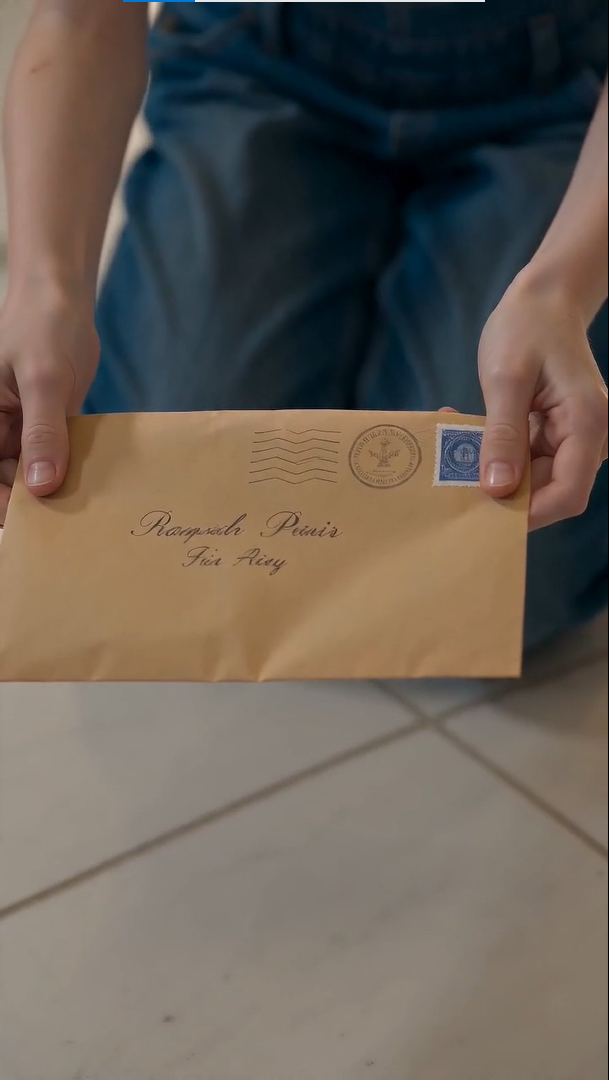
Adrian closed his eyes.
“Yes.”
“Did you love her?”
The question was simple.
The answer was not.
He turned his head toward Lucie.
“I think I was too foolish to understand what I felt,” he said honestly. “But I cared for her. And I should have protected her.”
Lucie was quiet.
“Grandpa said she smiled when she talked about you.”
Adrian’s eyes filled.
“She did?”
Lucie nodded.
“She said you were kind before you became far away.”
The words hurt because they sounded like Elena.
Soft enough to forgive.
Sharp enough to haunt.
“I was sent abroad,” Adrian whispered. “I thought it was for business. I didn’t know she was carrying you.”
Lucie touched the bracelet on her wrist.
“Did you not want me?”
Adrian turned fully toward her.
“No.”
His voice broke on the word.
“No, Lucie. Never think that. I didn’t know about you. But the moment I knew, you became the most important person in my life.”
She searched his face.
“More important than the house?”
“Yes.”
“More than the money?”
“Yes.”
“More than your name?”
Adrian’s eyes filled.
“You are my name.”
Lucie’s lips trembled.
Then she whispered, “Can I call you Daddy again?”
Adrian broke.
This time there was no stopping it.
He covered his mouth, but the tears came anyway.
Lucie looked frightened.
“Did I say wrong?”
He shook his head quickly and gathered her carefully into his arms.
“No,” he whispered. “You said the most right thing anyone has ever said to me.”
She let him hold her.
Slowly.
Carefully.
And sometime before dawn, Lucie finally fell asleep with her small hand resting against his chest, as if she needed proof his heart was still there.
Morning came with lawyers, police officers, reporters at the gate, and a house full of shame.
The story spread quickly.
The hidden heir of the Morel estate.
The wife who buried a child’s identity.
The grandmother drugged into silence.
The little girl made to work as a servant in her father’s home.
Adrian hated every headline.
Not because they embarrassed him.
Because each one turned Lucie’s pain into a spectacle.
He stood before the gates that afternoon, cameras flashing, and gave only one statement.
“My daughter is not a scandal,” he said. “She is a child. This family failed her before it knew her, and some people failed her while knowing exactly who she was. That ends now.”
Questions flew at him.
“Is Lucie legally the heir?”
“Did your wife confess?”

“Was your mother poisoned?”
“Who was Elena?”
At Elena’s name, Adrian stopped.
The cameras clicked faster.
He took a breath.
“Elena was Lucie’s mother,” he said. “And she deserved honor long before the world learned her name.”
Then he turned and went back inside.
No more questions.
No more feeding the public.
Inside, Margot sat with Lucie in the sunroom.
Lucie had a plate of toast in front of her, untouched.
Margot was trying to convince her that she could eat as much jam as she wanted.
Lucie looked skeptical.
“Will I get in trouble?”
Margot’s eyes filled every time the child asked a question like that.
“No, darling.”
“What if I spill?”
“Then we clean it.”
Lucie frowned.
“Me?”
Margot shook her head firmly.
“Together.”
That answer seemed to please her.
She picked up the toast.
Adrian watched from the doorway.
Margot noticed him and smiled softly.
“Come in. Your daughter is negotiating for a second spoonful of jam.”
Lucie looked down quickly, embarrassed.
“I wasn’t.”
Adrian walked in and sat beside her.
“I think you should ask for three.”
Lucie’s eyes widened.
Margot gave him a look.
“Do not teach her greed on her first morning.”
Adrian smiled faintly.
For one moment, the room almost felt normal.
Then Lucie asked, “Where will I go now?”
The smile disappeared.
Adrian looked at her.
“What do you mean?”
“When people find out things, children get moved,” she said quietly. “That’s what happened before.”
Margot closed her eyes.
Adrian took Lucie’s hand.
“You are not being moved.”
“But what if the papers say I belong somewhere else?”
“The papers say you belong here.”
“What if someone says I’m not good enough?”
Margot’s face hardened.
“Then they answer to me.”
Lucie blinked at her.
Margot lifted her chin.
“I have been quiet for too long. I am finished with it.”
Adrian looked at his mother.
So did Lucie.
And for the first time, the little girl smiled.
Only a little.
But enough.
The legal battle lasted months.
Celeste denied everything at first.
Then the recordings surfaced.
Then the staff statements.
Then the medical report showing Margot had been given sedatives she had never been prescribed.
Then the remains of burned documents were found in an old fireplace, along with one metal clip stamped with the family lawyer’s mark.
But the strongest proof came from the bracelet.
Inside the silver band, behind the tiny hidden clasp Margot had known how to open, Adrian’s father had placed a thin strip of microfilm and a folded note.
My granddaughter Lucie Morel is to be recognized as blood of this house.
Elena carried my son’s child.
If I am gone before I can repair what fear and pride have broken, let this bracelet speak where cowards stayed silent.
Adrian read the note once.
Then again.
Then he sat alone in his father’s study and cried like a boy.
He had spent years thinking his father was cold, calculating, obsessed with legacy.
And maybe he had been.
But at the end, the old man had tried to do one brave thing.
He had failed to finish it.
Now Adrian would.
The court recognized Lucie legally.
Her name was restored.
Lucie Elena Morel.
When Adrian told her, she stared at the paper.
“That’s my mama’s name.”
“Yes,” he said softly. “I thought you should carry it.”
Lucie touched the letters.
“Will people call me that?”
“If you want.”
She thought about it.
“Sometimes.”
Adrian smiled.
“Sometimes is fine.”
She looked up at him.
“Will you remember it?”
His face softened.
“I will remember everything about you.”
Slowly, the house changed.
The laundry room where Lucie had once slept was emptied.
Adrian ordered it turned into a staff lounge with windows, proper chairs, fresh paint, and a sign that read:
No one who works in this house is invisible.
The mop Lucie had dropped in the foyer was not thrown away.
Margot insisted it be kept.
Adrian was startled at first.
“Why would we keep that?”
Margot looked at him.
“Because comfort forgets quickly.”
So they placed it in a small glass case near the service entrance, not for guests, not for newspapers, but for the family and staff.
Beneath it was a simple brass plate.
Remember what silence allowed.
Lucie did not like looking at it at first.
Then one day, months later, she stood before it for a long time.
Adrian found her there.
“Do you want me to remove it?” he asked gently.
She shook her head.
“No.”
“You’re sure?”
She nodded.
“That mop was mine when I was scared.”
Her small hand reached for his.
“But it isn’t mine now.”
Adrian squeezed her fingers.
“No. It isn’t.”
Celeste’s trial came in the winter.
Adrian did not bring Lucie to court.
He refused.
“She has faced enough rooms full of adults,” he told the lawyers.
But Margot came.
She wore black.
Not mourning.
Judgment.
Celeste looked at Adrian across the courtroom with hollow eyes.
When she finally spoke, she tried once more to make herself the victim.
“I was afraid,” she said. “Afraid of losing my place. Afraid of being replaced. Afraid that everything I built would belong to another woman’s child.”
The judge listened.
Adrian listened too.
Then Celeste looked at him.
“I loved you.”
Adrian’s face did not move.
“No,” he said quietly when it was his turn to speak. “Love does not require a child to suffer so it can feel safe.”
Margot testified after him.
Her voice shook, but never failed.
She spoke of the death certificate.
The locked room.
The medicine Celeste brought with false sweetness.
The moment she saw Lucie’s eyes and knew the dead had not stayed buried.
When the verdict came, Celeste was sentenced.
Not for every wound she caused.
No sentence could measure that.
But enough for the world to know she had not won.
As she was led away, she turned once toward Adrian.
This time, he was not looking at her.
He was looking at the small bracelet in his hand.
Lucie’s bracelet.
Elena’s proof.
His father’s final truth.
When Adrian returned home that evening, Lucie was waiting near the stairs.
She was wearing a blue dress Margot had chosen and shoes she had picked herself because they had tiny flowers on the buckle.
“Is she gone?” Lucie asked.
Adrian knelt before her.
“Yes.”
“For always?”
“For a very long time. And she will never come near you again.”
Lucie nodded slowly.
Then she asked, “Did you win?”
Adrian thought about that.
Then he shook his head.
“No.”
Lucie frowned.
“But she lost.”
“Yes,” he said. “But winning would mean none of it ever happened.”
Lucie looked down.
He touched her cheek.
“So we didn’t win. We survived. That matters more.”
She considered this.
Then she put her arms around his neck.
“I like survived.”
Adrian held her.
“I do too.”
Years began to soften the sharpest edges.
Not erase them.
Just soften.
Lucie grew.
At first, she kept food hidden under her pillow.
Bread.
Apples.
Wrapped biscuits.
Adrian found them one night and cried silently in the hallway before going back in with a small basket.
When Lucie woke, afraid she was in trouble, he placed the basket beside her bed.
“For anything you want to keep,” he said.
She stared at him.
“You’re not angry?”
“No.”
“Even if I take too much?”
“There is no too much anymore.”
It took months for the basket to stay empty.
At first, Lucie asked permission for everything.
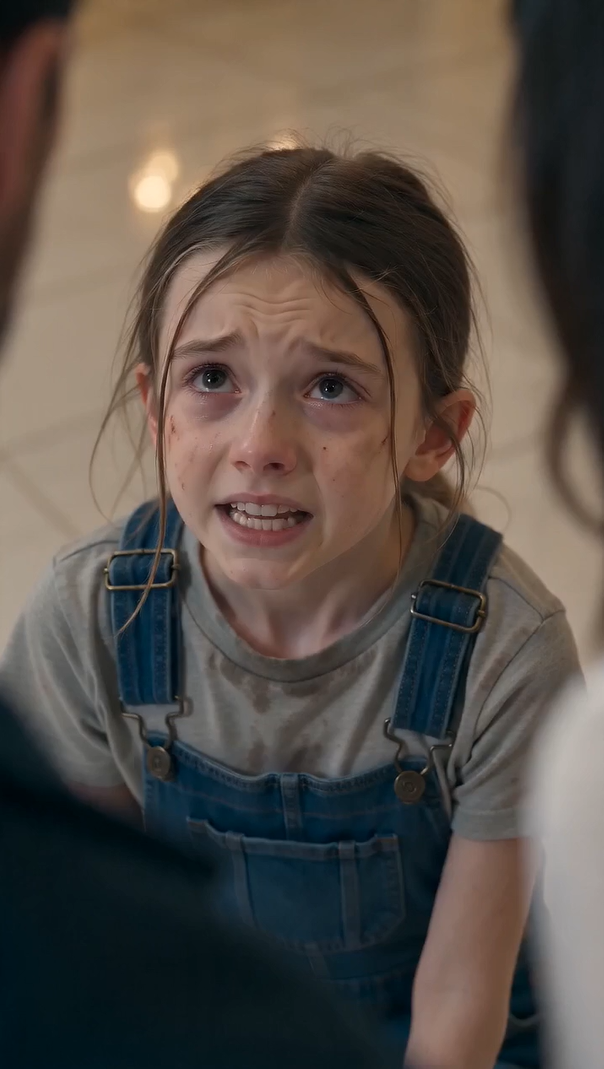
To sit.
To speak.
To use the front stairs.
To touch the piano.
To laugh loudly.
Every yes became a tiny repair.
Margot taught her to read music.
Adrian taught her to ride a bicycle and fell into the rose bushes twice.
The staff, once afraid to look directly at her, slowly became her protectors.
The old cook made her pancakes shaped like hearts.
The gardener showed her where Elena used to sit during lunch breaks.
A maid named Sophie confessed one day, crying, that she had once ignored Lucie’s bruised hands because she was afraid of Celeste.
Lucie listened quietly.
Sophie sobbed.
“I’m sorry. I should have helped you.”
Lucie looked at Adrian.
He did not answer for her.
She turned back to Sophie.
“I was afraid too,” she said.
Sophie covered her mouth.
Lucie added, “Don’t be afraid next time.”
Sophie broke down.
Adrian turned away because he could not bear the grace of a child who had every right to be cruel and chose not to be.
On Lucie’s eighth birthday, Adrian took her to the village where Elena had lived.
Lucie wore the bracelet on her wrist.
Not because she needed proof anymore.
Because she wanted to.
The village was quiet, smaller than Adrian expected, with stone cottages and narrow lanes. Elena’s old home stood near the edge, covered in ivy, empty now.
An old neighbor recognized Lucie immediately.
Not by name.
By face.
“Oh,” the woman whispered. “Elena’s girl.”
Lucie stepped closer to Adrian.
The woman began crying.
“She used to sing to you before you were born,” she said. “She would sit by that window and sing every evening.”
Lucie looked at the window.
“What did she sing?”
The old woman sang a few trembling lines.
A soft lullaby.
Simple.
Sad.
Beautiful.
Lucie stood very still.
Adrian felt her hand tighten in his.
That night, back home, he heard the same melody coming from the nursery.
Lucie was humming it to herself.
He stopped outside her door and cried without making a sound.
The next morning, Margot had the song written down.
Then framed.
Then hung above Lucie’s bed.
Under it, she wrote:
Elena’s lullaby.
Lucie touched the frame every night before sleeping.
Years passed.
The Morel estate became less like a museum of power and more like a home.
Adrian opened part of the grounds as a school for children from the villages tied to the old estate.
Not a charity for photographs.
A real school.
With teachers paid properly, meals served daily, warm uniforms, and no child ever made to feel grateful for being treated with dignity.
He named it Elena House.
At the opening, reporters came again.
This time, Lucie was older, standing beside him in a pale blue dress, her bracelet shining in the sunlight.
A reporter asked, “Miss Morel, how does it feel to be the heir to such a historic family?”
Lucie looked at Adrian.
He gave her a small nod.
She looked back at the reporter.
“I am not proud of being an heir,” she said carefully. “I am proud that children will eat here.”
The reporter fell silent.
Margot, sitting in the front row, laughed through tears.
“That’s Elena,” she whispered.
Adrian looked at Lucie and knew she was right.
On the tenth anniversary of the day Lucie came through the doors, the family gathered in the foyer.
The same marble floor.
The same staircase.
But the house was not the same.
Neither were they.
Lucie was sixteen now.
Tall, graceful, with Elena’s eyes and Adrian’s quiet intensity.
Margot’s hair had turned fully silver, but her voice still cracked like a whip when needed.
Adrian had lines on his face that had not been there before, but they were softer now.
Earned.
Lucie stood at the spot where the mop had fallen years earlier.
For a while, she said nothing.
Then she looked at Adrian.
“Do you ever wish you had known sooner?”
His face tightened.
“Every day.”
She nodded.
“Me too.”
“I’m sorry.”
“I know.”
He had said it a thousand times over the years.
And every time, she had answered differently.
Sometimes with silence.
Sometimes with tears.
Sometimes with anger.
Sometimes with a hug.
Today, she gave him the answer that came from healing, not pain.
“I don’t blame you for not knowing,” she said softly. “I blame the people who made sure you didn’t.”
Adrian’s eyes filled.
“But I do blame you for one thing.”
He went still.
“What?”
She smiled gently.
“You still look sad when I laugh too loud.”
His lips parted.
Lucie stepped closer.
“You always look like you’re surprised I can be happy.”
Adrian lowered his head.
“I am.”
“Don’t be,” she whispered. “I worked hard for it.”
That broke him more than blame would have.
He pulled her into his arms.
She hugged him back, no hesitation now.
No fear.
No flinch.
No child waiting to be pushed away.
Just his daughter.
Fully home.
That evening, Margot gave Lucie a box.
Inside was Elena’s old diary, found years earlier among Marcel’s belongings but kept sealed until Lucie was old enough.
Lucie opened it with trembling hands.
The first page carried Elena’s handwriting.
If my daughter ever reads this, tell her she was loved before she was known.
Lucie pressed the diary to her chest.
Adrian sat beside her.
Margot sat on the other side.
Together, they read.
Elena’s fears.
Elena’s hopes.
Elena writing about Adrian’s smile.
Elena writing that she wanted her baby to grow up brave, but not hard.
Elena writing that if she did not survive, she hoped someone would tell her daughter that love had existed before pain.
Lucie cried quietly.
Adrian cried too.
Margot held both of them.
For the first time, Elena did not feel like a ghost in the house.
She felt like a voice.
A mother finally allowed to speak.
Years later, when Lucie became head of the Morel estate, she did not hold the ceremony in the grand hall.
She held it in the foyer.
On the marble floor where she had once stood barefoot beside a mop bucket.
Guests filled the room.
Staff stood at the front, not hidden in the back.
Children from Elena House sat on the staircase.
Margot, very old now, sat proudly in a chair near the first step.
Adrian stood beside Lucie, older, quieter, with tears already shining in his eyes.
Lucie wore a simple white suit and Elena’s bracelet.
Not diamonds.
Not a crown.
A bracelet that once held the truth when everyone else tried to bury it.
When she stepped forward to speak, the foyer went silent.
“I came into this house as a servant,” she said.
Adrian closed his eyes.
“I was a child, but I had already learned to make myself small. I thought silence kept me safe. I thought kindness was something rich people gave when they felt generous. I thought family was something other children had.”
Her voice trembled, but she stood tall.
“Then a bracelet opened. A grandmother remembered. A father listened. And the truth came home.”
Margot covered her mouth, crying.
Lucie looked at the staff.
“This house once allowed a child to be invisible. That will never happen again.”
Applause rose softly.
Lucie continued.
“My mother, Elena, was hidden by shame that was never hers. My grandfather tried to repair the truth too late. My father repaired it by staying. And my grandmother taught me that love can be furious when it needs to be.”
A small laugh moved through tears.
Margot lifted her chin proudly.
Lucie turned toward Adrian.
“For years, my father apologized for the life he missed. But what I remember most is not what he missed.”
Adrian looked at her, stunned.
“I remember the night he slept outside my door. The first time he let me eat three spoonfuls of jam. The day he kept my old mop so the house would never forget. The way he said yes until I believed I was allowed to exist.”
Adrian broke.
Lucie took his hand.
“So today, I accept this house. Not as an inheritance of marble and land. But as a promise.”
She looked around the foyer.
“No child on Morel land will ever kneel because adults protected their pride more than a child’s dignity.”
The applause came louder now.
Deep.
Sincere.
Lucie looked toward the glass case near the service entrance, where the old mop still rested beneath its brass plate.
Remember what silence allowed.
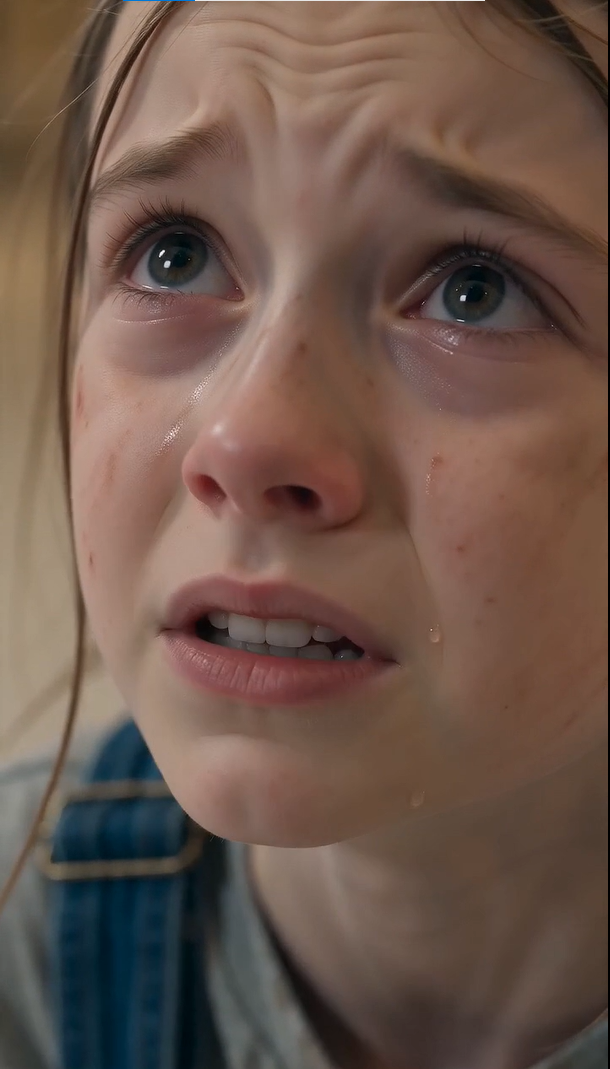
Then she touched the bracelet on her wrist.
“And remember what truth restored.”
After the ceremony, Adrian found Lucie alone in the nursery.
It was no longer a nursery now.
It had become her favorite room, filled with books, plants, letters, and sunlight.
Elena’s lullaby still hung above the bed.
Lucie stood by the window.
Adrian came beside her.
“You were brilliant today,” he said softly.
She smiled.
“You cried before I finished the first sentence.”
“I was being supportive.”
“You were being embarrassing.”
He laughed.
For a while, they looked out over the gardens.
Then Lucie whispered, “Do you think Mama would know me?”
Adrian’s eyes softened.
“Yes.”
“How?”
“Because you have her eyes.”
Lucie smiled faintly.
“Everyone says that.”
“And her courage.”
She looked at him.
He touched the bracelet gently.
“And because mothers know the children they love. Even when the world keeps them apart.”
Lucie leaned her head against his shoulder.
Adrian wrapped an arm around her.
For years, he had thought home was a house.
A name.
A line of inheritance.
A portrait on the wall.
But home had turned out to be a little girl letting go of a mop.
A grandmother unlocking a room.
A dead mother’s handwriting.
A father learning, too late but not too late to matter, that love meant staying long after the truth stopped being dramatic.
Downstairs, laughter rose from the foyer.
Children from Elena House were running across the marble, their shoes squeaking loudly.
Lucie looked up.
“Should we tell them not to run?”
Adrian smiled.
“No.”
She laughed.
“Good.”
They stayed by the window a little longer.
Outside, the evening sun washed the estate in gold.
Inside, the house that had once hidden a child now echoed with children’s voices.
Celeste had tried to bury Lucie beneath shame.
But shame had not kept her.
Lies had not erased her.
Cruelty had not named her.
The bracelet had opened.
The truth had spoken.
The heir had come home.
And the little girl who once trembled beside a mop bucket grew into the woman who made sure no one in that house ever had to tremble again.