PART 2
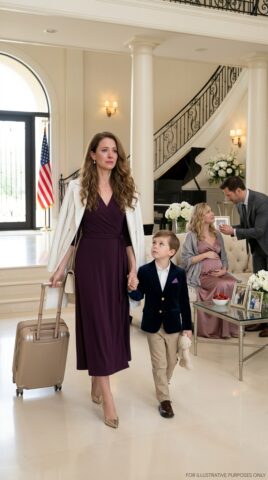
Before the Cadillac reached us, my mind slipped backward, not from fear but from memory.
Chicago. Thanksgiving. Two years earlier.
The Hart family dining room glowed with candlelight, polished silver, and expensive lies. Vivian had arranged white roses along the table because she said color made a home look “common.” Landon sat at the head, though the house had belonged to our grandmother before she died. He carved the turkey like a king dividing conquered land.
I sat near the kitchen door, in the chair with the loose leg. The same chair I had been given since I was twelve. Close enough to help clear plates. Far enough not to appear in family photographs.
Landon lifted the carving knife and pointed it at me.
“Still playing soldier, Evie?” he said. “Thirty years old and crawling through dirt for a paycheck. It’s almost impressive how little ambition you have.”
Vivian did not correct him. She smiled into her wine.
I had come home from deployment with sand still caught in the seams of my duffel bag. My hands were cracked from solvents and cold desert nights. Three members of my unit were spending Thanksgiving in rehab hospitals. One was never coming home.
But my brother looked at me as if my uniform were a costume from a discount store.
“Military people are manual labor with medals,” he continued. “You know that, right? The real world rewards talent.”
Landon said this while his own company was three months behind on rent.
I knew because the first warning letters had started arriving at my grandmother’s old business address, a location Vivian had forgotten was still connected to the trust. The company he called an empire was built from unpaid invoices and charm. His assistant had quit. His accountant had resigned. A sound engineer was threatening legal action over forty-seven thousand dollars in unpaid fees.
Still, Vivian adored him.
Landon was art.
Landon was brilliance.
Landon was the son she had wanted.
I was the daughter who reminded her that control could fail.
My grandmother, Eleanor Hart, had been the only person in that family who saw me clearly. When I was a child, she used to pull me into the kitchen after Vivian’s cruel little comments and press a cookie into my hand.
“You are the only real thing in this house, Evelyn,” she would whisper. “Don’t let polished people convince you that you are made of mud.”
When she died, she left me the trust.
Not Vivian.
Not Landon.
Me.
That single act of love had poisoned my mother.
Three days before that Thanksgiving dinner, two police officers had knocked on my apartment door at dawn. Vivian had filed a report claiming I suffered from violent combat delusions. She had attached medical notes from a psychiatrist who belonged to her country club. She claimed I was dangerous, unstable, and unable to manage money.
I made the officers coffee.
Then I showed them my service record, my current evaluation, my therapist’s actual letter, and the trust documents with Eleanor Hart’s handwritten note attached.
For Evelyn, who knows how to survive without becoming cruel.
The officers apologized before leaving.
My mother did not.
At Thanksgiving, I watched Vivian lift her glass and toast Landon’s “visionary future.” I watched Landon smirk across the table at me. I watched Cole Barrett avoid my eyes because he knew what had been filed and what had been false.
That night, I stopped thinking of them as family.
The next morning, I drove to a corporate law office in downtown Chicago.
The senior partner charged nine hundred dollars an hour and had the calm expression of a man who had destroyed many powerful people without raising his voice. I wore a black blazer over a white shirt. My dog tags were in my pocket. My hands were steady.
“I don’t want a lawsuit,” I told him.
He leaned back. “What do you want?”
“To buy the ground under my brother’s feet.”
That was the beginning of Meridian Shield Holdings.
A private company hidden behind layers of legal ownership. Its purpose was simple: identify, purchase, and consolidate every outstanding debt connected to Landon Hart and Hartline Arts Group.
A lawsuit would have warned them.
A confrontation would have fed them.
So I chose the method I understood best.
You do not attack a fortified building through the front gate.
You tunnel underneath it.
You place the charge in the foundation.
Then you wait for the celebration upstairs.
Over the next twenty-four months, Meridian Shield bought defaulted loans, vendor claims, lease obligations, private notes, and secured credit lines. Landon believed a faceless investment firm had saved him. He never asked who controlled it. Men like my brother do not ask questions when money arrives. They assume money recognizes their greatness.
Through Meridian Shield, I extended him a six-hundred-fifty-thousand-dollar restructuring loan.
The contract said it was for payroll, taxes, vendors, and debt repair.
Within seventy-two hours, Landon used one hundred eighty thousand of it to buy a vintage Porsche from a collector in Scottsdale.
I did not stop him.
I added the Porsche to the collateral schedule.
Six months later, I purchased the Meridian Building in San Diego, a renovated brick property near the waterfront. Landon’s “premium creative headquarters” occupied the third floor.
He paid rent to me every month.
He did not know.
He also did not know that the final eviction notice sitting unopened on his assistant’s desk had been signed by the same sister he called a parasite.
Back in the alley, rainwater soaked my jeans. My mother was still talking. Cole was still holding the pen. Landon was still playing the genius victim of his unstable sister.
And the Cadillac was getting closer.
PART 3
Landon noticed the headlights before my mother did.
He turned, squinting into the white glare. For one second, annoyance crossed his face, as if even government vehicles should have known better than to interrupt his evening.
“Who is that?” he demanded.
No one answered.
The Cadillac stopped at the mouth of the alley with a controlled, heavy silence. Its doors opened. Four armed federal security officers stepped out in dark suits, their movements clean and practiced. Not rushed. Not theatrical. Dangerous people rarely need theater.
Then Admiral Thomas Rourke stepped into the rain.
He was tall, broad-shouldered, white-haired, and severe in his dress uniform. Four stars caught the alley light. His face had the weathered hardness of a man who had spent his life carrying other people’s sons and daughters through war, grief, and ceremony.
Vivian transformed instantly.
Her spine straightened. Her voice softened. Her smile appeared like a switchblade opening.
“Admiral Rourke,” she called, stepping in front of me. “I am so sorry you had to see this. My daughter is having an episode. She’s been troubled for years. The military sent her home damaged, and we’ve been trying to manage her privately.”
Rourke did not take her offered hand.
His eyes moved past her.
They found me.
I was slumped against the wall with one hand pressed to my chest, my collar torn, my face wet from rain and sweat. The chain around my neck had slipped free. Hanging from it was a scratched EOD insignia, blackened along one edge from heat that should have killed me.
The admiral’s expression changed.
It did not soften.
It broke.
He stepped around Vivian as if she were furniture.
“Evelyn?” he said.
My mother blinked.
Landon’s mouth opened.
Cole Barrett took half a step back.
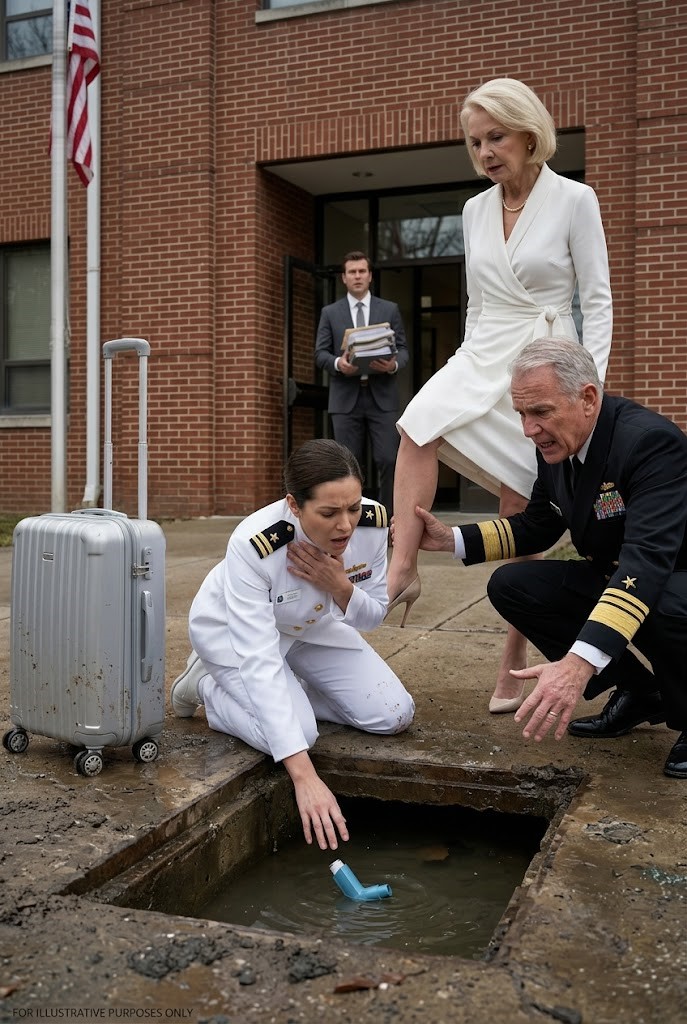
Rourke crossed the alley fast. One of his aides was already pulling a portable oxygen kit from the vehicle. The admiral dropped to one knee in the dirty water in front of me, ruining the trousers of a uniform that probably had more protocol attached to it than my mother had morals.
He fitted the mask over my nose and mouth himself.
“Slow,” he said, his voice low. “Small breaths, Staff Sergeant. That’s an order.”
Air entered my lungs.
It hurt like a blade sliding between my ribs.
But it entered.
My hands shook. I hated that they shook. Rourke saw and placed one steady palm against my shoulder.
“You’re safe,” he said.
The word safe nearly destroyed me.
My mother made a thin sound. “Admiral, I really must insist—”
Rourke turned his head.
The alley seemed to lose temperature.
“You must insist on nothing,” he said.
Vivian recoiled as if slapped.
Landon tried to recover first. “Sir, with respect, my sister has manipulated people before. She exaggerates her service record. She’s jealous of my work, and tonight she—”
“Be quiet,” Rourke said.
Two words.
Landon obeyed before he realized he had obeyed.
The admiral rose slowly. Rain struck the shoulders of his uniform and darkened the fabric. He looked at my family, then at the papers in Cole’s folder, then at the storm drain where my inhaler had disappeared.
“What did you do?” he asked.
No one answered.
The stagehand near the fire exit raised a trembling hand. “Sir, I saw the older woman kick her inhaler down the drain. The man in the tux kicked her leg. The lawyer tried to make her sign something.”
Cole’s face went gray.
Vivian snapped, “That is not what happened.”
Rourke ignored her.
He looked at his security chief. “Body cameras?”
“Active, sir.”
“Good.”
Then he faced my mother again.
“This woman does not have ordinary asthma,” he said. “Her lungs were crushed by blast trauma three weeks ago because she held a damaged security door shut during an IED detonation while three hundred Marines evacuated through a service corridor.”
Vivian’s face emptied.
Rourke’s voice dropped lower.
“She absorbed the pressure wave through her body. She stayed conscious long enough to warn the last team about a secondary device. The Pentagon believed she was dead for nine minutes. Her name was already being prepared for a memorial wall.”
Landon stared at me.
For the first time in my life, he looked unsure of what I was.
Not weak.
Not useful.
Not beneath him.
Unknown.
That frightened him more than anything.
Rourke pointed toward the drain. “And you took away her oxygen?”
My mother’s lips moved. No sound came out.
I pulled the mask aside just enough to speak.
“Admiral,” I said, each word scraped raw, “they were trying to force a psychiatric detention and conservatorship transfer.”
Cole closed the folder too late.
Rourke saw the heading.
So did his security officers.
The admiral’s face became unreadable in the most terrifying way. “Mr. Barrett, place the folder on the ground.”
Cole swallowed. “Sir, this is a private family medical matter.”
“On the ground,” Rourke repeated.
Cole obeyed.
Landon’s phone chimed.
Then Cole’s tablet chimed.
Then Vivian’s phone began vibrating inside her clutch.
The sound spread through the alley like a signal moving through wires.
Cole looked at his screen first.
I watched his eyes scan the message. I watched the sweat appear along his hairline. I watched him understand that the night was no longer moving in my family’s direction.
“Cole?” Landon whispered.
The lawyer did not answer.
“Cole,” Landon said again, sharper.
Cole looked at me.
For the first time ever, he looked afraid of me.
PART 4
The email on Cole Barrett’s tablet had arrived from the Superior Court’s commercial division.
Emergency debt acceleration approved.
Asset freeze authorized.
Secured creditor enforcement initiated.
Cole read the first line three times, hoping the words might rearrange themselves into mercy.
They did not.
Landon grabbed the tablet from him. “What is this?”
Cole’s hand twitched, as if he wanted to snatch it back but no longer had the courage. “Landon, don’t speak.”
“What is this?” Landon shouted.
I removed the oxygen mask slowly and handed it to the medic beside me. I used the wall to stand. My legs threatened to fold, but I locked my knees and forced my spine straight.
The rain had loosened my hair from its knot. My jacket was torn. Mud streaked one sleeve. I looked nothing like the polished people inside the opera house.
That was fine.
Wars are not won by polished people.
“Read the creditor name,” I said.
Landon stared at the tablet. His eyes flicked over the page, then stopped.
“No,” he said.
My voice was quiet. “Read it out loud.”
His mouth trembled.
Cole did it for him, his voice thin and cracked.
“Meridian Shield Holdings, LLC. Chairwoman and sole executive officer…” He swallowed. “Evelyn Hart.”
The words struck harder than shouting ever could.
Vivian turned slowly toward me. “What have you done?”
I looked at my mother and saw every version of her at once. The woman who smiled at charity luncheons. The woman who told teachers I was difficult. The woman who blamed me when Landon broke things. The woman who once left me alone in a Chicago train station for two hours because I had embarrassed her by crying in public.
“I bought Landon’s debt,” I said. “All of it.”
Landon made a strangled sound. “That’s impossible.”
“No,” I said. “It was expensive.”
His face flushed red. “You can’t own my company.”
“I don’t own your company. Not yet. I own the loans, the vendor claims, the lease debt, the private notes, the secured credit facility, and the personal guarantees you signed without reading.”
Cole closed his eyes.
Landon looked at him. “Tell her she’s lying.”
Cole said nothing.
That silence was the first honest thing he had given my brother in years.
I took one step forward.
“You used restructuring funds to buy a Porsche,” I said. “You classified it as image development. You used company money for your Malibu mortgage, your private chef, your wardrobe consultant, and tonight’s donor reception. You missed payroll twice. You ignored the cure notices. You violated the morality clause when you assaulted your senior creditor in front of federal witnesses.”
Landon’s eyes bulged. “You set me up.”
“I gave you money to save your employees,” I said. “You bought a car.”
Vivian found her voice. “Evelyn, this is grotesque. Whatever resentment you have toward this family—”
“This family?” I asked.
The words left my mouth colder than I expected.
The alley went still.
“This family tried to have me locked in a psychiatric ward to steal my trust. This family called my service embarrassing while spending money I earned in combat. This family kicked my oxygen into a sewer and asked me to breathe on my own.”
Rourke stood slightly behind me, silent and immense.
I did not need him to fight my battle.
I only needed the truth to have witnesses.
Landon backed away, shaking his head. “I’ll file bankruptcy.”
“You can,” I said. “Clause four transfers personal collateral in the event of voluntary liquidation. The Malibu house, the Porsche, your royalty catalog, your equipment, and the Hartline Arts Group accounts all move under creditor control.”
He looked at Cole.
Cole whispered, “She’s right.”
“I’ll sue.”
“You can try,” I said. “Clause twelve accelerates the debt after ethical misconduct against the creditor. Body-camera footage will support it. So will the stagehand. So will the medical report showing what happens when a person with blast-damaged lungs is deprived of oxygen.”
Vivian’s clutch slipped from her fingers and hit the ground.
Inside the opera house, applause thundered. Landon’s concert was supposed to begin in five minutes. His donors were waiting. The critics were waiting. The admiral he had hoped to impress was standing in an alley watching him collapse.
His whole life had been built on entrances.
Tonight, he had no way back inside.
A police siren wailed in the distance.
Rourke turned to his security chief. “San Diego PD?”
“Two minutes out, sir.”
Vivian lunged toward me then, not with love, but with panic.
“Evelyn, listen to me. We can fix this. You don’t want to destroy your brother.”
I looked at her hand reaching for my sleeve.
She stopped before touching me.
Some instinct finally warned her that the daughter she used to grab, slap, shame, and silence was no longer available to her.
“You’re right,” I said. “I don’t want to destroy him.”
Hope flashed across her face.
I let it live for one second.
Then I said, “I want him to live with the receipts.”
PART 5
The police arrived with red and blue light sliding across the wet brick walls.
Everything became official after that.
Not dramatic. Not loud. Official.
That was worse for my mother.
Vivian Hart understood screaming. She understood reputation, pressure, manipulation, and tears released at exactly the right moment. But she did not understand forms, recorded statements, body-camera footage, medical liability, financial injunctions, and uniformed officers who did not care that her gown had been flown in from Milan.
A San Diego police sergeant spoke with the stagehand first.
Then with Admiral Rourke.
Then with me.
I told the truth in short sentences because long ones still hurt.
My mother interrupted twice.
The second time, the police sergeant looked at her and said, “Ma’am, if you interfere again, you will be detained.”
Vivian stared at him, stunned, as if laws had always been things that applied to other rooms.
Landon sat on a metal service step with his head in his hands. His tuxedo pants were soaked. His violin case lay open near the fire door. The instrument inside had not been damaged, but he looked at it as if it had betrayed him by remaining silent.
Cole Barrett stood apart from everyone, making frantic calls to partners who were not answering.
The opera house manager stepped into the alley, pale and horrified.
“Mr. Hart,” she said carefully, “the audience is waiting.”
Landon lifted his head.
For one desperate second, I saw the old him return.
The performer.
The golden boy.
The man who believed applause could erase anything.
He stood, wiping rain from his face. “I can still go on.”
Rourke looked at him. “No.”
Landon blinked. “Sir, with all respect—”
“You have none from me.”
The words struck with military precision.
The manager shifted uncomfortably. “Mr. Hart, several board members are asking why Admiral Rourke left the hall. There are rumors already.”
Of course there were.
Rich people smell scandal faster than smoke.
My mother stepped toward the manager. “This is a private medical situation. You will tell everyone the concert is delayed because of a security concern.”
The manager looked from Vivian to the police officers.
“No, Mrs. Hart,” she said quietly. “I don’t think I will.”
It was a small rebellion.
It was beautiful.
Landon’s phone buzzed again. Then again. Then again.
He looked down.
His donors had started texting.
One message turned his face white. Another made him sit back down. A third caused him to whisper, “No, no, no.”
Meridian Shield’s enforcement notice had reached the banks.
The accounts were frozen.
The corporate cards were dead.
The Porsche was locked under asset hold.
The Malibu mortgage lender had been notified.
The opera house contract, paid with restricted funds, was now under review.
Inside, the concertmaster began informing musicians there would be no performance.
The first wave of guests started leaving through the front doors.
I imagined them in their gowns and tuxedos, whispering beneath the chandeliers. What happened? Why did the admiral leave? Did you hear something about fraud? Wasn’t his sister military? Didn’t someone say police were behind the building?
Reputations do not die all at once.
They leak.
Then they collapse.
A paramedic approached me. “Staff Sergeant, we need to transport you.”
“I’m fine.”
He gave me the professional look of a man who had heard that lie from soldiers before. “You are not.”
Rourke stepped beside me. “Go.”
It was not a suggestion.
I hated needing help. I hated the stretcher. I hated the oxygen mask. I hated the way my body had become a battlefield after the war had supposedly ended.
But when the paramedic guided me toward the ambulance, something happened that I did not expect.
Rourke’s security detail stepped back and formed two lines.
Then every uniformed service member who had arrived with the admiral raised a hand in salute.
For me.
Not for Landon.
Not for Vivian.
Not for the opera donors inside waiting to spend money on prestige.
For me, in muddy clothes, with damaged lungs and shaking hands.
I stopped walking.
My throat tightened for a reason that had nothing to do with injury.
Rourke saluted too.
“Staff Sergeant Hart,” he said, “you brought them home.”
The alley blurred.
For years, my mother had made me feel like the smallest person in every room. At school events. At family dinners. At airports when I came home on leave and she looked disappointed by my haircut, my boots, my silence. She had taught me that love was something I had to earn while Landon received it like sunlight.
But here, in an alley behind a canceled concert, men and women who owed me nothing honored the part of me my family had tried to bury.
Vivian began crying then.
Not soft tears.
Ugly, panicked, public sobs.
“Evelyn,” she called. “Please. I’m your mother.”
I turned my head.
For the first time that night, I looked directly at her.
“No,” I said. “You’re the woman who told me to breathe on my own.”
Then I climbed into the ambulance.
PART 6
The hospital room overlooked San Diego Bay.
Morning came pale and clean through the blinds, painting the walls in soft gold. Machines hummed beside my bed. An oxygen line rested beneath my nose. My chest ached with every breath, but the doctors said the damage had not worsened permanently.
That was their word.
Permanently.
As if some injuries obeyed medical charts.
Rourke visited at nine. He brought coffee he did not drink and a folder he did not open until the nurse left.
“You should have told us what was happening with your family,” he said.
I looked out at the water. “Families are hard to report.”
He nodded once. He understood more than he said.
“The Department will provide legal support for the assault and attempted coercion. Civilian authorities are handling the rest. Your mother was released pending charges. Your brother is trying to hire counsel, but his accounts are frozen.”
A tired smile touched my mouth. “That must be difficult for him.”
“Devastating,” Rourke said dryly.
He opened the folder.
“There’s something else.”
I turned from the window.
“The Silver Star recommendation is moving forward,” he said. “The report was delayed because your survival complicated the initial casualty filing. That has been corrected.”
I absorbed the words slowly.
A medal.
A ceremony.
More rooms full of people looking at me.
More speeches about courage when most of what I remembered from that blast was fear, heat, and the taste of blood.
“I don’t need a medal,” I said.
“No,” Rourke replied. “But the truth needs a record.”
That stayed with me.
After he left, my attorney from Chicago called. His name was Martin Sloane, and he sounded almost cheerful, which for him meant mildly less severe.
“Your brother’s counsel requested negotiation,” Martin said.
“No.”
“I assumed.”
“What did they offer?”
“A public apology, repayment schedule, and a request that you release the Malibu house from collateral.”
I laughed once. It hurt.
“Absolutely not.”
“My response was more formal but identical in spirit.”
By noon, Vivian had called fourteen times.
Landon had called nine.
Cole Barrett had left one voicemail, which my attorney advised me not to listen to unless I enjoyed the sound of a man trying to crawl out of a pit he billed hourly to dig.
I stared at my phone for a long time.
Mom.
Landon.
Two names that had once controlled the weather inside my body.
When I was little, I used to study Vivian’s face before speaking. If her mouth was tight, I stayed quiet. If Landon was angry, I apologized before knowing why. If dinner felt tense, I made myself useful. Plates. Napkins. Silence.
War had not taught me hypervigilance.
Home had.
I opened my contacts.
My thumb hovered over my mother’s name.
A message appeared.
Evelyn, please don’t let strangers turn you against your blood. I made mistakes. I was scared. Landon is fragile. You know how he gets. We need to talk as a family.
As a family.
I deleted the message.
Then I deleted the contact.
Not blocked.
Deleted.
Blocking meant the door still existed.
I wanted no door.
Landon’s last message came through before I erased him.
You think you won, but you’re alone. No husband, no kids, no real home. All you have is money and war stories.
I looked around the hospital room.
Flowers from my unit covered the windowsill. A card from Petty Officer Reyes sat beside my water cup. The nurses had taped a small American flag near the monitor because one of the corpsmen said I complained less when I had something to glare at.
I was not alone.
I had simply stopped calling my captors family.
I deleted Landon too.
In the weeks that followed, Meridian Shield took control of Hartline Arts Group’s assets. The employees were paid first. Vendors second. The office lease was terminated. The Porsche was repossessed from a private garage where Landon had tried to hide it under a tarp, as if secured creditors were vampires who could be fooled by fabric.
The Malibu house entered foreclosure proceedings.
The music catalog went into managed sale.
Vivian’s friends stopped inviting her to luncheons.
Not because they became moral.
Because scandal is contagious in wealthy circles, and nobody wants to sit too close to a woman whose daughter nearly died in an alley while a four-star admiral watched.
Landon gave one interview claiming he had been the victim of a “militarized financial ambush.”
It aired once.
Then footage from the alley leaked.
Not the worst parts. Not my choking. Not the medical details.
Just enough.
Vivian’s voice saying, Breathe on your own.
Landon standing over me.
Cole holding the papers.
The country heard what I had heard my whole life.
And this time, it did not stay behind family walls.
PART 7
Six months later, I returned to Chicago for my grandmother.
Not for Vivian.
Not for Landon.
For Eleanor Hart, whose grave sat beneath an old maple tree in a quiet cemetery north of the city. Snow rested along the stone paths. The air was sharp enough to make my lungs complain, but I walked slowly and gave them time.
The headstone was simple.
Eleanor Grace Hart.
Beloved grandmother.
Truth teller.
I had added the last line myself.
I stood there with my hands in the pockets of a dark wool coat, watching my breath rise in the winter air.
“I did it,” I said.
The cemetery gave no answer.
It did not need to.
I told her about Meridian Shield. About San Diego. About Admiral Rourke kneeling in the mud. About the salute. About deleting Vivian and Landon from my phone. About sleeping through the night for the first time in years.
Then I told her the part that mattered most.
“I’m selling the Malibu house,” I said. “The money is going into a foundation for service members fighting conservatorship abuse, medical coercion, and family financial exploitation.”
The idea had come to me in the hospital.
Not revenge.
Not charity.
A weapon with a door attached.
People think survival ends when you leave the battlefield. They do not see the second war waiting at home for some soldiers. The relatives who smell benefits. The spouses who control medication. The parents who use mental health language as a leash. The polished families who know exactly how to make cruelty look like concern.
The foundation would pay lawyers.
It would pay emergency housing deposits.
It would pay for second medical opinions, trauma advocates, and financial audits.
It would be called the Eleanor Project.
For the woman who had known love was not control.
A voice behind me said, “That sounds noble.”
I turned.
Landon stood ten feet away in a cheap gray coat, thinner than before, his face hollowed by consequences. His hair had lost its perfect shape. Without money, stylists, and stage lights, he looked less like a genius and more like a frightened man approaching middle age with no audience left.
I did not step back.
“How did you know I was here?” I asked.
“Mom.”
Of course.
Vivian had always known how to send someone else when her own hands were dirty.
Landon looked at the headstone. “She loved you more than me.”
“Yes,” I said.
He flinched.
I did not soften it.
Truth had been softened around Landon his entire life. It had made him weak.
“She saw you,” he said. “Everyone sees you now.”
I waited.
He shoved his hands into his coat pockets. “I lost everything.”
“No,” I said. “You lost what you stole.”
His jaw tightened. For a second, the old cruelty flickered. Then it died. Maybe from exhaustion. Maybe from fear. Maybe because there was no one there to clap for it.
“Mom says you’re ruining her life.”
“She tried to end mine.”
“She says she didn’t understand how sick you were.”
“She understood the inhaler.”
He looked away.
Snow moved through the branches above us.
For a moment, I saw us as children. Landon at eight, crying because he had broken a vase and Vivian blaming me before I even entered the room. Me at ten, learning that telling the truth only made punishment more creative. Him at fifteen, already comfortable with the throne they had built beneath him.
He had been shaped by her.
But he had chosen, too.
That mattered.
“I came to ask if there’s any way back,” he said.
The question hung between us.
Once, I would have mistaken it for hope.
Now I heard the missing words.
Back to what?
Access? Money? Forgiveness without repair? A sister who stayed small enough for him to stand over?
“No,” I said.
His eyes reddened. “That’s it?”
“That’s it.”
“I’m your brother.”
“You were.”
He inhaled sharply.
I expected anger. A speech. A final insult.
Instead, he nodded once, like a man receiving a sentence.
Then he turned and walked away through the snow.
I watched until he disappeared beyond the cemetery gate.
My chest hurt.
Not from injury this time.
From grief.
Freedom does not erase grief. It gives grief a clean room to sit in. It lets you mourn what should have been without crawling back to what was.
A year later, the Eleanor Project opened its first office in Washington, D.C., three blocks from a veterans’ legal clinic and close enough to the Capitol that lawmakers could not pretend not to know where we were. Admiral Rourke attended the opening. So did members of my old unit. Petty Officer Reyes cried and denied it. The first client was a Marine whose father had tried to seize his disability payments. The second was a Navy corpsman whose husband had hidden her medication.
We helped them both.
Then we helped more.
I kept the Meridian Building in San Diego. I moved into the top floor permanently. From my windows, I could see the bay, the ships, the morning light opening over the water like a promise that did not need witnesses.
Some nights, my lungs still woke me.
Some mornings, pain sat behind my ribs like an old enemy refusing eviction.
But the air was mine.
No one granted it.
No one owned it.
No one stood above me in silk and diamonds telling me to earn it.
On the first anniversary of the alley, I took the recovered inhaler from a sealed evidence box. The police had pulled it from the storm drain after the arrest. It was scratched, dented, useless.
I placed it in a glass case in the Eleanor Project office.
Beneath it, I had a small plaque engraved.
BREATHE ON YOUR OWN.
Not as an insult.
As a warning.
As a promise.
As proof that the thing meant to kill me had become the thing that opened the door for others.
My mother never apologized in a way that cost her anything.
Landon never rebuilt the empire he believed he deserved.
Cole Barrett lost his license.
And I learned that the cleanest revenge is not watching people suffer.
It is building a life so far beyond their reach that their voices can no longer find the windows.
My name is Staff Sergeant Evelyn Hart.
I survived the blast.
I survived my family.
And when they told me to breathe on my own, I finally did.