
The teller’s fingers tightened around the watch.
For a moment, he couldn’t speak.
Then he looked up at the boy’s face—really looked at him—and whatever little color he had left disappeared completely.
The photograph inside the watch showed a much younger version of the teller standing beside another man, both of them smiling in front of the same bank vault decades earlier.
The engraved name beneath it was one he had not heard spoken aloud in years.
His older brother’s.
The boy’s voice was quiet, but it cut through him. “My father said you were the only one left.”
The customers in line stayed frozen. Even the security guard said nothing now.
The teller’s eyes filled with something between fear and grief. “Your father…” He stopped, swallowed hard. “Your father is dead?”
The boy nodded once. “Three days ago.”
The words landed like a blow.
The teller gripped the counter to steady himself. “No…”
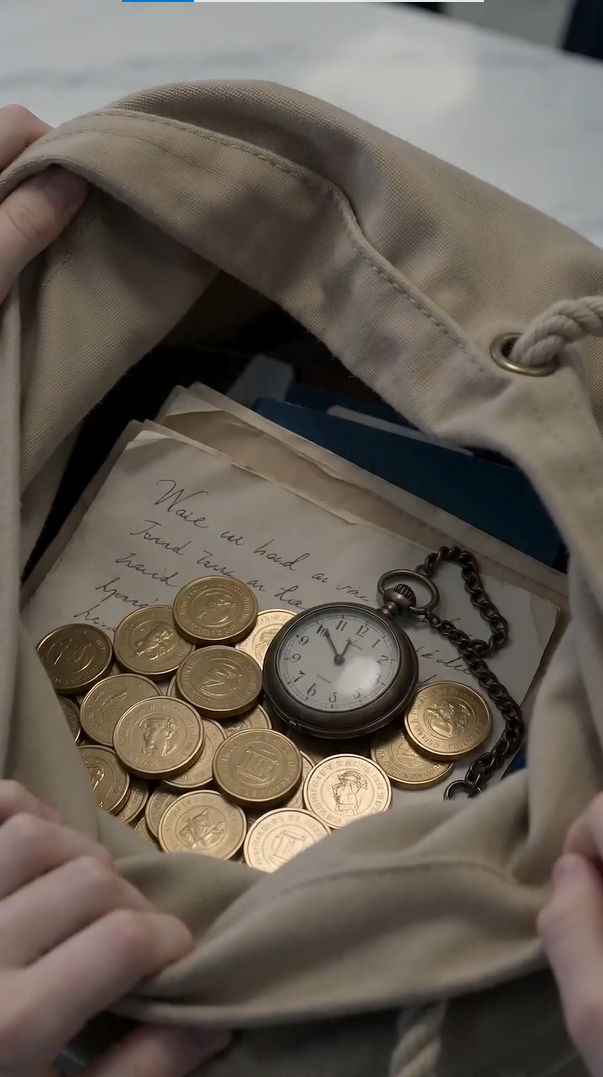
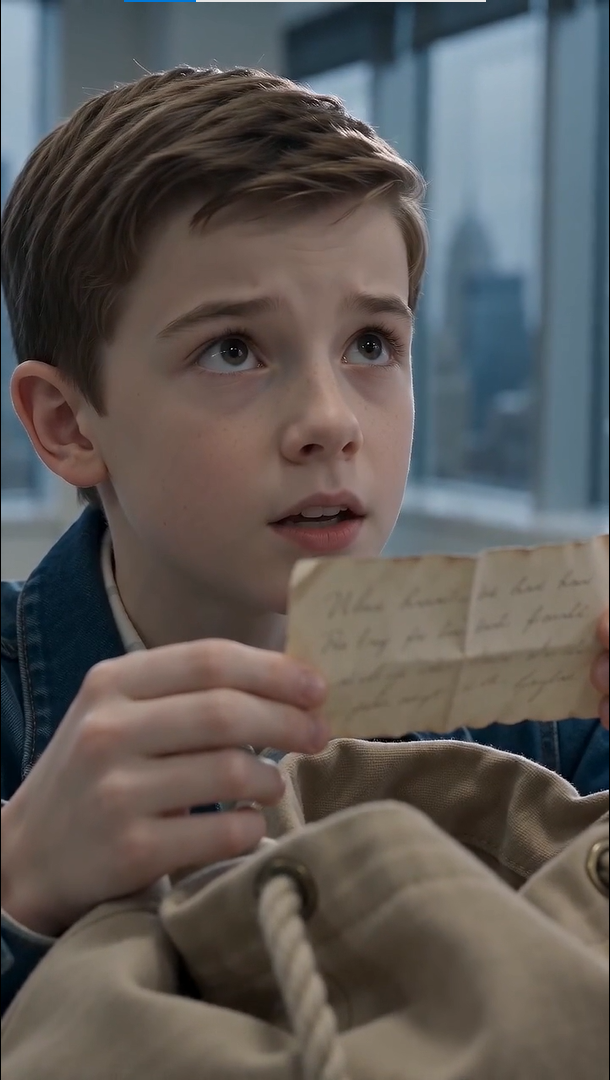
The boy slowly pushed the sack a little closer. “He told me not to trust anyone else. He said if I brought you the coins, the papers, and the watch… you’d understand.”
With shaking hands, the teller reached into the bag and pulled out one of the folded documents. He opened it just enough to see the seal.
His breath broke.
It wasn’t just old family property.
It was proof.
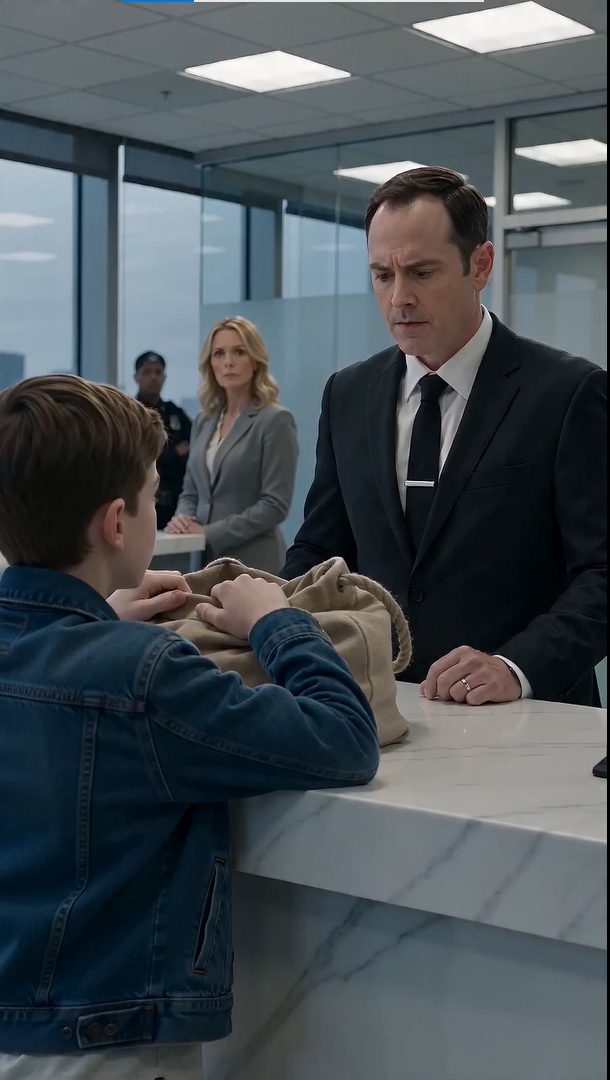
Proof of money hidden, land stolen, names changed, and one heir kept out of everything.
The teller looked up at the boy with wet eyes. “He kept all this for you?”
The boy’s lips trembled for the first time. “He said they would come for me next.”
The guard’s posture changed instantly.
The teller stepped out from behind the counter, no longer caring who was watching. He knelt in front of the boy, his own hands still shaking, and touched the side of the watch like it hurt to hold.
“I should’ve found you years ago,” he whispered.
The boy blinked fast, trying not to cry. “So… you know who I am?”
The teller looked straight into his eyes.
“Yes,” he said, voice breaking. “You’re not just his son.”
He drew in one unsteady breath, then added, “You’re the rightful owner of everything they buried.”
And in the middle of the sterile, silent bank, the frightened boy with the worn canvas sack stopped looking lost for the first time.
For one second, the boy didn’t understand.
He looked at the teller, then at the bag, then back at the watch in his uncle’s hand.
“Owner?” he whispered.
The teller nodded slowly, but his face was full of pain.
“This bank,” he said. “The land it stands on. The old estate outside town. The trust accounts. All of it was your grandfather’s.”
The boy’s fingers curled around the strap of the canvas sack.
“My father said we had nothing.”
The teller closed his eyes.
That one sentence hurt more than anything.
Because it was true.
The boy and his father had lived with nothing while their own blood sat behind marble counters, polished doors, and locked vaults.
The teller opened his eyes again.
“No,” he said softly. “They made him believe he had nothing.”
The boy looked down.
“My dad worked nights. He used to cough so much, but he still went.” His voice broke. “He said poor people can’t afford to rest.”
The teller’s face crumpled.
Behind him, the senior bank manager came out of his glass office, irritated by the crowd.
“What is going on here?” he demanded.
The teller stood immediately, slipping the old watch into his palm and stepping protectively in front of the boy.
The manager’s eyes fell on the sack.
Then the documents.
Then the gold coins.
His expression changed too fast.
For a moment, greed flashed across his face.
“Where did you get those?” he asked.
The boy moved closer to the teller.
The teller noticed.
So did the security guard.
The manager forced a smile. “This is bank property. Hand it over.”
“No,” the teller said.
The manager’s eyes sharpened. “Excuse me?”
“I said no.”
A murmur moved through the customers.
The teller was an old man. Quiet. Careful. The kind of employee who had spent his life saying yes to people who never deserved it.
But now he stood taller than anyone had seen him stand in years.
The manager stepped closer. “You’re making a mistake.”
The teller looked at him with wet, furious eyes.
“No,” he said. “I made my mistake twenty years ago, when I believed the men who told me my brother ran away with stolen money.”
The manager went still.
The boy looked up at him.
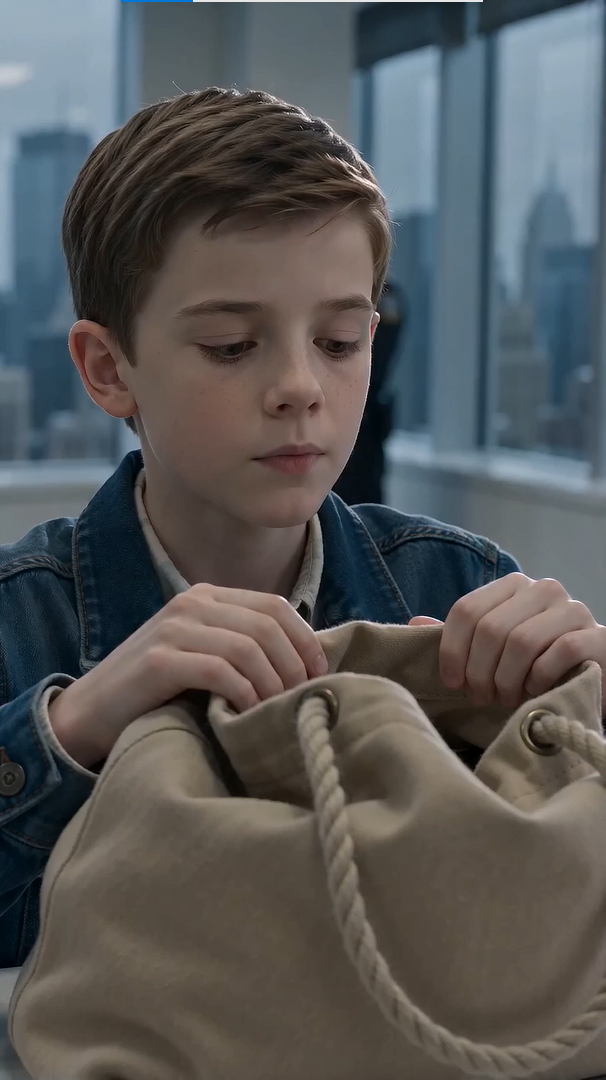
The teller’s voice shook, but he did not stop.
“They told me he betrayed the family. They told me he forged documents. They told me he disappeared because he was guilty.” He looked at the papers in his hand. “But he didn’t disappear because he was guilty. He disappeared because he found out what they had done.”
The manager looked around at the watching customers.
“This is not a public matter.”
“It became public,” the teller said, “the moment a child walked into this bank carrying the truth in a torn bag while grown men hid behind suits.”
The boy’s eyes filled.
The security guard moved closer to the counter.
“Sir,” he said carefully to the manager, “maybe we should call the authorities.”
The manager snapped, “No one is calling anyone.”
That was the wrong thing to say.
Every head turned toward him.
The teller looked at the guard.
“Call them.”
The manager’s face darkened. “You don’t have the authority.”
The teller turned toward him.
“My brother is dead. His son is standing in front of me. And you think I care about authority?”
The guard took out his phone.
The manager lunged toward the bag.
The boy flinched.
But before the manager could touch it, the teller grabbed his wrist.
Not hard.
Just enough.
Enough to say that the old man everyone ignored was done being afraid.
“Don’t,” the teller said.
The manager stared at him.
The teller’s voice dropped.
“If your hands touch one page, one coin, one thread of this boy’s bag, I will make sure every camera in this building sees it.”
The manager slowly pulled back.
The boy stared at the teller like he was seeing something he had never had before.
Protection.
The customers began whispering.
One woman near the back quietly lifted her phone and started recording.
The teller noticed, but he didn’t stop her.
For years, silence had protected the wrong people.
Not anymore.
He turned to the boy.
“What is your name?”
The boy swallowed.
“Eli.”
The old man’s eyes filled again.
“Eli,” he repeated.
“My dad said you used to call him Danny,” the boy said. “He said nobody called him that after he left home.”
The teller’s face broke.
A memory hit him so hard he almost bent under it.
Two brothers running through the back hall of the bank when they were young. Two boys laughing in front of the vault before money turned their family into strangers. His older brother putting him on his shoulders and saying, “One day, little man, this place won’t own us. We’ll own our choices.”
“Danny,” the teller whispered.
Then he covered his mouth, but the tears came anyway.
Eli looked frightened by the grief.
“I’m sorry,” he said quickly. “I didn’t mean to—”
“No.” The teller shook his head and knelt again. “No, don’t you ever apologize for saying his name.”
Eli’s chin trembled.

“He told me not to cry in front of people.”
The teller looked into the boy’s eyes.
“Your father was brave. But even brave people cry when they have carried too much.”
That did it.
Eli’s face folded.
The boy who had walked into the bank pretending to be strong finally broke.
He cried silently at first, his shoulders shaking, still trying to swallow the sound.
Then the teller opened his arms.
Eli hesitated for only a second before stepping into them.
The old man held him tightly.
Not like a bank employee holding a stranger.
Like an uncle holding the last piece of his brother.
The customers fell completely quiet.
Even the phones lowered.
There are some moments people know they should not disturb.
This was one of them.
When the police arrived, the bank no longer felt like a bank.
It felt like a courtroom.
The documents were spread across the manager’s office table.
The old papers showed signatures, transfers, forged names, hidden accounts, and a trust that had been changed after the boy’s grandfather died.
Eli sat beside his uncle, holding the watch with both hands.
The manager sat across from them, sweating.
The officers asked questions.
The teller answered what he could.
But the papers answered more.
Names appeared again and again.
The bank manager.
A retired family lawyer.
Two board members.
And one signature that made the teller close his eyes in shame.
His own.
Eli saw his face change.
“What’s wrong?” the boy asked.
The teller couldn’t answer right away.
One officer turned the document toward him.
“Is this your signature?”
The teller stared at it.
“Yes,” he whispered.
Eli’s hand slowly slipped away from his arm.
That hurt worse than the question.
The teller turned to him quickly.
“I didn’t know what I was signing,” he said, voice breaking. “They told me it was to protect the bank after your father stole from us. I was young. I was angry. I believed them.”
Eli looked at him with wounded eyes.
“You helped them?”
The teller’s mouth trembled.
“Yes.”
The truth came out like a punishment.
“I helped them because I was foolish. Because I was jealous of your father. Because everyone loved him more, trusted him more, and when they told me he betrayed us… part of me wanted to believe it.”
The room went silent.
Eli stared at him.
The teller lowered his head.
“I have hated him for years for a crime he never committed. And while I sat here in a clean suit, your father lived in hiding, raising you alone.”
His voice cracked.
“I don’t deserve to be called your uncle.”
Eli looked down at the watch in his hands.
For a long time, he said nothing.
Then he opened it and looked at the photograph inside.
“My dad said you were good once,” he whispered.
The teller looked up.
Eli’s eyes were wet.
“He said people can be tricked when their heart is already hurting.”
The old man’s breath caught.
“He said that?”
Eli nodded.
“He said if I found you, I should give you one chance. But only one.”
The teller covered his face.
His brother had forgiven him before he even came asking for it.
That almost destroyed him.
“I won’t waste it,” he whispered.
The investigation moved fast after that.
Too many people had seen.
Too many cameras had recorded.
Too many documents had survived.
By evening, the bank manager was led out through the same lobby where he had stood so proudly that morning.
His hands were in cuffs.
He kept his head down as customers watched him pass.
Eli stood behind his uncle, clutching the canvas bag.
When the manager walked by, he looked once at the boy.
There was no apology in his eyes.
Only anger that the truth had chosen a child to carry it.
The teller stepped in front of Eli again.
The manager looked away.
Outside the bank, reporters had already gathered. Someone’s video had spread across town within hours.
The frightened boy with gold coins.
The old watch.
The teller crying.
The manager trying to take the bag.
People wanted a scandal.
But Eli didn’t care about scandal.
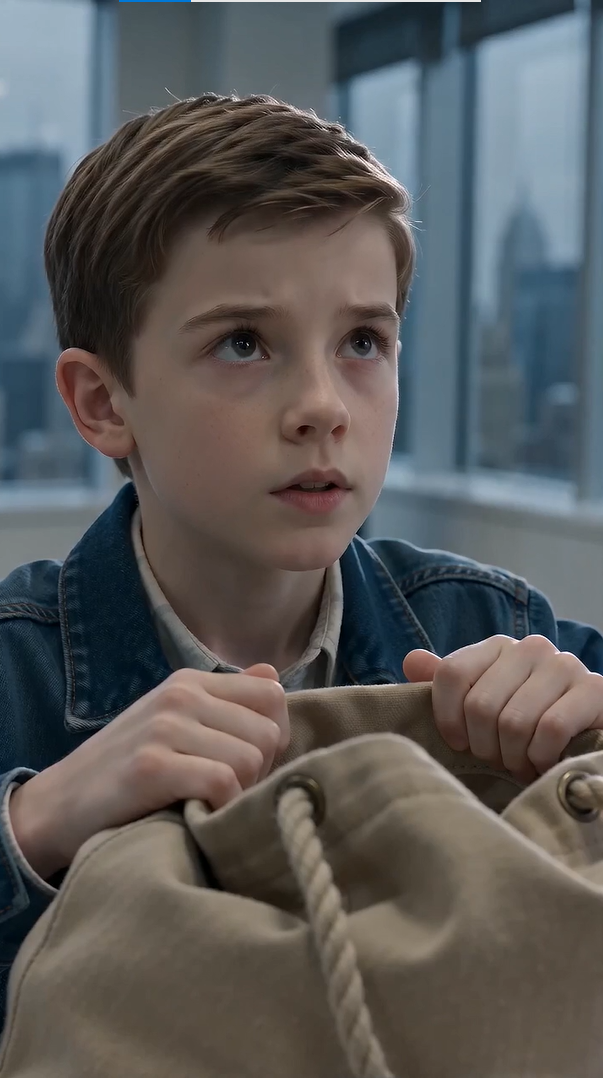
He wanted his father.
That night, the teller took him home.
Not to a mansion.
Not to the estate.
To a small, old house at the edge of town, where the paint was peeling and the porch light flickered.
Eli stood at the doorway with the bag in his hands.
“You live here?” he asked.
The teller gave a sad smile.
“Yes.”
“But if the bank was yours…”
“It was never mine,” he said. “I only worked there. I thought loyalty would give me a place. But lies only give you a cage.”
Inside, the house smelled like dust, old paper, and tea.
On the mantel were no family photographs.
The teller noticed Eli looking.
“I took them down,” he said quietly. “Years ago.”
“Why?”
“Because your father was in all of them.”
Eli looked at him.
The old man swallowed hard.
“I couldn’t look at his face.”
Eli said nothing.
The teller went to an old wooden cabinet and opened the bottom drawer.
He pulled out a small metal box.
Inside were photographs.
Two brothers on a bicycle.
Two brothers in school uniforms.
Two brothers standing proudly in front of the bank vault.
The same photograph from the watch.
Eli stepped closer.
“That’s my dad?”
The teller nodded.
“He was sixteen there.”
Eli touched the picture gently.
“He looks happy.”
“He was,” the teller whispered. “Before everything.”
They sat on the floor for hours.
The teller told stories.
About how Danny used to steal mangoes from the neighbor’s tree.
How he once sold his own shoes to buy his little brother a birthday gift.
How he could make anyone laugh, even their strict father.
Eli listened like someone starving.
Every story gave him another piece of the father he had lost.
And when the teller finally stopped, Eli pulled something from his pocket.
A folded letter.
“My dad wrote this before he died,” he said.
The teller’s hands shook as he took it.
On the outside, written in weak handwriting, were two words.
For Samuel.
The teller closed his eyes.
Samuel.
His own name.
He had not heard it from his brother’s mouth in over twenty years.
He opened the letter slowly.
Danny’s words were uneven, like his hand had been trembling.
Samuel,
If my son finds you, it means I am gone.
I know what they told you about me. I know you believed them. For a long time, that hurt more than losing the money, more than losing the house, more than running.
But you were my brother before you were their weapon.
I don’t know what kind of man you became. I don’t know if the boy I carried on my back is still somewhere inside you.
But Eli will need someone.
They will come for what I kept. They will come for him.
If there is anything left of us, protect my son.
And tell him I was not always afraid.
Tell him I laughed once.
Tell him I loved him more than the life they stole from me.
Your brother,
Danny
Samuel pressed the letter to his chest.
He cried so hard that Eli moved closer without thinking.
The boy placed one small hand on his shoulder.
Samuel looked at him through tears.
“I’m sorry,” he whispered. “I’m so sorry.”
Eli didn’t say it was okay.
Because it wasn’t.
Instead, he said, “Then help me do what he asked.”
Samuel nodded.
“I will.”
The next morning, they went to the old estate.
It stood behind iron gates on a hill outside town.
Eli had never seen anything like it.
Tall windows.
Stone walls.
Gardens overgrown with weeds.
A fountain that had gone dry years ago.
“This was ours?” he whispered.
Samuel nodded.
“This was your father’s home.”
Eli stared at the mansion.
“My dad used to sleep in a room behind a mechanic shop.”
Samuel closed his eyes.
“I know.”
Eli’s voice became quiet.
“Then I don’t want it.”
Samuel looked at him.
Eli’s jaw tightened, trying to be strong.
“If this house made everyone cruel, I don’t want it.”
Samuel knelt beside him.
“The house didn’t make them cruel. Greed did.”
Eli looked at the broken fountain.
“My dad said money changes people.”
“It shows people,” Samuel said. “But it can also help people, if someone good holds it.”
Eli turned to him.
“What would Dad do with it?”
Samuel smiled sadly.
“He would open the gates.”
So they did.
Not that day.
Not quickly.
But slowly, after the courts confirmed what the documents had already proved, after the hidden accounts were unfrozen, after the land titles were restored, after men who had smiled behind desks were forced to answer for what they had buried.
The newspapers called Eli the lost heir.
But Samuel never let them crowd him.
“He is not a headline,” he told them. “He is a child.”
For the first time in his life, someone said that for Eli.
The boy began living with Samuel, not because the court forced it, but because Eli chose it.
At first, he slept with the canvas bag beside his bed.
Every night.
Even when Samuel bought him a safe.
Even when the papers were locked away.
Even when the coins were placed under legal protection.
The bag stayed near him.
It was the last thing his father had sent with him.
Some nights, Samuel heard him crying.
He never rushed in loudly.
He would knock softly and ask, “Can I sit?”
Sometimes Eli said no.
Samuel respected it.
Sometimes Eli said yes.
On those nights, the old teller sat on the floor beside the bed until the boy fell asleep.
He never told him to stop grieving.
He never told him to be strong.
He only stayed.
And slowly, the boy began to believe that people could stay.
Months later, the old estate reopened.
But not as a private mansion.
Eli stood in front of the gates in a clean shirt that Samuel had ironed three times because his hands kept shaking.
A crowd gathered outside.
Reporters.
Villagers.
Former bank customers.
People who remembered Danny.
Above the gate hung a new sign.
The Daniel Foundation for Children and Families.
Eli stared at it for a long time.
Samuel stood beside him.
“Do you think he would like it?” Eli asked.
Samuel’s voice broke.
“He would love it.”
The estate became a place for children who had nowhere safe to go.
A schoolroom was built in the east wing.
The old dining hall became a community kitchen.
The gardens were cleaned and opened to the public.
And the bank vault, the same vault where the photograph had been taken decades earlier, became a small museum with one glass case in the center.
Inside it sat the old pocket watch.
Beside it was a note written in Eli’s handwriting.
This watch belonged to my father.
He gave it to me so I could find the truth.
Some things are worth more than gold.
On the opening day, Samuel stood in front of everyone and tried to speak.
He had written a speech.
Three pages.
But when he saw Eli standing there, holding the same canvas bag, he folded the paper and put it away.
“My brother was innocent,” Samuel said simply.
The crowd went silent.
“I did not believe him when I should have. I signed what I should have questioned. I stayed silent when I should have searched.”
His voice shook.
“I cannot give him back the years he lost. I cannot give this boy back his father. But I can spend whatever years I have left telling the truth.”
Eli looked up at him.
Samuel turned to the boy.
“And I can protect what Danny protected until his last breath.”
He held out his hand.
Eli hesitated.
Then he took it.
The cameras flashed, but neither of them looked away from each other.
That evening, after everyone left, Eli and Samuel returned to the bank.
Not because they had to.
Because Eli asked.
The lobby was empty now.
No customers.
No whispers.
No manager behind the glass door.
The marble counter shone under the white lights.
Eli walked to the exact place where he had dropped the canvas bag months earlier.
Samuel stood beside him.
“I was scared,” Eli admitted.
“I know.”
“I thought you might throw me out.”
Samuel’s eyes filled.
“I almost did before I saw the watch.”
Eli looked at him.
Samuel swallowed.
“That is the truth. I had become the kind of man who looked at a child and saw trouble before pain.”
Eli was quiet.
Then he placed the empty canvas bag on the counter.
It landed softly this time.
No coins.
No papers.
No fear.
Just cloth.
Samuel looked at it.
Eli took a breath.
“I don’t want to carry it anymore.”
Samuel’s face softened.
“You don’t have to.”
Eli pushed it toward him.
“You keep it.”
Samuel touched the worn fabric.
“Are you sure?”
Eli nodded.
“My dad gave it to me to find you. I found you.”
Samuel’s throat tightened.
“And now?”
Eli looked around the bank.
Then back at his uncle.
“Now I want to go home.”
Samuel smiled through tears.
For the first time, that word did not hurt.
Home.
Not a mansion.
Not a vault.
Not a hidden account.

Just two broken people learning how to become family.
Samuel picked up the canvas bag and held it against his chest.
Then he took Eli’s hand.
As they walked toward the doors, the security guard from that first day stepped aside with a small smile.
“Good night, Mr. Eli,” he said.
Eli stopped.
No one had ever called him that before.
He looked at Samuel, unsure.
Samuel smiled.
Eli lifted his chin just a little.
“Good night,” he said.
Outside, the air was cool.
The town lights glowed softly in the distance.
Eli looked up at the sky.
“Do you think Dad can see?”
Samuel followed his gaze.
“I don’t know,” he said honestly. “But if he can, I think he’s finally resting.”
Eli nodded.
Then he slipped his small hand into Samuel’s.
At first, Samuel froze.
Then he held it carefully, like something sacred.
The boy who had walked into a bank with a sack full of secrets no longer looked lost.
And the man who had spent half his life hiding behind a counter finally stepped out from behind it.
They had both lost Danny.
Nothing could change that.
But the truth he left behind had done what he hoped it would.
It had found his son.
It had awakened his brother.
And it had turned a worn canvas bag, a handful of gold coins, and an old pocket watch into the beginning of a family that greed could no longer bury.